

Why a zoo or dolphinarium needs interactive kiosks
Visitors to zoos and dolphinariums walk past enclosures in a few seconds: they stop, look, and move on. Without context, the animal remains just a picture, and the impression stays superficial.
Guests grow tired of monotonous signs, lose interest, and leave before they even see the highlights. For the park, this means weak loyalty, fewer repeat visits, and word of mouth that does not work.
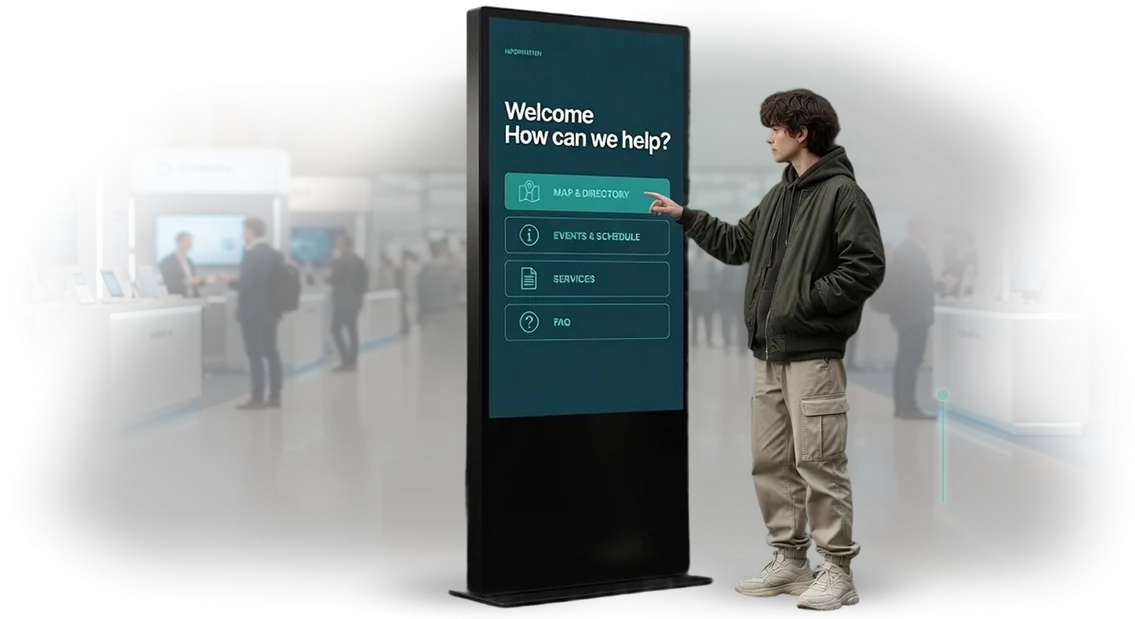
An interactive kiosk turns a tour into a live conversation: on the touchscreen, the guest chooses what to learn about — what the animal eats, how it communicates, what its habits are.
This kind of visitor engagement holds attention for several minutes, and the person walks away with an emotion, not just a glance at a sign.
In a dolphinarium, a kiosk can show how dolphin hearing works or invite guests to “talk” with a dolphin through game scenarios. In a zoo, it can guide visitors along a map and tell the stories of animals that cannot be seen from the main path.
The format works both with children, who are hard to keep engaged, and with adults who want more than the standard tour.
For the park, this is also a budget benefit: while guests enthusiastically explore the screens, they stay on the grounds longer, spend more at cafés and souvenir shops, and come back with friends.
Photos and stories from such kiosks spread across social media, attracting new visitors without advertising costs.
We make interactive kiosks for the specific needs of a particular zoo or dolphinarium: scenarios that hold the attention of different age groups and a design that fits the exhibition. This is not just a screen but a tool that turns a one-time visit into a habit.
What you get from an interactive kiosk in the park
An interactive kiosk turns an ordinary stroll through the park into an exciting exploration. Guests do not simply walk past enclosures — they get involved in a game, examine details, compare facts, and want to reach the next point.
The longer a visitor stays in the park, the more they have time to see and try, which means a higher average check at cafés and souvenir shops.
This format directly affects attendance growth and park recognition. Unique interactive scenarios become a local attraction: guests photograph the screens, share impressions on social media, and return again to explore what they missed on their first visit.
Word of mouth and visitor posts work as free advertising, attracting a new audience — families with children, school groups, and tourists.
For the park owner, a kiosk is not just an information stand but a source of additional revenue. Promotional offers can be easily built into game scenarios: coupons for a photo session with an animal, a café discount, or an invitation to the evening show.
This way, the park sells more services without pushy salespeople — the guest shows interest on their own, and the screen gently guides them to the right action.
In addition, the interactive panel remembers guest preferences. A welcome animation, personalized route recommendations, and bonuses for repeat visits build a habit of returning specifically to your park.
The guest feels cared for, and the owner gets a loyal audience that regularly brings friends and positive reviews.
We design scenarios so that every minute spent at the screen benefits both the visitor and the business. The interactive kiosk becomes a point of attraction that pays off through increased attendance, higher average check, and a stronger park brand.
Interactive kiosk formats for a zoo
A zoo visitor comes for emotions, not for reading signs. If they see a bright touchscreen with a map or a game, they stop, engage, and remember the place. If the kiosk is inconvenient or placed incorrectly, it becomes just a dusty corner.
That is why the kiosk format must match the goal of the location. At the entrance — routes and schedules; at the enclosure — a story about the animal; in an open area — outdoor protection. We select and configure each option for a specific location.
| Format | For whom | What it gives the customer |
|---|---|---|
| Floor-standing kiosk | Children, families with strollers | Low screen is accessible to a child, includes a game, and does not create queues — adults have time to look around |
| Wall-mounted kiosk | Information zones, narrow corridors | Takes up no floor space, always in sight, quick check of routes or show schedules |
| Outdoor kiosk | Entrance area, summer enclosures | All-weather housing, not afraid of rain or sun, interactive map and quiz available year-round |
| Touch panel | Exhibitions, thematic pavilions | Additional content: video, infographics, quests — deepens the experience of learning about animals |
We do not simply place a “screen on a stand” — we think through the scenario: how long a visitor will spend at the kiosk, what they will see, and what action they will take.
That way the kiosk becomes part of the exhibition, increases time spent in the zoo, and gives visitors a reason to come back.
Kiosk development stages: from brief to launch
Working on a kiosk for a zoo or dolphinarium is not just installing a panel with a program. We structure the process so that you always understand what is happening at each stage and can influence the result. Below is a typical project path: from the first brief to the moment visitors start using the kiosk.
- Brief and task analysis. We discuss who the kiosk is for, where it will be located, and which functions matter: territory map, show schedule, animal information. At this stage, we lock in timelines and budget so there are no surprises later.
- Concept and design approval. Based on the brief, we create a screen prototype and a visual solution. You see how the interface will look before development begins and can make edits without wasting extra time.
- Development and content population. We prepare interactive scenes, upload texts, photos, videos, and audio guides. You receive an intermediate version and test it for usability — this helps us find flaws before installation on site.
- Equipment production and preparation. We assemble the touch panel in a housing protected against moisture and impact, and configure the software for the specific kiosk model. Everything goes through hours of testing in our workshop — you get a stable device, not a “raw” assembly.
- Delivery and on-site installation. We bring the kiosk, install it at the right spot in the zoo or dolphinarium, connect power and network, and check operation under real conditions. You do not have to search for contractors — we do everything.
- Launch and support. We run final testing together with your staff, train administrators, and provide clear instructions. After launch, we stay in touch: we update content and quickly resolve any issues.
This workflow helps us meet agreed deadlines and deliver a kiosk that works immediately and pleases visitors. You control every key step without spending time on technical details.
What is included in kiosk supply and setup
When you order an interactive kiosk for a zoo or dolphinarium, you get not just a device but a ready-made tool for navigation and guest entertainment. We handle the entire process — from choosing the right housing to installation and training your team. As a result, you save time and get a solution that works right after launch.
Here is what is included in the supply and setup:
- Professional touch equipment. A durable housing, protected screen, and reliable mounts — the construction is designed for intensive visitor use and year-round operation. For outdoor areas, protected versions with reinforced housings are available.
- Software tailored to your needs. Territory map, show and feeding schedules, animal information, photo galleries, and interactive routes. The interface is customized to match the style of your zoo or dolphinarium — with a logo and brand colors.
- Easy content updates. Your staff can change texts, photos, and videos on their own without involving programmers — through a simple admin panel. This is especially convenient when schedules change or new events appear.
- On-site installation and connection. We bring the equipment, install it at the right location, connect it to power and the internet, and test all scenarios. We position the kiosk so it does not block visitor traffic yet remains clearly visible.
- Staff training. We provide simple instructions: how to turn the kiosk on, restart it, update information, and what to do in unusual situations. Your employees do not need technical knowledge.
- Post-launch support. We do not disappear after installation. We set up remote diagnostics, answer questions, and quickly update software when needed. If a failure occurs, we resolve the problem as fast as possible.
This package covers the main goal: guests quickly find the right enclosures, schedules, and important information, while your staff are freed from repetitive questions.
The kiosk becomes part of the visitor experience and works as your digital guide — without adding extra load to the team.
Case study: how an interactive kiosk increased attendance
Visitors come to the zoo for emotions, but without navigation they get lost on the grounds: they skip distant enclosures, do not learn about the show program, and leave quickly.
The administration saw this in the numbers — the average visit lasted one and a half hours, and remote pavilions remained half-empty. Ordinary signs and paper maps did not solve the problem.
We proposed replacing them with interactive touchscreen kiosks that work both as navigation and entertainment.
At the entrance, we installed a map with route recommendations; at key enclosures, we placed panels with animal stories, quizzes, and “daily facts.” Content is updated through the admin panel: staff change the program themselves according to the season, new animals, and holidays.
Results in numbers
Within two months, Zoolend Zoo recorded an increase in average visit duration — from one and a half to two and a half hours. Guests lingered at the screens for 4–6 minutes, whereas previously they did not stop at enclosures even for a minute.
Attendance at remote pavilions grew by a third: the kiosks suggested the optimal route and sparked interest in animals that were usually missed.
Visitor behavior after the visit also changed. According to an exit survey, 40% of visitors entered a pavilion for the first time that they had not known about before, and one in five returned to the zoo with friends. For the client, this meant increased ticket sales without additional advertising investment.
After the first results, management ordered additional panels for the new exhibition. A repeat order is the main indicator of effectiveness: when a client sees measurable benefits, they scale the solution.
How to choose a kiosk format for your facility?
Choosing a kiosk format starts not with the model but with the goals of your facility. For a zoo or dolphinarium, it is important to understand where a guest meets information: at the entrance, at an enclosure, or in the show waiting area. This determines whether you need a separate stand or a compact device within existing navigation.
The main criterion is who will use the kiosk and how. In zoos and dolphinariums, this primarily means families with children, so the interface must be large and designed for easy touch interaction.
If the audience is mixed, add several levels of information: a short reference for quick viewing and detailed materials for those who want to linger.
Also consider traffic: at peak times there may be a queue at the kiosk, so the format must allow people to get what they need quickly.
A kiosk in a zoo or dolphinarium is part of the entertainment, not just an information desk. Bright videos and animal stories hold attention and create emotions. Choose a location with good visibility and a construction resistant to heavy use, especially if it is placed outdoors.
We analyze visitor routes and objectives, then select a format to fit the budget — a stationary stand, a wall-mounted unit, or a compact option. Before launch, you receive a test version of the interface to make sure it is convenient for your guests.
The right format pays off immediately: it reduces queues, helps visitors navigate, and increases sales of additional services. Tell us about your facility — we will help you decide and build a kiosk that works for you.
Frequently asked questions about kiosks
Before launching an interactive kiosk in a zoo or dolphinarium, clients often have typical concerns: will the equipment withstand visitor flow, who will update the information, will we make it in time for the season, and what about the warranty. We answer these questions directly.
How reliable is the kiosk and what happens if it breaks down?
We use industrial-grade equipment designed for 24/7 operation and high loads. Components come with a warranty; in case of a malfunction, we provide a replacement kiosk or arrange quick remote diagnostics.
Who will update the content after launch?
You receive a simple control panel — any manager can change schedules, prices, or promotions on their own within 15 minutes. If you do not have time, we can sign a content management agreement so the information stays up to date without your involvement.
What is the kiosk launch timeline?
From project start to a working kiosk usually takes 2–4 weeks. If you need to be ready for the start of the season, we can reduce the timeline to two weeks using standard solutions.
What does the warranty and maintenance cover?
The warranty covers repair and replacement of components due to manufacturing defects. Basic maintenance includes remote diagnostics and staff training. For complete peace of mind, we offer an extended agreement with regular checks and priority technician visits.
Let us discuss an interactive kiosk project for you
Every zoo and dolphinarium is unique in its own way: its own exhibition, its own audience, its own guest routes.
A ready-made template will not work here — the kiosk must become part of your space and solve a specific task: hold attention, reduce queues, and tell stories about animals so that visitors come back again.
That is why we start with a consultation and cost estimate. We analyze your task, propose a suitable format, and state timelines and budget — before you make a decision.
Leave a request and get:
- A consultation and cost calculation for an interactive kiosk within two business days.
- A proposal on format and content tailored to your exhibition: from a route map to a children’s game quest.
- Clear timelines and work stages before the contract is signed.
- Examples of completed projects for zoos and dolphinariums with photos and testimonials.
- A cost fixed in the contract — it will not change during development.
We work remotely across the country and have been creating interactive solutions for museums, parks, and entertainment centers for 10+ years. We have dozens of projects behind us where kiosks became favorite guest attractions.
To discuss your project, leave a request for a consultation. We will call you back, answer your questions, prepare a cost estimate, and offer a solution that both you and your visitors will love.