

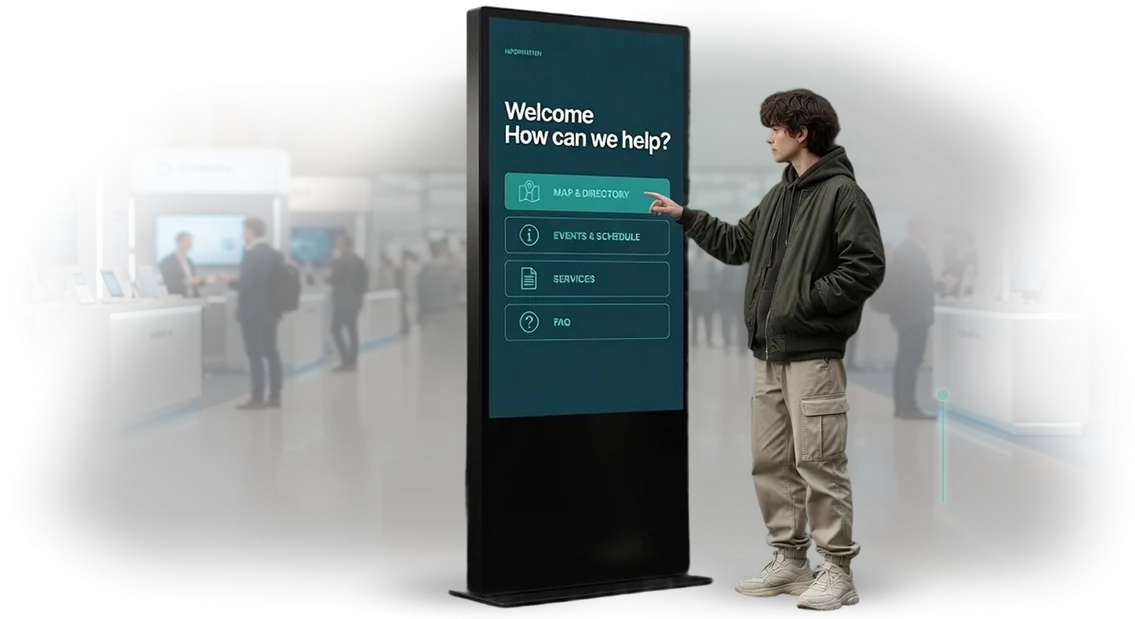
Guests and employees lose time at the plant without navigation
A production site is an entire city with its own infrastructure: workshops, warehouses, administrative buildings, checkpoints, parking lots.
A guest without an escort easily loses 15–20 minutes looking for the right department, while an employee loses time accompanying visitors and explaining directions.
Over the course of a day, such lost time at the plant adds up to hours taken away from core work, and on days when delegations visit, it means a derailed agenda.
Every navigational hiccup means a disrupted meeting schedule, partners arriving late to briefings, and extra stress for the hosting side.
Guests wandering around the facility involuntarily create an impression of disorganization — and for a plant that values its reputation as a reliable supplier, this is a direct blow to its image.
Clear navigation reads as process maturity and respect for people, and it also works in favor of the employer brand.
Interactive navigation kiosks address both issues: a visitor plots a route in under a minute, and an employee stays focused on production instead of escorting guests.
We configure the system around the specific logic of your facility — accounting for access zones, restricted areas, and delegation routes. It looks like part of a modern plant, not a temporary sign, and pays for itself within the first month through saved time.
Calculate how much the hours your specialists spend greeting visitors are worth — and it becomes obvious: navigation at a plant long ago stopped being a minor detail. It is part of efficiency that can be measured in hours and in reputation.
What benefits interactive navigation brings to an enterprise
Guests and partners remember not the numbers from a presentation, but how comfortable they felt at the enterprise.
When a person spends 10 minutes looking for the right workshop or office, they are already tired before the meeting begins — and the overall impression of the company suffers.
An interactive kiosk solves this quietly and quickly: the guest selects the desired destination on screen and immediately gets a route, rather than trying to catch the eye of an overloaded receptionist or security guard.
For the plant, this is not just convenience but measurable value. Below are three key benefits the enterprise gains after implementing such a system.
Increased guest and partner loyalty
The first impression of a company forms in the first minutes of a visit. A touchscreen kiosk welcomes the guest, shows the enterprise structure, and instantly builds a route to the desired point.
The visitor feels cared for and sees a modern approach — and this directly affects trust in the brand. The guest is more willing to return and recommend the company to partners.
Faster wayfinding and reduced staff workload
The reception desk and security service spend dozens of minutes a day on the same routine questions: "where do I go," "where is the department." An interactive kiosk takes over this routine.
Employees focus on their own tasks instead of repeating directions, while navigation becomes faster and more accurate. During peak hours, the kiosk serves several people at once, eliminating queues and frustration.
A modern image and information control
A navigation kiosk is also an image element. In addition to the map and routes, the screen can display up-to-date information about the enterprise, achievements, and products, updated in a couple of clicks.
Such a tool reinforces the image of a technology-driven and open company — this matters especially when receiving delegations and at exhibitions.
We, our team, have been implementing interactive navigation projects for production facilities for over 10 years.
We work with professional equipment and cover the enterprise's needs "out of the box" — from the first touch of the screen to full integration with the plant's internal directories.
Touchscreen kiosk formats for a plant
Every zone at a plant — checkpoint, workshop, warehouse — serves a different purpose, and the touchscreen kiosk must match.
At the checkpoint you need a protected stand for quick registration and pass verification, in the workshop an impact-resistant screen with instructions and diagrams, and in the warehouse a compact terminal that does not interfere with vehicle movement. The wrong format means the equipment will be left unused or will quickly fail.
We select the enclosure type, screen size, and mounting method for each location. Properly built touchscreen kiosks work flawlessly in plant conditions and blend naturally into the existing space.
Employees and visitors get the information they need on their own, without staff assistance — this reduces the load on security guards, warehouse staff, and engineers.
| Kiosk format | For which zones | What it provides to the customer |
|---|---|---|
| Checkpoint stand | Checkpoint, entrance area | Self-service visitor registration, pass verification, route around the facility — less load on security and administrators. |
| Floor-standing panel with a large screen | Workshop, production areas | Navigation across workshops, occupational safety instructions, reference information — newcomers find their way faster, and the risk of violations decreases. |
| Compact wall-mounted terminal | Warehouse, logistics zones | Search for storage locations, transfer requests, materials directory — warehouse staff stay focused on their work, fewer downtimes. |
Thanks to this approach, processes at the checkpoint, in workshops, and at the warehouse accelerate, while access control and internal navigation become transparent. You save employee time and get up-to-date statistics on kiosk usage.
How we build a navigation system for your specific task
A well-structured process for creating a plant navigation system is a guarantee that the kiosks will genuinely help people find their way rather than just stand in the lobby.
We start with a brief and an audit of your facility, then design the logic, implement it, and train the staff. At every stage you see the intermediate result and can make changes — this way we eliminate surprises at the finish line.
-
Brief and facility audit. We study the plant: employee and guest routes, checkpoints, workshops, warehouses, administrative buildings. We identify the points where people most often get lost or waste time searching.
-
Navigation structure development. We create the section logic, movement map, and hint texts. We account for your production specifics and typical visitor requests — from the checkpoint to the right office.
-
Prototype and approval. We show what the screen will look like and how the user will interact with the kiosk. You approve the mockup before we start assembly — no wasted expense on rework.
-
Assembly and configuration. We install professional equipment and configure the system and access rights. The kiosks are ready for intensive operation in plant conditions.
-
Deployment and testing. We place the kiosks at their locations and test navigation with real users. We fix any issues and make sure employees and guests can quickly find the destination they need.
-
Staff training. We hand your team simple instructions: how to turn on the kiosk, update information, and resolve common problems. We conduct a short training session for responsible employees so you are not dependent on us for day-to-day details.
-
Support and development. We stay in touch after launch: helping with content, refinements, and maintenance. The navigation system evolves together with your plant — new zones are added or routes change.
What is included in the interactive solution delivery
When ordering an interactive kiosk for a plant, it is important to understand exactly what is included in the delivery.
We put together a "turnkey" package — from hardware to warranty — so the solution starts working on the day of installation instead of becoming a puzzle for your staff.
- Hardware — touchscreen kiosks and stands designed for intensive use in workshops, entrance areas, and administrative buildings.
- Software — the navigation interface, a content management system, and the ability to update information without involving programmers.
- Content — facility maps, building layouts, routes for employees and visitors, department directories, and announcements.
- Installation and commissioning — delivery, setup, connection, configuration, and testing at your site.
- Staff training — instructions for administrators: how to change content, reboot the kiosk, and handle common issues.
- Warranty and service — warranty maintenance, software updates, consultations, and priority support.
This package covers every aspect of the delivery. You do not need to look for separate contractors for hardware, software, and installation — we act as a single party responsible for the result. You only manage the timeline and quality; we handle everything else.
Case study: how we implemented navigation at a production facility
At a production site with hundreds of employees and dozens of workshops, time lost searching for the right area is a real problem that hits the bottom line.
Workers and engineers spend hours every week trying to find a warehouse, laboratory, or the right office, while new employees simply wander around the facility in their first days.
We implemented an interactive navigation system for a large plant — it was the first project of its kind in the industry. Instead of paper maps and questions to security, touchscreen kiosks were placed at key points.
An employee or guest selects the desired destination, receives a route and map, and the system estimates travel time accounting for access zones.
Measurements after launch showed: the time needed to find a destination at the production site was cut in half. The number of late arrivals to meetings and delivery delays decreased — workers stopped wandering around the facility.
New employees especially appreciated the navigation: their on-site onboarding accelerated several times over.
The economic effect was higher than expected. We not only eliminated the costs of printing and updating paper signs but also freed up staff who previously had to guide visitors.
Following the pilot project, the customer asked to extend the system to other buildings — the best proof that the solution works.
One important detail: we adapted the system to the enterprise's internal standards — accounting for closed zones, restricted facilities, and different access levels.
This is critical for production, because ordinary city maps do not work here: a guest at the plant should only see what they are permitted to see, while an employee gets the full route network.
How to choose the right kiosk format for your facility
Choosing a kiosk format starts not with the hardware model but with the question "who will use it and how." Visitors need simple navigation and fast wayfinding to the right workshop or department, employees need quick access to internal regulations and requests, and logistics needs vehicle routes and unloading zones.
Once you define the primary task, the other parameters — screen size, installation location, interface — fall into place by themselves.
Also consider operating conditions. A kiosk in a clean lobby for guests is one solution, while a stand in a workshop with dust, vibration, and frequent gloved touches is quite another. Enclosure durability, impact resistance, and screen tilt angle all depend on this.
We ask these questions at the brief stage so we can propose a format that will last for years rather than cause problems within a month.
Session frequency and duration matter just as much. If the kiosk will have a long line of visitors, you need a simple two-to-three touch scenario. If employees work with it daily, the interface can be more feature-rich, but with quick access to recurring operations.
For occasional guest sessions, large buttons and self-explanatory prompts that require no training work best.
Our approach is not "here is a standard kiosk, install it as is," but rather selecting a format for your specific facility: number of people, type of spaces, tasks, and even the floor plan.
You get a solution that fits into the plant or business center's workflow instead of forcing you to restructure processes around it. At the same time, we stay within budget, offering exactly the options you really need rather than the full feature set.
If you are unsure which format suits you — send us a description of your task, and within one day we will propose 2–3 options with justification. This is non-binding: you will see the reasoning behind the choice and can make a decision based on facts, not guesses.
Frequently asked questions about implementing interactive kiosks
Enterprises that are implementing interactive kiosks on their plant grounds for the first time tend to ask similar questions. That is unsurprising: how the hardware behaves in a workshop determines the entire navigation experience for employees and visitors.
We answer the main concerns — based on experience with such projects, with clear timelines and a guarantee.
Will the kiosk withstand plant conditions?
Yes, we use an industrial enclosure and a protected screen — they are designed for dust, vibration, and temperature fluctuations. Operating around the clock, such a kiosk lasts 5–7 years without repairs.
What prevents the kiosk from being broken or stolen?
The design is vandal-resistant: a steel enclosure, impact-resistant glass, and floor mounting. Inside there is a tamper sensor that instantly alerts the security service.
How much does implementation cost and when does it pay off?
The cost is calculated after audit of your project, based on a short technical specification — this is non-binding. Implementation typically pays off through saved employee time and reduced dispatcher workload.
How quickly can the kiosk go live?
The standard timeline is 2–4 weeks, including map development and installation. We install on weekends or between shifts so production never stops.
What warranty and support are provided after launch?
The warranty on hardware and software is 12 months. After that, post-warranty service continues: a free support line and on-site engineer visits. While repairs are being made, we provide a replacement kiosk — production will not be interrupted.
Discuss your task — we will propose a solution for your budget
A plant's grounds mean dozens of buildings, a steady flow of visitors, and "how do I get to the workshop?" questions that distract your staff.
An interactive kiosk removes this burden, but for it to actually work rather than just stand in the lobby, it is important to define the tasks and constraints in advance.
We suggest starting with a short conversation — tell us about your facility, and we will propose a solution for your budget.
Leave a request for a consultation — it takes a couple of minutes. After that, we will prepare a proposal ourselves, making it clear what you get and what the cost after audit is. Usually the conversation goes like this:
- You describe the situation: how many visitors, which zones, where people most often get lost, whether there are complex routes.
- We ask clarifying questions and help you articulate the task — even if you do not yet know what functionality you need.
- We select the optimal option: from a basic navigation scheme to a multimedia kiosk with a map, workshop search, and reference information.
- We show a stage-by-stage breakdown — what is included in the cost, what work happens at each step, and what you are paying for.
- We give realistic timelines: you know when you will receive the finished kiosk and what is needed for its installation.
- We explain support: we train your employees, help load the information, and stay in touch after launch.
This approach is not just "we will make you a kiosk." It is a way to avoid unnecessary spending and get exactly what meets your plant's needs. You make a decision with a transparent budget and a clear understanding of the result, rather than risking money blindly.
Leave a request for a consultation — and we will prepare a solution that fits your budget and solves the navigation challenge at your plant.
Translate the above into English. Preserve structure exactly.