

Visitors Get Lost in the Business Park: How Much Are You Losing on This?
Visitors come to a business park with a specific goal: to reach the right tenant for a meeting, negotiations, or an event. But when the lobby has no clear map and signs only lead to the nearest elevator, a large share of guests start getting lost.
People wander through corridors, call the office, ask security for directions—and get their first negative experience before the conversation even begins.
Every lost minute like this is visitor dissatisfaction and a blow to the tenant's reputation. The meeting starts late, nerves are already frayed, and the partner perceives your complex as inconvenient.
In the end, the tenant suffers too: their clients don't come back, and they start wondering whether to renew the lease in your building at all.
Signs and paper maps don't solve the problem: they are static, quickly become outdated, and don't account for the fact that at different times people may need different destinations—from a specific company's office to a meeting room or a cafe inside the complex.
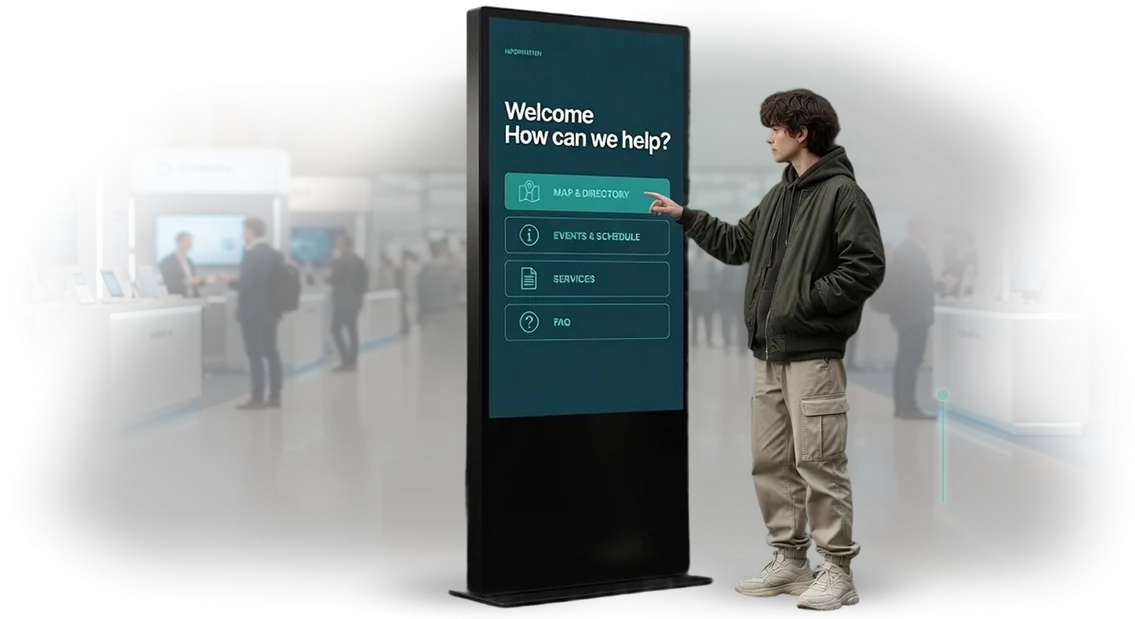
Interactive navigation kiosks in a business park give visitors a fast and accurate route, and give tenants the confidence that their guests will arrive on time.
We've been working on such projects for more than ten years and know how to turn navigation from a source of stress into a clear service.
Interactive kiosks help visitors find the right offices in a minute, help tenants get satisfied and punctual clients, and help you increase the complex's attractiveness and retain the loyalty of the professionals and companies working there.
What Interactive Navigation Gives Tenants and Guests
In a large business park, guests often get lost: the buildings look alike, paper signs become outdated, and the reception desk is overloaded with questions. As a result, tenants miss out on visitors, and the management company wastes time on repetitive explanations.
Interactive navigation removes this burden—guests find the right office on their own in a couple of taps.
More Live Meetings for Tenants
When visitors quickly find their way, they arrive at the right office in a good mood and ready to talk. The touchscreen kiosk shows the route to a specific company, suggests the nearest entrance, and saves guests time. As a result, tenants get more real visits, not just calls asking, "how do we get to you?"
Convenience for Guests Is Brand Care
Guests don't need to look for security or catch the administrator's eye. The kiosk works around the clock without breaks and gives clear prompts at every step. This creates the impression of a modern, caring space that people want to return to and recommend to colleagues.
Less Routine for the Management Company
When a tenant changes or moves, there's no need to re-glue a sign on the wall—the information is updated in the system once. Reception staff stop being a "live map" and focus on their own tasks. And data on the most popular destinations helps plan internal park logistics more clearly.
Such navigation pays off quickly: it reduces staff workload, increases guest loyalty, and makes the business park competitive in the commercial real estate market.
Interactive Kiosk Formats for Zones of Your Property
A business park visitor rarely approaches the administrator's desk with the question "where is the company I need?" They expect an instant answer: a glance at the screen, a tap, a ready route.
If the kiosk is installed in the wrong zone or is inconvenient, the guest simply walks past—navigation turns into wasted time, and visits no longer bring pleasure. A properly chosen format solves this problem right away, without staff involvement.
We select the type of interactive kiosk for each zone of your property: at the entrance you need a quick reference, in the lobby a detailed map, near the elevator a short prompt. Below are the basic kiosk formats that cover the main business park scenarios.
| Format | Who it's for | What it gives your property |
|---|---|---|
| Floor-standing kiosk | Visitors who are used to finding information on their own | Relieves the reception desk, reduces the time spent searching for an office or cafe |
| Wall-mounted touchscreen | Waiting areas, elevator lobbies, spaces with limited floor area | Works as a 24/7 information desk without taking up useful space |
| Interactive map | Retail galleries, food courts, parking areas | Visually shows the route, increases the time spent in the complex |
| Compact kiosk | Entrance groups, quick reference needs | Gives instant answers to frequent questions without queues or staff involvement |
We adapt each format to your corporate style and tasks: we add search by organization, clear service categories, and prompts for different types of users. After launch, you see tap analytics—which zones are in demand and which should be adjusted.
We'll help you choose the format and propose a placement scheme based on your building plan—come and see practical examples.
Stages of Launching Navigation in a Business Park: From Plan to Support
A clear plan is half the battle. In a business park, navigation must go live on time and without downtime, otherwise visitors get lost and tenants receive a wave of negative feedback.
We've structured the process so the client sees all project stages, understands what's happening, and controls the outcome.
We work remotely but manage the kiosk launch as a single project: from the first brief to ongoing support. Below is the typical path a client goes through.
-
Brief and site audit. We gather tenant needs, study visitor flows, entry points, elevators, stairs—everything that affects routes. We define goals: what matters more—quick office search, service areas, or cafes.
-
Navigation plan and approval. We prepare a kiosk placement scheme, catalog structure, and search logic. You receive a document that can be approved with the management company and tenants. At this stage, the full scope of work and timelines are visible.
-
Navigation development: design and content. We create an interface in the business park's corporate style and fill the directory: offices, services, events, infrastructure. We verify that visitors can find what they need in 2–3 taps.
-
Kiosk assembly and setup. We prepare touchscreen stands and the server side. At this stage, it's important that information updates happen without stopping operations—you can change tenants, working hours, and the map without redesigning the interface.
-
Kiosk launch. We install the equipment, configure remote management, and run a test day with real scenarios: we check how routes behave during peak hours and when the schedule changes.
-
Training and instructions. We provide staff with clear guides: how to turn on the kiosk, what to do in case of a failure, how to quickly add a new tenant. So the reception team doesn't have to figure out the technology.
-
Ongoing support. We stay in touch: we monitor the system, update information, and quickly respond to changes in the business park. You get stable navigation without your own IT team.
What's Included in the Delivery: A Kit for Your Property's Navigation
When you order interactive navigation for a business park, it's important to understand in advance what you're paying for and what you'll get. We define the delivery scope so there are no surprises after launch: you receive a turnkey system ready to work. Here's what's included in the kit.
- A touchscreen kiosk in a vandal-resistant enclosure—suitable for lobbies, entrance groups, and high-traffic areas. Professional equipment is designed for around-the-clock operation.
- Navigation software with a business park map, floor plans, tenant search, and route building to the right office or meeting room.
- A design mockup of the interface in your corporate style: logo, colors, menu structure. Guests start using the system without prompts or training.
- Delivery of the kiosk to the site, elevator transport to the floor, and unpacking at the installation location. You won't have to deal with logistics or coordinating carriers.
- Installation and setup: kiosk mounting, connection to power and network, loading maps and content, testing navigation scenarios before launch.
- Administrator training and a clear instruction guide—so your team can independently update news, tenant promotions, and temporary announcements.
- Scheduled map and plan updates: when tenants change or layouts are adjusted, we make edits without lengthy approvals. Plus technical support with remote diagnostics and an engineer visit when needed.
This kit covers the entire cycle—from delivery to daily operations. You get a predictable result and don't have to think about the technical side.
Case Study: How Kiosks Relieved the Administrator Desk at a Technology Park
One of Minsk's technology parks approached our team with a typical pain point: the administrator's desk was drowning in a flow of visitors. People asked how to get to the meeting room, where a certain company was, and how to reach the cafe faster.
The administrator physically couldn't keep up with everyone—the queue grew, and so did guest dissatisfaction.
We proposed installing two touchscreen kiosks with interactive navigation in the lobby. On the screen: a technology park map, search by company name, routes to the right office, and infrastructure hints—meeting rooms, cafes, parking. The client didn't have to explain anything—the system was ready to go two weeks after the brief.
Result for the Technology Park
In the first month of operation, the kiosks recorded more than 4,500 navigation sessions. The load on the administrator desk dropped by almost 60%—guests started finding their way on their own, and the administrator focused on rental questions and guest reception.
The technology park's management noted that visitors began arriving late to meetings less often, and tenants asked for kiosks in the neighboring building.
Three months later, we received a repeat order to install two more terminals—this time for the second building. That's the best indicator that the project delivered real value to the business.
Why This Works
The navigation kiosk removes routine work from live staff and gives visitors an instant answer at any moment. For the technology park, that means reduced administrator workload, fewer queues, and a more comfortable atmosphere for tenants.
How to Choose the Right Navigation Format for Your Task?
Choosing a navigation format starts not with the kiosk model but with a question: what matters more for your visitors—quickly finding the right office or comfortably orienting themselves in a large space?
For a business park with many tenants, stationary touchscreen stands in the lobby, complemented by clear signs, become the optimal solution.
If you have multiple entrances or buildings, it's worth considering identical kiosks at each entrance so the search logic is uniform for all guests.
Pay attention to usage scenarios. If visitors arrive for meetings and are in a hurry, they need a simple route "from point A to the company's office" in a couple of screen taps.
If the business park regularly hosts events or new residents move in, choose a format that allows maps and the organization list to be updated without redesigning the interface.
Choose navigation that solves the task for both the regular guest and the employee who travels around the park several times a day—and you'll relieve the reception desk and the security service.
Navigation requirements are determined by the layout and the flow of people. For long corridors and a large number of offices, interactive maps work better, where a person can see themselves on the diagram.
For open spaces with common areas, an information stand with search by company name or business field is sufficient. Think about how many languages you need—an international business park often chooses an interface with language switching so foreign guests don't waste time.
The rule is simple: the more routes and points of interest you have, the more interactive the format should be. If the visitor flow is predictable and stable, a compact kiosk with large buttons and symbolic prompts is enough.
We'll help you assess your situation and propose a format that reduces search time, lowers the number of questions to administrators, and leaves guests with the feeling that everything in the business park is designed for their convenience.
Addressing Your Concerns: Reliability and ROI of Navigation
Many business park clients have doubts: won't the kiosk break down in the first month, who will watch over the screen, and how do you verify that the investment paid off?
These are normal questions—the answers determine whether navigation becomes a working tool or turns into "another screen by the entrance." We use professional equipment designed for intensive use, so we address the most common objections—briefly and to the point.
What happens if the touchscreen kiosk freezes?
The system will restart the interface on its own within a few seconds, and if the failure repeats, it will send a signal to the support service. A specialist will connect to the kiosk remotely, check its status, and eliminate the cause.
In most cases, you won't even need to call a technical employee, and visitors won't notice any downtime.
Who will maintain the kiosks and update information?
All technical maintenance is included in the contract. We perform regular diagnostics, update maps, the tenant list, and navigation scenarios—you don't need to keep a dedicated person.
All that's required from you is to approve the content and let us know if new zones appear or office locations change.
How can we tell whether navigation has paid off?
Look at the load on the reception desk: when guests independently find the right office, administrators are less distracted by "how do I get there" questions, and meetings start on time.
Additionally, the kiosk can display tenant advertising or event announcements—this turns navigation into a source of revenue. Attach QR codes and promo codes to the screen to measure real conversion.
Let's Discuss Your Project: We'll Calculate Scenarios and Timelines
Navigation in a business park doesn't forgive planning mistakes. Poorly thought-out scenarios mean lost visitors and queues at the information desk.
Send us a request for a calculation: we'll analyze visitor flows, suggest how many kiosks you need, and where they'll have the maximum effect.
From a short consultation, you'll get a clear picture of the future system: what scenarios your business park needs, realistic implementation timelines, and how to integrate kiosks into the logic of the zone.
Ordering a kiosk from us means removing risks in advance, rather than dealing with them after launch.
Leave a request to:
- Get a navigation calculation for your spaces and visitor flows.
- Learn the exact development and delivery timelines based on your layout.
- Compare configurations: number of points, enclosure design, operating scenarios.
- Understand the cost calculated after audit—installation and technical support.
- Discuss integration with tenant maps and park events.
- Receive a commercial proposal and launch plan to fit your budget.
- Ask questions and clarify the project brief before work starts.
After your request, a project engineer will ask clarifying questions and prepare a preliminary calculation within one business day. The discussion is non-binding.
Fill out the form or write to us via messenger—together we'll calculate the business park navigation and determine the timelines.