

Patients Get Lost in Hospitals: How Navigation Affects Reputation
The same scene plays out every day in hospitals: a patient arrives for an appointment but gets stress instead of peace of mind. They search for the right office by following signs and placards, wander through corridors, ask staff for directions, and end up late for their doctor.
The result — a disrupted schedule, a tense conversation with the physician, and the feeling that no one here cared about the patient.
A lost patient is not just an everyday inconvenience — it is a blow to the medical facility's reputation. People share their experiences: they talk about endless searching, indifferent administrators, and overall chaos.
Negative reviews spread quickly, and potential patients choose another clinic where their time is treated with more care.
Navigation for a clinic is part of the medical service, not a minor detail. When a person needs to visit several rooms at once — for lab tests, a specialist appointment, a treatment room — they want to understand the route without wasting extra nerves.
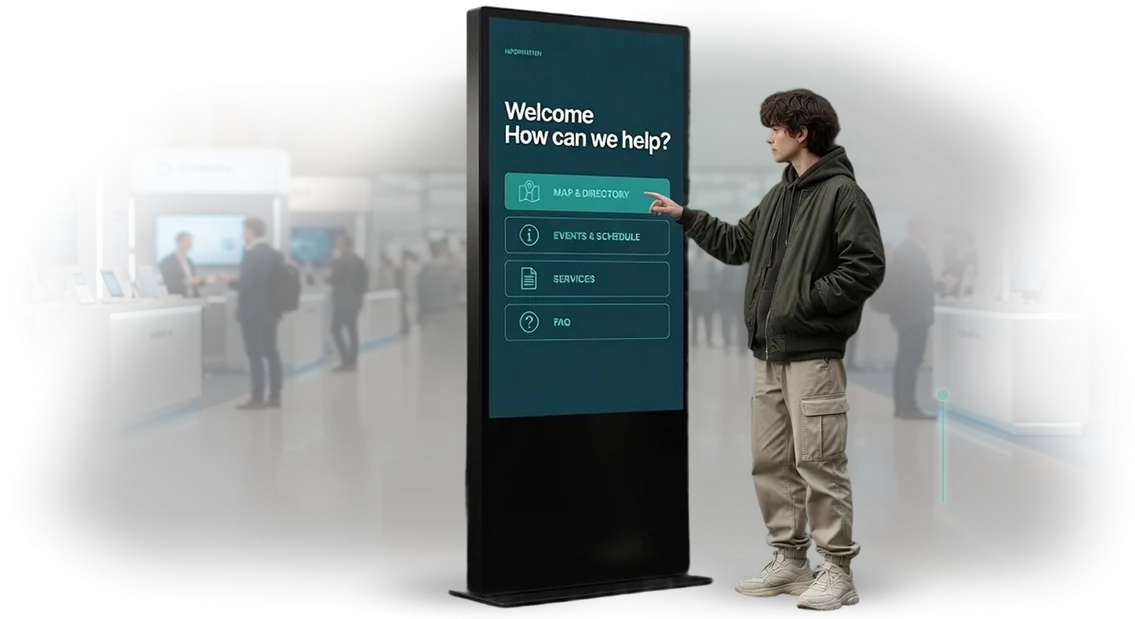
An interactive kiosk in the hospital solves this in seconds: the patient enters the desired office or selects a destination on the screen and receives a clear route.
Staff are freed from endless explanations, reception queues shrink, and patients arrive at their appointments on time and calm.
That is why more and more clinics are implementing interactive kiosks as part of their navigation system. We develop solutions that fit into the medical facility's interior, are easy to use for people of all ages, and help turn a visit into a straightforward process.
The patient is no longer lost, and the clinic gains a reputation as a place that truly cares about people.
What an Interactive Kiosk Gives Patients and Hospital Staff
Patient Convenience and Clinic Navigation
Instead of searching for signs and queuing at the information desk, the patient independently finds the route to the right office on a touchscreen kiosk. The kiosk shows the path through the hospital, accounting for building wings and walkways, and prints directions when needed. This reduces stress and the number of late arrivals.
Staff Workload Relief
Nurses and administrators stop being distracted by the same questions — "where is this office?", "how do I get there?" The interactive kiosk handles up to a third of such inquiries, and staff focus on their direct responsibilities. The time previously spent escorting visitors is now used for patient care.
Greater Loyalty and Reputation
Modern service is memorable: patients see that the clinic cares about them and tell their friends about it. Based on our experience, even a single kiosk at the entrance halves the flow of questions to the administrator and leaves a positive impression. This encourages repeat visits and strengthens the clinic's reputation.
Reduced Burden on the Information Desk
Automating routine questions frees up administrators and makes it possible to avoid expanding staff even as patient flow grows. The kiosk works around the clock — it does not get tired and does not get sick — so help is available at any time. The investment in an interactive system pays for itself through saved working hours.
Touchscreen Kiosk Formats for Hospitals: Wall-Mounted, Floor-Standing, and Counter Units
In a hospital, navigation affects not only logistics but also the emotional state of visitors. Patients and guests get lost in corridors, distract staff, and arrive late for appointments.
A touchscreen kiosk takes on these tasks: it shows routes, departments, wait times, and relieves the registration desk.
We select the right format for each specific zone — taking into account foot traffic, available space, and usage scenarios. Here are the typical options most often chosen for hospitals and medical centers.
| Format | Who It Is For | What It Offers the Client |
|---|---|---|
| Wall-mounted kiosk | Narrow corridors, elevator lobbies, entrance areas | Saves space, does not block walkways, helps visitors find offices without staff assistance |
| Floor-standing kiosk | Spacious halls, waiting areas, central lobbies | Attracts attention, works as an independent navigation hub, relieves administrators |
| Counter kiosk | Registration desk, admissions department, children's areas | Replaces part of the administrator's functions: appointment scheduling, information, routes, wait times |
A wall-mounted unit is ideal for point navigation in corridors, a floor-standing kiosk serves as a central information hub in the lobby, and a counter unit replaces part of the administrator's duties at the reception desk.
A properly chosen format is half the battle: users find their own way, and staff focus on their own tasks.
How We Build a Navigation Kiosk: From Brief to Launch
We make the navigation project transparent: you understand what happens at each stage and know the implementation timeline in advance.
The process is designed so it does not distract hospital staff from their core work — you receive a finished kiosk that immediately directs patients to the right office.
-
Briefing and space audit. We study your building: entrance areas, elevators, walkways, and typical patient questions. We map out the key points where a kiosk will deliver the most value.
-
Navigation structure development. We create clear logic: departments, offices, procedures, laboratory. The patient finds what they need in 30–40 seconds — without administrator assistance.
-
Design and content. We choose fonts, icons, and color zones and adapt the texts for all ages. Each department has its own color — easy to remember and use for signage.
-
Approval with your team. We present prototypes and mockups and make revisions. Everything is adjusted before installation — no "fixes after launch" and no schedule slippage.
-
Kiosk production and installation. We build a durable enclosure, place it carefully in the lobby, and connect it to the power supply. Installation does not require remodeling or stopping department operations.
-
System upload and testing. We install the software and verify all routes. We make sure the kiosk operates without delays or queues even under heavy traffic.
-
Launch and staff training. We show administrators how to use the kiosk and provide a short instruction manual. Technical support stays in touch after launch.
The whole process typically takes 2–4 weeks depending on the number of departments and kiosks. In the end, you get a navigation system that reduces staff workload and improves patients' impression of the clinic.
What Is Included in the Delivery: A Complete Package for the Hospital
A hospital is not an exhibition hall: navigation must work the day it is delivered, and staff should not have to figure out technical details. That is why we assemble a turnkey package — from the kiosk itself to employee training. You get a ready-made system, not a box of equipment.
- Touchscreen kiosk unit — a durable, vandal-resistant enclosure, a bright touch-responsive display, and a built-in system unit. The device runs flawlessly even in high-traffic lobbies.
- Navigation software — an interactive hospital map, search for offices by name or doctor's surname, and detailed routes to the desired department. The patient spends a couple of minutes finding their way instead of asking staff for directions.
- Custom design finish — the kiosk shell is styled to match your clinic's branding, with a logo and navigation colors. Patients immediately recognize it as part of the hospital, not a foreign device.
- Installation and connection — our engineers deliver the kiosk, place it in a convenient location, connect it to the power supply, and test all operating scenarios. All you need is a nearby power outlet.
- Content setup — we pre-load the doctor schedules, department lists, and building floor plans. When data changes, you update the information through a simple control panel, without calling a technician.
- Staff training — a short session for administrators and security: how to help a patient, what to do in case of a failure, how to restart the system. No technical complexity — just basic actions.
- Warranty and support — we support the system after launch. If needed, we arrive within 24 hours and monitor updates and the performance of all modules.
Case Study: How Kiosks Reduced Queues at a Hospital Registration Desk
A city medical center with 600–800 visitors per day faced a serious navigation problem. Patients got lost in the corridors, spent up to 15 minutes finding the right office, and constantly approached the registration desk — which created queues and tension among the staff.
The management decided to implement interactive kiosks to relieve administrators and make visiting the clinic a clear, simple experience.
Our team installed touchscreen terminals at the entrance, on each floor, and near the registration desk. The kiosks featured a map of the center, a list of doctors with office numbers, routes to the desired location, and hints for elderly visitors with enlarged text. The project took three weeks — from measuring visitor flows to launching the first screens.
Implementation Results
One month after launch, the average time to find an office dropped from 12 to 3 minutes.
The load on the registration desk fell by nearly a third — staff no longer had to act as a "directory service." Patients reached their appointments faster, and staff could focus on their own tasks instead of repeating the same directions over and over.
The effectiveness of the navigation was confirmed by the numbers: the number of late arrivals was cut in half, and the share of requests to administrators for directions fell from 45% to 12%.
The system paid for itself not through new revenue but through the freed-up time of staff and a calmer atmosphere in the lobby.
This medical center kiosk case showed that proper navigation is not an extra service but a tool that directly affects the quality of care. Six months later, the clinic ordered an expansion of the system to its branch — with the same interface and no need for redesign.
If you want the same result, start with an audit of your visitor flows — we will show you where kiosks will deliver the most value.
How to Choose a Kiosk Format for Non-Standard Requirements?
Choosing a kiosk for a hospital rarely comes down to "just pick a standard model from a catalog." First and foremost, it is important to understand who will use the device and what tasks it should solve: route guidance to an office, appointment scheduling, department information, or appointment schedules.
The screen size, the placement, and the interface — what the patient sees and understands within 10 seconds — all depend on this.
An unusual layout of the medical facility is the most common reason a standard kiosk configuration does not work.
Long corridors, multiple buildings, elevators, and walkways on different floors require special navigation logic: the kiosk must not simply show a map but account for real walking paths.
In such cases, we discuss visitor flows and "bottleneck" points with you — and then design the interface around them, with prompts, photos of walkways, and step-by-step routes.
The kiosk configuration itself can also be a custom solution.
A wall-mounted option for narrow halls, a floor-standing model with a larger screen for the main entrance, or a version with a lowered panel for pediatric departments and accessible environments — each option solves its own task.
We help you choose the enclosure, display size, and mounting method so the device does not obstruct movement, does not require permanent remodeling of the facility, and remains convenient for both elderly visitors and staff.
The key point is that this is not a "kiosk for the sake of a kiosk" but a tool that reduces the load on administrators and decreases the flow of "how do I get there?" questions.
To choose correctly, one joint audit is enough: we will look at the layout, discuss typical scenarios, and propose a configuration tailored to your needs.
And after launch, we will stay in touch — we will update the navigation whenever the layout changes or a new building is added.
Answering Your Questions Before You Order
Any equipment in a hospital operates in a demanding environment, and an information kiosk is no exception. You want to know in advance what happens in case of a breakdown, who is responsible for repairs, and how to plan the maintenance budget. Here we address the most common questions so you can sign the contract with peace of mind.
What does the kiosk warranty cover and how long is the service period?
We provide an official warranty on all equipment and installation. During the warranty period, we fix any faults related to manufacturing defects or configuration free of charge.
If the damage was caused by external impact, you can always order a repair using a separate service price list — it is known to you in advance, no surprises.
What should we do if the touchscreen stops responding to touch?
In most cases, the issue is resolved by a restart or calibration — our engineer can do this remotely in a few minutes. If the screen is physically damaged, we will replace it as quickly as possible because we always keep spare parts in stock. There will be no navigation downtime, even during the repair.
Who will come to service the kiosk and how quickly?
We work remotely, but if necessary, we arrange a service engineer visit to your city — usually within one or two days. During the repair, we provide a replacement touchscreen module so patients and visitors can continue using the navigation.
If the fault can be fixed remotely, a specialist will connect within a few hours during business hours.
Won't the total cost of owning a kiosk be unreasonably high?
We design kiosks to last for years, with routine maintenance only once a quarter — that is enough for stable 24/7 operation. The contract specifies fixed maintenance with no hidden fees: you know your expenses in advance.
Fast navigation relieves the registration desk and reduces the flow of questions to staff, so the investment pays for itself within the first few months.
Request a Navigation Consultation for Your Clinic
Patients get lost in clinic corridors, ask administrators the same questions, arrive late for appointments — and associate all of this with the quality of service. An interactive kiosk solves the navigation problem before it turns into a negative experience. You get calm visitors, relieved staff, and fewer urgent calls to the registration desk.
We develop turnkey kiosks for hospitals and clinics: from screen concepts to installation and staff training.
Over 10 years, we have delivered navigation for medical centers that see hundreds of patients a day — and we know how to make sure people use the kiosk without any guidance.
Leave a request for a navigation consultation — and within one business day we will send you a cost estimate for the kiosk and the project timeline. Along with the estimate, you will receive:
- Selection of kiosk quantity and placement for your facility's layout;
- Recommendations for menu structure and department categories;
- Design options that fit your clinic's interior;
- A detailed cost estimate for equipment, development, and installation;
- An implementation schedule — from brief to launch;
- Technical support and information updates after launch.
Tell us about your clinic — we will advise you on making navigation convenient for elderly patients and parents with children. To order a kiosk or ask questions, simply write to us through the form on the website.
The consultation comes with no obligation — but it will help you see how quickly an orderly, stress-free environment pays for itself.