

Navigation in a Botanical Garden: How to Avoid Losing Visitors
A botanical garden is a space where visitors easily get lost: paths intertwine, exhibits are scattered, and signs at the entrance do not answer the question “which way next?”.
As a result, guests waste time searching, miss key collections, and leave with the feeling that “they did not see the most interesting part”. For the garden, this means lost emotions, negative reviews, and fewer repeat visits.
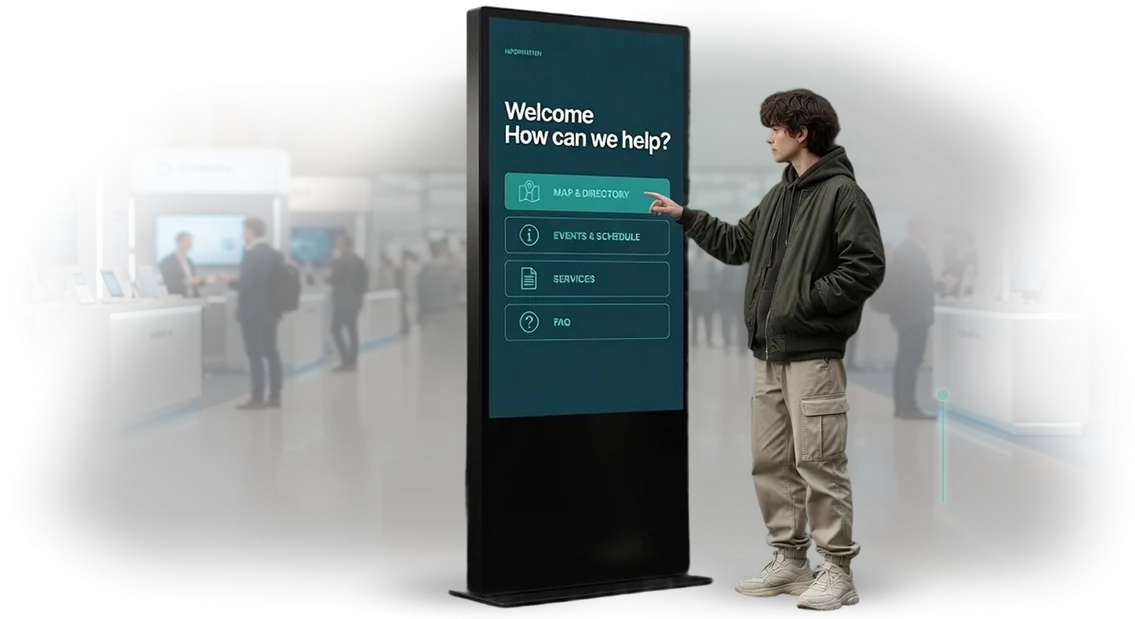
An interactive kiosk for the garden solves this problem on the spot. A visitor walks up to a touchscreen stand, finds the desired greenhouse or rare plant on the map, and receives a clear route in 10 seconds — instead of studying a paper map.
This is not just a garden map but a personal navigator that takes the visitor’s interests into account: a short stroll, a family route, or a tour of all collections.
Such navigation across the grounds reduces the load on staff — employees no longer need to explain directions ten times a day.
The kiosk also becomes a point of attraction: people inevitably gather around the screen, bringing the entrance area to life and making visits more thoughtful.
The main effect is that visitors stop “getting lost” and begin exploring the garden more deeply: they linger at exhibits, return again, and recommend the garden to friends.
We address this need through a carefully designed interface and routing logic adapted to the layout of each specific garden. The result is fewer lost guests, more positive impressions, and increased loyalty to your space.
First Impressions and Repeat Visits: What an Interactive Guide Changes
Visitors come to a botanical garden for beauty, but without clear navigation they often get lost: they miss the greenhouse, search for the right entrance, or are late for the start of a tour. The chaos of the first minutes spoils the impression even of the most well-kept garden.
An interactive guide turns confusion into ease: guests choose their own route and receive hints along the way.
Navigation convenience is not just arrows on a map. Touchscreen kiosks help build a walk tailored to interests: with children, for photos, or through a rare plant collection. Visitors can see what is nearby, how long it takes to reach the next point, and what awaits them ahead.
The guide points out benches, fountains, and restrooms — little things that affect comfort. As a result, guests get less tired, see more, and their impression of the garden becomes brighter.
When every visit brings new discoveries, the desire to return grows. An interactive guide makes it easy to update routes and add seasonal stories: magnolia blooms in spring, shady paths in summer, a palette of foliage in autumn. This boosts visitor loyalty: they plan their next visit and recommend the garden to friends.
We build kiosks on professional equipment that works reliably under load and outdoors. Over 10 years, our team has refined the process — from brief to launch with minimal time spent. Management gets a ready-made tool that requires no supervision and pays off through repeat visits.
Send us your brief — we will show you how an interactive guide can fit into your garden and what is needed to launch it. At the meeting, you will see live examples and assess how it will change guests’ experiences.
Formats for Interactive Kiosks in a Botanical Garden
In a botanical garden, visitors solve different tasks: quickly reach the greenhouse, learn about a rare plant, keep children occupied, or plan a route for an hour. One universal kiosk rarely covers all scenarios.
That is why we select the interactive kiosk format based on specific zones and tasks — this improves convenience and reduces the workload on staff.
| Format | Who it is for | What it gives the garden |
|---|---|---|
| Touchscreen navigation kiosk at the entrance | First-time visitors | Helps build routes quickly, reduces queues at the ticket office and questions to staff |
| Interactive stand in the greenhouse | Families with children and excursion groups | Turns plant viewing into a game — holds attention and increases time spent |
| Kiosk with a “reference guide” mode near rare collections | Visitors passionate about botany | Provides in-depth plant information without a guide, increases ticket value |
| Outdoor kiosk with a protected enclosure | Visitors on open routes | Works in any weather and remains available during peak hours |
The modular design allows the kiosk’s operating mode to be changed by season: in summer — a map of events and tours, in winter — a greenhouse reference guide and lecture schedule. This approach increases guest engagement and collects useful data about the routes visitors choose. This data helps develop the garden and plan new exhibits.
Development Stages: From Brief to First Screen
Work on a kiosk for a botanical garden begins not with technology but with logic: how a visitor finds the way to the greenhouse, café, or children’s playground.
We go through the journey from brief to first screen together with you — without lengthy approvals and with clear decisions at every step.
- Kiosk brief. We record the tasks: how many visitor flows, which points of attraction, where questions most often arise, and who uses the kiosk — adults, families with children, or tourists.
- Navigation design. We collect the garden map, route logic, and scenarios: “how to get to the fountain”, “where is the nearest restroom”, “what is blooming now”. We simplify it into understandable categories — the visitor finds the answer in two touches.
- Layout approval. We present the design and screen structure, fitting them into the garden’s style. At this stage, you see the final interface and can make changes without reworking the entire system.
- Production and content preparation. We assemble the kiosk enclosure, upload approved texts, maps, and photographs. In parallel, we prepare instructions for administrators.
- Kiosk launch. We deliver the finished solution, install it at the desired location, and check it on site. We train your staff — in just half an hour they understand how to use the system and what to do in an emergency.
After launch, there is nothing left to do but enjoy the results: visitors find their own routes, ask staff fewer questions, and you get a neat, modern navigation point.
All development stages are recorded in short reports, so you always see where the project stands and when to expect the first screen turned on.
What Is Included in the Delivery of an Interactive Kiosk
An interactive kiosk is not just a touchscreen — it is a full-fledged navigation tool. To ensure it works reliably from day one and delights visitors, the delivery package includes everything needed — from pre-installed software to installation and staff training.
- Kiosk software. The interface with the botanical garden map, plant descriptions, and routes is already configured for your tasks. Content updates are done remotely — you do not need to call a specialist to add new objects or change prices.
- Touchscreen enclosure and hardware. A durable enclosure protected from moisture and sunlight, with a bright display that is easy to read even on a clear day. The hardware is selected for outdoor use and intensive operation.
- Mounting kit. All brackets, mounts, and cables for installation on a flat surface or a special stand. Installation is carried out by our engineers: they connect the kiosk to electricity and the internet and check all operating modes.
- Documentation. An easy-to-understand user manual, a primary maintenance guide, and a daily inspection checklist. All documentation stays with you and helps staff quickly understand the device.
- Staff training. We provide in-person or remote training for administrators and garden attendants: turning on the kiosk, uploading new content, and solving common problems. After training, your staff work confidently with the system without constant support.
- Warranty and service support. The first year of support is included in the cost — this means quick responses to requests, scheduled checks, and replacement of consumables if needed. You are never left alone with the device.
Such a package saves you from searching for different contractors and unnecessary approvals. You get a single turnkey solution whose operation we are responsible for — from the first day of installation until the end of the warranty period.
Case Study: Navigation in an Arboretum and Its Results
At the GreenPark arboretum, visitors often got lost: paper signs indicated directions but did not explain where the desired greenhouse was or how long it would take to get there.
Guests left feeling they had not seen even half the collection, while staff answered the same questions dozens of times a day — “where is the rose garden”, “how do I get to the ticket office”.
We proposed replacing the signs with interactive navigation kiosks — with a map, plant name search, and ready-made routes.
Two months after launch, the arboretum team and we measured the effect. The results were more noticeable than expected: visitor satisfaction grew from 74% to 93%, and the number of inquiries to the information desk halved.
The kiosks took over standard questions, while live staff focused on meaningful conversations about plants.
Implementation Results
| Indicator | Before kiosks | After |
|---|---|---|
| Navigation satisfaction | 68% | 94% |
| Visitors who reached rare collections | 31% | 67% |
| Daily staff inquiries | ~120 | ~45 |
| Desire to visit again | 58% | 82% |
The interactive kiosk in the park also attracted a younger audience: the touchscreen feels like a game rather than a boring map.
On average, about 250 people use the kiosk per day, and two-thirds of them build an individual route — for example, “half an hour to the pond with water lilies” or a short route for a family with a stroller.
Importantly, the positive effect appeared not only in survey numbers. Repeat visits became more frequent, and arboretum staff noted that guests began asking deeper questions about plants — instead of asking for directions.
Following the project’s results, GreenPark ordered two more kiosks from us: one at the entrance and one near the children’s playground.
This case shows: navigation in an arboretum is not about signs but about a tool that increases access to rare zones, reduces staff workload, and turns a walk into a well-planned route.
If you doubt whether kiosks will pay off in your park, here is an example of how they change both guest impressions and garden performance.
How to Choose a Kiosk Format for Your Tasks?
There is no universal kiosk — and that is good news. Choosing a format starts with the question of what exactly the kiosk should do: show the garden map, guide visitors to a specific object, tell about plants, or sell tickets.
The screen size, enclosure design, and software depend on this, so first you define the tasks, then you choose the equipment.
For a botanical garden, navigation and educational content matter most. A visitor looks at a map, searches for a greenhouse, lecture hall, or children’s playground — on a large screen, the route is immediately visible and raises no questions.
If the kiosk is located at the entrance and a queue forms, ease of use becomes decisive: a guest must understand where to tap without hints, and the response to touch must be instant.
The second selection criterion is the installation location. Outdoor kiosks are protected from moisture and sunlight and withstand any season, but they require higher display brightness for reading on bright days.
Indoors, there are more options: floor stands, wall panels, narrow “screen boards” for point-specific hints. Here it is important to consider the distance from visitors’ eyes to the screen and the mounting height.
Another factor is how often content is updated. If your team edits the map, event schedule, and plant descriptions on its own, the kiosk must allow loading new materials without stopping operation or calling in a contractor.
This determines the software and management scheme: for example, from any laptop via a personal account rather than from a separate computer in a server room.
We do not offer a “one-size-fits-all” kiosk; instead, we select a configuration for your garden’s specific tasks: we help you decide on the location, use scenarios, and screen size so that the kiosk works for visitors and brings value from day one.
Tell us how you envision its use — we will recommend the optimal format and show you how it will look in your space.
Frequently Asked Questions About Navigation for Parks
We understand the doubts that arise when installing interactive kiosks outdoors. Weather, information updates, possible breakdowns — we address the main questions so you can make a decision with confidence.
How weather-resistant is the kiosk?
The kiosk is designed for open-air operation: it is protected from rain and dust and withstands temperature fluctuations. In a botanical garden, the equipment will work both on a hot afternoon and on a cool evening, without requiring special shelter.
How do I update information on the kiosks?
Updating takes a couple of minutes and requires no programmer. You upload new materials through a simple admin panel — changing plant descriptions, route maps, and event schedules. Data on all kiosks updates simultaneously.
What happens if a kiosk breaks down?
We offer a warranty and a service center. Most issues are resolved remotely — through diagnostics, without sending anyone to the site. If repairs are needed, a specialist will arrive with the equipment and replace the parts at a time convenient for you.
What is the warranty on the kiosk?
The enclosure, touch panel, and software are covered by a warranty for the period specified in the contract. During this time, repairs and maintenance are performed free of charge. After the warranty expires, we offer extended service contracts.
Our team is responsible for results at every stage — from design to launch. Contact us to discuss navigation for your botanical garden, and we will prepare a solution for your tasks.Let’s Discuss Your Interactive Navigation Project Today
Leave a request for a kiosk — and we will prepare an interactive navigation option for your botanical garden that improves visitor convenience and reduces the workload on staff.
A consultation and cost estimate will take one business day — you will receive a transparent proposal with no hidden charges.
What you get after submitting a request:
- A consultation: we will analyze what tasks the kiosk solves in your garden — routes, plant information, event schedules.
- A preliminary cost estimate: we will give you a budget range based on your goals and the number of navigation points.
- An analysis of installation locations: we will suggest where kiosks will be in highest demand — at the entrance, near the greenhouse, or at path intersections.
- Format recommendations: a stationary stand or a compact panel that fits the landscape without overwhelming the space.
- Examples of our solutions for gardens and parks: we will show how interactive navigation helps guests build routes and find the objects they need.
- A launch plan: we will outline the stages — from layout approval to installation and equipment configuration.
To start the project, simply submit a request through the form on the website, call us, or write to us in a messenger. We will call you back within one business day, clarify the details, and prepare a personalized proposal.
You get a complete turnkey solution: design, content, equipment, and support. Let’s start with a consultation — we will discuss your tasks and answer all your questions.