

Lost visitors and contractors: navigation in an industrial park
An industrial park is not just a territory with buildings and warehouses. It is a living ecosystem: shipments, meetings, inspections, negotiations. A first-time visitor can easily get lost in the park: identical facades, long driveways, scattered signs.
Lost visitors mean broken schedules, a spoiled first impression, and sometimes a missed contract. It is worse for contractors and drivers: they spend hours looking for the right building, and every hour of downtime is a direct loss for both sides.
Navigation for industrial facilities is a task of its own. Pedestrian signs and paper maps do not work when traffic moves along internal driveways and buildings are arranged according to production logic rather than guest logic.
Without a clear system, a person is left alone with a large space: questions, delays, negative reviews.
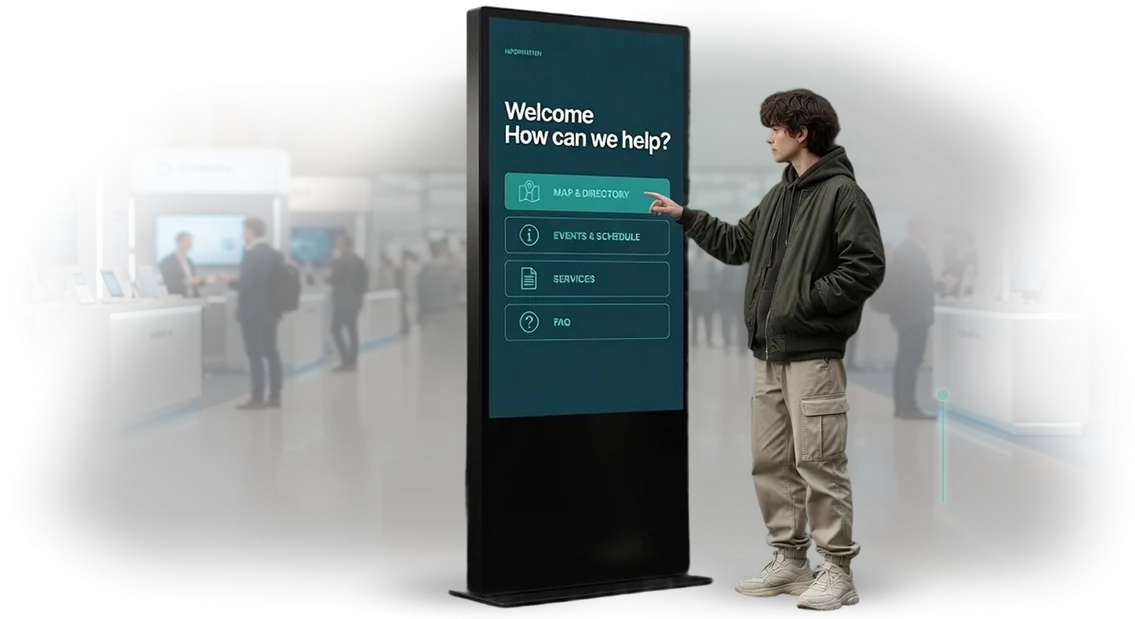
The solution is an interactive map on touchscreen kiosks. It turns a chaotic territory into a clear route: the visitor sees not "the third building after the second," but the exact path to the desired point.
This saves partners' time, speeds up request handling, and shows that the company cares about its guests.
We deliver on this task. We design navigation that works on real industrial territories: concise prompts, clear landmarks, instant search for a building or checkpoint. The result is fewer delays, more partner trust, and confidence for everyone visiting you for the first time.
What touchscreen kiosks will give you and your guests
Guests of an industrial park often get lost among pavilions and service areas — this creates tension and wastes time. Touchscreen kiosks solve the navigation problem: in a couple of touches, a person finds the right point, route, and operating hours.
For the administration, such terminals become an assistant that relieves staff and turns a chaotic flow into a manageable process.
Improved navigation
Instead of paper maps and asking security guards, the guest gets a clear diagram with points of interest. The kiosk builds a short route to a pavilion, café, or meeting room — the visitor wanders less and reaches their destination faster.
This reduces the number of late arrivals to meetings and makes the park territory friendly to newcomers.
Interactive directory
The kiosk replaces an information desk and thick booklets. It contains tenant contacts, event schedules, a list of services, and answers to frequent questions.
The guest finds everything they need independently, and the administration does not have to repeat the same information verbally.
Visit statistics
Each interaction with the kiosk is data: which pavilions are searched most often, when peak load occurs, which services are in demand. Based on these figures, you can plan navigation more intelligently, redistribute flows, and offer tenants clear traffic reports. Statistics help you make decisions, not guess.
Convenience for guests
The terminal works at any time and never gets tired. The guest receives information without queues or waiting — and therefore leaves with a positive impression.
Convenience directly affects loyalty: a person who found everything easily will return and recommend the park to colleagues and partners.
We develop kiosks on professional equipment, adapted for open spaces and intensive use. So you get stable operation from day one and save on maintenance. Implementing such terminals is a step toward modern service that both guests and park management can feel.
Interactive kiosk formats for different enterprise tasks
In an industrial park, everyone needs navigation: guests, employees, delivery services. But their tasks are different — one is looking for a meeting room, another for a warehouse, a third for a pass office.
A universal kiosk performs worse than a properly chosen format: the more precise the scenario, the faster a person gets what they need.
That is why, before installation, we analyze routes and entry points. Then we select the kiosk type accordingly — from a compact touch terminal to a multimedia stand with a map and video instructions. Below are the standard formats that cover the main enterprise tasks.
| Format | For whom | What it gives the client |
|---|---|---|
| Touchscreen terminal | Guests and business partners | Fast search for a facility, route, and travel time — fewer questions at reception, more productive meetings |
| Multimedia kiosk | New employees and contractors | Park map, traffic rules, instructions — quick adaptation without a dedicated attendant |
| Interactive panel | Administration, security, dispatchers | Instant updates on operating hours, events, and emergency situations |
| Floor-standing kiosk with map | Event guests, open days | Flow distribution, no queues or crowds at the entrance |
These are not all possible options: for a non-standard task, we will assemble a hybrid solution. This approach reduces search time on the territory by an average of 30–50% and frees up staff.
The main thing is that an employee or guest does not have to think "where to click," but immediately gets the answer. We handle selection, interface design, integration into the park infrastructure, and post-launch support.
How we implement kiosks: 6 clear steps
For a kiosk to genuinely simplify navigation in an industrial park, rather than just stand in a lobby, you need to go from brief to launch. We have structured the implementation stages so that you understand the result at every step.
-
Brief and territory audit. We gather the tasks: which buildings and companies need to be found, who the main visitors are, where most questions arise. We record the navigation project goals and work deadlines.
-
Navigation project and structure. We design the search logic: categories, map, prompts. You see the structure before kiosk development even starts — no surprises or unnecessary revisions.
-
Design and prototype. We create an interface in your park's style that is understandable to every visitor. We agree on the look and click scenarios so that first use raises no questions.
-
Kiosk development. We assemble the system on professional equipment and configure the software for your tasks. We test all scenarios, from map to company search, so the kiosk works reliably.
-
Installation and on-site setup. We deliver the kiosk, carefully mount it at the chosen location, and connect power and network. We load data on tenants, buildings, and access routes.
-
Launch, training, and support. Together with you, we go through key scenarios, train staff, and hand over instructions. After launch, we stay in touch: we update information and support system operation.
This way you get a working interactive navigation system that reduces staff workload and helps guests quickly find the companies they need. Subsequent updates take minimal time — the database is already configured.
What is included in kiosk delivery and launch
When you order a kiosk from us, you receive a ready-to-use solution — not separate parts, but a fully assembled and tested package. We cover all stages: from equipment delivery and interface development to installation and regular maintenance. All you have to do is turn on the kiosk and start using it.
The standard delivery includes:
- Turnkey touchscreen kiosk — housing and display configured for your space. The equipment is already assembled, tested, and ready to operate on installation day.
- Software — an interactive navigation system with a park map, points of interest, and search by tenant. The interface is adapted for touch control and works without delays or freezes.
- Design and content — screen styling in the brand's visual language, populated with maps, company descriptions, events, and promotional materials. We upload content and update it remotely when needed.
- Installation and setup — placement at the desired point, network connection, screen calibration, and verification of all functions. We do the work at a convenient time, without extended downtime.
- Employee training — a short instruction for administrators: turning on, turning off, loading new content, and resolving common issues. The session takes no more than an hour.
- Warranty and maintenance — parts replacement, software updates, remote diagnostics. If the kiosk breaks down, we arrive and restore operation according to the service procedure.
This package eliminates the need to find different contractors for each part. You work with a single point of responsibility: we ensure the kiosk looks great, operates stably, and benefits park visitors.
We personally oversee every project: before shipment, we coordinate the configuration; after launch, we stay in touch for fine-tuning. As a result, you know exactly what is included in the delivery and do not pay for "surprises" beyond the budget.
Case study: kiosks at the «Yakor» industrial park
A real case of interactive kiosks — navigation implementation at the Yakor industrial park. Before the project, guests got lost among the buildings, and dispatchers answered the same questions 40–50 times a day.
The park's infrastructure was growing, and old signs could no longer handle the visitor flow. We installed touchscreen kiosks at key points: at the entrance, near intersections, and in the waiting area.
The system builds a route to the required building, shows cafés and meeting rooms, and displays tenant contacts.
Project results
One month after launch, the number of requests to staff decreased by 30%, and the average time to find a facility dropped from 12 to 4 minutes. Guests are now less likely to be late for meetings, and administrators handle real questions instead of repeating route explanations.
- Requests to staff — down 30%.
- Average search time — from 12 to 4 minutes.
- Estimated payback — 8 months.
Conclusions for the client
This is not a one-off action but a systematic navigation implementation that scales. Kiosks pay off where there is a visitor flow and remove routine work from live staff. For the management company, operating costs decrease; for tenants, guest loyalty increases.
The interactive kiosks case at the «Yakor» industrial park shows how a properly designed system removes chaos and strengthens the impression of the site. If you have a similar task, let's discuss how to adapt the solution to your buildings and flows.
How to choose the right kiosk format for your facility
Choosing a kiosk format for an industrial site is not a design question but a strategic decision. The same enclosure can be used for territory navigation, access to regulations, or booking negotiations — the key is to correctly determine which tasks it should solve.
Selection criteria begin with usage scenarios. If the kiosk greets visitors and tenants, you need a clear touchscreen with a map, resident lists, and events. If the kiosk serves employees, priority shifts to fast access to internal documents and pass procedures.
Check who will stand at the screen: a guest with a phone in hand, a driver with a pass, an engineer in workwear — this affects the housing height, screen tilt angle, and resistance to dirt.
The second point is industrial park conditions. This is not a warm mall lobby: dust, humidity, and temperature fluctuations are possible. The kiosk must operate stably all year round and not require constant supervision.
Order a protected enclosure — and you will save on repairs and downtime within the first months. If the site experiences severe frost or blazing sun, check the operating temperature range and screen glare protection — this directly affects user comfort.
The third criterion is scalability. In a year, new buildings, shipping zones, or checkpoints may appear — it is important that the software allows updating the map and directories without rebuilding content.
Choose a solution that integrates into the infrastructure: access control systems, meeting room calendars, internal directory. Then the kiosk becomes part of the facility's unified navigation, not an isolated information point.
Finally, assess the total cost of ownership: installation, setup, updates. A properly selected kiosk pays for itself by reducing the load on reception and cutting the time spent searching for a facility.
Compare two or three configurations that differ in display size and housing protection — the price difference is usually several times less than the cost of downtime caused by the wrong enclosure choice.
If you are unsure which format is optimal, send us the site parameters and typical user requests, and we will select a configuration for the specific installation point.
Frequently asked questions about touchscreen kiosks and navigation
A touchscreen kiosk in an industrial park is a working tool, not a luxury item. Before implementation, clients raise the same questions: warranty, maintenance, security, and payback.
If your question is not on the list, our team will provide a personal consultation — just write to us.
What happens if the kiosk breaks down? Is there a warranty?
Yes. We provide an official warranty on equipment and installation. After launch, we stay in touch: scheduled maintenance, remote monitoring. If a problem occurs, we resolve it remotely or visit the site so that navigation is never interrupted.
How long will a kiosk last in a park lobby?
Vandal-resistant enclosures and industrial components are designed for round-the-clock operation. With regular maintenance, the service life is several years. During that time, the device pays for itself and works for the park's image.
Is the kiosk safe for people and for the internal network?
The housing and electrical components meet safety requirements, external corners are rounded, and the structure is impact-resistant. Users only have access to navigation and information sections; service functions are protected from unauthorized access.
Can a kiosk generate revenue, not just cost money?
The kiosk frees staff from repetitive questions and provides an advertising channel: event announcements, tenant promotions. With a flow of several hundred guests per week, the savings quickly recoup the investment.
Order a turnkey interactive kiosk in just 30 days
Leave a request for development — and we will take the project on a turnkey basis from day one. In 30 days, the interactive kiosk will already be working in your industrial park: territory navigation, resident map, reference information for visitors and tenants.
You do not need to understand technical details — we handle the entire cycle: from idea to launch and support.
Ordering a kiosk is simple: you send a request, we calculate the cost and propose a solution tailored to your park's specific tasks. Implementation timelines are fixed in the contract, so you know exactly when you will receive the finished result.
What you get after your inquiry:
- Cost and timeline estimate — within one business day.
- A transparent work plan with clear stages and checkpoints.
- Format selection for an industrial park: number of locations, screen types, usage scenarios.
- Design and content approval before production begins — no surprises at launch.
- Manufacturing, delivery, and installation of equipment by our team.
- Kiosk content: maps, resident lists, event schedule, useful information for visitors.
- Training for your staff and technical support after launch.
Every stage is assigned to a dedicated project manager. They answer questions, monitor deadlines, and keep you informed — you always know what is happening with the project.
Do not postpone improving navigation in your park. Leave a request for development — tomorrow you will receive a cost estimate, and in a month the kiosk will start working for your clients and guests.