

Why Visitors Get Lost in an Art Gallery
Visitors come to a gallery for an experience, but instead end up spending time searching for the right hall. When an exhibition is large and signage is scarce, guests lose their way, miss key exhibits, and leave before the main attraction — with a sense of dissatisfaction.
This loss of visitors directly damages the reputation: a disappointed person is less likely to return and less likely to recommend the gallery to friends.
Traditional navigation — signs and paper maps — stops working precisely where the exhibition is complex and multi-level. A visitor stops at the entrance, tries to get their bearings, makes a few extra laps, and ends up tired before even reaching the central painting.
This is not just a ruined impression of the exhibition, but also wasted time that the guest could have spent with the artworks.
The problem is not that people are inattentive, but that navigation does not account for the logic of how a real person moves through a space.
In a gallery, it is important not just to show a direction, but to build a path that leads from one significant work to another, allows for a pause, and ensures nothing important is missed.
When the route is clear from the very first step, the visitor feels confident and fully immerses themselves in the art.
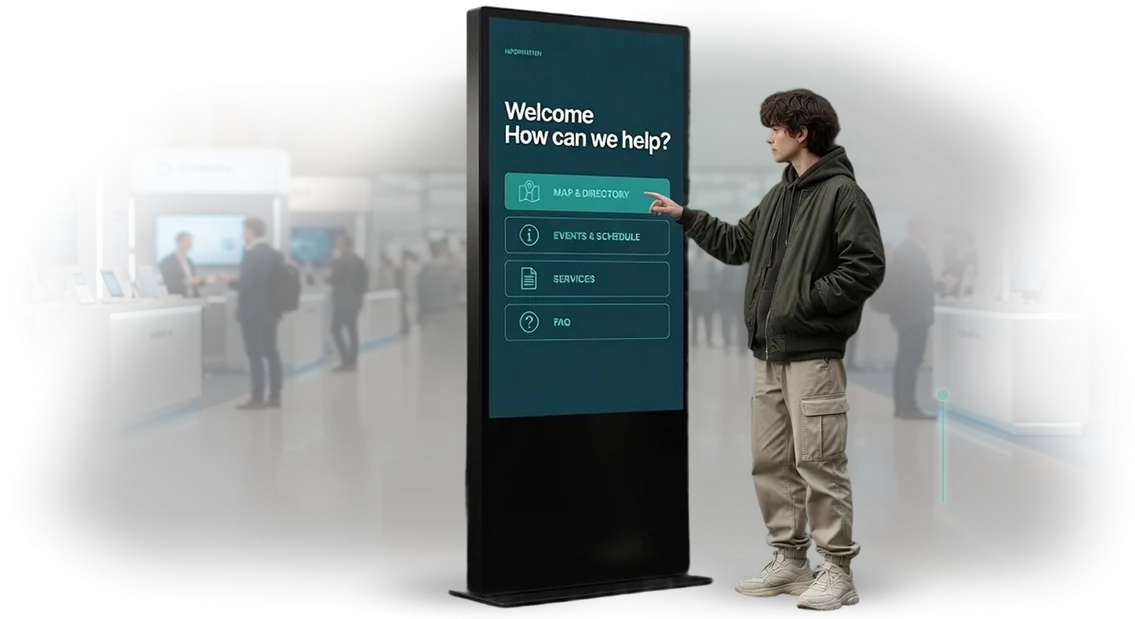
We solve this problem with interactive information kiosks. They help visitors choose a hall, plan a route, and learn more about the artworks — without fuss or unnecessary questions.
As a result, guests reach the main exhibit, and the impression of the exhibition becomes cohesive and positive.
What Tasks an Interactive Kiosk Solves
Visitors to an art gallery come for impressions, but often walk past masterpieces without stopping. Name plaques do not reveal the concept behind a work, and a guide cannot be at every painting.
An interactive kiosk solves this problem: visitors choose their own scenario, immerse themselves in the story, and stay longer. We build such systems and see three key benefits for a gallery.
Engagement: Visitors Stay at the Exhibits
The touchscreen displays paintings in detail, shares interesting facts, and offers thematic selections. Guests explore the work more deeply, share their impressions, and return to favorite artworks.
As a result, time spent at a single exhibit increases severalfold, and the impression of the visit becomes more intense.
Recognition: The Gallery Brand Is Remembered
The kiosk interface is designed in the gallery's brand style — from fonts to colors. Such a kiosk itself becomes an art object that visitors photograph and post on social media. This is natural reach and growing recognition without an advertising budget.
Analytics: Leads for Future Exhibitions
The kiosk collects anonymized statistics: which exhibits are popular, how much time visitors spend at the screens. Based on this data, the gallery plans exhibitions and the placement of artworks.
And the subscription form turns visitor interest into a contact for invitations — in other words, into a ready-made lead.
Kiosk Formats for an Art Gallery: What to Choose
The choice of format depends on the task: a kiosk for a permanent exhibition and one for a temporary exhibition solve different business challenges.
For a permanent exhibition, reliability, integration into the space, and a long service life matter; for a temporary one — mobility, speed of deployment, and the ability to restructure the display logic an hour before opening.
The main criterion is not the "enclosure design," but how the kiosk participates in the life of the gallery. At a permanent exhibition, it becomes part of the route: visitors return to it for artist information, hall maps, and audio guides.
At a temporary exhibition, the kiosk is a quick way to engage the flow of people, give them context, and nudge them toward souvenirs or subscriptions.
| Format | What tasks it serves | What it gives the gallery |
|---|---|---|
| Freestanding kiosk | Permanent exhibition, lobby, area near the ticket office | Stable navigation through halls, schedule, audio guide, reduced staff workload |
| Wall-mounted kiosk | Compact spaces, narrow corridors, next to an exhibit | Additional materials about the artwork, engagement without taking up valuable floor space |
| Mobile stand | Temporary exhibitions, off-site projects, festivals | Quick deployment and dismantling, easy content replacement for each exhibition |
| Transformer kiosk | Mixed scenarios: permanent base + replaceable modules | One enclosure, multiple formats — budget savings and flexibility |
If the gallery frequently changes exhibitions, go with a mobile format with a touchscreen on a stand: it can be moved between halls in 15 minutes, and content is updated through an admin panel without calling in a contractor.
For a permanent collection, a stationary kiosk with a protected enclosure is more effective — it runs daily without failures and does not require constant staff attention.
We have already built such solutions for museums and art spaces: we will help you choose the format for your layout, budget, and exhibition schedule, then assemble and configure the content.
Describe your gallery's tasks — we will propose a solution that pays off through increased attendance and visitor convenience.
How Implementation Works: From Brief to Launch
We understand how important it is to feel in control of a project and to know what is happening at every stage. That is why our implementation process is as transparent as possible: you always know what stage the project is at and when it will be completed.
-
Brief and task audit. We discuss the goals of installing the kiosks, the specifics of your space, and visitor behavior. Based on this, we create a technical specification that locks in timelines and budget.
-
Design concept and prototype. We create a visual interface style that harmonizes with the gallery's exhibition. At this stage, you see what the screen will look like and can make edits before development begins.
-
Layout approval. We finalize all screens and navigation scenarios. You get a complete picture of the future interface before it is even built.
-
Development and kiosk assembly. We prepare the hardware and software. In parallel, we assemble the enclosure — it can be styled to match the gallery so it does not disrupt the overall aesthetic.
-
Testing on real scenarios. We check how the system behaves under high load, how quickly it responds to touch, and whether it correctly displays information about halls and artworks. Any issues are fixed before launch.
-
Launch and staff training. We install the kiosks on site and configure them for your network and power supply. We conduct a short briefing for administrators and attendants so they can assist visitors.
After launch, we stay in touch: we update content, add new halls, and monitor stability. You do not need to worry about the technical side — you simply get a working tool that improves navigation convenience and the overall visit experience.
What Is Included in the Delivery: The Launch Kit
When you order an interactive kiosk for an art gallery, you get not just a device, but a ready-to-work tool. The package includes everything needed — from equipment to staff training and warranty obligations.
This eliminates the typical project problem where the client is left alone with a raw product after installation.
- Kiosk delivery — a professional touchscreen with a protected enclosure suitable for high-traffic halls. We deliver, install, and connect it to the power supply — you do not need to deal with contractors.
- Navigation interface — large buttons that are clear even to those seeing a touchscreen for the first time. A guest finds the right hall, painting, or event in a couple of taps, and there are no more lines of confused people at the ticket office or in the lobby.
- Ready-made content — gallery maps, exhibit descriptions, hints, and wayfinding indicators. The interface design is customized to the museum's brand style, so the kiosk looks like part of the space rather than a random technical device.
- Staff training — a short practical session for your employees: how to update information, add new exhibits, and handle common guest questions. No need to hire an admin for every small task.
- Warranty and support — official warranty obligations on the equipment and interface. In case of a failure, you contact the support service, and we help remotely or promptly dispatch a technician on site.
Additionally, we can configure visit statistics export or automatic updates of the events schedule — this is useful for reports and exhibition planning.
All details are agreed before installation so that the kiosk is up and running on launch day and immediately delivers value to visitors and your team.
Example Project: Navigation in an Exhibition Space
For a regional venue with a permanent collection and temporary exhibitions, we developed an interactive navigation system.
Before the project, visitors got lost in the transitions between halls, missed key works, and often returned to the administrator's desk to confirm their route. This created queues and increased the burden on staff.
We installed touchscreen kiosks at the entrance and at route intersections.
The screen showed a map with convenient options: "entire exhibition in 1 hour," "only masterpieces," "route by genre." The system offered short descriptions, and visitors could see their path from hall to hall without staff assistance.
The result changed guest behavior. The average route expanded: the number of halls visited grew by 40%, and the time spent in the gallery increased from 45 to 70 minutes. Meanwhile, the share of visits where guests asked staff for navigation help more than halved.
| Metric | Before | After |
|---|---|---|
| Halls visited per visit | 6 out of 12 | 9 out of 12 |
| Average time in the gallery | 45 minutes | 70 minutes |
| Staff navigation requests | every 3rd visit | every 7th visit |
The system paid off not only in numbers. Staff were able to focus on engaging with guests and selling tickets to additional exhibitions, while visitors got an independent and clear scenario.
The gallery ordered the second phase — navigation for temporary exhibitions — within two months of launch.
Common Concerns Before Launching a Kiosk
Clients often postpone launching a kiosk because of three fears: the technology will fail in the middle of an exhibition, visitors will not understand the touchscreen, and the content will become outdated within a month. These are normal concerns — we hear them at every briefing.
We have been building interactive systems for galleries and museums for over ten years, so we build solutions to these issues into the project from the start.
We use professional equipment, test kiosks before opening, design interfaces suitable for any age, and content can be updated without developers.
Below are answers to common concerns.
What if the kiosk breaks down?
Breakdowns are rare: reliable industrial components and overheating protection. We provide a warranty and stay in touch throughout the exhibition — we can connect remotely and help.
How do we update content?
Through a convenient admin panel. Your staff can change painting descriptions, add audio guides and images on their own — no special knowledge required.
Will older visitors manage?
Yes. Large buttons, clear hints, and hall logic. Before launch, we test on real visitors and remove anything unintuitive.
Who will train the staff?
We conduct a short training session and prepare a reference guide. We also support the launch for the first period so the team feels confident.
As you can see, the main fears are resolved at the design stage. Below, we answer other common questions.How to Choose a Format for Your Exhibition's Goals?
The choice of format starts not with design, but with answering the question of what a visitor to an art gallery should do at the kiosk. If the task is to quickly navigate the halls and find a specific artist, a compact floor stand in the lobby will work.
If the visitor should spend time studying the history of a painting or an artist's biography, a wall-mounted screen deeper in the exhibition offers more possibilities.
Pay attention to traffic and layout. At the entrance and in narrow corridors, the kiosk operates under constant load — stability and uninterrupted performance throughout the day are essential.
In individual halls with lower foot traffic, you can install larger formats with bigger screens: they attract attention and create a sense of immersion.
The third practical question is how often content changes. Temporary exhibitions and collection rotations require content to be updated quickly and without involving a programmer.
Clarify who will upload new descriptions — this determines how simple and user-friendly the management system needs to be.
Finally, think about a measurable result. Guests will ask attendants for directions less often, and queues at the ticket office for information will shorten. A format chosen for your exhibition's goals pays off through reduced staff workload and increased visitor satisfaction.
To make sure the choice does not turn into guesswork, we visit the venue and, based on the visitor flow scenario, propose a specific configuration — taking into account lighting, power outlets, and spots where the kiosk will not interfere with viewing. This way, you get not just a device, but a tool that works for the goals of a specific exhibition.
Launch the Kiosk and See the Results at Your Next Exhibition
Launching interactive navigation by the opening of an exhibition is realistic if you follow a clear plan. We do not start development "in the air" — first we lock in your date and goals, then build a timeline where every stage moves toward a finished result.
How the work goes from request to launch:
- Request. You submit a request for a solution quote — we get in touch within one business day, confirm the exhibition opening date, and discuss the specifics of the halls.
- Solution quote. We prepare a proposal: list of navigation points, hall map structure, visual style, required equipment, and timelines. You receive a document and can approve or adjust the plan.
- Project launch. After approval, we finalize the calendar plan, assign a manager, and grant access to the layouts. You always see what stage the work is at.
- Production and content. We develop the touchscreen interface, gather information about the exhibits, write audio guides, and prepare content for your collection. In parallel, we prepare print layouts if the gallery needs additional signage.
- Testing. We test the kiosks on actual hardware, fix any issues, adapt the interface to the screen size, and train the staff. This removes the risk of failures on opening day.
- Launch and result. Kiosk installation, final screen configuration, audio guide verification — and on opening day, visitors are already using the navigation. You receive a certificate of completed work and instructions for staff.
As a result, the gallery gets a system that reduces the burden on attendants, saves visitors' time, and makes the exhibition more convenient. And you get peace of mind: everything is launched by the date you planned for.
Submit a request for a solution quote, and within a day you will know the cost and the exact project launch timeline.