

Guests Get Lost in the Congress Center — You Lose Revenue
In a large congress center, guests get lost — and that's not just an inconvenience, it's a direct loss of revenue. Confusing navigation makes visitors wander through corridors, arrive late to business sessions, and miss the booths of key exhibitors.
Lost guests engage less with the program, interact less with other attendees, and are less likely to return for the next event.
Poor navigation in a congress center hurts everyone: organizers get negative feedback, exhibitors see lower foot traffic, and sponsors question the effectiveness of their investment.
Every lost visitor means not only their frustration, but also missed connections, unsold booths, and lost contracts. The cause is almost always the same — the guest doesn't understand where to go and what awaits them next.
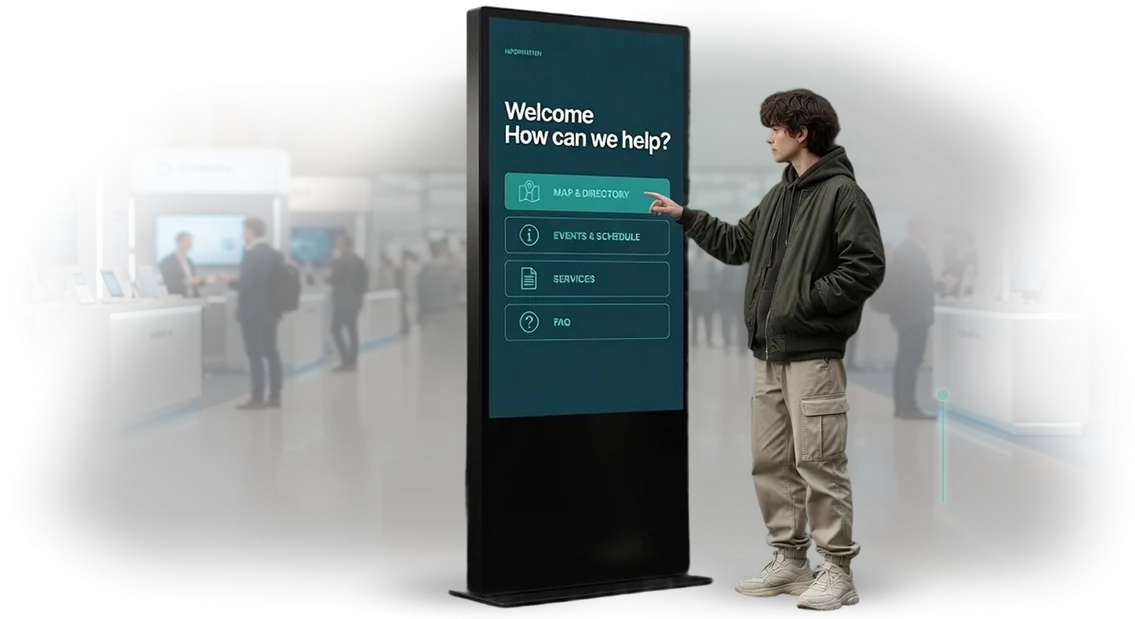
The solution is interactive navigation kiosks that turn chaos into a clear path. In just a couple of touches, a visitor gets a route to the right booth, meeting room, or dining area, sees the travel time and key landmarks.
Everyone is already familiar with this format: a person simply enters their destination — and moves confidently, without stress or unnecessary questions.
We develop a congress center navigation system that addresses this pain point: kiosks appear at key locations, help guests find their way, and relieve staff of repetitive questions. The organizer gets satisfied attendees, less chaos, and more time to grow the event.
Most importantly — visitors reach what they came for without getting lost and take away exactly the impression you planned.
What Interactive Navigation Gives Visitors and Organizers
A congress center guest comes for the business program but spends time searching for the right hall, elevator, or registration desk. The frustration of wandering cancels out the impression from the presentations and reduces the desire to return for the next event.
An interactive kiosk solves this problem: with a few touches, the visitor maps a route to the right room, checks the schedule, and finds interesting booths. As a result, the guest doesn't miss sessions, gets less tired, and leaves with a positive impression of the venue itself.
For the organizer, navigation becomes a tool for managing audience attention. The kiosk can be customized for a specific event: put sponsors on the main screen, offer the visitor a chance to download presentation abstracts, or leave a contact for receiving materials.
This turns navigation from technical equipment into a channel for lead collection and partner promotion.
Every screen touch is recorded — you see which parts of the program are in demand and where crowding occurs, so you can quickly relieve congestion in certain zones and improve the scenario of future events.
The brand benefits too. A stylish touch kiosk with the venue's logo highlights the congress center's technological edge and stays in guests' memory.
When a visitor sees polished navigation, they unconsciously transfer that quality to the entire business center — that's how loyalty is born and recognition grows.
We know these tasks from the inside, so we build our solution around real guest scenarios: from a short route "from the parking lot to the hall" to an extended meeting program.
Our kiosks run on professional equipment with stable screen response, and we design the interface so that people of any age and skill level can use it.
In the end, you get calm, predictable navigation for thousands of attendees and clear analytics for the organizing team.
Guests ask staff fewer questions, find the right sessions faster, and are more willing to leave their contacts — which means the event runs more efficiently and brings them back again and again.
Interactive Kiosk Formats for a Congress Center
Congress center visitors arrive with different tasks: finding the right hall, registering for a session, or orienting themselves in the program.
If a kiosk is in the wrong place or is inconvenient to use, the guest loses time and turns to staff — that means extra queues and a heavier load on administrators. The right kiosk format solves these problems before they arise.
We select a solution based on the building's layout and the logic of foot traffic: floor-standing kiosks, wall-mounted panels, and touch counters.
Each option plays its role, and in complex projects, formats can be combined — for example, a wall-mounted kiosk in an elevator lobby and a floor-standing one in the central atrium.
| Format | For Whom | What It Gives the Client |
|---|---|---|
| Floor-standing kiosk | Lobbies, waiting areas, entrance zones | Stands out prominently and directs visitor flows, withstands heavy touch volume |
| Wall-mounted kiosk | Narrow corridors, elevator lobbies | Saves space and fits where a floor unit cannot be placed |
| Touch counter | Registration, badge distribution, welcome area | Convenient when working with a consultant, helps check in a guest quickly |
We can also offer mobile tablets for buffet zones and outdoor events — they work on the same logic but aren't tied to a single location.
The choice of format depends on the scenario in each specific area. We help determine where to place a floor-standing kiosk, where a wall-mounted one, and where a touch counter is enough, and we design the interface so that a guest finds the answer in 10–15 seconds. This reduces the number of questions to staff and improves the overall impression of the event.
Stages of Developing and Launching a Navigation System
A navigation system for a congress center needs to go live quickly and without surprises. That's why the development stages form a clear path: from brief to installation and support. You are involved at every step and get a result that matches your expectations.
-
Brief and task analysis. We study the layout, visitor flows, and the zones where kiosks will be most useful. We pin down the goals — so the system solves exactly your tasks.
-
Concept and navigation logic. We design the interface structure: map, search, events. We think through guest scenarios — from "where is my meeting room" to "what's happening at the congress center today."
-
Approval of layouts and content. You approve the design, texts, and style. We make changes before production — nothing is redone after installation.
-
Kiosk production and preparation. We build the enclosures, touch panels, and software. Kiosk deployment follows a schedule agreed with you.
-
Touch panel installation. We install the equipment at the chosen points, set up the connection to the server, and check the mounts. Installation doesn't disrupt the center's operations.
-
Commissioning and launch. We test the kiosks under real load and run through guest scenarios. We train the administrators — they'll be able to manage the system on their own.
-
Support and development. We update information, add new tenants, change events. The system stays current and works for years.
What's Included in the Interactive Kiosk Delivery
Congress center guests value their time: they need to quickly find a hall, registration desk, or meeting room. Without clear signage, visitors get lost and miss sessions, while administrators answer the same questions instead of doing their work. Interactive kiosks solve this — but only if the delivery is complete, from devices to floor plans.
We supply a turnkey navigation system. You get a ready-made package with the specifics of your space and guest movement scenarios already taken into account.
No searching for subcontractors on your own, no back-and-forth coordination between programmers and designers — one party responsible for the result.
The delivery package includes:
- Touch equipment: a durable enclosure, a screen protected against scratches and impacts, rated for round-the-clock operation.
- Software: an intuitive interface with a map, search by halls and events, understandable to any guest.
- Navigation layouts: floor plans and signage in your brand style, pre-adapted to typical event scenarios.
- Installation and setup: mounting, connection, and testing of all kiosks before the event starts.
- Technical documentation: instructions for staff on powering on, updating content, and preventive maintenance.
- Warranty and support: maintenance, equipment replacement, and consultations — you're never left alone with the hardware.
With this package, you don't just get devices — you get a working navigation system that's easy to update for new formats. All the details are already coordinated with each other, so the kiosks start delivering value from the moment they're installed.
Case Study: How We Doubled Navigation Speed
For Forum Congress Center, we built an interactive navigation system for three parallel conference tracks. Before, attendees took up to 8 minutes to find the right hall, and organizers answered dozens of identical questions every day.
We installed 12 touch kiosks in the halls and at route intersections and synchronized them with the schedule.
The interface shows the route on a single screen: from the current point to the target room, taking into account elevators, stairs, and the time before the session starts. No paper maps and no queues at the information desk.
Implementation Results
Navigation speed doubled: on average, a visitor found the hall in 4 minutes instead of 8. Late arrivals to session starts dropped by 60%, and the number of questions to organizers fell threefold.
The center's team stopped spending time on repeated explanations and focused on the substantive part of the event.
Why It Worked
The kiosks are placed at decision points, and schedule data updates automatically. Guests see current information even if a session was moved or a speaker replaced.
For us, this is standard practice — we design scenarios around real people flows, not "install screens for the sake of screens."
After the successful launch, the client came back with a follow-up order for mobile navigation for attendees. We didn't get a thank-you note — we got a new project, and that's the best measure of results.
How to Choose the Right Kiosk Format for Your Task?
Choosing a kiosk format always starts not with the device model but with the tasks of the specific venue. In a congress center, several flows operate at once: attendees look for halls, speakers, coffee-break zones, and exhibition booths.
So first you should determine which questions visitors will ask most often and how many people will approach the kiosk during peak moments — for example, before sessions begin or during breaks.
For large congress venues with many parallel halls and high foot traffic, floor-standing kiosks with a large screen and a convenient building map are optimal.
Such solutions make it possible to build a route to the required hall, show the speaker schedule, and display real-time updates — this reduces the load on the registration desk and cuts the number of late arrivals to sessions.
For lobbies, meeting areas, or smaller exhibition spaces, compact wall-mounted or tabletop kiosks are a better fit. They take up minimal space and quickly provide targeted information: a schedule, a map of a specific floor, or a list of speakers.
This format works well when a visitor doesn't need to build a complex route but just needs a quick reference.
When choosing, it's important to consider how often the information will be updated and who will manage the content. If the schedule changes every day and remote access is needed, it's better to choose a kiosk with a simple admin panel.
Resistance to load also matters — the equipment must run without failures for the entire event, and the interface must stay clear for people of any age.
We match the format to the tasks of your specific congress center: we analyze typical guest routes, peak loads, and usage scenarios.
Then we propose a solution that closes the main goal — so that a visitor quickly finds their destination and the organizer saves staff time and improves overall navigation efficiency.
Answers to Frequently Asked Questions About Touch Kiosks
Before a project launches, clients most often ask not about functionality but about reliability: what will happen to the kiosk in a year, who services it, and how quickly will we respond if the hardware fails on the day of the event.
These are the right questions — the answers determine whether one broken panel could derail your congress or forum.
We provide a warranty and structure our service so that the kiosks work exactly when you need them. Below are answers to the three main questions we hear from venue organizers.
What warranty is provided on touch kiosks?
We provide a warranty on the equipment and installation for a term of one year or more. If a fault occurs during this period due to our fault, we'll fix it at our expense, including the engineer's visit and replacement parts.
Who services the touch panels after launch?
We take maintenance on ourselves: content updates, preventive care of screens and enclosures, and software monitoring. You don't need to look for a subcontractor — one party is responsible for keeping the kiosks always operational.
What should we do if a kiosk breaks down during an event?
We have a response procedure: remote diagnostics and, if necessary, an engineer's visit on the day of the request.
This is especially important for congress centers — we understand that an event won't wait, and we do everything possible to get the panel back up and running before sessions start.
You get not just interactive stations, but predictable performance for the entire duration of the project. If you have any remaining questions about warranty or maintenance, just ask — we'll respond within one business day.Order Custom Interactive Kiosks for Your Venue
In a congress center, every minute of a guest's time counts: they search for the right hall, miss presentations, waste time, and get frustrated. Staff are constantly distracted by "how do I get there" questions when they should be focused on the program.
Interactive kiosks solve this right away: visitors find their own routes, see the schedule, and learn about sponsors and partners.
To order kiosks for your venue, simply leave a request on the website. We'll calculate the cost based on the building's size, the number of zones, and your tasks, provide a consultation on navigation, and advise on how to save on implementation. You'll get a ready-made solution, not an abstract proposal.
After you contact us, you receive:
- An individual cost estimate — a quote with no hidden fees or unnecessary line items.
- A navigation consultation: which points to place, which routes matter most, how to connect the kiosks to the schedule.
- A demonstration of the solution on your scenarios — you'll see how guests will find a hall, a speaker, or an exit.
- A clear implementation plan with stages and timelines — from installation to launch.
- Staff training and materials for a quick start.
- A warranty and technical support after launch — the kiosks keep working while you focus on the event program.
After you contact us, you're never left alone with the problem: we handle the estimates, approvals, and launch. Show us your congress center floor plan — and get a first navigation draft as early as the consultation stage.
Order your kiosks today — and in a couple of weeks, visitors will be finding the right halls in seconds instead of getting lost in the corridors. Leave a request to calculate the cost and get a demonstration — it comes with no obligation.