

Laboratory without navigation — visitors and employees lose time
A modern laboratory is dozens of rooms, waiting areas, and technical spaces. Without clear navigation, even a prepared visitor spends 10–15 minutes looking for the right room.
Employees constantly get distracted by questions like "where is your analyzer?", and room utilization drops because clients show up late.
Lost time is the main hidden expense that never shows up in reports. Every person who arrives late for an appointment shifts the schedule and creates a queue. For the laboratory, that means lower throughput and tension in communication with patients or partners. For the visitor, it's frustration and a desire to pick a different organization next time.
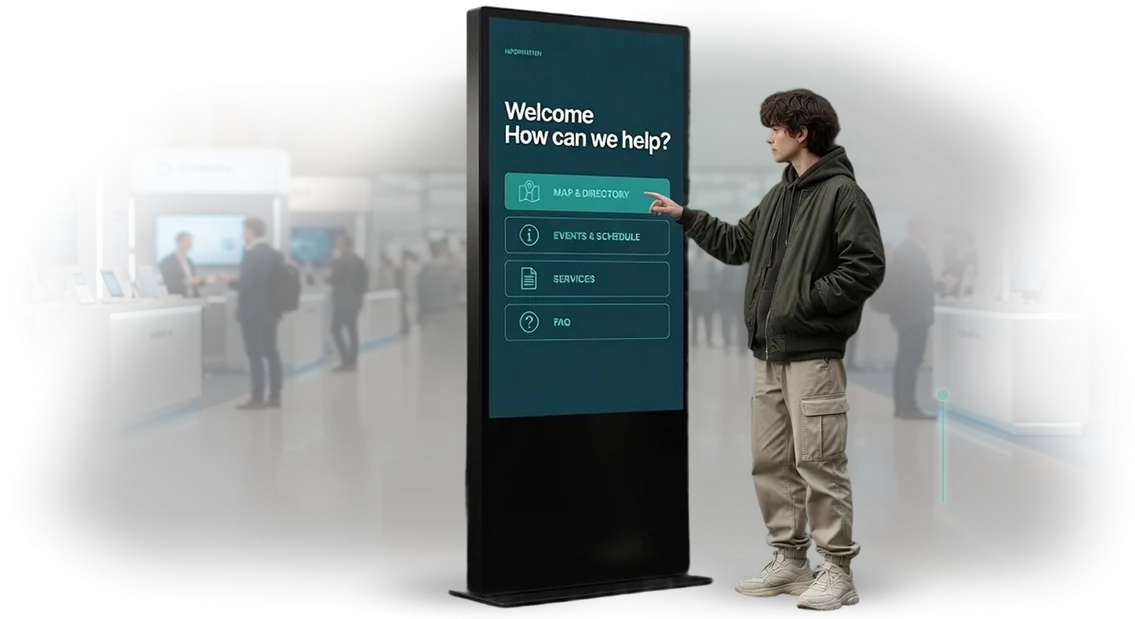
Interactive kiosks solve this problem before the person even talks to the staff. Guests independently find the room they need and see the route and waiting areas on screen.
Information stands placed in the lobby and on each floor take over routine questions like "where do I go" and "who is on duty."
We address this need as a whole: we design navigation logic around a specific laboratory's floor plan and place kiosks where they are actually needed. Visitors stop wasting time, staff focus on their work, and management sees order in foot traffic and growing satisfaction.
What an interactive kiosk gives your laboratory
Laboratory visitors — patients, partners, inspectors — often get lost in corridors and waste time looking for the right room. Questions like "where's biochemistry?" repeat dozens of times a day and distract administrators.
An interactive kiosk eliminates this problem: it provides directions on its own and takes routine load off the staff.
The first and biggest benefit is fast navigation. A visitor selects the room or type of test on the screen and immediately gets a clear route. The search takes minutes instead of tens of minutes of wandering, so there are fewer late arrivals and less frustration at the door.
Second, it saves employee time. Administrators no longer have to explain directions ten times a day or answer the same questions. The freed-up minutes go to paperwork, calls, and visitor care — not to repeating routes.
Third, it gives the laboratory a modern image. A touch kiosk instantly signals the level of service and care for people. It impresses patients and business partners, and it shows that the laboratory keeps up with the times and values other people's time.
Fourth, information is always current. Working hours, schedule changes, and room moves are updated directly on the screen in a couple of minutes, without reprinting signs and paper maps.
The kiosk eliminates the situation where the door says one schedule and the website says another — saving time every day for both visitors and staff.
Formats of interactive kiosks for different laboratories
Every laboratory has its own visitor flow, floor area, and goals: one needs a permanent directory at the entrance, another needs routes to a specific room, and a third needs a mobile assistant for an open house.
That's why the interactive kiosk format is chosen for a specific situation — not the other way around.
Three working formats
| Format | Who it suits | What task it solves |
|---|---|---|
| Wall-mounted kiosk | A laboratory with a fixed reception desk or waiting area | Saves space, always in sight, works as an electronic schedule and navigator for visitors. |
| Floor-standing kiosk | Spacious halls, lobbies, high-traffic zones | Attracts attention, maps routes across floors, and relieves the administrator during heavy flow. |
| Portable kiosk | Mobile teams, exhibitions, open houses, off-site testing | Quickly sets up in any space and runs autonomously — no rewiring or permanent power needed. |
Laboratories often combine formats: wall-mounted for daily navigation, portable for off-site events and campaigns. In that case, data is synchronized and visitors see up-to-date information anywhere.
We work with professional touch equipment in protected housings — the kiosk keeps operating even in laboratory environments with temperature swings and contact with cleaning agents.
You don't need to worry about the technical side: we select the format, build the enclosure, configure the software, and support the system after launch.
How an interactive kiosk project is developed
Ordering an interactive kiosk is not buying a ready-made device — it's a compact project with its own logic and stages. We break it into transparent steps so you always know what's happening and what you're responsible for.
Every stage ends with an approval — you control the timeline, scope of work, and the final result. This approach rules out surprises and lets you see in advance how the kiosk will work in your laboratory.
-
Brief and discovery. We meet or call, study the laboratory's tasks, visitor flows, and usage scenarios. We capture the requirements in a document — that's the foundation of the whole project and our reference at every next step.
-
Concept and navigation. We propose a section structure and screen logic that guide the user to the right information. We approve the scheme together — you see how the kiosk will behave in a real situation and can adjust it before development begins.
-
Design and content. We create an interface in the laboratory's style and prepare texts and graphics. We show mockups — you make edits before the technical work starts, so the result matches your expectations.
-
Technical implementation. We configure the software on professional equipment and test every usage scenario. We stress-test for load and abnormal situations so the kiosk runs stably during peak hours.
-
Kiosk launch. We install the kiosk in the laboratory, connect it, and tailor it to the specifics of the space. We train the staff — they can use the kiosk and help visitors from day one.
-
Support and updates. We regularly check performance, update content, and add new sections. We're available during business hours — if anything comes up, we respond quickly and make changes remotely.
What is included in the interactive kiosk package
When you order an interactive kiosk, you don't just get a touch panel — you get a complete turnkey solution. Everything from hardware to instructions is already set up and working: all you have to do is turn it on and use it.
The standard package includes:
- Kiosk hardware — a robust enclosure, touchscreen, and protected components built for 24/7 operation in a public space. The equipment is selected to minimize downtime and failures.
- Software — an interactive navigation system for the laboratory: floor maps, search by test names, directions to the right rooms, and information about specialists. The whole interface is understandable from the very first screen.
- Design — the kiosk's look and screens are developed in the laboratory's brand style, so the equipment blends into the interior and strengthens brand recognition.
- Installation and setup — our specialists deliver the kiosk, install it in the right place, connect it to power and the internet, and load current data on branches and services.
- Instructions and training — you get clear staff guides and a reference card for quickly replacing informational materials. Employees can update content without calling in technicians.
- Warranty and service maintenance — all hardware and software is covered by an official warranty. During the warranty period we fix issues free of charge and provide remote consultations when needed.
This package removes the need to find separate contractors — one team handles hardware, software, and installation. You know exactly what you'll get: a working kiosk by the agreed deadline, and if anything needs adjusting, a single message to our support is enough.
Case study: navigation in a scientific laboratory
The client was a research center with a heavy flow of guests: interns, partners, delegations. Before navigation was introduced, visitors got lost in the corridors and constantly pulled staff aside with "where is..." questions.
The administrator had to give building tours several times a day, and queues piled up outside the labs.
We proposed solving the problem with interactive touch kiosks. After a short brief, our team built a clear building map with search by department name, employee surname, and room type.
The system automatically maps a route from the kiosk's current position to the right door — with floors, room numbers, and landmarks. The interface was made bilingual, so both Russian-speaking guests and foreign delegations could use it comfortably.
The rollout took three weeks: from approving the building scheme to installation and testing. In the very first month, 70% of visitors used the kiosk instead of asking staff. The average time to find the right room dropped fourfold — from ten minutes to two and a half.
The administrator's workload fell so much that he gained time for processing requests and record keeping.
The laboratory management also appreciated that the kiosks fit into the lobby interior and needed no constant maintenance: data is updated remotely and technical support works online. Six months later, the client came back asking for additional navigation points in a new wing.
This example shows: interactive navigation is not just a "screen with a map" — it's a working tool that saves people's time and reduces the load on staff. For a laboratory, that means an organized visitor flow and more uninterrupted work for the team.
How to choose the right kiosk format?
When the question "what kiosk does our laboratory need" comes up, it's easy to get lost in catalogs and specs.
But the choice really comes down not to screen size or casing, but to the tasks the kiosk must solve: registering visitors for tests, issuing results, showing the room layout, or accepting payments. That's what determines which format is sufficient — and what you shouldn't overpay for.
The first question to ask yourself: where will the kiosk be placed and who will use it? If it's a small laboratory with a reception desk where an administrator is always nearby, a compact touch stand with a basic "selected a service — viewed the info" flow is enough.
If the space is large, peak hours create queues, and clients arrive without appointments — you need a full navigation terminal with a map, queue statuses, and self-service registration. The less staff involvement you want, the more functional the kiosk should be.
The second criterion is the volume of information and how often it changes. Laboratories need prices, promotions, and turnaround times to update quickly, without calling an engineer.
If content changes several times a week, pick a format with a simple admin panel and remote management. If the information is static and rarely changes, you can save on the software side and take a simple standalone solution. That's direct budget savings without losing value.
Finally, think about the use case a year from now. Visitor flow grows, the service list expands, and a second floor or branch may appear. The universal rule: choose a format that can scale — adding screens, integration with the laboratory system, an online appointment module.
That way your current purchase won't turn into a full replacement later. We help clients go from "what do we pick" to a working kiosk that pays for itself by relieving staff and improving service.
The key is not to take the "most powerful" one and not to take the "cheapest" one, but to choose the level that fits your real task.
Frequently asked questions about interactive kiosks
Clients often ask the same things before launching kiosks: is it hard to install, how long does implementation take, what happens if it breaks, how do we change information.
Here are the answers to the main concerns, based on our experience with laboratory and research center projects.
Is it hard to install the kiosk?
No. We handle installation, setup, and connection. The kiosk is ready to work on launch day — you just need a power outlet and Wi-Fi.
How long does implementation take?
A typical project takes 1–2 weeks: from approving mockups to delivery. If the content is already prepared, the kiosk goes live even faster.
What happens if the kiosk breaks down?
We provide service maintenance and warranty repairs. If a fault occurs, we quickly restore operation and supply a replacement kiosk while repairs are under way — navigation never sits idle.
How do we update information on the kiosk?
Through a simple control panel. A laboratory staff member updates schedules, instructions, and contacts on their own, with no programmer needed — changes appear immediately.
Order an interactive kiosk today
Laboratory visitors often waste time finding the right room or don't understand how to submit samples. Staff get distracted by the same repeated questions, and that affects the testing schedule.
An interactive kiosk solves this: it handles typical requests, shows routes and rules, and unloads administrators.
You don't need a technical specification to order a kiosk. Just leave a request on the website — we'll consult with you, analyze your laboratory's tasks, and suggest the right format. Right after ordering, you'll receive:
- A consultation with an integration engineer on equipment selection for your budget.
- An individual cost and timeline calculation — no hidden fees or forced options.
- Recommendations on kiosk placement and content: maps, instructions, directories.
- A work plan with stages and dates — you'll know exactly when the kiosk starts operating.
- A test interface scenario that can be approved before production begins.
- Staff training and a trial run before the final handover.
It's better to start now: preparation for the academic season, planned renovations, or opening a new department is the perfect time to embed a kiosk into your infrastructure. The sooner we receive the brief, the sooner you'll see the result. And if you're in a hurry, we offer an accelerated turnkey delivery format.
Leave a request — and today we'll send you a short briefing questionnaire and propose a time for a video call. You'll get concrete solution options without any pressure and understand how the kiosk will pay off in your laboratory.