

Why Passengers Get Lost in the Port and Switch to Competitors
Passengers get lost in the port not because of inattention, but because of chaotic navigation: scattered information stands, long walkways, signs that appear too late.
A person who is running late for a departure experiences stress and remembers the port as an inconvenient place they don't want to return to.
Losing passengers means a direct loss of revenue. A disappointed guest doesn't just switch to competitors — they leave negative reviews that scare off other travelers.
In the end, both profit and reputation suffer, even though the cause is often the same: poor navigation in the port.
Port navigation is not just arrows on the floor. It's a system that should guide a person from the entrance to boarding without a single question.
When such a system doesn't exist, passengers spend an extra 20–30 minutes searching, miss connections, get frustrated, and project those feelings onto the entire service. For a business owner, this isn't a "small detail" but a factor affecting loyalty and repeat trips.
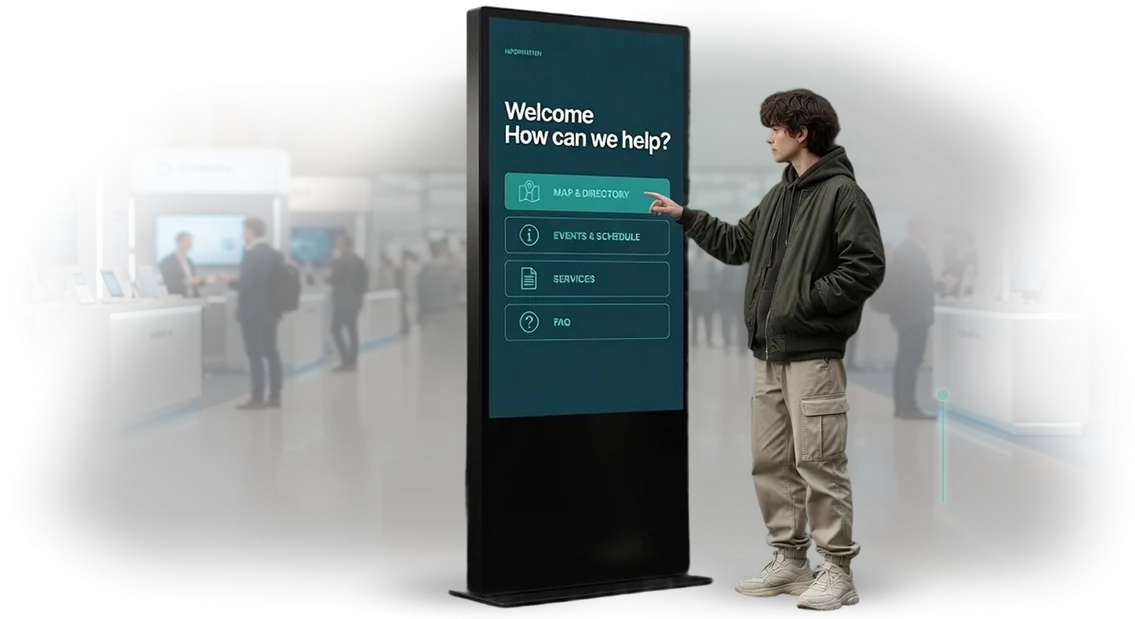
An interactive kiosk addresses this pain point. It shows an exact route to the terminal, exit, café, or pharmacy, instantly answers frequent questions, and works 24/7 — without queues, pauses, or human error.
Passengers get peace of mind and confidence, while the port reduces staff workload and increases satisfaction.
At our team we develop interactive kiosks tailored to the specifics of port infrastructure: passenger flows, peak loads, different types of travelers.
Such port navigation turns chaos into a clear route, and customers who left for competitors return — because it's convenient here.
Benefits of Interactive Kiosks: What Passengers and Administration Gain
Passengers in the port value their time: they need to quickly understand where the required terminal is, how to get to the pier, and how long boarding will take.
An interactive kiosk answers these questions in seconds, saving people from searching through printouts or waiting at the information desk.
Even saving five minutes on the way through the port positively affects the overall impression of the trip and reduces stress levels — especially during peak hours when the flow of travelers is at its maximum.
For the administration, a kiosk becomes a digital employee that works without breaks and answers hundreds of similar requests.
The information desk stops being a bottleneck: staff handle only non-standard situations instead of explaining the route to the ferry to every second passenger.
This noticeably reduces the load on employees and allows manpower to be allocated more efficiently, without hiring additional consultants for the season.
Convenient and predictable service is directly linked to passenger satisfaction. When a person finds the answer themselves on a touchscreen, it gives a sense of control and modernity.
The kiosk works in the user's native language, offers alternative routes, and displays up-to-date departure information — the passenger feels the port cares about their comfort.
Implementing interactive kiosks shapes the port's image as a modern transport hub that follows digital trends.
Guests share their experience in reviews and social media, and for business representatives and partners, this is a signal of reliability and technological maturity of the infrastructure.
The port is no longer perceived as just a temporary point on the way — it becomes a place with quality service.
In the end, both sides benefit: passengers save time and nerves, while the administration saves resources and reputation.
Kiosks pay off not only by easing staff workload but also through increased passenger loyalty — travelers are more willing to return to the port and recommend it to others. This is a comprehensive solution that strengthens operational efficiency and the port's long-term brand.
Interactive Kiosk Formats for Port Navigation
A port is constant motion: ferry arrivals, check-in queues, searching for the right pier. Passengers aren't ready to study diagrams and read instructions — they need to understand in seconds where to go.
If navigation stalls, crowds form, the load on the information desk grows, and service ratings drop.
A properly chosen kiosk format eliminates these problems before they even arise. We develop interactive navigation systems for ports that account for real passenger flows and the architecture of the territory.
Kiosk Formats: Outdoor, Wall-Mounted, Mobile
| Format | Port tasks it addresses | What it gives the customer |
|---|---|---|
| Outdoor kiosk | Open piers, parking areas, entrance zones | 24/7 navigation in any weather, resistance to moisture and sun |
| Wall-mounted terminal | Waiting halls, lobbies, walkways | Space savings and quick guidance at high-traffic points |
| Mobile kiosk | Temporary zones, mass events, peak hours | Flexibility: can be moved where the main questions arise |
The choice of format depends on where exactly passengers encounter navigation. Outdoors, weather-protected outdoor kiosks do the job; inside the terminal, a wall-mounted terminal is convenient; and for temporary situations, a mobile one.
We combine formats so that a person can cover the entire route from entrance to boarding without staff assistance.
As a result, passengers ask for directions less often, queues at the information desk shrink, and movement in the port becomes predictable. The system is easy to update and scale when routes change or new services appear.
How Project Development Works: Stages and Timelines
We structure the process so that you understand the timeline, cost, and your role at every stage from the very start — no "black boxes" or unexpected changes at the end of the project.
Below is the standard scenario for developing an interactive navigation system for a port: from the first brief to launch and ongoing support.
-
Kiosk brief and task immersion (2–3 days). We gather requirements: which visitor flows need to be separated, which navigation scenarios matter, what content to display.
As output, you get an understanding of how the system will fit into the port's infrastructure and which tasks it will cover.
-
Prototype and structure approval (5–7 days). We show the screen layout, menu navigation logic, and key navigation points — from the parking area to the terminal. You see how a guest will find a desired location before visual development even begins.
-
Design and content preparation (1–2 weeks). We adapt the interface to the port's brand style and prepare texts, maps, and diagrams. Everything is approved with you — no "creative" decisions that would get in the way of passengers.
-
Development and integration (2–3 weeks). We build the system and connect it to data — schedules, service lists, reference information. At every step you receive a demo version, can make changes, and see how the system works on real touchscreens.
-
Testing and debugging (5–7 days). We check typical visitor scenarios: finding ticket offices, getting to the pier, calling for help, alternative routes. We make sure the kiosks respond quickly, don't freeze, and work correctly under heavy load.
-
System launch and training (2–3 days). We install the equipment, configure it for the site, and train your staff: how to update content, respond to abnormal situations, and monitor request statistics.
-
Support and development. We stay close after launch: updating schedules, adding new scenarios, and monitoring stability. You always know who is responsible for the kiosks' operation — and within what timeframe issues are resolved.
In summary: the entire cycle takes 4–6 weeks on average. You control the project at every stage — from the brief to system launch and beyond.
What's Included in the Delivery: Customer Package
When you order an interactive kiosk, you get not just a device but a ready-to-operate package. Our kiosk delivery includes equipment, installation, software, documentation, and staff training — a turnkey solution, without looking for separate contractors.
The delivery package includes:
- Equipment set — a touchscreen kiosk with a protected enclosure, display, and built-in computer, designed for 24/7 operation in the port. Everything is tested and ready for connection.
- Installation and connectivity — our specialists will install the kiosk at the required point in the terminal and configure the network and power supply. You get a working navigation point without involving your own IT department.
- Software — a navigation system with a port map, object search, and a visitor-friendly interface. The software is pre-installed; updates and configuration are included in the delivery.
- Documentation — a complete set of instructions: operator's guide, maintenance schedule, certificates, and protocols. Everything for your control service and smooth shift handovers.
- Staff training — a short training session for employees: how to power on the kiosk, resolve common issues, and interact with the system. This usually takes 1–2 hours, after which the staff works independently.
- Warranty and support — official warranty on equipment and work, plus a direct communication channel with an engineer. If needed, we dispatch a specialist to the site within agreed timelines.
This package covers all stages — from receiving the kiosk to the first day of operation. You don't need to find installers and programmers separately: you order from us, and we take care of the rest.
Case Study: Navigation Kiosks in the Port — 40% Increase in Satisfaction
When a large port renovated its passenger terminal, it became clear: the old navigation couldn't handle the flow. People kept losing the way to the ferry gates, searched for luggage storage, and crowded around the information desk. The client asked us to make navigation clear for everyone — from tourists to drivers.
We designed a turnkey navigation system: touchscreen kiosks were placed at points where passengers most often hesitated, and the interface was built around large pictograms and live route search. our team ran the project from flow analysis to kiosk installation. Within two weeks, the kiosks were already easing the load on the information desk.
Result for the Port
Surveys and data from the kiosks themselves showed: navigation satisfaction rose by 40%. Requests to staff dropped by a third, and the time to reach the right exit shrank from fifteen minutes to four. Fewer missed departures — and less stress for the staff.
"Passengers stopped being late for ferries, and employees returned to live service. This is the best navigation implementation result," says the head of the passenger department.
After the first phase, the client expanded the system to the neighboring terminal and came back to us with new tasks. We don't offer kiosks for the sake of kiosks — we create an environment where the route is found in seconds.
How to Choose a Kiosk Format for Your Port's Needs?
When choosing a kiosk for a port, there is no single right answer — everything depends on the tasks you're solving and the conditions in which the equipment will operate.
A universal terminal is rarely equally good at both navigating a huge terminal complex and providing quick departure information.
Start with passenger flow. In a port, it's rarely uniform: in the morning there's a ferry peak, in the afternoon a lull, in the evening a cruise ship arrival.
During peak hours, visitors need instant response, large fonts, and clear prompts, so the kiosk must be easy to use even for someone with luggage or a child.
For calmer zones, more feature-rich stands with additional services — café and pharmacy search, taxi ordering — are a better fit.
The next factor is port infrastructure. If the terminal spans multiple floors with long corridors, floor-standing kiosks with large screens are more effective — they're visible from a distance and don't get lost in the space.
For tight spots near check-in counters, compact wall-mounted panels work better — they save space and handle a focused task: showing the schedule, gate number, and boarding time.
Installation conditions are also worth considering. In open port areas with possible precipitation, temperature swings, and mechanical impact, you'll need a protected enclosure with an anti-vandal screen.
Inside the terminal, there's more freedom for aesthetics: you can choose a kiosk that blends with the interior and doesn't clutter the space. Our engineers select equipment for a specific location rather than offering a standard model without regard for your port's specifics.
And most importantly — decide what a passenger should do at the kiosk: find an exit, check departure time, download a map, or get reference information. The screen size, sensor type, and number of installation points are chosen based on this scenario.
We conduct a site audit and, together with you, determine the optimal format so that every kiosk delivers value and pays for itself quickly. Contact us for a consultation — we'll recommend a solution that fits your port.
Frequently Asked Questions About Navigation Kiosks: What's Important to Know
Port and terminal managers ask the same questions: will the kiosks withstand the harsh marine environment, will they require round-the-clock attention, and how quickly will they pay off. We've gathered answers to the most common concerns — short and to the point.
How reliable are kiosks in port conditions?
The equipment is adapted to the marine climate: special coatings, protection against salt and moisture, and an operating temperature range from freezing to summer heat. This isn't consumer electronics — it's industrial-grade solutions built for 24/7 operation in public spaces.
The average service life spans several years of active use without loss of screen brightness or touch response.
What happens if a kiosk breaks down? Who maintains it?
Every kiosk sends a technical health signal to a remote monitoring point. So most of the time, a fault is detected before users even notice it. Many situations are resolved through remote configuration — without an engineer visit.
If on-site intervention is required, a specialist arrives with a replacement module and performs the work during low-traffic hours so as not to disrupt visitor flow.
Outdoor conditions: how do kiosks handle rain, wind, and temperature swings?
The enclosure and screen are protected to outdoor equipment standards: sealed joints, UV resistance, and built-in thermal regulation. Images stay readable in bright sunlight, and in winter the kiosk doesn't freeze and is immediately ready for use.
These solutions have been proven in port-city projects where kiosks stand on open piers and in security screening areas.
Is it difficult to update information — departure schedules, maps, announcements?
Content is updated through a simple control panel, no programmer needed: you change the timetable, add news, and modify routes in minutes. When required, kiosks sync with existing port systems — schedules load automatically. Training takes a couple of hours, and staff turnover no longer affects the accuracy of navigation.
If your questions are more complex than the standard ones — we'll walk you through the details for your specific site: installation location, coverage zones, integration with the port's IT infrastructure. We'll answer without obligation and show case studies of similar projects.Let's Discuss Your Task and Prepare a Commercial Proposal
Tell us about your task — we'll help plan the project and offer a solution tailored to your goals.
Leave a request for a cost calculated after audit, and we'll call you back within one business day to clarify the details: where the kiosks will be placed, what the visitor flow looks like, and which navigation scenarios passengers need.
After your inquiry, we'll prepare a commercial proposal with transparent project cost and timelines. You'll receive a document that clearly shows what's included in the work, which navigation sections are planned, and how the launch will proceed. No hidden line items — only the stages that are actually needed for your port.
What you get after submitting a request for a cost estimate:
- a consultation on the capabilities of interactive kiosks for port navigation;
- an analysis of your task and a proposal on the system's composition and functionality;
- a project cost calculation with a clear breakdown by stage;
- an indicative timeline for development, testing, and launch;
- recommendations on kiosk placement and map structure for guest convenience;
- a demonstration of similar solutions we've already implemented.
Submit your request for a cost estimate — we'll respond within one business day. If the project fits your task, we'll propose implementation options; if not, we'll honestly say so and suggest an alternative.
You can clarify the details in a consultation — we'll discuss how the navigation system will pay off in your port and what it will give passengers.