

Time Loss and Errors in the Distribution Center
In a distribution center, every hour counts: a delay at an intermediate stage stretches the entire supply chain. Employees waste time asking colleagues, searching for the right zone, and trying to navigate by paper signs and outdated layouts.
The result is equipment downtime, queues at shipping, and missed deadlines — a typical picture for warehouses without a proper navigation system.
The cost of chaos goes beyond minutes. Because a new or temporary employee cannot quickly find the right rack or dock, picking errors, sorting mix-ups, and repeat shipments occur. Each such error requires rechecking, return processing, and additional human resources. Logistics starts to stall exactly where it should run like clockwork — in the operational zone.
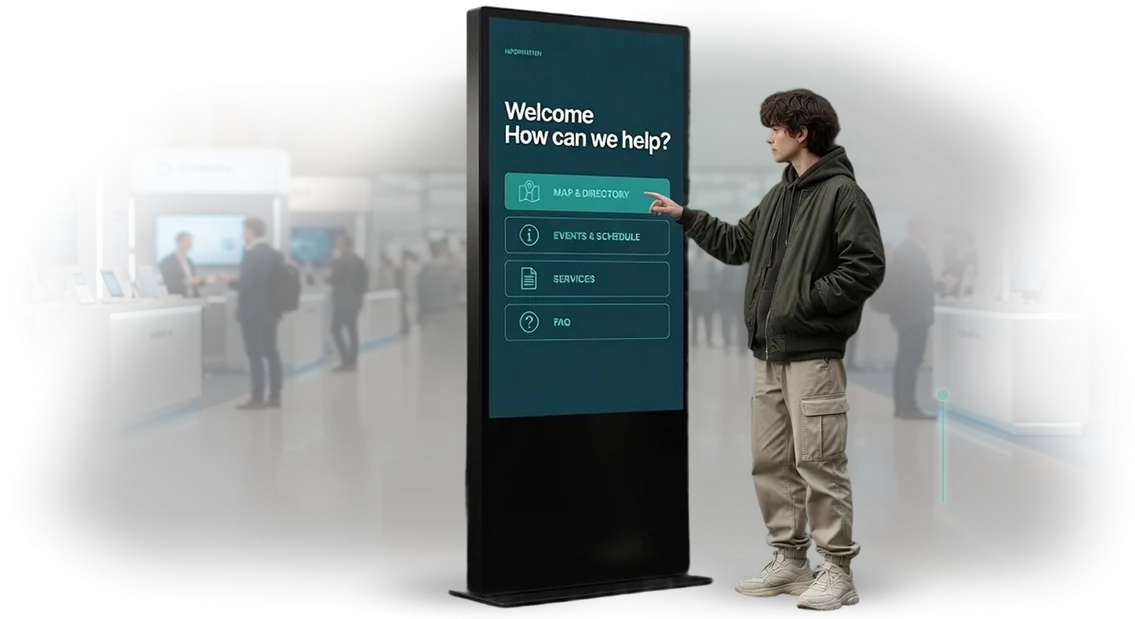
Interactive navigation in a distribution center solves this problem systematically. A touchscreen kiosk shows an up-to-date route to the desired point, taking into account the current layout, storage zones, and task status.
An employee spends ten seconds on a request and immediately takes the short route instead of wandering through aisles in search of the right zone.
This solution reduces staff onboarding time, lowers the number of human-factor errors, and makes processes predictable. Management gets transparent logistics where every employee step is justified and requires no extra checks.
We put an end to this chaos with interactive navigation — fast, visual, and with measurable results for your center.
What You Get from an Interactive Navigation System
An interactive navigation system in a distribution center is not just a map on a screen but a working tool that saves employee time, reduces errors, and gives management full control over personnel movement.
The implementation pays for itself by accelerating internal processes, not through one-time savings.
The first and most noticeable benefit is speed. Employees don't need to ask colleagues or search for the right rack from memory: the kiosk shows a short route from the current point to the picking or unloading zone.
Even ten to fifteen minutes saved per shift translates into hundreds of working hours per month across the center.
The second benefit is fewer errors. When the system suggests the address and destination zone, employees are less likely to mix up sections, return goods to the wrong place, or lose time on the wrong aisle. This shows up in a lower number of defective orders and faster processing of incoming cargo.
The third benefit is control. Management can see which zones are overloaded and which are idle, where queues build up, and where employees lose time.
Based on this data, storage zones can be rearranged, and schedules and routes adjusted without stopping work — decisions based on numbers rather than gut feeling.
Finally, return on investment. Interactive kiosks replace paper diagrams and verbal instructions, so the result is visible within the first month: fewer delays, fewer reworks, faster onboarding of new employees.
A simple way to estimate the benefit is to multiply the average employee salary by the hours they no longer spend searching. This arithmetic is what makes the system self-funding.
Interactive Kiosks in a Distribution Center: Formats and Solutions
In a distribution center, interactive kiosks solve several tasks at once: they help visitors and carriers quickly find the pickup/delivery point, reduce the flow of questions to dispatchers, and simplify internal navigation for new employees.
The key is to choose a format that fits into your process rather than requiring a warehouse restructuring.
Below we break down three basic formats and show which one solves your task. This allows you to make a decision in 10 minutes rather than after lengthy approvals.
Kiosk Formats for Distribution Center Tasks
| Format | For Whom | What It Provides |
|---|---|---|
| Floor navigation stand | Visitors, drivers, couriers | Immediately shows the route to the required department/dock, offloads the dispatcher, reduces time spent on site |
| Wall-mounted touch panel | Distribution center employees and staff | Quick search for storage zones, task status, and instructions right at the work area — no running to the other end of the warehouse |
| Mobile kiosk on wheels/portable | Seasonal and temporary points, repairs, expansion | Easily moved to another zone in 15 minutes, no dependence on power outlets or mounting location |
Stationary warehouse kiosks withstand intensive use: the enclosure is resistant to dust, impacts, and accidental contact with equipment. Wall-mounted panels save space in aisles and work great in narrow corridors. Mobile stands are optimal when department locations change every quarter.
Choosing a format is not about hardware but about the scenario: who needs information and how often. A distribution center typically combines a floor stand at the entrance with 2-3 wall-mounted panels in picking zones — this covers both external traffic and internal movement. Before expansion or a seasonal peak, adding a mobile kiosk requires no lengthy installation.
Describe your typical flow of people and movement routes — we'll propose a set of 1-2 formats for your volume. This takes one business day.
Stages of Interactive Navigation Development
In a distribution center, navigation is not just a screen with a floor plan. It determines how quickly an employee finds a rack, a driver finds the unloading zone, and a visitor finds the exit.
That's why we've made the development process as transparent as possible: you see results at every stage and can make changes before significant investments are made.
The project takes from two weeks to a couple of months depending on the area and the number of control points.
But the main thing is predictability: you know in advance what will happen at each stage, who is responsible for the result, and when the interim version will be ready for approval.
- Brief and zone audit — you set the task, we study the center's layout and routes. Result: an agreed technical specification.
- Interface prototype — we draw navigation screens based on real scenarios. You see the logic and can adjust it before development.
- Design approval — we adapt the interface to your brand style. The approved mockup is the basis for the next step.
- Content and floor plan mapping — we load the layout, zone names, and routes. Temporary closures are taken into account.
- Kiosk testing — we check response speed and readability on touchscreens. Any inaccuracies are fixed before launch.
- Launch, training, and support — we install the system, instruct administrators, and stay available for updates.
What's Included in Delivery and What Guarantees You Get
When you order interactive kiosks for a distribution center, you get not just devices but a complete working navigation system.
We handle the entire cycle — from a project tailored to your logistics to staff training — so that within a few days the kiosks start delivering value: offloading dispatchers, speeding up zone and staff searches, and reducing errors.
The standard delivery includes:
- Project tailored to your center — kiosk placement scheme, menu logic, and navigation structure considering zones, warehouses, aisles, and service areas.
- Delivery and installation — we bring the equipment, install it, connect it, and configure it for your network and operating schedule.
- Content setup — center map, department list, staff search, routes to the required zone — everything specified in the brief.
- Documentation — operating instructions for administrators and reference guides for staff, understandable without technical training.
- Staff training — we conduct a short practical training session for your team: how to update data, change content, add employees and sections.
- Warranty service — we set warranty periods for both hardware and software, and in case of a failure, we arrange replacement or remote resolution.
- Post-launch support — we provide consultations by phone or messenger and help with modifications and content updates when the center's structure changes.
We formalize all agreements in the contract and technical specification, so you know exactly the timelines, cost, and scope of responsibility. The guarantees cover not only device operation but also the outcome — the kiosks must be convenient for your employees and actually used.
If after launch we see that a section is in low demand, we propose replacing it with something more useful — this is already included in service support.
Case Study: How We Brought Order to Logistics
In a distribution center, every hour of downtime translates into losses — but most often the losses hide in small things. Employees spend a long time searching for the right rack, drivers for the right terminal, and newcomers spend days memorizing the warehouse layout.
A large distribution center operator approached us with exactly this problem: on-site navigation was chaotic, and the time spent searching for product positions constantly "ate into" the picking plan.
our team approached the task not as installing screens but as creating a system that understands how the warehouse operates. We analyzed the main employee movement routes, storage zones, and typical scenarios — from receiving to shipping.
Instead of scattered signs, interactive kiosks appeared that build a clear route in a couple of touches: which rack to go to, through which aisle, where there are fewer bottlenecks. No paper diagrams and no "where is it?" questions.
The result exceeded the client's expectations. The time needed to find the right zone was cut in half — confirmed by measurements taken before and after launch.
Beyond the headline number, we saw a secondary effect: fewer delays at loading docks, faster order processing, and noticeably calmer warehouse staff. Thanks to the unified navigation system, even first-time visitors to the center no longer got lost.
This case is telling: good interactive navigation pays off not through "looks" but by accelerating everyday processes. The client received a system that is easy to update when the warehouse changes and, after the trial period, expanded it to the adjacent building.
If employees in your distribution center waste time searching — that's not the norm but a growth point we know how to address.
Frequently Asked Questions and Client Concerns
Before any project in a distribution center gets started, natural concerns arise: will the equipment disrupt workflows, will timelines slip, will the system require constant attention.
That's normal — we hear these questions on every second project and are used to answering them honestly and to the point.
Below are answers to the most common client concerns. If you still have questions, ask us directly: we'll explain exactly how we'll set up work at your facility.
Is it difficult to integrate kiosks into an operating distribution center?
Implementation does not require stopping operations. We connect to your network, install kiosks at key points, and upload the floor plan and navigation system. Everything happens in stages, at a convenient time for you — for example, at night or on weekends. The basic launch typically takes 1-2 weeks, including testing and staff training.
How much does it cost and when will it pay for itself?
The cost depends on the number of kiosks, the complexity of the layout, and additional features.
But the main point is that this is not an expense but an investment: kiosks reduce employee time spent searching for zones and products, ease the load on the information desk, and reduce errors in cargo movement.
In a distribution center with a high volume of tasks, the system pays for itself within a few months.
What happens if a kiosk breaks down?
We ensure uninterrupted operation: modern equipment is designed for intensive use, and management through a secure platform allows remote monitoring of every kiosk's status. If needed, replacement or repair is carried out promptly under the service agreement. There is also a backup mode — part of the information is available on employees' mobile devices.
Will we be ready for launch in time?
We have a well-established process: first we analyze flows and layout, then we prepare a mockup, approve the design, and only then install and configure. At every stage you receive clear reports, and final testing is conducted with your team. The result is a stable system by the agreed date, without surprises.
Order Interactive Navigation Development
Leave a request — and we'll prepare a solution for your distribution center. We'll explain how interactive navigation will speed up employee workflows and reduce "where is what" questions, and you'll receive a clear implementation plan.
After contacting us, you receive:
- A consultation: we analyze current routes, control points, and bottlenecks in personnel movement.
- A cost estimate tailored to your scale — no hidden items, with clear timelines.
- A proposal on the number of kiosks and navigation logic: where to place them and what to show on each screen.
- An engineer's visit to the site to assess placement conditions and refine installation requirements.
- An interface prototype before work begins, so you can approve the navigation logic in advance.
- A launch plan and post-handover support: interactive maps are updated along with layout changes.
- A warranty on equipment and the entire system — we're responsible for kiosk operation at your facility.
The delivered result is not just "kiosks installed." It's a working tool that helps new employees and couriers quickly find the right zones, while helping you reduce time losses and cut errors in movement.
Leave a request — an engineer will visit, calculate the scope of work, and propose the optimal configuration. We'll start with a consultation, and the final decision will be approved before signing.
How to Choose the Right Format for Your Task?
The right kiosk format is not the one with the most features but the one that fits your specific distribution center.
Navigation in the warehouse, at the gates, or in the receiving area solves different tasks: sometimes you just need to direct a driver, and sometimes you need to help an employee quickly figure out a route.
That's why the selection starts not with a model or a price but with an analysis of who will use the kiosk and how.
Distribution centers typically use three types of kiosks. Compact wall-mounted terminals are convenient for quick reference: showing a diagram, providing a zone number, confirming a receipt.
Floor stands with a large screen suit regular navigation when the kiosk is used dozens of times per shift. Mobile units are useful when routes and zones change: they can be moved to wherever information demand appears today.
When selecting a solution, we look at three things: how many people will use the kiosk, in what mode — briefly or for extended periods — and what actions they need to perform. One center may need just a simple sign, while another needs an interactive map with storage zone search. This is not about "better or worse" but about matching your operational needs.
We help you decide on the format before development begins: we propose the kiosk type, its placement, and the interface scenario tailored to your distribution center's specifics.
As a result, the kiosk doesn't become an obstacle or a decoration but genuinely accelerates work — reducing the time spent finding the right point, lowering the number of questions to staff, and reducing errors in cargo movement. That's the criterion for the right choice.