

Visitors Get Lost in a Rehabilitation Center: How to Fix It?
Every day, dozens of visitors come to a rehabilitation center: patients heading to procedures, relatives, couriers, and new employees. A large building with several wings, offices, and floors easily turns into a maze where you cannot get by without guidance.
As a result, people waste time searching, arrive late for appointments, and feel stressed — the last thing anyone needs when they are already worried about their health.
Visitors getting lost is not just an inconvenience; it is also a direct burden on administrators and medical staff. Employees are pulled away from their work to give directions and answer the same questions over and over.
In the end, the quality of service suffers, tension builds in the lobbies, and the impression of the center is spoiled before the appointment even starts. For a medical facility, navigation is part of caring for patients and their loved ones — a sign of attention to detail.
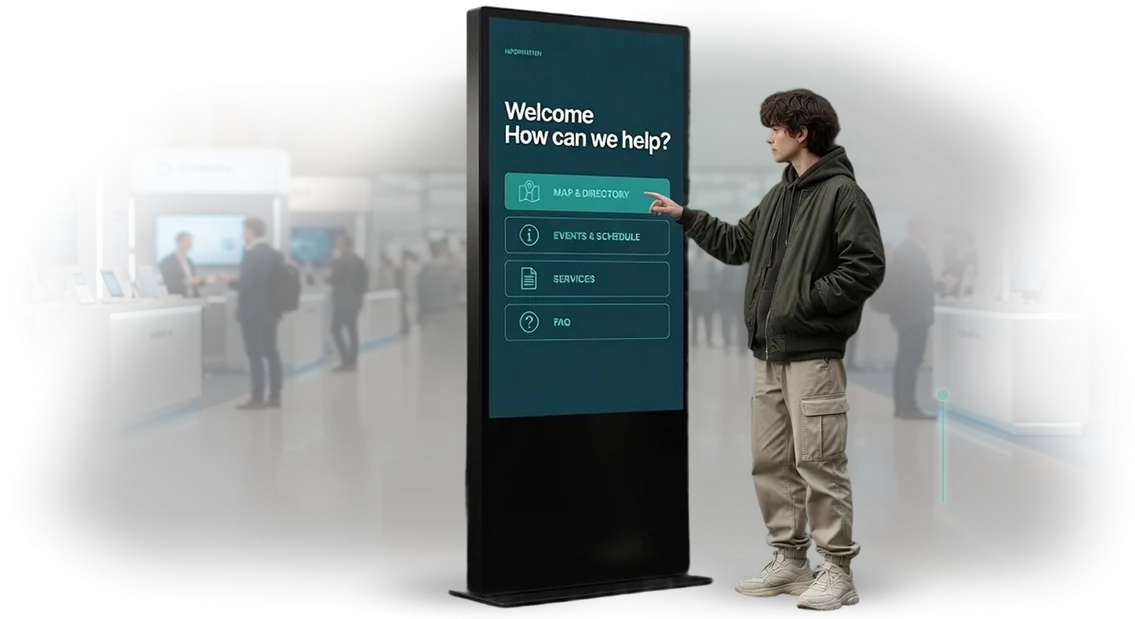
The solution is an interactive navigation system: a touchscreen kiosk with an interactive map that helps visitors quickly find the right office, department, or doctor. Visitors select their destination on the screen and get a clear route without having to ask staff.
This is especially important for elderly people, patients with limited mobility, and those visiting the center for the first time: patient comfort begins with feeling confident and at ease.
We develop such kiosks with the specifics of medical facilities in mind: a simple interface, large buttons, and adaptation for different user groups. The kiosk runs reliably, requires no special maintenance, and fits easily into the lobby design.
Implementing interactive navigation reduces the flow of inquiries to the information desk, saves visitors' time, and makes time spent at the center more comfortable — we handle this task on a turnkey basis.
What Does Interactive Navigation Offer Guests and Staff?
Visitors and patients of a rehabilitation center often find themselves in an unfamiliar building with a confusing layout. While a person searches for the right office, they waste time and energy, and staff are forced to step away from their work to give directions.
That is exactly why we develop interactive navigation kiosks — they help guests feel confident and allow staff to focus on their own tasks.
Our team creates navigation systems that cover all everyday questions: how to get to the treatment room, where the cloakroom is, how to call staff. Here is what your center gains by implementing such kiosks:
- Instant navigation around the building. Guests set a destination on the touchscreen and see a route that accounts for elevators, ramps, and corridor widths — important for people with limited mobility.
- Convenience for guests. Large font, clear pictograms, and the ability to zoom the map remove the stress of finding the right office. No more trying to catch the administrator's eye.
- Relief for staff. Employees stop answering the same questions repeatedly — instead, they focus on patients and their direct responsibilities. This saves several working hours a day.
- Interactive directory. Procedure schedules, the list of doctors, department phone numbers, visiting rules — all useful information is available in one place and is always up to date.
This way, kiosks become the first assistant for both guests and staff. Navigation stops being a point of tension and becomes a simple, clear service that works around the clock, seven days a week.
If you want to discuss installation at your center, call us — we will find a solution that fits your layout and visitor flows.
Touchscreen Kiosk Formats for a Rehabilitation Center
Kiosk formats differ not in the cabinet design but in the tasks they solve. For a rehabilitation center, it is important that visitors quickly understand where to go and that staff do not waste time repeating the same information.
A correctly chosen touchscreen kiosk saves resources in the admissions department and reduces stress for patients and their relatives.
We select the configuration to match the facility's specific tasks: from a simple map of the premises to an information portal with schedules and procedure booking. Below are the main formats most commonly used in medical and rehabilitation centers.
| Format | For whom | What it offers the client |
|---|---|---|
| Navigation kiosk with center map | Visitors looking for an office or department | Quick orientation without an administrator's help, shorter lines at the information desk |
| Touchscreen kiosk with class schedule | Patients and instructors | Up-to-date schedule on screen, fewer late arrivals and clarifying calls |
| Information kiosk about rehabilitation programs | New patients and their relatives | Clear presentation of services and center benefits, greater trust in the facility |
| Multifunctional portal: navigation, schedule, booking | Administration and all visitors | A single entry point for key questions, staff time savings |
Whichever format you choose, we adapt the interface to the center's audience and corporate style.
The screen is not overloaded with unnecessary elements, the font is easy to read, and access to the needed information takes no more than a couple of taps — this is convenient for both elderly patients and young specialists.
If necessary, the kiosk can be supplemented with a route or memo printing function so visitors can take the needed information with them.
Stages of Developing an Interactive Kiosk for Your Facility
To keep the navigation launch from turning into a long and unpredictable process, we run the project according to a clear procedure. You know in advance what you receive at each stage, who is responsible for what, and when the kiosk will go live. Below is the proven workflow we have refined across dozens of facilities.
-
Brief and task research. We gather requirements: who will use the kiosk, which routes matter, whether visitors have any specific needs. The output is a technical specification for kiosk development that takes your center's specifics into account.
-
Structure and interface design. We design the navigation logic: service catalog, office numbers, floor plans. We agree on the structure with you so that staff find it easy to maintain and visitors can find what they need within one screen.
-
Design mockups. We create a visual style that fits the interior and corporate identity of the facility. We account for contrast, large buttons, and fonts — this is critical for elderly people and visitors with mobility limitations.
-
Kiosk assembly and configuration. We prepare the hardware on professional equipment and install the software. We set up remote content updates so you can change schedules or the list of offices without bringing in a contractor.
-
Content loading and testing. We load real data from your center: staff, offices, services.
We test scenarios such as "how to get to the physiotherapist," "where the information desk is," and "how to call for help." We fix errors before the first visitor sees the kiosk.
-
Navigation launch and staff training. We install the kiosk and give administrators a short briefing: how to turn it on, reboot it, and update the schedule. You receive a two-page cheat sheet instead of a thick manual.
-
Post-launch support. For the first two weeks, we stay in touch and quickly make edits if something goes wrong. After that, extended maintenance or one-time improvements, as you prefer.
Typical implementation timelines range from 3 to 6 weeks, depending on the size of the facility and the number of navigation points. All stages are fixed in the contract, so you see what you are paying for and when you will receive a working turnkey project.
What Is Included in the Navigation Kiosk Package
For a rehabilitation center, a navigation kiosk is not just an electronic display — it is a tool that helps visitors quickly find offices, procedures, and the specialists they need.
To make sure the system works from day one, we include everything necessary in the package — from the device itself to technical support and staff training.
- Kiosk hardware — a touchscreen in a protective enclosure, selected for your space. The device is designed for continuous operation and requires no special maintenance.
- Software — a navigation system with building maps, office search, and directions. The interface is adapted for visitors of different ages and health conditions.
- Interface design project — styling in the center's corporate identity, large buttons, clear icons, and legible labels. Development takes your audience's characteristics into account.
- Installation and launch — delivery, on-site setup, connection, configuration, and testing before opening. We manage the process so the kiosk starts working exactly on time.
- Technical support — phone or remote consultations, regular system diagnostics. If necessary, a specialist arrives at the site as quickly as possible.
- Staff training — we brief administrators and personnel on how to use the kiosk, update data, and handle typical visitor questions.
- Warranty and maintenance — free troubleshooting during the warranty period, followed by service support on special terms.
This way, you receive a comprehensive turnkey solution: one company is responsible for the hardware, software, design, and ongoing operation of the system. This saves you from searching for contractors and unnecessary hassle — the kiosk simply does its job.
Case Study: How a Kiosk Improved Convenience at a Medical Facility
Patients at the center often lost their way to the right office, especially in the first days after admission. Inquiries at the registration desk took up staff time, and guests with limited mobility avoided extra trips altogether after unsuccessful attempts to find their way.
We installed a touchscreen kiosk with an interactive building map for the Vosstanovlenie rehabilitation center. We made the interface intuitive: large buttons, clear department labels, and an automatic route from the current point to the desired office. One-touch control suits patients of any age and requires no explanation.
What Changed After Launch
During the first three months of kiosk operation, the average time spent finding an office dropped by 35–40%. The number of phone calls and in-person questions at the administrator's desk almost halved: staff stopped being distracted from processing documents and paperwork.
Patients began moving around the building more confidently, and reviews note that the route is logical and clear even without assistance.
In addition, the kiosk solved an internal task for the facility: publishing up-to-date doctor schedules and office changes now happens in one place. The information is always fresh, and visitors see it before they have a chance to approach staff.
The case showed that a kiosk is not just an electronic sign but a working tool that reduces the load on administrators and increases patient satisfaction.
The center noted the results and continues to develop the navigation system in new wings — this is our recurring growth point in the medical sector.
How to Choose the Right Kiosk Format for Your Needs?
Choosing a kiosk starts not with a model but with questions: where it will stand, how many people will use it daily, and what tasks it must solve.
In a rehabilitation center, this could be a floor-standing unit in the lobby for booking procedures, a wall-mounted terminal in a corridor for navigating between offices, or a compact touchscreen panel in the waiting area for self-registration.
Visitor traffic determines the load: if several hundred people pass through the lobby a day, you need a sturdy floor-standing construction with a large screen and a reinforced enclosure.
If the kiosk serves a narrow flow — for example, only patients from one department — a wall-mounted format that takes up no usable space is enough.
Functionality also affects the choice. An interactive map of departments, doctor appointments, procedure schedules, and reference information about the center all fit into the basic version.
But if you plan to issue tickets, collect feedback, or conduct surveys at admission, you will need additional modules: a printer, a scanner, or a discreet camera for analytics.
We select a kiosk for your real situation: we assess the installation area, foot traffic, usage scenarios, and staff preferences. At the briefing stage, we pin down the main tasks and then propose a format that will neither sit idle nor become overloaded. This saves your budget and shortens implementation timelines.
You get a ready-made turnkey solution: a kiosk matched to your size and load requirements, an adapted interface, configuration for your scenarios, and staff training. After that, the system works on its own, and you can change content and add features without replacing equipment.
Frequently Asked Questions About Implementing Touchscreen Kiosks
Every client has questions about kiosks, and that is normal. A touchscreen kiosk works with visitors 24/7, so it is important to understand how it will behave in real conditions.
Over years of work, we have noticed that the same concerns keep coming up: reliability, ease of management, and updating information. Below we answer them.
The first question is kiosk reliability. In a rehabilitation center lobby, the device runs constantly: visitors touch the screen, staff look up information, and sometimes the load reaches its maximum.
We install professional equipment with a protective enclosure that withstands this pace for years. Warranty and service support are part of the contract, so a breakdown will not stop operations for long.
The second question is staff training. Employees worry that they will have to learn complex software. In reality, the interface is configured once, and managing it only requires basic tablet skills.
We provide a short training session: within an hour, your staff can independently change the screensaver, add an announcement, or adjust the schedule.
The third question is updating information. You need to be able to easily change contacts, doctor schedules, and news. With our kiosk, this is done through a simple admin panel — without calling developers or going through lengthy approvals.
Make the changes, save them, and they appear on the screen immediately. The whole process takes a few minutes.
To address the most common fear — a sudden breakdown — let us show you with an example.
What should you do if the kiosk fails on the busiest day?
We specify the response time in the contract: no more than 4 hours on business days. Often, the issue is resolved remotely without an engineer visiting. If equipment replacement is needed, we have backup kiosks for a quick swap. Your operations will not be interrupted.
Order Interactive Kiosk Development for Your Facility
To order a kiosk for a rehabilitation center, leave a request on the website or by phone.
We will contact you within one business day, clarify the facility's tasks, and provide a consultation: we will recommend which navigation and information presentation scenarios will be most convenient for your visitors. After a short brief, we will prepare a transparent cost estimate and timeline.
A turnkey project is one contract and one responsibility. We design the interface logic, develop the design, assemble and configure the equipment, install the kiosks at your facility, and train your staff.
You do not need to coordinate multiple contractors, and we accept the result together during final testing.
How the Kiosk Order Process Works
Typically, the path from request to launch takes from two weeks to two months — depending on the number of points and the complexity of the content. At each stage, you see intermediate results and can make edits.
- Request and consultation: we discuss the tasks, the number of points, and the expected effect.
- Brief and cost estimate: we formalize the requirements, timelines, and scope of work — with no hidden payments.
- Scenario design: we plan out the menu structure, navigation, and texts that are clear to visitors of different ages.
- Design and approval: we show mockups and make edits until full approval.
- Production and configuration: we assemble the kiosks, install the software, and check operational stability.
- Installation and launch: we place the equipment in the right areas, run testing, and train staff.
- Post-launch support: we update content, provide technical support, and respond under warranty.
Order interactive kiosk development — we will start with a consultation and send the cost estimate within one or two business days after the brief. This is not binding and will help you assess the project budget.