

Are fans getting lost at sports stadiums?
Fans come for emotions, not for a section search. Large stadiums have dozens of entrances, levels, and staircases — not everyone manages to find their seat on the first try.
People crowd around signs, arrive late for kickoff, and the club gets negative reviews instead of gratitude.
While advertising works on attracting spectators, navigation inside the arena decides whether the guest will come back. Every confused fan means wasted time, stress, and lines at the information desk.
Instead of buying programs or snacks, people think only about how to get to their seat. And those minutes directly affect the match experience.
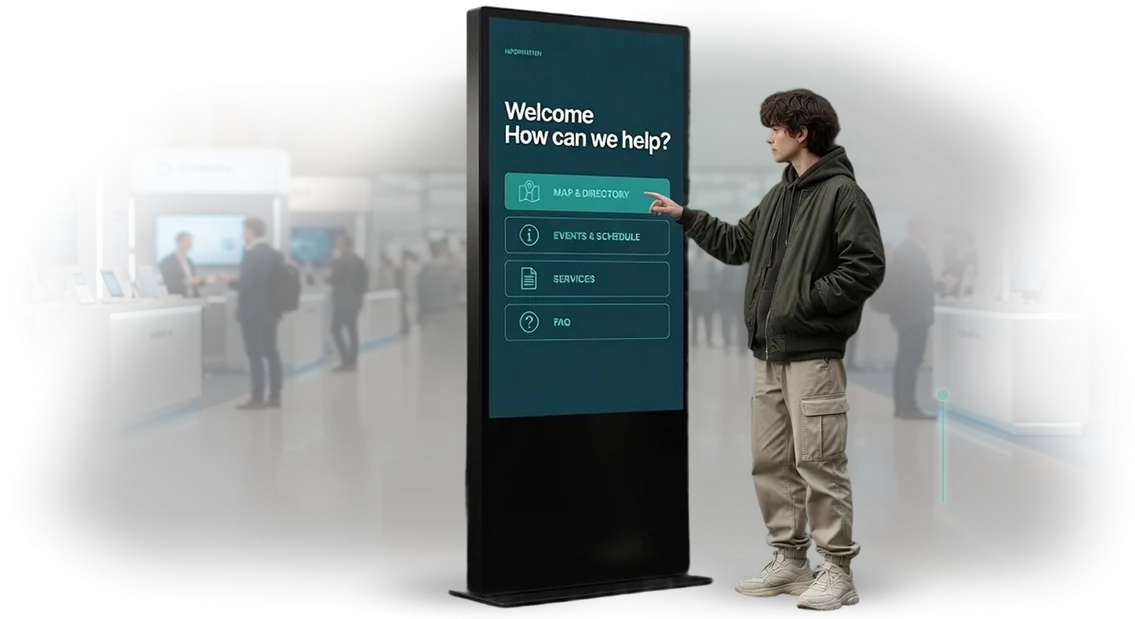
Interactive kiosks at the entrance are a fast route to the right section without staff assistance. On the touch screen, a guest selects their stand, sees the route, landmarks, and travel time — and immediately understands where to go.
Our team has already helped stadiums get their navigation in order: we deployed kiosks that reduced the number of late arrivals at game time and lowered the load on administrators.
We don't just install screens — we remove the stress from a fan's journey. Our stadium navigation takes crowd flow logic into account and helps spectators find not only their section but also the nearest concession stand, restroom, or pharmacy. Guests stop asking for directions and feel the club's care from the first minutes.
For the organization, this is also a benefit: fewer crowds, calmer work for stewards, and higher visitor loyalty.
A fan who spends less time finding their section is more willing to buy food and merchandise, which means the arena earns more revenue per spectator at subsequent matches.
This is how interactive kiosks become more than just a convenience — they become part of the service that brings guests back again.
What interactive navigation gives fans and the club
A fan comes to the stadium for emotions, not to search for the right section. When a guest spends time wandering, standing in lines, and asking staff for directions, the match experience is spoiled, even if the game was exciting.
Interactive navigation solves this problem before it ruins the evening. The fan gets a clear route in a couple of taps, and the club gets a manageable flow of people plus additional revenue opportunities. Below is exactly what changes after implementation.
For the fan: less stress, more emotions
A touch kiosk at the entrance is the first point of contact with the club, and it works without queues or irritation. The guest immediately sees how to reach their section, where the nearest concession stand or fan shop is, and how long the walk will take.
Each screen tap is seconds that used to go into looking for signs or talking to staff. The guest reaches the stands faster, has time for a coffee before the match, and is in a good mood by the time they sit down.
For the club: loyalty, order, and new revenue
Stadium navigation — our team builds interactive kiosks that collect data on guest movement. The club sees where crowds form and can proactively redistribute load, reducing queues during peak hours.
But most importantly, the kiosk becomes a storefront for upselling. Guests see fan shop promotions, concession specials, and announcements of upcoming matches right on the way to their section. This turns navigation from a cost center into a revenue-generating tool.
What the club gets after launch
- Reduced queues and a more evenly distributed guest flow
- Increased loyalty: a comfortable match = the desire to return
- An additional sales channel for tickets and merchandise
- Lower staff workload: fewer questions about “where is my section”
- Movement analytics to improve stadium operations
A fan remembers not only the score on the board, but also how easy it was to spend the evening. Kiosks make stadium visits simple and enjoyable — which means the guest will want to spend the next match here too.
Touch kiosk formats for different needs
At a sports stadium, visitors face different tasks: finding their section, moving quickly through the entry area, or orienting themselves around the food court. One and the same touch kiosk cannot handle all scenarios equally well — each location needs its own format.
Below we compare the main options so you can choose a solution that fits your stadium layout and guest behavior.
| Kiosk format | Where it is placed | What it gives visitors and businesses |
|---|---|---|
| Floor-standing touch kiosk | In lobbies, atriums, and passages between sections | Full stadium map, section search, and route to the seat. Convenient for high-traffic areas and reduces staff workload. |
| Wall-mounted kiosk | Near elevators, staircases, and in narrow corridors | Compact navigation where every meter counts. Helps keep foot traffic moving and saves usable floor space. |
| Outdoor kiosk | In front of stadium entrances, near ticket offices | Works in any weather. Provides directions, match schedules, and ticket information — before the guest even gets inside. |
| Entry-area kiosk | Inside the main entrance, near turnstiles | Fast ticket verification, house rules, and directions to sections. Reduces lines and speeds up guest entry. |
| Food court kiosk | In the dining area and near food stalls | Photo menus, pre-ordering, and wait time estimates. Speeds up service, increases the average check, and relieves the queue. |
By choosing the right format for each stadium location, you get a unified navigation system: visitors ask staff for directions less often, reach their seats faster, and are more willing to return for future matches.
We will help you choose the right configuration for your needs, design the interface, and set up the kiosks to run without failures on the busiest days.
How a navigation project works: from brief to launch
Stadium navigation is not just signage — it's a system that helps thousands of fans quickly find the entrance, section, restroom, or food outlet. To make sure it works without glitches or stress for your team, we follow a clear path: from brief to launch and ongoing support.
- Brief. We discuss your goals: which stadium areas matter, where queues and frequent visitor questions arise, and what events take place. We ask clarifying questions and record requirements so you immediately understand the scope of work.
- Design. We develop the navigation scheme: where to place kiosks, which routes to choose, and how to distribute guest flows to avoid crowds and confusion. You get a logical solution that accounts for the specifics of your stadium.
- Layout approval. We show the screen design, menu structure, and building map. You see what navigation will look like for fans and make edits to colors, logos, and texts. At this stage, the project is fully locked in.
- Installation. We manufacture and install the kiosks at the agreed locations. We work carefully without disrupting events and connect the system to your infrastructure. We schedule the work in advance so installation causes no inconvenience.
- Launch. We configure the software, upload content, and test the system together with your administrators. You get a ready-to-use navigation system that is immediately available to guests. We also train staff on the system if needed.
- Support. We support the system after launch: update event information, change schedules and maps when necessary, and quickly resolve technical issues. You can always contact us, and we'll respond fast.
At every stage, you know what is happening and can make adjustments. We handle the technical side so navigation delivers value without distracting you from the stadium's core operations.
What is included in the interactive solution delivery
When you order an interactive kiosk, you want more than just a device — you want a turnkey solution. We put together a complete package, from the stand to the warranty, so all you have to do at the stadium is plug in the kiosk and use it. The delivery includes all the components that cover navigation and service tasks for fans.
- Stand and hardware — a vandal-resistant enclosure, touch screen, and reliable internals built for 24/7 operation and high visitor traffic.
- Software — an interactive stadium map, section search, food outlets, and stores. The interface is intuitive for any fan and runs without delays.
- Design layouts — screens are adapted to the club's brand identity: colors, logos, fonts. Navigation blends seamlessly into the arena space.
- Club system integration — the kiosk connects to the event schedule and ticketing data, automatically showing current events and updates.
- Staff training — a short briefing for employees, cheat sheets, and guidelines. Your team will quickly learn how to assist visitors.
- Warranty and service — technical support, software updates, and fast hardware replacement if needed. The kiosk works reliably on match days.
The result is a fully completed system, including installation and configuration. No hidden work and no need to figure out the hardware yourself.
Case study: navigation for a 45,000-seat sports stadium
“Grand Arena” is a stadium with 45,000 seats. On match days, the flow of spectators exceeded the capacity of the information desks: lines of 20–30 people, guests arriving late, and staff answering the same questions hundreds of times.
We installed a network of navigation touch kiosks around the entire arena perimeter — at entrances, in transition areas, and near sections. Guests choose their own stand, and the kiosk plots a route in seconds, showing it on the stadium map.
Results for the stadium
Average time to find a seat dropped from 12 to 4 minutes. Crowd flow is distributed more evenly — bottlenecks clear up, and there is less jostling before the match starts.
Navigation satisfaction rose to 94% according to post-event surveys. Staff workload went down: information desks now focus on helping special guests and handling unusual situations instead of handing out maps.
An extra bonus — kiosk screens display announcements for the next match and club store promotions. This brought the stadium hundreds of additional ticket and merchandise sales over the season.
This case study demonstrates that the customer doesn't need technology for technology's sake — they need measurable results. The stadium got them, so it extended the contract for the next season — navigation now works at all home matches and major concerts.
How to choose a kiosk format for your facility's needs?
The kiosk format should be chosen not by appearance but by the tasks it will perform at your facility. For a sports stadium, this is primarily navigation: helping fans find a section, entrance, cafe, or medical point. How accurately you define the usage scenario determines both your budget and your launch timeline.
If you need a kiosk for one major match or a temporary campaign, a mobile stand is the smarter choice. It's easy to move between zones and remove after an event, and installation costs are minimal.
For permanent stadium use, a stationary floor kiosk is more suitable — it is stable, doesn't obstruct visitor flow, and requires no additional dismantling.
Consider equipment load as well. On match days, queues form at the kiosks and passionate fans are all around, so enclosure reliability becomes a top priority.
Vandal-resistant construction with screen protection keeps the kiosk working even under heavy use and reduces repair costs. This format lasts longer, and navigation won't fail at a critical moment.
To avoid overpaying for unnecessary options and ending up with an unreliable solution, it's important to discuss operating conditions in advance.
We help you decide on the kiosk type before the estimate: just describe your tasks, load, and placement requirements — we'll suggest the right format and prepare a quote. We'll also take into account mobility requirements and the necessary level of protection. This way, you get a predictable budget and a result that fits your specific facility.
Frequently asked questions and concerns before ordering
Before ordering interactive kiosks, stadium owners ask the same questions: what happens if a kiosk breaks, how to update content, who handles the warranty, and whether the equipment will fail in freezing weather.
These are normal concerns — the comfort of tens of thousands of fans is at stake. Below, we break down each worry point by point, just as we answer our clients.
What happens if a kiosk breaks during a match?
A failure of even one kiosk should not disrupt navigation. That's why we design the system with built-in safety margins: the base stand handles loads, and built-in diagnostics warn about issues in advance.
If a problem does occur, we connect remotely and usually restore operation within minutes without sending anyone to the site. For the repair period, backup scenarios are provided: duplication of key routes and mobile versions of maps for stadium staff.
How often does content need to be updated, and who does it?
Kiosk content changes along with match schedules, entry maps, promotions, and guest information. We set up the system so updates take minutes: upload a new file to your account, and changes appear on all screens immediately. No programmer or contractor is needed.
If necessary, we can handle maintenance ourselves: we monitor content freshness and make updates promptly.
What warranty is provided and what does it cover?
We provide an official warranty on equipment and installation — it covers any malfunctions that occur through no fault of your staff. In addition, we offer a service contract with scheduled maintenance and priority on-site visits.
This means you never face the problem alone: parts replacement and repairs are handled at our expense within agreed timeframes. All terms are documented in the contract for full transparency.
Will the equipment fail in winter frost?
Stadium kiosks operate year-round, so industrial touch panels are adapted to outdoor temperatures. Low temperatures do not affect screen sensitivity or response speed — navigation remains stable even in severe cold.
We also provide protection against icing and condensation so guests can use the kiosks in any weather.
If you recognize your own concerns in these questions, that's a good sign: it means you are thinking about the project years ahead. In the next section, we'll look at how we organize the process — from brief to launch at your stadium.Ready to improve navigation? Leave a request
Stadium navigation affects the match experience and repeat visits. If a fan cannot find the entrance, section, or cafe, that means lost minutes and stress. We create touch kiosks that quickly resolve these issues while you focus on the event itself.
Leave a request, and we will get back to you within one business day with an action plan for your stadium. You don't need to understand the technology or figure out how to fit kiosks into your infrastructure: we'll propose a solution, show how it works, and handle the launch.
After you submit your request, you get a clear sequence of steps:
- Request on the website or by phone — we respond within one business day, record your goals, and find a convenient time to talk.
- Consultation — we discuss visitor flows, navigation bottlenecks, and expectations of fans across different categories.
- Cost estimate — a transparent quote tailored to your scale: from a single kiosk to an entire stadium complex, with no hidden fees.
- Pilot project — we place a kiosk in a test area ahead of the main event, so you see real results before the full launch.
- Launch and staff training — we connect the equipment, configure the interface, and show your team how to update information.
- Support and analytics — we track which navigation sections are popular and refine the scenarios.
This way, you know the timeline, budget, and guest impact in advance. Every stage — from request to pilot project — is designed to avoid distracting you from your core work and to fit within your event schedule.