

Customers Are Tired of Queues — Insurance Companies Need Navigation
Queues at an insurance office are not just waiting time — they are lost customers. A person comes for a policy or a payout, spends 20–30 minutes trying to figure out where to go, and leaves with a negative impression.
There won't be a second visit — they will choose a company where service starts with respect for their time.
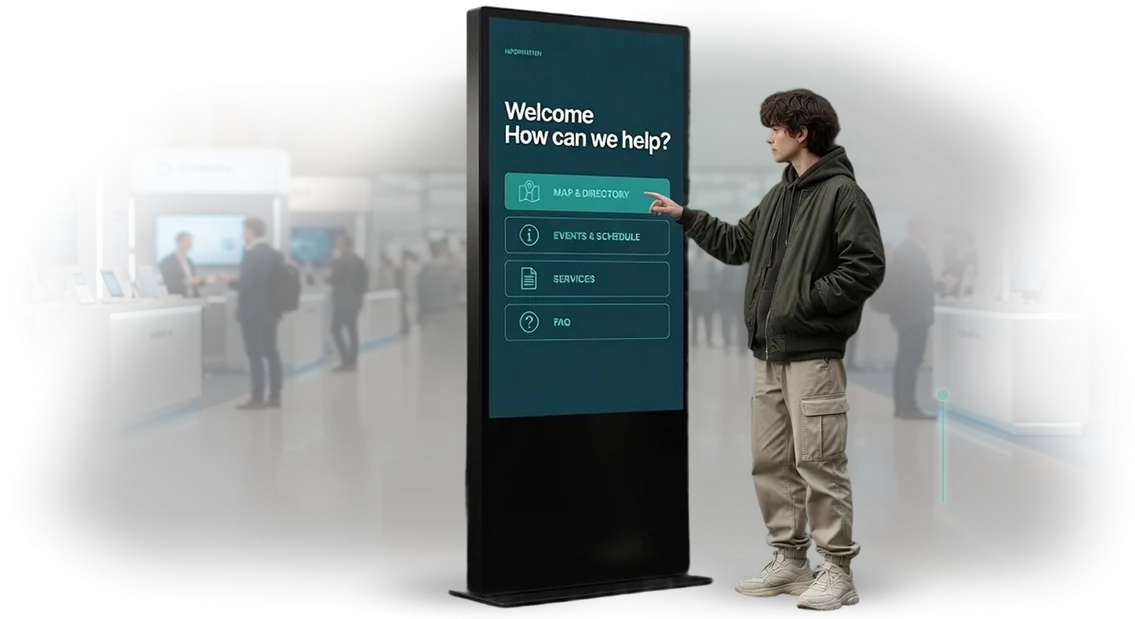
An information kiosk solves this problem even before the conversation with an employee. The customer sees on the screen: what services are available, which window to approach, and approximately how long the wait will be.
They stop asking the administrator and stop feeling anxious about uncertainty — and your staff gets time for actual work instead of repeating the same directions for the hundredth time.
Wehave been creating navigation for offices with visitor flows in the hundreds per day for more than 10 years.
Our kiosks run on professional hardware and reliable server architecture — so the system does not freeze during peak hours and consistently guides the customer from the entrance to the right specialist.
Navigation in an insurance company's office is the first step toward making service feel fast and caring. And that is exactly the task we cover.
What Changes in Office Operations After Installing an Information Kiosk
An insurance office today is not just a place where policies are issued, but also a space where the customer wants to resolve their matter quickly.
Most visits start with a queue to a specialist and repeated explanations of the same information: what documents are needed, what services are available, what conditions apply. This eats up the visitor's time and distracts employees from truly important tasks.
An information kiosk changes this logic: the customer gets answers on their own, without waiting in line. They can check the list of services, book an appointment, view the status of a request, or review program terms — all in a couple of screen touches.
Employees focus only on matters that actually require their involvement, and service becomes noticeably faster.
For the visitor, such a kiosk is freedom and control. They don't depend on a specialist's availability, don't feel obligated to wait, and don't waste time repeating themselves.
This is especially valuable for routine operations: checking a policy, calculating the cost, submitting a claim for payout. Simple scenarios are completed in a few minutes, which directly affects customer loyalty.
What does the office get in the end? First, speed: the average visit time decreases, and the customer flow stops piling up in the waiting area. Second, staff relief: specialists work with those who genuinely need expert advice and don't waste time repeating routine information.
Third, order in analytics: the system records activity, and you see which services are in highest demand.
Importantly, the kiosk does not replace live communication — it complements it. The customer chooses the convenient scenario for themselves: quickly resolve the matter at the screen or discuss details with a specialist.
As a result, the office is perceived as modern and customer-oriented, and that directly affects people's willingness to recommend the company to others.
An interactive kiosk pays off not only in money, but also in trust — which is hard to measure in numbers but easy to feel when talking to a customer.
What Interactive Kiosk Formats Are Suitable for the Office
In an insurance company's office, visitors solve different tasks: find the right department, wait for a consultation, quickly purchase a policy. No single kiosk format covers everything at once — so we select a configuration for each specific area and scenario. The right touchscreen kiosk reduces staff workload and shortens waiting times.
Floor-standing kiosk — a large, full-height kiosk. Placed in the lobby, it works as a wayfinding tool: helps visitors find a department, join a queue, and learn about promotions. Wall-mounted kiosk — a compact panel on the wall in the waiting area.
It displays reference information, allows checking application status, or calling a consultant. Countertop kiosk — a small screen at the administrator's or consultant's desk.
It is used for quick policy cost calculations and preliminary processing — not replacing live communication, but accelerating it.
| Format | For whom | What it gives the customer |
|---|---|---|
| Floor-standing kiosk | Lobby, navigation area | Visitors find the department on their own without an administrator; fewer queues |
| Wall-mounted kiosk | Waiting area, corridors | Customers spend waiting time productively, learn about products without distracting staff |
| Countertop kiosk | Consultant's desk, reception | Quick calculation and preliminary processing — consultations take less time |
The choice of format depends on the layout and visitor flow. Wevisit the site, assess traffic, and propose a placement scheme — so each kiosk works toward a specific department goal and does not sit idle. This delivers measurable results: faster service and higher customer satisfaction.
How Kiosk Development for an Insurance Company Works
Developing a kiosk for an insurance company is not just supplying a terminal — it's a turnkey project, from the first brief to launch and staff training.
We handle all stages of kiosk implementation so you get a working tool for navigation and service processing without taking your attention away from your business.
-
Brief and task analysis. You tell us about your insurance company: what services you offer, how customer flows are organized, and what you want to automate. We study the office, attendance, and typical visitor questions to propose the optimal service structure.
-
Scenario and design development. We create a clear interface that guides the customer from choosing an insurance product to booking a consultation or getting policy details. You see the future screen and can make edits before a single line of code is written.
-
Layout and prototype approval. We show an interactive prototype so you can "click through" all the buttons and confirm that the scenarios match visitor expectations. This eliminates misunderstandings at later stages.
-
Turnkey kiosk development. Once the layout is approved, we configure the operating logic, connect your information systems, and fill the kiosk with up-to-date content. You receive a ready-to-use product, not "raw" hardware.
-
Testing on real scenarios. We check stability under heavy load: simultaneous requests, input errors, non-standard inquiries. All issues are fixed before the kiosk appears in your office.
-
Kiosk deployment and launch. We deliver, install, set up communication with your infrastructure, and perform the final activation. We do this at a convenient time so it doesn't interfere with customers or staff.
-
Staff training and documentation handover. We teach administrators how to update information, change promotions, and monitor statistics. You get a clear manual, access to the control panel, and priority support.
In the end, the kiosk becomes a full-fledged service channel: queues shrink, consultants handle complex issues, and visitors explore your services on their own. All project stages are recorded in the contract, deadlines are met, and you see the result immediately after launch.
What's Included in Kiosk Delivery and Warranty Service
When you order an interactive kiosk, it's easy to imagine it's just a screen on a stand. But for an insurance company, office navigation is part of customer service: the visitor needs to quickly understand where to go and what products are available. That's why we deliver the kiosk as a turnkey solution — from hardware to support.
Standard delivery includes:
- Hardware. A touchscreen kiosk with a protected enclosure and a large display, designed for high loads and continuous operation in the waiting area.
- Installation and connection. Our specialists deliver the device, install it in the right location, and verify that all systems are working.
- Pre-installed navigation system. The kiosk starts automatically when powered on, requires no setup, and does not distract employees from serving customers.
- Information content. An interactive office map, a catalog of insurance products, and current company news. Materials are adapted to your branch and updated regularly.
- Staff training. A short guide for administrators — how to use the kiosk, change information, and resolve minor issues.
- Warranty and technical support. The hardware and installation are covered by warranty, and throughout the entire service life you can reach out for help — we'll resolve the issue remotely or come to your site.
Warranty and support are built into the cost, so you won't face unexpected expenses. If a kiosk stops working or the screen is damaged, we handle repair and replacement ourselves.
While repairs are underway, we provide replacement equipment so navigation never stops, not even for a day.
In the end, you get not just a device, but a working tool that helps customers find their way and relieves your staff. We take care of configuration, content, and maintenance — all you have to do is use it.
How We Relieved a Customer Office in Two Months
For the insurance company «Reliable Policy», the customer office was the main point of contact: people came here for policies, certificates, and consultations.
During peak hours, the queue stretched to 20–30 minutes, managers answered the same questions over and over, and dissatisfied visitors left to competitors. Employees spent up to a third of their working time on routine operations that customers could do themselves.
We didn't replace people — we gave them a tool. Interactive kiosks with a navigation system were installed in the lobby: customers selected their request type, received the route to the right window, or left a request for a callback.
Simple operations — certificates, policy changes, booking an appointment with a specialist — started taking just a couple of minutes without a manager's involvement. The kiosk indicated which documents were needed and immediately directed the visitor to the correct employee. This eliminated the main source of frustration: pointless waiting and repeated questions.
After two months, the queue during peak hours had shrunk by almost half, and the satisfaction index from surveys increased by 20%. Repeat visits became more frequent: customers remember the convenient scenario and return when a new question comes up.
For the office, this meant lower workload and higher loyalty without expanding the staff. Managers stopped acting as a help desk and focused on complex requests that genuinely require an expert.
For us, this is a successful project with a fast payback: the integration took three weeks, and the first changes in visitor flow were visible within a month.
We didn't change internal processes or rebuild the company's IT system — the kiosks adapted to the existing way of working. If your office faces a similar problem, let's discuss how to replicate this result on your timeline.
What If the Kiosk Breaks Down or Needs an Update?
We handle both repairs and regular updates — you won't need to dig into the technical details. The kiosk works as part of your service: the insurance agent and the customer see only up-to-date information, while all update processes remain on our side.
Software is updated remotely on a schedule, so content — rates, promotions, office contacts — is always current. You don't need to assign an employee to manually update materials or check system versions. We monitor correct operation ourselves and prevent failures at an early stage.
If a kiosk does go down, we respond according to the service agreement: perform diagnostics and replace faulty components. For critical cases, we provide prompt equipment replacement so the navigation zone in the insurance office doesn't stand idle. You get one direct line to an engineer, not a "call support and wait" experience.
Warranty service includes scheduled inspections of touch panels, enclosures, and communication modules — this reduces the risk of sudden failures. After each visit, we send a short report: what was checked, what was updated, and what work is planned.
This way, you always know what's happening with the equipment and can plan your maintenance budget in advance.
The main result — the kiosk works invisibly for customers and staff: no errors, no freezes, no outdated data. You focus on insurance products, and the technical side remains our responsibility.
Frequently Asked Questions About Interactive Kiosks for the Office
An interactive kiosk for an insurance company is not "just another screen" — it's a tool that relieves employees and helps customers get the information they need quickly.
Before launch, managers often ask the same questions: how long installation will take, what the development will cost, and how the kiosk will fit into the existing infrastructure. Below are answers to the most common ones.
How long does kiosk development and installation take?
A typical project takes two to four weeks from the moment the mockups are approved. This includes system configuration, content upload, and testing on your equipment.
If you need it urgently, we can launch a basic version in 5–7 business days and add the remaining materials after launch.
How is the development cost determined?
The price depends on the number of sections, the complexity of navigation, and the need for integration with your customer accounting system or policy database.
For an accurate estimate, send us the list of services and information structure — we'll prepare the calculation within one business day. A transparent estimate with no hidden payments: we fix the price at the start and don't change it during the process.
Is the kiosk compatible with our infrastructure?
Yes. We work with standard touchscreen equipment and configure the system for your network: employee authorization, database access, and content updates through an internal server.
If you need to connect to a corporate portal or a calculation program, we'll plan the integration during the design stage.
Still have questions about timelines, cost, or compatibility? Leave a request — within one business day we'll prepare an individual solution for your office and calculate the exact project cost.Submit a Request for Kiosk Development for Your Needs
An interactive kiosk is an investment in service, and it's important that it pays off.
Leave a request — and within two business days we'll prepare a project estimate for your insurance company, taking into account the customer flow, the number of offices, and the tasks the kiosk will handle. No "average prices" — only specifics for your situation.
During the consultation, we'll cover:
- What scenarios you need: office navigation, appointment booking, policy cost calculation, product consultations.
- How many kiosks are required and where to place them so they actually reduce staff workload.
- How the kiosk will fit your brand style and what features can be added later.
- Development timeline and a "turnkey" launch plan — from design to installation and staff training.
- What's included in warranty and technical support after launch.
After the calculation, you'll receive a clear estimate and step-by-step recommendations. You'll be able to compare options, ask questions, and make a decision without rushing.
Submit a kiosk request through the form on the website — we'll call you back within one business day, clarify the details, and prepare the estimate. There is no obligation.