

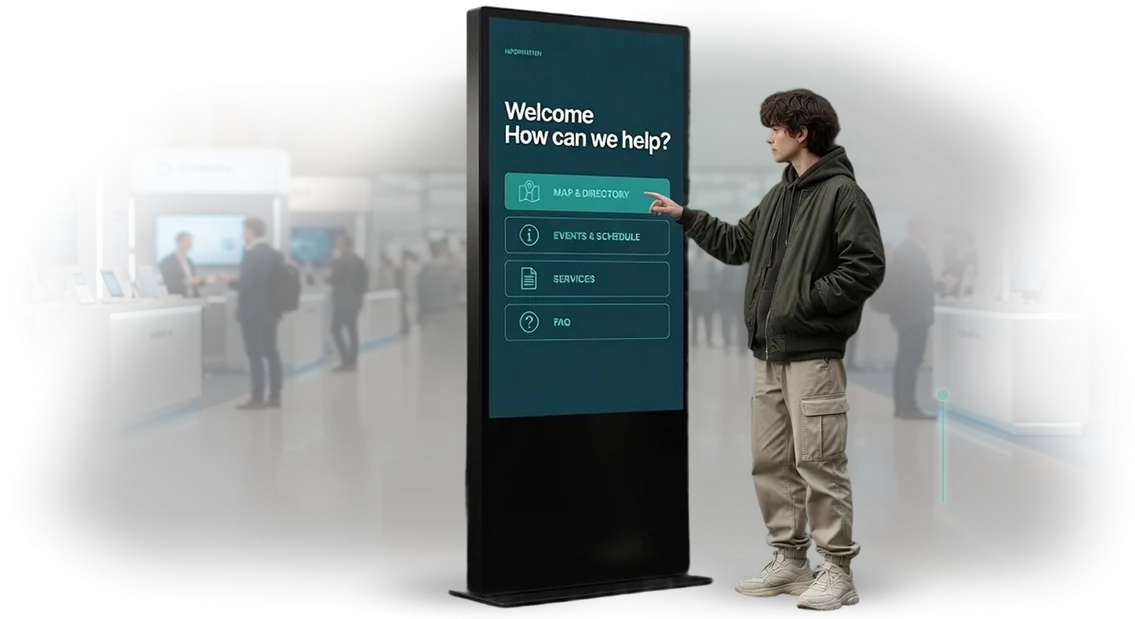
Why guests leave shopping malls without buying: outdated navigation
Visitors come to a shopping mall to spend time, browse storefronts, and buy what they planned. But when they can't find the right store or café on the first try, their mood sours: they lose 5–10 minutes, start getting annoyed, and often simply leave.
This isn't an isolated case but a systemic problem of outdated navigation in malls — it quietly eats away at tenant revenue and reduces foot traffic.
Half of guests enter a shopping center without a clear plan. They're looking for inspiration, but instead they run into confusing maps, small signs, and wayfinding that hasn't been updated in years.
Today's guest is used to getting an answer in a second — and if a paper-based system forces them to think, they perceive it as disrespect for their time. This is especially true for families with children and young people — the audience with the highest purchasing power.
Lost customers due to navigation are measurable losses
Every lost guest is not just a missed purchase. An unhappy visitor will leave a negative review, tell their acquaintances, and next time choose a different mall.
According to our clients' calculations, simply having convenient store search increases average visit duration by 20–30%, and the average ticket grows along with it. An outdated system is the silent killer of repeat visits.
The solution — interactive kiosks in shopping malls
An interactive kiosk is not just an electronic map, but a full-fledged digital assistant: it shows the route to the desired store, suggests what promotions are running today, and helps find the restroom, elevator, or family room.
A guest spends not minutes but seconds on searching — and moves from navigation to shopping. These are exactly the systems we've been creating for over 10 years: turnkey, tailored to your mall's layout and your guests' behavior. There's no need to put up with losses — just make navigation modern.
What benefits do information kiosks bring to a shopping mall
An information kiosk in a shopping mall is not just an electronic directory, but a full-fledged tool for increasing loyalty and boosting revenue.
It helps a guest quickly find the right store, café, or restroom, which reduces stress levels and the desire to leave the building quickly. The more comfortable the visitor feels, the longer they stay and the more they spend.
For guests: convenience they remember
Navigation via a touchscreen kiosk cuts search time several times over on average — instead of wandering through floors, a person goes straight to their destination. This directly affects the impression of the mall: the guest perceives it as a modern place that cares about them.
And if the kiosk also shows promotions, events, and a schedule, it helps visitors spend their time more richly rather than just "walking past."
Convenient navigation is also a matter of caring for different audiences: parents with strollers, elderly people, guests with limited mobility.
A kiosk with large buttons and clear categories makes the mall accessible to everyone, building lasting loyalty to the complex as a whole.
For brands and tenants: additional traffic
The kiosk works as a showcase for tenants: the screen can display not only a map but also advertising banners, information about promotions and new arrivals.
This increases brand recognition within the mall and encourages guests to look into a store they hadn't thought about before. In effect, tenants get an additional advertising channel without hiring external contractors.
For the management company, the advantage lies in data. Kiosks collect request statistics: which stores are searched most often, which categories are most popular.
This data helps plan leasable space wisely and improve navigation, which in turn increases the overall efficiency of the complex. Such a system pays for itself through increased foot traffic and longer average guest dwell time.
We design kiosks so they're intuitive from the first touch and easily fit into a mall's design. We work with professional equipment that performs reliably under heavy loads — so your kiosk won't let you down on the busiest day.
Interactive kiosk formats for shopping malls: choosing the right fit for the task
In any shopping center, a kiosk is not just a screen but a tool that solves specific tasks. However, there's no universal format: what works well in a small mall will get lost in a large complex.
That's why it's important to understand in advance which kiosk will benefit your visitors and your business.
Large malls: navigation and high load
In large shopping centers, visitors often get lost in the flow of stores. A navigation terminal with a map and search helps quickly find the right department, reduces queues at the info desk, and makes time spent in the mall more comfortable.
Such a kiosk must be visible, fast, and built for constant use — we make terminals that withstand heavy traffic.
Small and medium centers: compact solutions
Small centers don't need a complex system — an info kiosk with tenant and event information is enough, and a separate panel works well for advertising promotions.
This is a cost-effective way to make the space modern and useful for guests without cluttering it with unnecessary structures.
| Format | For whom | What it gives the client |
|---|---|---|
| Info kiosk | Small and medium shopping centers | Introduces tenants, answers typical questions, easy to update |
| Navigation terminal | Large malls, multi-level complexes | Helps quickly find stores, relieves staff, improves guest convenience |
| Advertising panel | Shopping centers of any size | Shows promotions and events, attracts attention, allows earning from ad placement |
The choice of format depends on floor area, visitor flow, and marketing goals. We help select the optimal solution — from a single kiosk to a system of terminals throughout the center.
How navigation development for a shopping center works
We've been working with shopping centers for years, so we've structured the navigation development process so that you see every stage and understand what's happening with the project at any moment.
You won't have to dig into technical details — we handle all the organization, from the first brief to launch and support.
Preparation stage: where the project starts
It all begins with a short kiosk brief: you tell us about your goals — whether you need store navigation, specific brand search, advertising zones, or integration with your loyalty program.
We clarify the mall's layout, study visitor flows, and determine optimal placement points so the kiosks deliver value rather than stand off to the side.
Based on this, we prepare a concept and a detailed plan: stand locations, menu structure, and a design mockup in your brand style. You receive a clear estimate and timeline, and after approval we move to implementation. No hidden stages — only what your shopping center actually needs.
Implementation stage: from mockup to a working kiosk
In parallel with manufacturing the enclosures and preparing the software, we align all texts, the map, and the corporate style with you.
Then we carry out installation: we mount the kiosks, configure the equipment, and connect them to the power supply and your internal system if required. After that, we run a test launch, train your staff, and hand over operating instructions.
At every step, you receive readiness reports, so you always know what stage the project is at. And after launch, we stay in touch and handle maintenance: content updates, technical support, replacement of consumables — everything to keep the kiosks running without interruptions.
The daily routine looks like this:
- Brief — we record tasks, wishes, budget, and timelines.
- Mall analysis — we study the layout, guest flows, and attraction zones.
- Plan and mockup — we prepare a placement scheme and design prototype.
- Approval — you make edits, we approve the final version.
- Implementation — we manufacture the enclosures and configure the software.
- Installation — we install the kiosks and connect the infrastructure.
- Launch and support — we test, train staff, and provide support.
What's included in the navigation system delivery package
The delivery package question usually comes down to two things: "what exactly will we receive" and "who will launch and maintain it." We cover both — we supply everything needed for the kiosk to operate and take on installation, configuration, and ongoing maintenance.
What's needed for installation
Kiosk equipment. A touchscreen enclosure with a vandal-resistant screen, an integrated mini-computer, and an uninterruptible power supply. The kiosk is ready to operate immediately after installation at the site — the engineer just needs to connect it to power and the internet.
Installation and commissioning. Our specialists deliver the kiosk, mount it in the navigation zone, connect it, and verify all usage scenarios. The client receives a fully working kiosk without needing to hire subcontractors.
Instructions and training. We provide mall staff with a short guide on powering on and basic care, and administrators get access to the control panel with descriptions of actions for typical situations.
In the software part
Navigation software. A license for the mall's interactive map, store and service search, route building, and promotion display. Updating the catalog and floor plans doesn't require a programmer — a manager can change everything through a simple interface.
Custom branding. Design configuration to match the mall's style, uploading logos and store photos. The client gets an interface that looks like part of the brand, not a generic template.
In the end, the delivery package covers the full cycle — from the "box" to a working navigation service. The final list includes:
- a touchscreen kiosk with a vandal-resistant enclosure and power surge protection;
- licensed navigation software with update rights;
- on-site installation, connection, and commissioning;
- interface customization to match the mall's corporate style;
- operating instructions and staff training;
- technical support and remote kiosk monitoring.
Case study: 32% footfall growth in a shopping center
We developed navigation for a large regional mall. The problem: visitors got lost, couldn't find the stores they needed, spent less time, and left without buying.
Replacing paper signs with interactive kiosks dramatically changed guest behavior — they became more willing to explore the floors and stay longer inside.
Project details
For a large regional mall, we installed 12 touchscreen kiosks with a map, store search, and routes. Three months after launch, footfall grew by 32%, and average dwell time increased from 1.5 to 2.3 hours.
The number of inquiries at the information desk dropped by half — administrators shifted their focus to helping with leasing and special projects.
The main result of the project isn't just the numbers. Many tenants noted an increase in visits to their boutiques, and the management company gained an analytics tool: we can see which locations are searched most often and advise tenants on better signage and promo placement.
Six months later, the mall ordered content updates from us and added advertising zones on the kiosks — a separate source of revenue.
This navigation case confirms: a well-designed wayfinding system turns chaotic movement through the floors into a manageable flow. Growth in footfall and dwell time directly affects tenant revenue and the shopping center's attractiveness to new brands.
How to choose a kiosk format for your facility's needs?
Choosing a kiosk starts not with the screen but with the task it must solve: guide a visitor along a route, tell them about promotions, or collect contacts.
There are no universal solutions, so first define the main scenario — the number of locations, screen size, and feature set depend on it.
The best guide is guest behavior and the logic of your facility. If traffic is distributed across several entrances, it's better to install several compact stands with store search than one large terminal in the center.
If the main goal is to keep visitors longer and show them entertainment options, you need an interactive format with a map and event schedule. That way you don't overpay for unnecessary features and you solve exactly your business task.
A common client mistake is choosing the "most feature-packed" model for future needs because it seems like a better value.
In reality, guests walk past such a kiosk: a huge screen with a dozen sections is off-putting, and a queue of people asking for directions simply makes others follow the signs.
It's equally risky to install a single terminal for the whole mall — it can't cope during peak hours, and all the benefit drops to zero.
Another tip: pay attention to load resistance. In a shopping center, a kiosk works seven days a week, and thousands of people approach it, sometimes with children and bags. Cheap models save on materials and touch glass, which leads to freezes and repairs after a few months.
So choose professional enclosures with dust and vandal protection, even if they look simpler on the outside.
The main thing is to conduct a short brief before purchasing: what questions visitors ask most often, where they get lost, what you ultimately want to measure. An interactive systems specialist will help turn these inputs into a configuration that works toward your results.
Then the kiosk becomes not an expensive toy but a tool that relieves staff, increases guest loyalty, and brings measurable value to the facility.
Answers to frequently asked questions about kiosks
Before ordering a touchscreen kiosk, mall managers tend to ask the same questions: how long will it take, how reliable is the equipment, who maintains it, and what determines the cost.
We've collected answers to the most common ones — without unnecessary technical details, only what affects visitor convenience and your operations.
How long does development and installation take?
A typical project takes two to four weeks from the moment the mockups are approved. This timeframe includes interface design, enclosure production, software configuration, and a test launch.
If integration with your store database or custom branding is needed, we discuss timelines at the brief — but we usually fit within the same window.
What happens if a kiosk breaks down during mall operating hours?
The stands are built for intensive non-stop use throughout the entire working day. Even in the event of a fault, the system reboots itself and returns to the home screen — no staff intervention required.
During warranty repairs, we provide a replacement device so navigation keeps working without pauses or queues.
What warranty is there, and is technical support available?
We provide a warranty on the equipment and software, and after launch we support the project remotely: we monitor the condition of the kiosks and update content. If questions arise, we respond within one business day. If necessary, we visit the site to resolve the issue in person.
Is it expensive, and what determines the cost?
The cost is made up of the enclosure with a touchscreen, interface design, and navigation logic configuration. The exact estimate is calculated after the brief and fixed in the contract — it doesn't change during the work.
The kiosk pays for itself because visitors find the stores they need faster and administrators spend less time giving directions.
If your question isn't covered here — ask us directly, and we'll respond within one business day and send you an estimate for your task.Order the development of an interactive kiosk for your shopping mall
Developing an interactive kiosk for a shopping mall isn't about buying a "piece of hardware" — it's about launching a tool that guides visitors, reduces questions to staff, and increases time spent in the center.
We handle the entire journey: from idea and design concept to installation and commissioning. You get a working turnkey solution, not a pile of tasks and reports.
What you get after ordering
- Expert consultation — we analyze your mall's challenges: traffic, attraction points, complex transitions, tenant needs. We advise where kiosks will deliver the most value.
- Accurate estimate for your facility — the number of stands, their placement, and functionality: maps, store search, events, advertising zones. No unnecessary options — only what pays off.
- Design concept in the mall's style — the kiosk looks like part of the interior, not a temporary technical device. We account for corporate style, materials, lighting, and safety.
- Turnkey development — from interface to installation work. You don't need to find subcontractors for every detail: we're responsible for the entire result.
- Commissioning with training — we configure content, test operations in real conditions, and show your team how to update information. The kiosk works from day one.
- Post-launch support — map updates, adding new tenants, technical maintenance. You're never left alone with the equipment.
To request an estimate, just send an inquiry through the website or call us — we'll get back to you within one business day with a preliminary solution. We'll explain how the kiosk will fit into your mall, how long implementation will take, and what will be needed from your side. Leave a request — and get a clear action plan without technical details or unnecessary questions.