

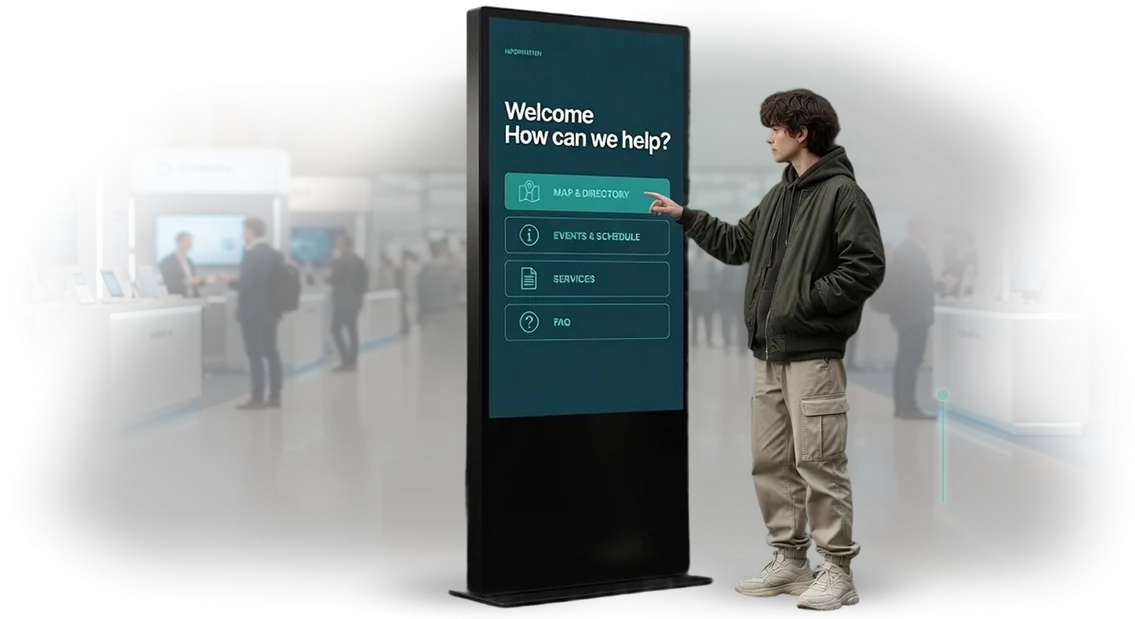
Passengers get lost at the station — how a kiosk restores order
Every day, hundreds of passengers at the station waste time searching for the right exit, platform, or luggage storage.
During peak hours this turns into chaos: people crowd around the departure board, miss their trains, and information desk staff endlessly answer the same questions.
Lost passengers mean not only frayed nerves but also direct losses for the station: less time spent at cafés and shops, poorer reviews, and a heavier workload for staff.
An information kiosk with clear navigation solves this problem. Passengers select the desired destination on the map and receive step-by-step directions without having to approach the staffed information desk.
As a result, the station operates more smoothly: fewer lost passengers, less burden on staff, and faster passenger flow. For management, this means predictable operation of the hub and satisfied passengers who come back again.
At our team we design information kiosks for the specific needs of a station: we analyze passenger flows, frequent questions, and the layout of facilities, and create navigation that works without constant staff involvement.
This is not just equipment installation — it's the implementation of a system that brings order to people flow.
What interactive navigation gives you: 5 key changes
An interactive kiosk at a station is not just a screen with a map but a tool whose impact passengers and administration feel immediately. The our team solution delivers five measurable changes in station operation.
1. Passengers find their way in a couple of taps
Minutes at a station are precious: a person is looking for a platform, ticket office, or exit while their train is about to depart. The kiosk builds a route from the current location to the desired destination — quickly, clearly, and without staff involvement.
Passengers wander less, reach their train with less stress, and remember the station as a convenient one.
2. The information desk is relieved of routine questions
"Where is the ticket office?" and "How do I get to the platform?" — the kiosk handles these questions on its own. Information desk staff can focus on complex and non-standard requests, and queues during peak hours shrink. Staff time goes to what truly requires human contact.
3. Satisfaction and loyalty grow
People control their own search instead of waiting to be served. This reduces stress and creates a sense that the station cares. Satisfied passengers complain less, return more often, and leave positive reviews.
4. A single showcase of services appears
The kiosk shows schedules, services, cafés, hotels, and travel rules — all in one place. Information stays current and updates without printing new signs. This saves the printing budget and makes navigation dynamic and manageable.
5. You see what passengers really need
The kiosk collects data on the most frequent requests and peak hours. You understand where signs are missing and when to reinforce the information desk. Decisions are made based on real demand rather than guesswork.
Interactive kiosk formats at the station: choosing the right one for the task
Every station operates by its own rules: in one place the priority is relieving the queue at the information desk, in another it's guiding passengers through confusing passageways, and in a third it's making waiting time useful for the brand.
The kiosk format should match not only the installation zone but also how people behave in that zone.
A floor-standing kiosk in the center of the lobby is visible from afar and acts as a prominent point of attraction. A stationary kiosk near an exit or in a corridor is a quick hint for those already on the move and not ready to engage in a long dialogue.
We select the form factor so that passengers get an answer in 15–20 seconds and staff hear fewer repeated questions.
| Kiosk format | Station zones it suits | What it gives the client |
|---|---|---|
| Floor-standing kiosk | Lobby, waiting hall, area near ticket offices | A prominent information point that draws passenger flow, reduces staff workload, and shortens queues |
| Stationary kiosk (wall-mounted or wall-anchored) | Corridors, passageways, exits to platforms, elevator lobbies | Does not take up useful floor space; helps passengers move in the right direction without stopping or backtracking |
| Compact kiosk with touch panel | Ticket office area, information desks, waiting areas | Duplicates part of the ticket office and information desk functions — passengers independently find schedules, fares, routes, and the way to their train |
This is a guide, not a rigid scheme. At the same station, a floor-standing kiosk can stand in the lobby while stationary units are placed in every passageway.
We will help you place the formats so that passengers encounter information exactly where they need it and don't waste time searching for it.
How kiosk implementation works: 6 steps without surprises
Implementing a kiosk is not "delivered and installed" but a structured process with clear timelines and accountability. We work so that the station experiences no downtime: every stage is agreed in advance, and you can see at any moment what stage the project is at.
- Passenger flow analysis and brief — we meet with you, study movement routes, the points where passengers look for information, and the current signage. We record the goals: what should appear on the screen, which routes take priority, and how the kiosk will fit the interior. The result is a technical specification approved by all parties.
- Kiosk design and approval — we design an interface that is easy to read from a distance and clear to people of any age. We show body style variants and placement options at the station. Once you confirm, we begin manufacturing.
- Manufacturing and configuration — we manufacture the body, install reliable touchscreens and the control module. In parallel, we set up the monitoring system so that faults are caught immediately and queues at the kiosk never build up.
- Installation and connection — we deliver the kiosk, mount it at the agreed location, and connect power and the station's internal network. We configure the schedule and, if needed, integration with other information services.
- Peak-hour testing — we check how long passengers take to find a route, whether the right platform is easy to locate, and whether crowds form. Based on the results, we make targeted adjustments to the interface.
- Launch and staff training — we switch the kiosk into continuous operation, show your staff how to restart the system, refill paper for route printing, and who to call in an emergency. We hand over a clear manual and a maintenance schedule.
The project usually takes two to four weeks — timelines are fixed in advance. You receive finished navigation with trained staff and support, and the station gets calm passengers who don't miss their trains.
What's included in the delivery: the complete kit for launching navigation
We supply not just a touch kiosk but a complete navigation system you can activate on launch day. The package includes equipment, interface, content, installation, and training — you know exactly what's included in advance and receive no unexpected surcharges.
- Kiosk equipment and installation. A touch-enabled body protected against wear, dust, and passenger traffic is delivered and installed in the station's navigation zone. The work is completed in a single day.
- Navigation interface. A clear map with search by name and platform number. Visitors find exits, ticket offices, and the information desk on their own — staff are distracted less by repeated questions.
- Kiosk content. A station map, list of destinations, exit scheme, and up-to-date schedule. No "empty" screens: the information is ready for the first launch.
- Schedule updates. Data is updated through an easy-to-use admin panel — a designated staff member makes changes without a programmer, in minutes.
- Staff guide. Instructions for turning on, restarting, and replacing information. A duty employee can handle it without special knowledge.
- Training and launch. A specialist delivers the kiosk, installs it, uploads the content, and provides brief training for station staff.
- Warranty and support. After launch, you're not left alone with the equipment: we work under contract, answer questions, and help when failures occur.
In essence, it's a checklist for verification: this is exactly the package you should see in the contract. In the end, you solve the navigation task once and get a system that works from day one and requires no constant external support.
Case study: interactive kiosk in the waiting hall improved navigation
In the waiting hall of a major station, passengers wasted time searching for ticket offices, luggage storage, and the right exits.
Staff answered hundreds of identical questions every day — hours were spent on this, while travelers' stress grew along with the risk of missing their train.
We — our team — installed two touch kiosks with an interactive building map in the waiting hall.
Passengers select the desired point on the screen (ticket office, restroom, platform exit) and get step-by-step directions with landmarks, plus the current time until train departures. The project took four weeks from brief to launch.
Results after three months of operation:
- The flow of questions to the information desk dropped by 60% — staff shifted to helping passengers who genuinely need it.
- The average time to find a destination dropped from 4 minutes to 40 seconds — just a couple of screen taps.
- 85% of users noted that the kiosk improved their impression of the station and made orientation easier.
The station administration received an analytics dashboard: it shows which services are searched most often, where congestion occurs, and when the kiosks face peak load.
Based on this data, they plan sign placement and flow distribution — saving passengers' time and reducing the burden on staff.
The client was satisfied: we continue to maintain the kiosks and are preparing an expansion to the adjacent halls. If you want the same result for your facility — start with a short consultation; we'll select a format for your passenger flow and goals.
What to do if a non-standard kiosk scenario is required?
Non-standard requirements are not a limitation but a design challenge. We build each kiosk for a specific situation rather than a standard template.
If the station needs not just a track diagram but an electronic queue for the ticket office, boarding pass issuance, or a warning about platform changes — all of this becomes part of the scenario.
A station is an environment with heavy loads and a tense rhythm, so the specific characteristics of the facility are taken into account from the start.
What matters is not only what the screen shows but how a person interacts with the device: response speed, large buttons, resilience to crowds, and reliability at peak hours.
We design the logic so that passengers of any age and skill level can figure it out on their own in 10–15 seconds without creating a queue.
A custom scenario does not mean lengthy development or complex configuration. We select the configuration for your tasks: from a simple menu to multi-step scenarios with feedback.
The client gets a kiosk that solves the specific problem of their facility, not just a device with a standard set of functions.
The key thing is we keep everything manageable. Any scenario can be easily updated remotely: change the schedule, add information about track repairs, or modify routes.
You don't depend on a programmer for every change — the system adapts to the station's day-to-day life without downtime.
Frequently asked questions about interactive kiosks
Clients in the transport industry most often ask about kiosk reliability and the maintenance process. We answer the main concerns so you understand what we're responsible for and what falls on your side.
What warranty is provided on the kiosk and what does it cover?
We provide an official warranty on the equipment and software. Under it, we fix faults related to kiosk operation free of charge: parts replacement, software configuration, and recovery after failures. This protects you from hidden expenses during the first year of operation.
What to do if the kiosk stops working?
A simple procedure applies: you submit a request, we run remote diagnostics and either resolve the issue remotely or send a specialist to the site. Average response time is 24 hours.
For critical situations — for example, a widespread navigation failure during peak hours — priority on-site visits are provided.
How is the schedule updated on the kiosks?
The schedule and other content are updated remotely via a secure channel. You send a file in the agreed format — and within a few hours the information appears on all kiosks at the station. No need to go around to each screen and reconfigure the system manually.
Who is responsible for kiosk operation after launch?
We remain responsible for the system's operability for the entire term of the contract. The agreement specifies an SLA: response time to requests, recovery deadlines, and the procedures for maintenance and equipment replacement. You won't have to look for a new contractor with every breakdown.
What are the launch timelines and what do we need to prepare?
A standard launch takes two to four weeks depending on the number of kiosks and the integration format. All we need from your side is a space for the kiosk and a power outlet. Connection, configuration, test runs, and staff training are on us.
Launch convenient passenger navigation this season
For a station, navigation is not a service — it's part of passenger logistics.
When schedules, ticket offices, platform exits, and the information desk are two or three taps away from where passengers need to be, there are fewer missed trains, shorter queues at information counters, and calmer flow even at peak hours. This directly affects passenger loyalty and the image of the transport hub.
We handle design, production, and launch — from planning based on your layout to installation and configuration. We'll show you how the kiosk will fit into the station's interior, which one to place in the waiting area and which one near the entrance.
We'll account for safety zones, passenger flows, and accessibility for passengers with limited mobility.
Why the kiosk is needed now
- Fast launch: just a few weeks from project planning to installation.
- Thoughtful kiosk placement based on passenger flow and safety zones.
- Information about trains, station services, taxis, hotels, and city transport in one place.
- Reduced load on the information desk and staff.
- Uninterrupted operation: remote monitoring and data updates without a specialist visit.
- Integration capability with the station schedule and online display boards.
Leave a request for a kiosk — we'll send you a project assessment, a preliminary placement plan, and answer your questions about timelines. All you need to do is write to us via the form below or call.
We'll discuss not only the kiosk itself but also the content plan for it: how passengers will find what they need in two taps. We'll handle approvals and help you prepare the specification for contractors.