

How Not to Lose a Client in a Residential Complex: Interactive Navigation
In a residential complex with several buildings, a guest or resident easily gets lost: the right entrance, the management company office, a playground, guest parking.
Finding these takes minutes, sometimes half an hour — instead of a calm visit, a person gets stress and a negative impression. Ordinary signs do not solve the problem: there are too many objects and nuances on the territory.
For the management company this is a direct cost: overloaded staff answer the same questions, residents complain about inconvenience, and guests form their opinion of the complex based on first impressions.
Trust in the management company falls, even if the services themselves are good. This can be fixed in a simple way — give people the opportunity to find what they need in a few seconds on their own.
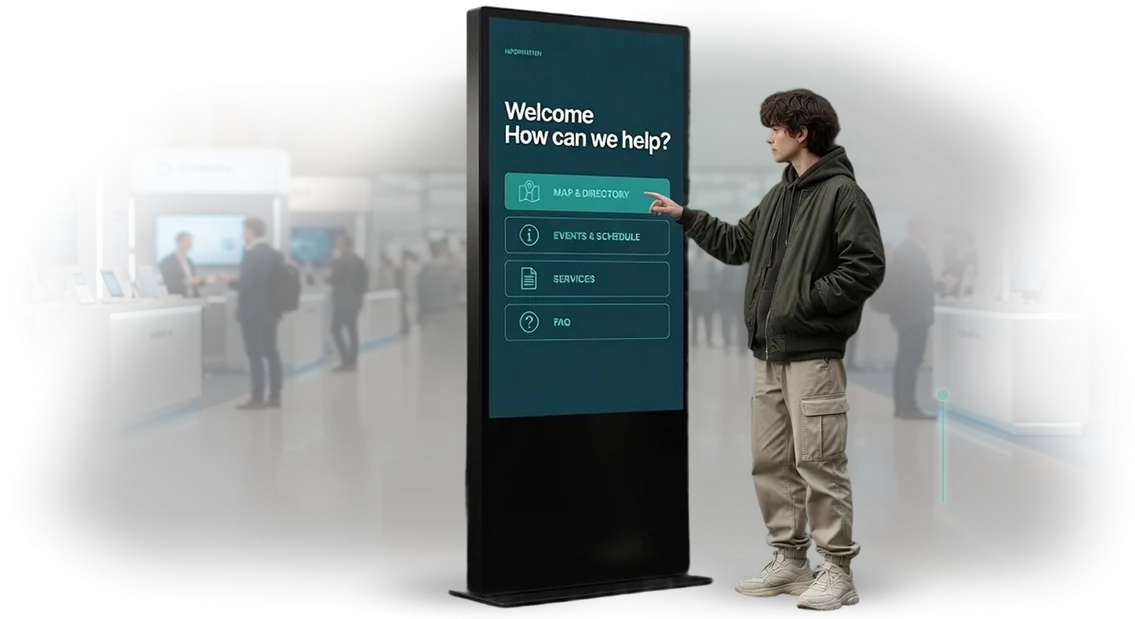
Interactive kiosks with touchscreens placed in lobbies and at entrance groups turn navigation for the residential complex into a fast and clear process. A visitor selects the desired building, office, or service on the screen — and immediately sees the route and landmarks.
There is no need to look for security or call the management company: information is available around the clock, and convenience for residents and guests becomes a competitive advantage of the complex.
Such kiosks enhance the image of the management company: modern, caring, technologically advanced. Residents see that they are being thought about, guests feel confident, and the burden on staff is reduced.
We design and develop interactive kiosks for a specific residential complex, taking into account its layout and needs. We help solve the navigation issue and make the area truly comfortable.
What the kiosk brings: loyalty, comfort, and fewer calls to the administration
Residents of a new complex ask the same questions every day: where the kindergarten is, how to make an appointment with the manager, when the commercial zone will open. Each such question distracts administration staff from real tasks and creates a queue of identical inquiries.
The touchscreen kiosk takes on these routine requests — a resident gets an answer in 30 seconds, and your team stops spending hours on repeated consultations.
The first and main benefit is increased resident loyalty. When a person can find information about the management company’s operations, services, and infrastructure at any time of day, they feel cared for and see a modern approach. This directly affects satisfaction and whether a resident will recommend your complex to friends.
The second benefit is relieving the administration. Instead of explaining ten times how the access control system works or where the meeting room is, staff can focus on resolving complex issues.
The kiosk reduces the flow of standard requests by 30–40%, meaning you will not need to expand support staff as the number of residents grows.
Third is improved service and brand recognition. The interactive kiosk looks modern and is visible to guests and potential apartment buyers.
A residential complex with such a solution is perceived as high-tech and premium, which strengthens its position when selling the next phases.
Finally, the kiosk operates without breaks or weekends, and content management takes moments: you can change announcements, events, and working hours yourself.
This is not a one-time investment in hardware, but a tool that gradually pays for itself through saved staff time and increased resident satisfaction.
Which info kiosk formats are suitable for a residential complex
A modern residential complex has several buildings, inner courtyards, and an underground parking lot. New residents and visitors spend time finding the right entrance, couriers get lost, and the management company receives a flurry of identical questions.
One kiosk format does not cover all scenarios: an outdoor solution will not survive a lobby, and a navigation panel near the elevator is useless on the grounds around the buildings.
Therefore, we separate formats by placement and purpose. The table shows the main options, their audience, and the benefit to the developer or management company.
| Format | Where to place | For whom | What it gives the client |
|---|---|---|---|
| Outdoor info kiosk | Grounds around the buildings, entrance groups | Guests, couriers, delivery services | Fast navigation between buildings, fewer calls to the management company |
| Indoor info kiosk | Lobby, vestibule | Residents, visitors | Floor map, service schedules, announcements |
| Navigation screen | Parking area, elevator zones | Car owners, guests | Direction signs to sections, reduced flow of inquiries |
| Residential complex info stand | Common areas | Complex residents | A single window for events, news, and reference information |
When choosing a format, evaluate the typical entry points to the residential complex: the street, the lobby, the parking area. For navigation between buildings, an outdoor kiosk is enough; inside the building, indoor screens with a floor map work best.
Often a combination of two or three formats is optimal to cover all movement scenarios around the site.
We develop turnkey info kiosks for residential complexes: we design them in the style of the complex, customize the interface to the management company’s needs, and support the launch.
We will advise which formats suit your specific property and offer a balanced package for the project budget.
How the project proceeds: from brief to launch
For a residential complex, navigation is not just signs; it is a way to reduce the administrative burden and increase resident satisfaction.
We have structured the process so that you know what is happening at each stage and the timeline for implementing the kiosks is clear from day one. Below is the step-by-step workflow.
-
Brief and needs analysis. We study the layout of the residential complex, the typical routes of residents and guests, and identify the points where navigation is needed most. Based on this, we define the requirements for the touchscreen kiosks and their placement.
-
Layouts and navigation logic. We develop the section structure and a search system by addresses, entrances, infrastructure, and important facilities. We agree on the visual style with you — from the color scheme to the icons.
-
Approval and sign-off. We show screen prototypes and refine the details: interface languages, maps, search methods. You get a clear picture of the future system before it is physically installed.
-
Delivery and installation. We manufacture and deliver the equipment and install the navigation systems in the agreed locations: vestibules, lobbies, common areas. We also connect power and network.
-
Testing and training. We test the kiosks in real-world conditions and set up remote content updates. We show the administration how to make changes without a programmer.
-
Warranty support. We stay in touch: we support the system and update maps and data. Launch usually takes 2 to 4 weeks depending on the area — exact timelines are fixed in the contract.
What is included in delivery: a turnkey package
Turnkey is not just delivery and installation. We structure the delivery package so that the kiosk works from day one and requires no technical knowledge from your team. Setup, design, and training are included in the cost.
-
Equipment tailored to the residential complex — touchscreen stands that withstand high traffic and fit neatly into a lobby or elevator area. The housings are protected from dust and accidental impacts, so they last a long time even with heavy use by residents and guests.
-
Design layout that fits the interior — we create a design in the style of your residential complex: logo, brand colors, a site map, and clear pictograms. The kiosk does not look like an alien element; it becomes part of the space.
-
Software shell with a clear interface — a resident finds a building, section, infrastructure, service hours, and contacts in just a few taps. The management company can independently update information: change schedules, add announcements, adjust the map.
-
Instructions and guidelines — short memos for staff and residents: how to turn on the kiosk, how to replace information, and what to do in an emergency. No complicated documentation — only practical everyday tips.
-
Warranty and technical support — official warranty on all equipment, prompt remote diagnostics, and component replacement in case of failure. You are not left alone with a problem.
-
Staff training — we hold a session with administrators or management company employees: we show them how to change data, use the control panel, and handle common resident questions. After training, your team works confidently with the kiosk without contacting developers.
Case study: how a 25-story building stopped being a maze
Residents of high-rise buildings know what a “maze” of identical corridors and similar lobbies looks like.
In one 25-story building with three sections, guests and new residents constantly got lost: they looked for the right entrance, called intercoms, and asked the concierge even in simple situations. The burden on the management company grew, and so did dissatisfaction.
We installed touchscreen kiosks with interactive navigation in lobbies and elevator areas — on every floor we placed a clear diagram showing apartments and the exit to the elevators.
The client received a complete turnkey solution: installation, configuration, loading the building diagram, and staff training. Residents only had to select the desired number on the screen — the system built the route in a couple of seconds.
Results appeared within the first month. The number of concierge inquiries about “where is the apartment” fell by more than a third, and the average time to find the right door dropped from five minutes to 30 seconds.
Guests began handing apartments over to renters faster, couriers stopped wandering, and residents stopped spending time giving directions — all of this reduced the overall level of irritation and complaints.
The management company confirmed the effect: “Previously, answering each ‘how do I get there’ question took up to two minutes of conversation, and people still got confused. Now all it takes is a look at the screen.
The navigation paid off within the first weeks — residents and guests stopped calling the intercom to confirm the route.” After that, we expanded the project to neighboring buildings, and the residential complex gradually became an example of how proper navigation turns a chaotic building into an easy-to-understand space.
This approach works in any residential complex — both in new buildings with confusing layouts and in old homes after renovation. If you have a similar situation, we will tell you about the options for adapting the solution to your specific building and residents.
Simply leave a request — we will help you calculate the benefits and prepare a proposal based on your floor plans.
How to choose the right option for your budget?
The cost of an interactive kiosk depends on several parameters, and the main one is not the “hardware inside” but the tasks it solves. For navigation in a residential complex, the key factors are screen size, interface usability, and housing durability.
These characteristics determine how comfortable the kiosk will be for residents and guests to use every day, and therefore how quickly it will pay off.
To avoid overpaying, it is important to start not from a catalog but from real use scenarios. If the kiosk helps guests find the right entrance, shows a map and reference information, a standard model with a comfortable reading diagonal and a protected housing is sufficient.
If you plan to add room booking, event listings, or access to a resident’s personal account, the functionality expands, but the cost changes consciously rather than “all-in-one.”
The optimal strategy is to start with a basic configuration that covers 80% of needs and build in room for further development. For example, one kiosk at an entrance group or in the center of a common space.
Later you can always add a second terminal or install additional modules — we design the system so that it grows with your tasks instead of requiring a full replacement.
We help you choose a model for your budget in two ways. First, we fix the estimate before work begins: you understand the cost already at the brief stage, with no hidden extras.
Second, we offer alternatives for the housing, screen, and software that maintain the required level of reliability without inflating the price. You pay for what residents actually use, not for technical specifications for their own sake.
In the end, a properly selected kiosk is not an expense but a tool that saves residents’ time, reduces the burden on the management company, and increases the complex’s appeal to new buyers.
Start with a short consultation: we will discuss your tasks, visitor flow, and budget — and within a few days you will receive a clear proposal with a transparent estimate.
Frequently asked questions about kiosk operation and warranties
A kiosk in a residential complex operates around the clock — so it is natural to have questions. We have collected the most common concerns from clients, from breakdowns to navigation updates, and briefly explained how it all works.
What happens if the kiosk breaks down or stops responding to touch?
Any equipment can fail, which is why we provide warranty service for all hardware and software. In case of a failure, you send a request — we remotely diagnose the issue and, if necessary, come and replace the module.
While repairs are being made, we provide a replacement kiosk so residents are not left without navigation.
How is information about new buildings, infrastructure, and events updated?
Updating the navigation takes a few minutes and does not require a programmer. You pass new data to us — we make the changes and check them remotely.
So the list of services, the site map, or the section opening hours are always up to date, even if the information changes several times a week.
Is the kiosk safe for residents, especially children?
We use professional equipment with housing protection and a screen diffuser. The power supply voltage is safe, and the software prevents unauthorized access to settings.
The kiosk does not overheat and automatically reboots after failures, so it is safe both for people and for the building’s infrastructure.
Will the kiosk be resistant to vandalism and weather conditions?
For outdoor models, we install them in protected niches or use anti-vandal housings with shatterproof glass. The touchscreen responds to touch even with gloves on, and the system maintains an optimal internal temperature. The solution is selected for your location — for a lobby or the outdoors.
Who will answer residents’ questions if the kiosk freezes?
After launch, we provide a dedicated manager and technical support. You and the residents receive contacts to report a problem quickly. The average response time is a few hours, and most issues are resolved with a remote reboot or update without a technician’s visit.
Leave a request — we will prepare a kiosk placement plan for you
Residents and guests of a residential complex are increasingly resolving issues without contacting the administration — they look for corporate services, book appointments at the outpatient clinic, and check cleaning or delivery schedules.
A touchscreen navigation kiosk makes these scenarios fast and clear, and the complex itself more modern and comfortable.
But for the kiosk to actually work, rather than become just another interior feature, it is important to choose the right location, content, and connection method.
We take this on ourselves: we analyze resident flows, entry points, and waiting areas, prepare a placement plan tailored to your residential complex, and calculate a transparent cost.
You do not need to understand hardware or software — we select everything according to your needs and budget.
After you contact us, you will receive:
- a kiosk placement plan for your residential complex, taking into account resident traffic;
- a cost estimate for your scale — from one kiosk in the lobby to a system covering several buildings;
- a commercial proposal with a list of work and timelines;
- consultation on use cases: from navigation to access to residential complex services;
- design and content recommendations so the kiosk fits the interior;
- a launch guarantee and support after installation.
Leave a request — and we will prepare an individual solution for your residential complex. We will explain how kiosks can reduce the load on administrators and increase resident loyalty. Fill out the form, and our specialist will contact you within one business day.