

Guests Get Lost in the Cultural Center: How Navigation Restores Comfort
A large cultural center means dozens of halls, studios, rehearsal spaces, and several events happening at once. A first-time guest easily gets lost: wall signs aren't always noticeable, and asking for directions means standing in line and wasting time.
The usual outcome: late arrivals, missed performances, and the impression that "everything is so confusing."
For you, this translates into visitor dissatisfaction and extra work for staff — employees answer the same questions over and over instead of focusing on guests and the program.
Lost visitors also mean lost revenue: less time spent at the café, gift shop, and additional services, and some guests don't come back at all.
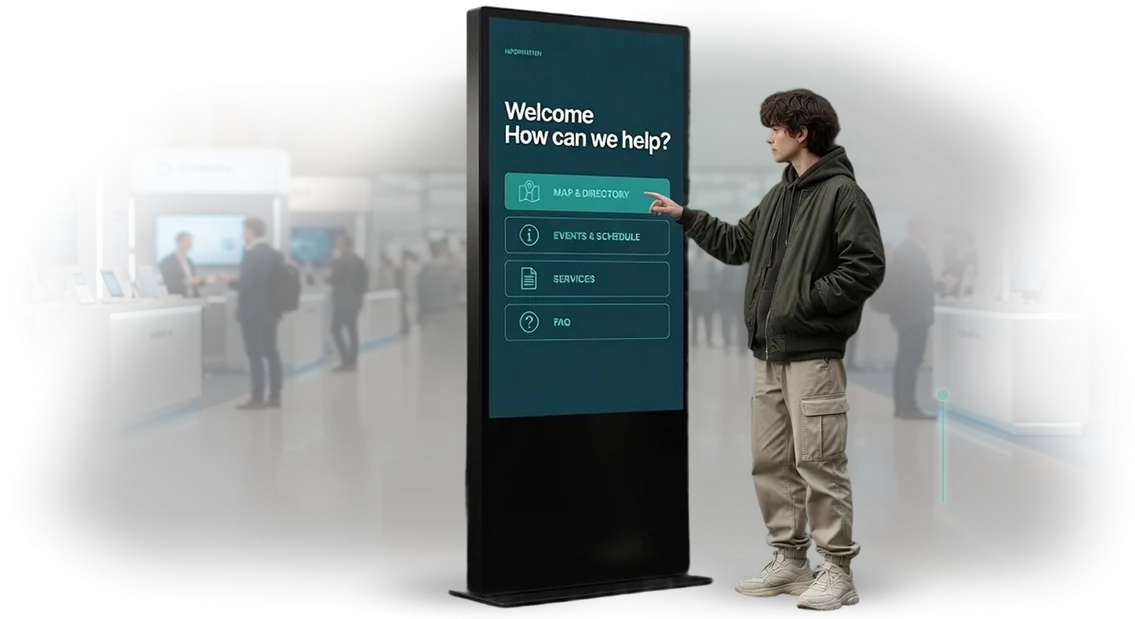
A navigation system at a cultural center solves this problem. Touchscreen kiosks with interactive maps are placed in the lobby, near hall entrances, and wherever visitor flows cross — the guest selects the desired event on the screen and immediately sees the route.
No complicated instructions: the path is shown visually, and if needed, the kiosk will point out where the cloakroom, café, or restroom is.
The result: relaxed guests who arrive on time. They find their way faster, spend less time searching, and remember the visit better.
The interactive map is easy to update for new programming, and the design can match the cultural center's style — the navigation becomes part of the interior, not a temporary sign.
We develop interactive navigation specifically for your cultural center's layout: we choose kiosk locations, design the interface, and launch a system that works from day one.
Guests stop getting lost, staff focus on their work, and you gain one more reason for loyalty and repeat visits.
What the Project Delivers: Satisfied Guests, Fewer Questions, More Events
Every day, a cultural center hosts concerts, exhibitions, and conferences — often simultaneously in different halls. A guest arrives for a specific event, but without clear signage wastes time searching, arrives late, and remembers confusion rather than the experience.
An interactive kiosk solves this from the very first second: the visitor selects the desired event and immediately sees the route, instead of hunting for the cloakroom or the right floor by asking around.
The project delivers four key benefits to the client. First — satisfied visitors. People arrive late less often, feel less stressed, and move through the building with ease. This is especially important for families and older guests who find small signs hard to read.
Second — fewer distractions for staff. Administrators, ushers, and volunteers stop explaining the same route to the small hall ten times over and focus on meaningful work: welcoming guests, handling unusual requests, and ensuring comfort.
Third — increased attendance. When a cultural center is easy to navigate, visitors are more willing to come to new events and recommend the venue to friends and colleagues. Nobody wants to return to a place where it's hard to find the entrance to the space they need.
Fourth — a modern image for the institution. A touchscreen kiosk in the foyer looks fitting and shows that the venue keeps pace with the expectations of younger audiences rather than staying in the past.
Clear navigation works for both reputation and results: every event poster becomes a clear route, and every guest leaves with a positive impression of the event. The client gets a tangible effect — reduced staff workload, fewer lost visitors, and a lasting desire to return.
These are changes that are visible from day one and require no additional effort from the cultural center's team.
Interactive Navigation Formats for a Cultural Center: What to Choose
Visitors come to a cultural center for experiences: a concert, an exhibition, or a children's celebration. But if a guest can't quickly find the right hall, cloakroom, or café, the first impression suffers, and administrators get distracted from their tasks.
Interactive navigation solves this problem — it helps visitors find their way without staff assistance, reduces lines, and makes the visit comfortable.
We develop three main navigation formats: touchscreen stands (information kiosks), wall-mounted touch panels, and mobile assistants. Each has its own strengths, so the choice depends on the size of the cultural center, visitor flow, and event scenarios.
| Format | Best for | What It Delivers to the Cultural Center |
|---|---|---|
| Touchscreen stand | A center with heavy visitor flow and multiple floors | Large screen with a detailed map and search by event name. Guests find their hall themselves, while staff focus on organizing instead of explaining routes. |
| Wall-mounted panel | Compact spaces, corridors, transitions | Quick "here and now" information: direction, time until the next session, urgent announcements. Installed where a stand would be inconvenient. |
| Mobile assistant | Younger audiences, events with advance registration | Route on the guest's smartphone, schedule, change notifications. Requires no equipment purchase and is easily updated for each event. |
If the cultural center hosts events of various scales, combining a touchscreen stand in the lobby with wall-mounted panels at hall entrances is optimal — this covers the main navigation points.
For festivals and forums with participant registration, a mobile assistant is convenient: the guest receives the route before arriving, and the organizer sees which zones are in demand.
We help you choose a format for your cultural center's needs, design the visuals and interface, and then handle installation and technical support. The navigation launches immediately and easily adapts to new events — so you invest in a system that builds your image every day.
How the Project Works: From Concept to Launch and Staff Training
A clear process is half the success. When a kiosk is needed for City Day or a cultural center's anniversary, every week counts, and chaos in approvals eats away at deadlines and budget.
We've structured the work so you always know what's happening, who's responsible for what, and when the result will be ready.
Here are the project stages — from the first meeting to launch and training for your staff.
- Brief and task analysis. We define exactly what the navigation should solve: helping guests find halls, reducing the administrator's workload, and sharing information about clubs and schedules. We determine installation points and visitor numbers.
- Concept and structure. We develop the menu logic and choose categories and texts that are clear to both a schoolchild and a retiree. We show how visitors will "walk through" the kiosk before a single screen is written.
- Design mockup and approval. We prepare visuals in the style of your cultural center and institution. You receive the mockup for approval, make edits, and only after your "OK" do we move to implementation. No surprises at the final stage.
- Navigation development and content. We populate the kiosk with up-to-date information: event schedule, floor plans, contacts, class timetable. We configure the system so you can update data yourself without a programmer.
- Testing and kiosk launch. We test scenarios against real tasks: how quickly a guest finds the desired room, and whether the screen is comfortable for people of different heights and ages. We install the equipment and put the system into operation.
- Staff training. We show your administrators and front desk staff how to turn on the kiosk, update information, and resolve minor issues. Training takes no more than an hour, and then your team works independently.
- Post-launch support. We stay in touch, monitor the system's performance, and quickly help if questions arise. You're never left alone with the equipment.
This approach removes the client's main fears: "what if they build the wrong thing" and "what if we can't figure it out." You control the process at every stage, and we take responsibility for the technical side and the result.
What's Included in the Delivery: From Diagrams to Staff Instructions
Launching navigation in a cultural center usually comes down not to technology but to organization: who turns on the kiosks, where to place them, how to update the schedule when it changes.
If these questions aren't addressed in advance, even good equipment turns into an expensive decoration.
We deliver the project as a complete system, not a box of hardware. The client receives a package that regular staff can handle — no programmers or outside contractors needed.
Here's what's included in the delivery:
- Kiosk placement diagram — a plan that accounts for visitor flows, so the navigation is visible and doesn't block passage.
- Navigation screens — hall maps, event search, and a schedule designed in the cultural center's style.
- Guest scenarios — how to quickly find a hall, section, box office, or cloakroom; everything thought through to the smallest detail.
- Staff instructions — step-by-step guides for powering on, changing schedules, and handling common situations.
- Staff training — a short hands-on session so the team works confidently from day one.
- Content update access — managers change event listings and hours through an easy-to-use panel without contacting developers.
- Warranty support — assistance during the first months and quick help if anything goes wrong.
In the end, the cultural center gets navigation that the team manages independently. Diagrams, screens, and instructions work as a single package, not as scattered files.
This eliminates last-minute rushes before major events and the question of "who handles this" with every schedule change.
Case Study: How Navigation Improved Guest Impressions at a Cultural Center
At a large cultural center's season opening, guests often got lost: three floors, dozens of halls, and signs didn't help. People were late for performances, administrators explained directions twenty times over, and the event experience was spoiled before the first bell.
The organizers understood: the problem wasn't the people, but the lack of a clear navigation system.
We installed interactive touchscreen kiosks with a building map and event list. On screen, guests saw the route to their hall, distance, and travel time. No complicated instructions — just touch the screen and go.
The kiosks worked flawlessly throughout the event, and the system automatically suggested the day's current events.
The result exceeded the organizers' expectations. Guests found their halls in two minutes on average, and the number of requests to staff nearly halved. Visitors praised the navigation's convenience in reviews, and the event ran without delays — all sessions started on time. For the cultural center, this meant satisfied guests and less stress for staff.
"There used to be a crowd of confused people at the entrance; now everyone plans their own route. The kiosks relieved the administrators and brought a modern touch to our cultural center," noted the deputy director for development. Client testimonial
After the successful launch, the cultural center's management ordered an expansion of the system: event listings and box office hours were added. The project confirmed that well-designed navigation supports the venue's reputation and brings guests back. We received the team's gratitude and an invitation for the next season.
How to Choose the Right Format for Your Space?
The choice of kiosk format depends not on the latest model, but on three parameters: the size of the space, the types of events, and guest preferences.
These factors determine whether you need a wall-mounted screen, a floor-standing unit, or a mobile stand that's easy to move between halls.
Space is the main constraint. In a narrow foyer, a compact wall-mounted kiosk doesn't block visitor flow and serves as both a schedule board and a signpost. In a spacious lobby, a floor-standing station with two screens can display navigation and partners' event listings.
If the hall is transformable, choose a mobile kiosk: it can be removed during a concert and rolled out to the entrance for an exhibition.
The type of events changes the priorities. For concerts and festivals, quick navigation to zones and schedules is key, so guests don't crowd at the entrance. For forums — the speaker program, booth map, and available meeting rooms.
On children's performance days, the kiosk can become an interactive game: while parents find their row, kids remember your cultural center.
Listen to guest preferences. For families with children — a section with the family program and directions to the buffet. For tour groups — language switching and a map of the surrounding area.
The more accurately the kiosk answers real questions, the lighter the load on administrators and the higher visitor satisfaction.
We design the kiosk around your space, scenarios, and audience — from wall-mounted signposts to mobile stations.
During a consultation, we'll select the optimal size, number of screens, and placement so the solution fits perfectly into the space and goals of your cultural center.
Common Concerns: Reliability, Speed, and Ease of Maintenance
When ordering interactive kiosks for a cultural center, the key is confidence: everything works on event day, the schedule can be updated in minutes, and staff need no special training. Almost every client has these doubts, so let's start by addressing them.
We address pre-purchase concerns with a contract and warranty, and we build ease of maintenance into the design phase. Below are the questions we're asked most often before work begins.
What happens if a kiosk fails during an event?
The system is designed so that a single failure doesn't stop operations: the kiosk automatically restarts, and the screen returns to navigation. So you learn about issues before visitors do, we set up remote monitoring for all devices. If needed, we connect and resolve the cause remotely.
How quickly is information on the kiosks updated?
Content is updated through a simple control panel: event listings, schedules, and routes are updated by your team in 2-3 minutes. Changes apply instantly, without restarting the kiosk or interrupting its operation. No programmers are needed — just staff access rights.
Can cultural center staff handle the maintenance?
Yes. Administration is intuitive, and we provide a short manual and hands-on training for staff. During launch, we support the team remotely, so the transition to independent work is smooth. After that, maintenance comes down to wiping the screen and checking the power supply.
What warranty covers the kiosks and system?
We provide an official warranty on both the hardware and software, and we stay available for consultations after launch. If a technical issue arises, we resolve it remotely or, if necessary, visit the site. This reduces the burden on your staff and protects your investment in the project.
Get Navigation That Saves Time for Guests and Staff
Cultural center visitors often waste precious time searching for the right hall, cloakroom, or administrator. Staff get pulled away from their duties to answer the same questions over and over.
An interactive navigation kiosk solves this: guests find their way on their own, and staff have time for more important tasks.
Submit a request for navigation development for your cultural center — and within the next few days, you'll receive cost calculations for solution options.
A meeting with an engineer will help clarify technical requirements and discuss the launch plan, and the commercial proposal will outline all stages and timelines.
We don't send abstract commercial proposals — you get concrete options that account for the building's specifics, guest flows, and your team's objectives.
What we'll prepare right after you reach out:
- kiosk format selection matched to the architecture and layout of the cultural center
- cost calculations for two or three solution options — from a simple map to a multimedia system with schedule
- an on-site meeting with an engineer to assess connection and installation points
- a step-by-step launch plan: delivery, installation, configuration, staff training
- a commercial proposal with fixed deadlines and warranty commitments
This way, you'll have the full picture before we start and can compare options without spending weeks on approvals. Submit your request — we'll take care of all the implementation details, and guests and staff will feel the difference from the very first days.