

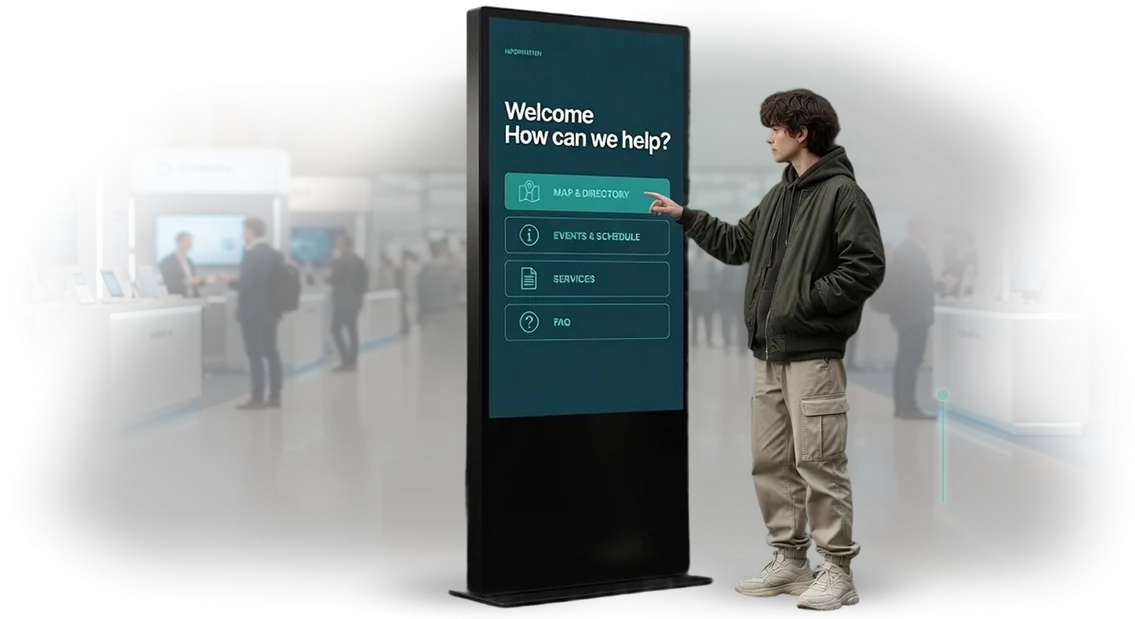
Parking without Navigation: How a Kiosk Brings Customers Back
A visitor enters the parking lot with a specific goal: to visit a store, pay for a service, or make an appointment.
But without navigation in the parking area, they get lost right at the entrance: it is unclear where the elevator is, which building they need, or where to go after payment. Five minutes of searching later, they drive away to a competitor where everything is more convenient.
Lost customers are not just missed revenue for one day. They mean fewer repeat visits, negative reviews, and a damaged reputation. For a parking lot or shopping mall owner, each such case is a direct loss of ROI from tenants and services.
An information kiosk in the parking lot restores the customer's confidence. It shows the route to the required office or store, suggests the payment procedure, and warns about congestion in certain zones. Instead of chaos, the person gets a quick answer—and stays in your space.
Such navigation works to retain visitors: people remember that they were taken care of here, and they come back again. A parking service in the form of such a kiosk increases tenant loyalty and makes the property more attractive to new customers.
We cover this need turnkey: we design a kiosk for a specific parking facility, with clear maps and prompts, install and support it. This brings customers back from the very first day.
Benefits You Will See in the First Months
Parking visitors value their time: if they have to search for the right floor or stand in line to see an attendant, they remember it as a negative experience.
An interactive kiosk removes these barriers—navigation, company information, service payment, and getting promo codes happen in a couple of screen touches. The result is higher loyalty, more repeat visits, and stable parking occupancy.
For ten years, we at our team have been building such systems on professional hardware and server architecture. The kiosk becomes part of your customer ecosystem: it shows drivers available spaces, sells additional services—from car wash to coffee—and collects feedback.
With built-in analytics, you see which features pay off, so the return on investment is clear within the first months.
The numbers speak for themselves.
Here is a typical review from a parking facility manager: “In the first season, parking occupancy grew by 20%, the share of regular customers grew by a third, and additional kiosk sales brought in revenue comparable to a month's rent.” This dynamic is achieved because the kiosk works as a full-fledged sales tool, not just an information board.
The key point is that you get a transparent picture: how many people used the services, which scenarios are popular, and where the growth points are.
This allows you to quickly adjust the range of additional services and marketing campaigns, amplifying the positive effect month after month.
Information Kiosk Formats: Solution Comparison
In a parking lot, customers value speed and predictability: no one wants to stand in line to find out the rate or find a spot. The right kiosk format solves this task without hiring extra staff and works around the clock.
But choosing is not easy—there are three main options on the market, and each addresses its own business task.
Compare the solutions by key scenarios. Note how the format affects guest convenience and your operational load.
| Format | For whom | What it gives the customer |
|---|---|---|
| Floor-standing kiosk | Shopping mall, airport, and business center parking lots | Quick navigation, route map, and rates without staff involvement. The driver gets an answer in 30 seconds, and you save up to 70% of employees' working time |
| Wall-mounted kiosk | Tight places: elevator lobbies, entry zones, pedestrian crossings | The compact solution does not block the passage and saves usable floor space. Helps guests orient themselves where a floor-standing option would not fit |
| Payment terminal | Entry and exit zones, barriers | Automatic parking fee collection, time extension, and receipt issuance. Reduces lines and eliminates cash handling costs, increasing throughput during peak hours |
The choice of format always comes down to your scenario. If the main task is to inform drivers at the entrance and take the load off security, choose a floor-standing kiosk. When every square meter counts, a wall-mounted kiosk is more reliable.
And to fully automate payments and free customers from cash—choose a payment terminal. In any case, we adapt the interface to your parking facility and help you choose a structure that will last more than one season.
How the Project Goes: From Brief to Launch
The project is built on clear development stages, so you control the result and do not waste time on technical details. All you need to do is fill in a short brief and approve a mock-up—we handle everything else. This approach allows you to launch a kiosk in the parking lot quickly and without surprises.
- Fill out the brief. Tell us who will use the kiosk, what functions are needed, and where it will be installed. Based on the brief, we propose the optimal solution and set the deadlines.
- Approve the mock-up and logic. We show the screen structure, texts, and operating scenarios. You make edits—this usually takes 2–3 days.
- Approve the design and content. We create an interface in the style of your parking facility and brand, and prepare texts and reference materials. At this stage, you see what the kiosk will look like.
- We build and test it. We assemble the kiosk, install the software, and verify all scenarios—from navigation to payment and printing. Testing is done on real hardware, so failures are ruled out.
- Launch the kiosk. We mount the device in the parking lot, connect it to networks, and, if necessary, train the staff. We set the launch date and monitor its readiness.
- Support after launch. We monitor operation, update content, and respond quickly to inquiries. If the parking lot's tasks change, we add new features.
What Is Included in the Delivery and How It Works
You receive a complete, ready-to-use interactive kiosk package for your parking lot—from the housing to the interface and warranty.
No hidden details, no extra charges “for assembly” or “for setup”: everything needed for launch is already included and works right after connection.
- Kiosk housing—a protected design for outdoor and high-traffic areas: vandal-resistant coating, dust and moisture resistance. An attractive appearance that fits the parking lot design and requires no constant maintenance.
- Touchscreen—a bright display with a clear picture even in direct sunlight. Guests and drivers easily tap the right button—without misses or repeated presses.
- Software—software tailored for touch control: fast response, freeze protection, and the ability to change content without a programmer. The system restarts itself after a failure and does not lose data.
- Kiosk interface—clear large buttons and navigation that requires no training. Visitors figure it out in 10 seconds: how to find their car, pay for parking, open the barrier, or contact the operator.
- Instructions—a guide for your staff and a quick reference for users. We explain how to turn the kiosk on, change the on-screen information, and resolve typical situations.
- Warranty and support—an official warranty on hardware and software. If something goes wrong, you are not left alone with the problem: remote diagnostics and help with restoring operation.
All components are matched to each other and tested as a single system. So you do not need to figure out whether the screen is compatible with the housing or whether the housing is compatible with the software—we have already done that for you.
The delivery includes everything necessary: you get a working kiosk, not a set of parts for self-assembly.
The warranty covers the entire set, not individual parts. This means that in any unusual situation, you contact one point—us—and we take care of the solution.
Case Study: Real Implementation Results
We installed interactive kiosks in the parking lot of Galeria shopping mall. Previously, visitors spent up to 12 minutes looking for a spot, got frustrated, and often left without going into the stores. Management asked us to turn the parking lot into an entry point to the mall, not a “bottleneck.”
Metrics Before and After
| Metric | Before Implementation | After Implementation |
|---|---|---|
| Average time to find a spot | 12 minutes | 3 minutes |
| Average ticket | baseline level | +42% |
| Share of repeat visits per month | 34% | 52% |
| Info desk inquiries | 40 per day | 6 per day |
The kiosks showed drivers available spaces and immediately offered bonuses from stores—a coffee discount, a loyalty card, or a parking coupon. This turned a visitor from "just parked" into a shopper with a specific route.
Within two months, the average ticket grew by 42%, and foot traffic to the upper-floor stores increased by nearly 1.5 times.
“We expected customer convenience, but we got an additional revenue source. The kiosks paid for themselves in four months—the best figure among the projects we have launched,” says the mall director.
Three months later, the client expanded the project to a second parking lot—navigation now works both at the entrance and by the elevators. The average ticket continues to grow.
How to Choose a Parking Kiosk Format for Your Needs?
Choosing a parking kiosk format comes down to four questions: what is your visitor flow, what is the area size, what is the implementation budget, and whether you need built-in payment. The answers determine the housing type, screen diagonal, and feature set. There is no universal solution—only the one that is right for your conditions.
If the flow is high, for example, a mall or business center parking lot, look for kiosks with fast response and a protected housing.
For a large area, it is better to have several navigation points or a terminal with a large screen, so visitors can see information from a distance. For a small parking lot, a compact floor-standing kiosk that does not overload the space is enough.
Budget is not only the price of the kiosk itself. Consider the cost of maintenance, updates, and potential downtime: a cheap option without support will cost more if it fails during peak hours. Better to choose a format that pays off by reducing staff load and increasing throughput.
Separately decide whether you will accept payments on-site. If yes, you need a kiosk with a built-in payment system and security standards compliance.
If not, you can limit yourself to an information board with a map and rates—this will make the project cheaper and speed up the launch.
So start with the numbers: how many cars and visitors pass per day, what area you need to cover, and what operations the kiosk should automate. The answers to these questions determine the optimal format. If you are unsure about the choice, we will help you calculate an option for your budget and flow.
Common Concerns: Reliability and Payback
When you order an interactive kiosk for parking, the first things that come to mind: will it break? Will it freeze at the busiest hour? And when will it all pay off?
The concerns are understandable—the kiosk works unattended, in a high-traffic area, and must withstand both weather and crowds. Wehave been developing such solutions for more than 10 years, so we have gathered answers to the five most frequent questions.
Won't the kiosk break from constant use?
We build kiosks on a reliable component base and test them in real conditions. They are designed for 24/7 operation and report any deviations themselves—before visitors notice them.
You will not have to monitor the kiosk's condition: the system will automatically notify us, and we will resolve the issue before it becomes a problem.
What if the kiosk freezes at a peak moment?
Automatic reboot and remote management are provided. In most cases, the kiosk recovers on its own, and if not, our engineer connects remotely and brings it back to work in a few minutes. The parking lot continues to function, and visitors will not notice the failure.
How do I update the software if content or rates change?
Updates are installed remotely, without an on-site visit. You send new files or edits, and we publish them on all kiosks in the parking lot at once. Changing prices, adding new services or promotions takes you a couple of minutes, not days of approvals.
Who repairs the kiosk if it does break down?
We take full responsibility for maintenance: from warranty to post-warranty service. We travel to the site, bring spare parts, and make repairs as quickly as possible. You do not need to look for a contractor—one call is enough, and we handle everything.
When will the kiosk pay for itself?
Usually within one season with good car flow. Automation reduces queues, lowers staffing costs, and additional services—advertising, navigation, prompts—generate new revenue. The exact term depends on your volume, but in most cases you feel the benefit within the first months.
Get a Cost Estimate and Implementation Plan
You have already invested time in choosing a contractor—now you want to quickly get a clear proposal without hidden details or lengthy approvals.
We have structured the process so that only a few business days pass from inquiry to contract, and you understand at every step what you are getting and how much it costs.
To do this, we divided the work into five simple steps:
- Inquiry. You submit a request via the website, by phone, or in a messenger—any convenient way. A short description of the task is enough.
- Brief. Within one business day, we clarify the details: the number of kiosks, placement locations, desired functions, and deadlines. No bureaucracy—only the questions that affect the solution.
- Cost estimate. Based on the brief, we prepare a quote for your scenario. You see what makes up the price: development, hardware, integration, support.
- Commercial proposal. We send a document with the implementation plan, stages, timelines, and payment terms. You can show it to management or coordinate with other stakeholders.
- Contract and start. After approval, we sign the contract, fix the scope of work, and set the release date. We begin design and development, keeping you informed at every stage.
This format saves your time: you do not need to search for extra information or understand technical details. You immediately get something you can base a decision on.
If you need a parking kiosk with payment, a space map, or navigation, leave a request and we will prepare an estimate for your specific case.