

Why Guests Get Lost in an Ice Arena and How It Affects Revenue
An ice arena is not just ice and stands. It's dozens of entrances, cloakrooms, cafes, merchandise stores, training zones, and VIP lounges.
A guest visiting for the first time or coming with children easily loses their bearings: they search for the right section, arrive late for the start of a match or show, miss the intermission, and end up tired before they even see the main event. In a familiar environment everything is simple, but for a newcomer, the arena is a real maze.
A lost visitor is not just an unhappy person. It's lost revenue for the arena: while the guest wanders, they miss the chance to buy drinks, snacks, and souvenirs.
And when navigation at an ice palace keeps failing, even those who planned to return walk away: instead of a repeat visit — a negative review and several friends who've been warned off.
Today's spectators are used to finding a route in a minute. When this doesn't happen at a huge complex, guest satisfaction drops, the venue's reputation suffers, and event organizers are forced to spend time on explanations instead of developing programs. In the end, both the arena's brand and attendance suffer.
We solve this with interactive information kiosks that help guests find their way quickly and reach the event on time. That's exactly why the first step toward revenue growth is getting navigation right in the ice palace.
What an Interactive Kiosk Gives the Business and Arena Guests
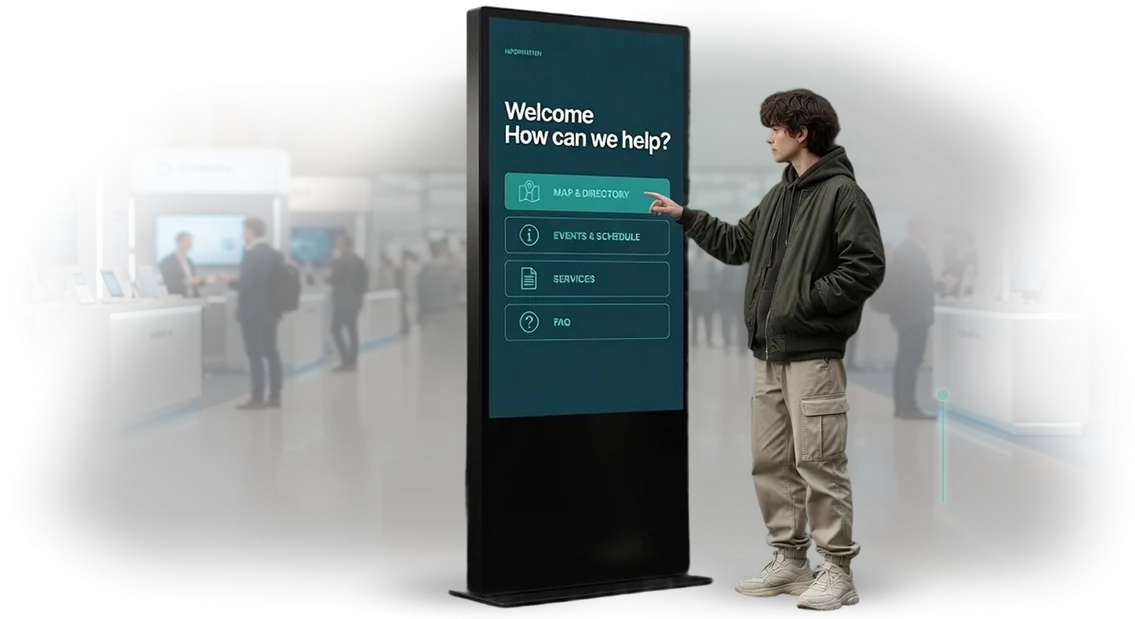
An interactive kiosk is not just a screen at the entrance, but a full-fledged tool that works for the arena from the first minute of a visit. It simultaneously replaces the ticket office queue, the info desk, and the information stand.
Guests get quick access to the information they need, and the business gets new points of sale and freed-up staff.
For guests, the kiosk simplifies navigation around the arena: match and practice schedules, section maps, cafe and souvenir shop hours. Instead of queues at the info desk — a couple of touches, and the answer is already on the screen.
Guests don't waste time looking for the right stand or rental point, so they have more time to try the arena's services, which directly affects their impression of the visit.
From the business side, the kiosk increases sales. Through it, guests can buy tickets to upcoming matches, book a spot at a public skating session, or order additional services — from equipment rental to a private training session.
Each such order happens without an administrator, so it doesn't get lost in the rush and isn't forgotten. As a bonus, the kiosk can offer upsells: for example, skating insurance or helmet rental, raising the average order value.
Customer service deserves special mention. The kiosk takes on routine questions — "where's the restroom?", "when does it start?", "how do I sign up?" — and thereby frees staff for live interaction with guests, where human contact really matters.
Administrators stop being an "information bureau" and focus on atmosphere, assistance, and handling difficult situations — the things people love and remember about the arena.
Finally, the interactive kiosk works for the arena's image. Modern equipment tells guests that comfort and technology are a priority here. Guests happily photograph the unusual screen and share impressions on social media — that's free mentions of your brand and extra reach.
Visitor loyalty grows, and they come back again — for matches, public skating sessions, and the cafe.
Interactive Kiosk Formats for an Ice Arena: How to Choose
Choosing the format of an interactive kiosk for an ice arena depends on where guests interact with the infrastructure. In the lobby they need information and tickets, in the food court area — quick ordering, at the entrances — navigation.
One kiosk rarely covers all scenarios, so the format is selected based on the task and placement point.
The table below lists the main types of interactive stands for an arena, their audience, and what they give the arena.
| Format | Who it's for | What it gives the arena |
|---|---|---|
| Touch information kiosk | Visitors who want to see match schedules, team rosters, and club history | Reduces staff workload and creates a modern arena image |
| Navigation stand | Fans looking for a section, food court, restroom, or exit | Helps guests find their way faster and reduces late arrivals at match starts |
| Food and drink ordering kiosk | Spectators during intermission who don't want to wait in line | Speeds up service and increases the average order value through upsells |
| Ticket kiosk | Guests without an e-ticket who buy tickets on site | Relieves the box office and allows ticket sales before and during the event |
One kiosk can combine several functions — for example, navigation and food ordering. But it's more effective to combine formats: navigation stands at the entrances, touch kiosks in the lobby, and ordering kiosks in the food court area.
This reduces queues, speeds up service, and makes the guest visit more comfortable — which in turn increases loyalty and repeat visits.
How Development Works: A Step-by-Step Process from Brief to Launch
Developing a kiosk for an ice arena is not just installing a screen, but a project that must account for visitor flow, load on match days, and ease of management.
We've structured the process so you always know what stage the work is at and can influence the result without diving into technical details.
- We fill out the brief. We discuss the kiosk's tasks: arena navigation, practice and game schedules, ticket and service sales, event information. At this stage, we determine who will use the system and how.
- We prepare a plan and estimate. We lock in timelines, scope of work, and cost. You get a clear schedule with checkpoints — no "work is in progress," only specific dates and results.
- We approve the mockup and scenarios. We show how the kiosk will look and how a visitor will interact with it. You make edits before development starts — this saves time and budget.
- We develop the interface and logic. We assemble the system, fill it with content, and set up roles: which employees will be able to change schedules or information without involving developers.
- We launch the kiosk at the arena. We install the equipment and test it in real conditions — under peak load on match day, across different usage scenarios. Only then do we hand the kiosk over for operation.
- We provide support. We stay in touch: update content, add features, and monitor stability. If something changes in the arena schedule — you make changes yourself or in a couple of requests to us.
What's Included in the Delivery: A Complete Set for Kiosk Operation
When you order a kiosk from our team, you get not just a device, but a working turnkey solution. The delivery set is designed so the information kiosk starts delivering value from the moment it's powered on — no rework, extra purchases, or hunting for subcontractors.
- Equipment: a touch kiosk in a vandal-resistant housing with a professional screen. It's built for intensive use in areas with constant visitor flow — from match schedules to arena navigation.
- Software: a management system with an intuitive interface. The administrator updates event listings, prices, and schedules on their own — no programmer needed.
- Content model: a rubric structure, page templates, and a content update policy. You get a ready-made navigation logic tailored to the arena's tasks: events, clubs, tickets, venue map.
- Analytics module: clear statistics by section and interaction time. You can see what actually interests guests — a foundation for improving service.
- Installation kit: mounting hardware, cables, surge protection. Our engineers install the kiosk at the right spot in the arena and connect it to the network.
- Training and documentation: clear instructions for staff and administrators. Staff start working right away without getting into technical details.
All equipment and software are covered by a warranty and post-warranty service. If a failure occurs, we quickly restore operation remotely or replace components of the kit.
In the end, you get one accountable partner instead of a chain of scattered suppliers — and a fully operational kiosk from day one.
Case Study: Interactive Kiosks Increased Sales by 40%
We installed interactive kiosks at the Arena "Meteor" ice complex — and within three months sales grew by 40%. This isn't a pilot project in ideal conditions, but a working model for real-world loads.
The kiosks were placed at the entrance, where guests buy tickets and rent equipment: previously, queues piled up here, and some visitors turned around and left.
The system itself selects skate and helmet sizes based on height and the stated shoe size, so service takes a couple of minutes instead of the previous five. Already in the first month, a third of all purchases went through the kiosks, and by the end of the quarter — half.
The average order value rose by 15%: the interface offers protection, curling, or a season pass at checkout.
Implementation Results
The project paid for itself in four months — faster than we promised in the estimate. From there, the arena gets pure savings: cashiers don't spend time on routine and are busy with consultations, and managers see sales statistics in real time. This made it possible to eliminate overtime without losing service quality.
Visitors note in reviews that the kiosks are understandable even to first-time users. The average convenience rating is 4.8 out of 5.
The most common request is to install the same machines at the snack bar and by the locker rooms, so guests don't have to step away from their leisure time.
Payback and Replication
After the first season, the complex ordered three more kiosks. We prepared a replication plan for other ice palaces and sports complexes. The case shows that interactive kiosks bring measurable revenue growth in the first months, and this result repeats without any rework.
How to Choose the Right Interactive Kiosk Format?
Choosing an interactive kiosk format for an ice arena isn't a matter of design, but a matter of what task the kiosk should solve at a given moment.
The key is understanding what you want to achieve: fast ticket sales, navigation support for fans, extra entertainment, or information about upcoming matches and promotions. Each task requires its own type of device — and that's the first step to the right choice.
An ice arena is an environment with special conditions: temperature swings, crowds before matches and during intermissions, and heavy equipment load.
Experience shows that the optimal kiosk for an arena is a device that works without failures during peak hours, responds quickly to touch, and doesn't require constant staff supervision. Such solutions save fans time and relieve employees.
If the main task is selling tickets and additional services, a kiosk with a clear payment interface and ticket printing fits. If navigation matters, choose a large touchscreen with an arena map so visitors can find their section, cloakroom, or cafe in a minute.
For an entertainment scenario, mini-quizzes and branded photo zones work well, and for an information function — convenient search by schedule and prices.
Before ordering a kiosk, it's worth testing it in real arena conditions: assess the speed of operation in a queue, ease of use for children and older fans, and resistance to rough handling.
We help clients choose the right format, integrate the kiosk with the existing sales system, and take on support after launch.
In the end, the right format is one that pays for itself in the first season: cuts queues, increases the average order value, and makes visiting the arena more comfortable. Start with the arena's goals — we'll adapt everything else to them.
Frequently Asked Questions and Concerns Before Ordering a Kiosk
Before ordering an information kiosk for an ice arena, the same questions always come up: will development drag on, will we have to overpay for yet another change, and how necessary is a kiosk when there's staff and signs around. That's normal — any new system should visibly simplify work, not just take up space in the lobby.
We've been making kiosks for arenas and sports facilities for over 10 years, so we know these concerns well. We've broken down the four most common ones — briefly and to the point, without complex technical details.
Will you have the kiosk ready by the start of the season or a major match?
Yes, if we fix the launch date at the brief stage. We put together a plan: mockup approval, interface design, equipment assembly, tests at the arena. The standard delivery time is two to three weeks, and under tight deadlines we assign a dedicated team to speed up the key stages.
Will we have to hire a programmer for every information update?
No. The kiosk comes with an easy-to-use control panel: your employee can change match schedules, news, food prices, and event listings themselves in a couple of minutes. No developer or special knowledge is needed — just access from any device.
How does such a kiosk actually pay for itself at an ice arena?
A visitor no longer scans for the right section or box office — they find the answer themselves and get to the stands faster. Staff spend less time on routine questions and more on serving guests.
As a result, queues are shorter, loyalty is higher, and sales of drinks, souvenirs, and additional services are noticeably stronger. The kiosk delivers a measurable effect, not just "looks great."
What guarantees and support can I count on?
We provide an official warranty on the equipment and all completed work. After launch, we stay in touch: we keep the system up to date, help staff, and update content.
If a failure occurs, we resolve it remotely, and in complex cases we come to the site — the kiosk is back up and running the same day.
Start Your Project with a Consultation: Get a Cost Estimate
A consultation isn't just a conversation — it's a ready-made estimate tailored to your task. Leave a request, tell us where in the ice arena you plan to install the kiosk and what it should do for guests: show schedules, sell tickets, help with navigation.
The project manager will clarify the details and give you a budget range and realistic timelines during the call.
We prepare the cost estimate as part of our work.
Along with the figures, you'll get recommendations on how the kiosk will pay off in the first month of operation: through a higher average order value, additional services, or savings on administrators. No hidden payments and no mandatory options forced on you at the start.
What's included in the consultation and estimate:
- Development cost for your ice arena, taking into account the number of screens and the installation method.
- An equipment and installation estimate in one document — no need to assemble it from three different estimates.
- Launch timeline: from contract signing to the first live session.
- A prototype of the future screens — you see the menu structure before development starts and make edits without extra costs.
- Content recommendations: skating schedule, event calendar, arena map, ticket and season pass sales.
- Post-launch support: we'll include updates for seasonal promotions and new events so the kiosk doesn't become outdated.
The consultation comes with no obligations. You'll get an estimate, an action plan, and an understanding of which tasks the kiosk will solve at your arena — guest service, relieving administrators, or revenue growth.
You can leave a request on the website, and we'll get back to you with an estimate on the next business day. And if the project is clear right away — just say so, and we'll move straight to the contract.