

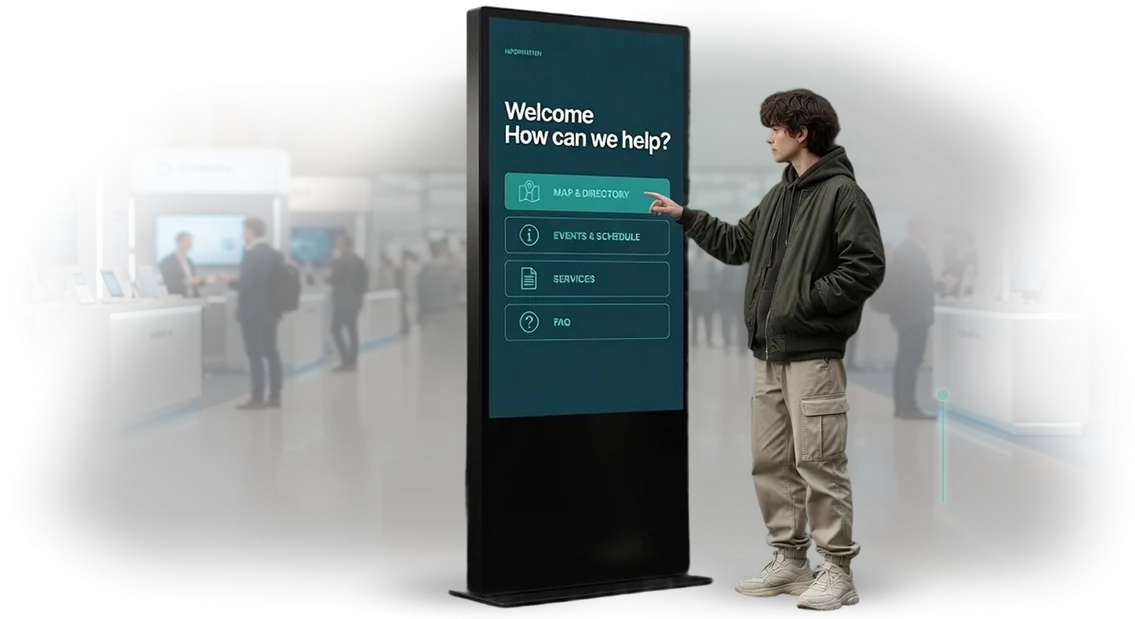
Patients get lost in a rehabilitation center — trust and time are lost too
A patient comes to a rehabilitation center facing an already difficult task: restoring their health.
But when they spend time searching for the physiotherapy room, get confused between floors, or arrive late for a procedure because navigation is not obvious, their stress only grows.
This also damages trust: the visitor may stay silent, but they remember the feeling of chaos and disregard for their time. And for someone who needs support and a calm environment, getting lost in a hallway is the last thing they need.
For the center itself, a lost patient means schedule disruptions, extra questions at the reception desk, and reputational risks. Relatives and patients share their impressions, and word of mouth starts working against the clinic. Every inconvenience multiplies by the number of visitors, so the price of chaos rises quickly.
An information kiosk solves this problem systematically. A clear interface shows the route to the right room, displays the procedure schedule, appointment times, and important announcements.
The patient sees where to go, feels more confident, and preserves their energy for recovery. Staff stop explaining the same thing dozens of times — freeing up time that can be spent on patient care. Clinic navigation becomes simple, and the impression of the center becomes modern.
We develop kiosks for the specific tasks of each facility, taking rehabilitation specifics into account.
Our team quickly immerses itself in the center's processes and proposes a solution that easily fits into daily operations — without unnecessary complexity for staff or visitors. Visitor convenience improves from day one, and the reputation gains a tangible boost.
What an interactive kiosk gives visitors and staff
An interactive kiosk in a rehabilitation center is not just a screen in the lobby.
It changes the daily experience of everyone who crosses the facility's threshold: patients find their way faster, staff get distracted less by routine questions, and administration gets an orderly service.
For a patient, the kiosk means calm navigation through the center. Instead of hunting for the right room at random or asking passersby, a person sees interactive maps with clear routes: to the treatment room, the cafeteria, the rest area.
This is especially important for people who come to rehabilitation for the first time and feel stressed by an unfamiliar environment.
Reducing the workload on staff is the second obvious effect. Nurses and administrators stop explaining a dozen times a day how to get to one department or another. The freed-up time goes into directly helping patients rather than repeating the same instructions.
Plus, the kiosk helps manage visitor flow: the interactive map shows the location of key points, lets visitors check the activity schedule, and provides guidance on where to go.
Patient experience improves measurably: fewer late arrivals, fewer anxious phone calls, higher satisfaction.
Essentially, this is a worthwhile investment in comfort. The kiosk takes over routine information work, and people gain more time for real communication and care — the very reason a rehabilitation center exists.
Interactive kiosk formats for a rehabilitation center
In a rehabilitation center, every patient and visitor faces the same task — quickly find their way through the schedule, locate the right room, and get answers to their questions. How easy this is affects both the impression of the center and the workload on staff.
There is no one-size-fits-all kiosk, which is why we have prepared three formats that cover typical scenarios.
| Format | For whom | What it gives the client |
|---|---|---|
| Touchscreen kiosk | Patients and accompanying persons | Self-service scheduling for procedures, viewing the schedule and helpful materials without waiting in line at the administrator |
| Information stand | Visitors and guests of the center | Clear navigation between departments, information about specialists and services, fewer questions directed at staff |
| Wayfinding touchscreen | Patients and staff | Quick route search to a room and orientation within the building, saving time and reducing late arrivals |
Each of these formats works autonomously and does not require constant staff supervision. Patients get the information they need on their own, while employees focus on their core responsibilities instead of repeating the same answers over and over.
We select the format for each specific center: we consider the floor area, visitor flow, and typical questions.
At the first stage, we conduct a needs analysis and propose a solution that delivers quick results — within a few days after launch you will see reduced workload for administrators and more confident patient navigation.
How we develop a kiosk for your facility
A kiosk for a rehabilitation center is not just a screen with a menu, but a working tool that saves staff time and helps patients quickly find important information: book a procedure, check the schedule, or learn about the center's programs.
We have structured the development process so that you control every stage and can influence the final result.
-
Brief and discovery. We study the specifics of your center: patient flows, typical requests, kiosk placement areas. Together we define the main use scenarios — from appointment booking to navigation between buildings.
-
Concept and design approval. We prepare the section structure and interface mockup: large buttons, clear labels, a mode for people with low vision. We present it to you for approval and refine it until it is fully agreed.
-
Prototype and testing. We build an interactive model on your device or on our equipment. We test usability for people of different ages and health conditions — this helps us find and eliminate non-obvious problems before launch.
-
Kiosk development and content delivery. We configure the system, connect the procedure schedule, and load information about specialists and services. We build in a simple admin panel so your staff can update data without a developer.
-
Kiosk installation and commissioning. We install the equipment in the chosen location, connect it to your network, verify stable operation, and set up automatic restart in case of failures.
-
Training and support. We hand over instructions to staff and help launch the kiosk on opening day. Then we support the system: update content at your request and monitor correct operation.
What's included in the delivery of a ready-made solution
When you order a kiosk for a rehabilitation center, it is important to get not just equipment, but a work-ready tool that helps patients and staff from day one. We structure the delivery package so that launch goes off without surprises or extra approvals.
What's included in the package
- Delivery of a kiosk in a protected enclosure — suitable for lobbies, corridors, and waiting areas with high foot traffic.
- Pre-installed software with an intuitive interface: procedure schedule, department navigation, information for patients and relatives.
- Content adaptation for your center: we load the schedule, contacts, instructions, and announcements — you receive a ready-made tool, not an "empty" program.
- On-site installation and setup: a specialist installs the kiosk, connects it to the network, and tests all scenarios.
- Staff training: a short session for administrators and medical staff so employees work confidently without an IT department.
- Technical support and warranty: for any issue, you contact us — a single point of responsibility.
- Updates as part of ongoing support: the information kiosk stays relevant, and you don't have to think about upgrades.
You get a comprehensive result where equipment, software, and training work as a single system. All that's left is to turn on the kiosk and start using it.
Case study: navigation at the clinic became simpler
When a clinic has multiple buildings and long corridors, patients easily get lost.
At the rehabilitation center “Healthy Rhythm”, this problem was especially noticeable: people were late to procedures, lines formed at the information desk, and nurses had to step away from their work to escort visitors. Management decided to change the navigation system — and turned to us.
We audited patient flows and installed an interactive kiosk at the entrance.
On screen, a visitor selects the needed specialist or procedure and receives a short route with landmarks — for example, “second floor, left wing.” The system works without staff involvement, with clear prompts and large buttons, which matters for elderly people and patients recovering from injuries.
Results appeared within the first month. Patients found their rooms on average 2 minutes faster, the number of inquiries at the information desk dropped by a third, and late arrivals for procedures stopped.
The center's director notes: “The kiosk relieved the administrators — now they attend to guests instead of explaining directions. And patients feel more confident because they understand where to go.”
Importantly, we configured the system around the clinic's logic: we took into account doctor schedules, the building layout, and even the days when different specialists work.
If navigation changes, we update the kiosk remotely — without an on-site visit and without stopping the facility's operations.
After the successful launch, management ordered a second kiosk for another building and asked us to add reference information about procedures. That says one thing: the client received measurable value, not just a nice-looking screen. The same navigation can work in your center too — just tell us about your task.
Frequently asked questions about implementation and safety
Introducing an interactive kiosk in a rehabilitation center is a new way of interacting with patients and visitors. But along with convenience come questions: is the equipment safe, what happens if it breaks, how often does the information need to be updated. Let's address the most common concerns so you can make a decision with a clear picture.
We design kiosks with the specifics of healthcare facilities in mind, where both care for people and operational stability matter. The answers below are not generalities, but a description of how the solution behaves in real-world operation.
Is the kiosk safe for patients and visitors?
Yes. The enclosure is made of impact-resistant materials, corners are rounded, and the structure is stable against accidental contact. Protection against electric shock is built in, as is locked access to technical settings — outsiders cannot affect the operation.
In addition, the software does not store personal data unnecessarily. Information collection is kept to a minimum, and when it is needed, data is transmitted only over secure channels.
What happens if the kiosk breaks down?
We equip kiosks with a remote health monitoring system: the monitoring center sees failures before staff even report them. Most issues are resolved remotely — restart, settings recovery, diagnostics.
If on-site intervention is needed, an engineer arrives with a replacement module. Average recovery time is 2 to 4 hours, and a backup set of key parts is always on hand as a safeguard.
How often does content need to be updated?
Updating takes just minutes and is done remotely, without calling a specialist or stopping the kiosk. You decide when to load new schedules, announcements, or reference materials.
Information can be updated on a schedule or with a button in your personal account. This is convenient when you need to urgently change a department's working hours or add an important message for patients.
Questions like “what if it's complicated and unsafe” arise before the first launch. After implementation, most clients are surprised at how autonomously the kiosk works — it requires no constant staff attention and fits into daily processes without disruptions.Request a consultation on a kiosk for your center
Visitors to a rehabilitation center come with various requests: procedure schedules, specialist offices, stay rules, contacts. When information is scattered between the administrator's desk and paper stands, staff get distracted from their core work and patients lose time. An information kiosk removes this burden and makes the center both modern and caring.
Leave a consultation request — we will analyze your center's needs and propose a solution that fits your budget and premises. After reaching out, you will receive:
- an analysis of patient touchpoints with information and recommendations on where a kiosk will be most useful;
- a cost calculated after audit for your specific task — no hidden fees or “surprises” at the installation stage;
- a content proposal: menu structure, sections for patients and staff, language versions if needed;
- implementation timelines from approval to launch — typically from 2 weeks, including delivery and setup;
- a support plan: staff training, content updates, technical support after launch.
The consultation is non-binding. We will show examples of kiosks already operating in medical and social facilities, discuss your scenario, and honestly tell you what is achievable in your case.
After the conversation, you will receive a short summary with options and cost estimates — you can discuss it within your team and make a decision without rushing.
Fill out the form or call us — we will respond within one business day and find a time to talk. Take the first step so that patients and their loved ones can always find the information they need on their own.
How to choose the right kiosk format for your center's needs?
The direct answer is: the kiosk format should be determined not by “what everyone else uses,” but by your center's needs. If the goal is to help patients find their way around the buildings, a compact touchscreen terminal at the entrance will work.
If you need to automate booking for procedures, a kiosk with an organizer screen and time-selection function is better. And if you want to engage visitors while they wait, an interactive showcase with useful information and simple motor-skills games makes more sense. But this is only a rough division — in reality, requirements are almost always unique.
That is why we start with a consultation and the collection of individual requirements.
We ask who will use the kiosk most often — patients, accompanying persons, staff — which questions come up most frequently, where the unit will be placed, and what should happen after an action is selected.
We analyze people flows and typical scenarios: from finding a room to booking a session or receiving results. Only on this basis do we propose a specific format — not just “the biggest panel with pictures.”
We also pay special attention to the specifics of a rehabilitation center. Among the visitors there may be people with visual impairments, motor disabilities, or elderly patients.
That is why we develop large interface elements, clear labels, adjustable font sizes, and contactless scenarios — so the kiosk does not create barriers but instead reduces the stress of an unfamiliar system. These are not “extra options,” but core principles we build into the work.
In the end, you get not an abstract device, but a working tool for your tasks. Here is our guidance: start with a short briefing of your staff — ask them to name the five most frequent patient questions. That will become the basis for choosing scenarios and format. And we will help you bring them to life in a convenient, reliable, and understandable kiosk.