

Optical Salon: Why Do Customers Leave Without Reaching the Fitting Area?
Every day, people walk into optical salons with a specific request — to choose glasses, sunglasses, or contact lenses. But instead of quick help, they see display cases with hundreds of frames, a line at the consultant, and no idea where to start.
After 5–10 minutes, some visitors turn around and leave, never reaching the fitting area. These are lost sales that cannot be recovered: the customer did not just fail to buy now — he or she is unlikely to return to a salon where they received no help.
This situation is a typical retail sales problem: the assortment is huge, and the customer has little time. The modern shopper is accustomed to exploring products on their own, comparing options, and choosing at their own pace.
If a salon does not give them a way to orient quickly, they start looking for answers elsewhere — at competitors or online. As a result, the salon loses not only a specific sale but also future repeat visits.
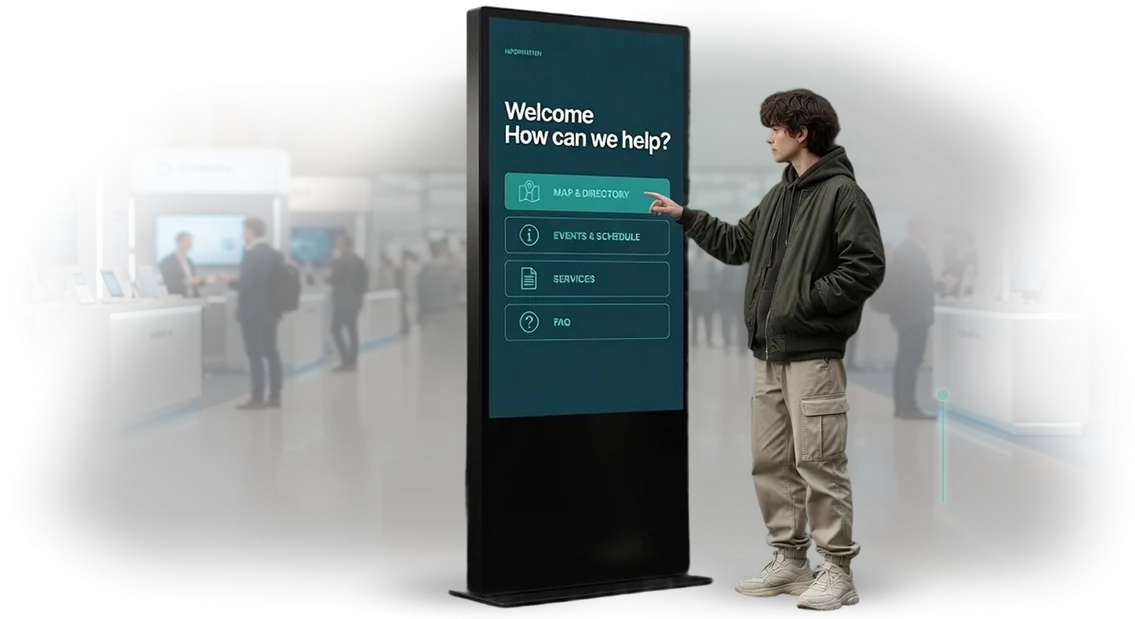
An interactive kiosk for optical salons changes this scenario. The visitor can independently browse the catalog, virtually try on frames and lenses, learn about product characteristics, and get recommendations without waiting for a consultant.
The time from entering the salon to the fitting area is noticeably reduced, the burden on staff decreases, and the customer retains a sense of choice and control. All this directly affects customer retention in the salon and conversion growth.
Implementing a kiosk is not just installing equipment — it is a systemic solution for your business. Wehave been developing such services for retail for more than 10 years and know how to turn a visitor's interest into a real purchase.
Our experience shows that even a single interactive kiosk increases the share of guests who reach the fitting area and raises the average ticket. We will help you stop losing customers and make your optical salon a place people want to return to.
5 Benefits of an Interactive Kiosk for Selling Glasses
An interactive kiosk in an optical salon is not just a screen with a catalog, but a full-fledged sales tool. While a consultant is busy with another customer, the kiosk keeps working: it attracts attention, introduces the assortment, and guides the customer toward a choice. As a result, the salon serves more visitors without expanding staff.
The first and main benefit is an increase in average ticket. The kiosk can suggest add-on sales: for a selected frame, it shows compatible lenses, care accessories, and cases.
The buyer sees a complete set and is more likely to agree to additional items than if they only heard about them in conversation with a salesperson.
The second benefit is saving staff time. Typical questions like "which lenses are thinner," "what suits my look," "is there a frame for my face shape" are handled by the kiosk itself.
Consultants spend their energy on complex consultations and closing deals rather than repeating the same information. This is a direct saving on payroll and an increase in sales conversion.
Third, an interactive display increases engagement. A customer can try on a frame via camera, see how the model looks with different lens types, and compare prices. This format holds the visitor at the stand 3–5 times longer than simply looking at a display case. And time spent with the brand directly affects the purchase decision.
Fourth benefit — growth in loyalty and repeat visits. The kiosk remembers customer preferences, suggests lens replacement times, and offers a discount on the next order.
The customer feels an individual approach and returns not just "to look around" but with the intention to buy.
Fifth — analytics for the owner. The kiosk collects data on which frames were viewed most often, which lenses were chosen, and when customers visit. Based on this data, it is easier to plan purchasing and advertising without relying on intuition.
Professionally configured software works reliably and does not require constant staff involvement — you get an employee who never gets tired and never forgets add-on sales.
Optical Salon: Which Kiosk Formats Solve Business Tasks
An optical salon has different tasks: attract new visitors, manage the line, speed up frame selection. Interactive kiosk formats address these in different ways — and the choice depends on where the salon is located and how customer flow is organized.
We divide kiosks into three typical formats: display, catalog, and interactive fitting room. Below is who each format suits and what it gives your business: more inquiries, less downtime, a higher average ticket.
| Format | Who it is for | What it gives the customer |
|---|---|---|
| Display kiosk | For a salon on a high-traffic street | An additional sign: attracts attention, shows promotions and new arrivals even outside staff working hours |
| Frame-selection catalog | For a salon with a large assortment | Relieves consultants: visitors select models themselves and approach with a ready list for trying on |
| Interactive fitting room | For a salon with a fitting room | Speeds up choice: the buyer sees the frame on their face, hesitates less, purchase conversion grows |
How the Kiosk Launch Goes in an Optical Salon: From Brief to Support
When you decide to install a kiosk in an optical salon, it is important to understand how the work proceeds. We have built the process so that you can see results at every stage and influence them. Below are the stages of kiosk development and implementation that we go through together with you.
-
Brief and task analysis. We study your assortment, target audience, and the main questions visitors have. We determine which scenarios the kiosk should cover: frame selection, eye tests, promotions, appointment booking. The output is a clear technical specification that you approve.
-
Prototype and approval. We create an interactive mockup of the interface — what the kiosk will look like and how it works. You see the catalog structure, buttons, and navigation logic before the first line of code is written. We make changes quickly, without unnecessary costs.
-
Development and content creation. We build the interface, upload your products, prices, descriptions, photos, and promotions. We configure the functions you specifically need: search by brand, filter by lens type, appointment booking. You receive a working tool ready for testing.
-
Testing and training. We test the kiosk on a real touchscreen: how quickly it responds, whether it is convenient to use. We train your staff in basic operations — turning it on, changing content, resolving small issues. You and the team feel confident.
-
Launch and integration. We install the kiosk in the salon and connect it to your systems (for example, your inventory database or catalog). We launch at a convenient time so as not to disturb customer flow. On launch day, we are available and monitor the process.
-
Support and development. After the launch, we do not disappear: we update content at your request, monitor stable operation, and help collect statistics. If promotions or assortment change, you simply send new data, and we handle the rest.
This approach lets you implement the kiosk without stress for staff or customers. You get a working tool that helps sell and inform, and we take care of all the technical side.
What Is Included in the Supply of an Optical Salon Kiosk
When you order a kiosk for an optical salon, it is important to understand that you get not just "hardware with software," but a ready-made turnkey solution — from the housing to staff training materials.
We put together the package so that after installation you only need to turn on the kiosk and start using it.
- Housing and equipment for the salon — anti-vandal housing, touchscreen, and connectivity components selected for the premises and the store's operating hours.
- Kiosk software — an interface with a catalog of glasses, lenses, and accessories, service navigation, and appointment booking for eye exams.
- Content supply — uploading the assortment, photos, prices, and promotions; if needed, we adapt the design to the salon's style.
- Integration with the inventory system — synchronization of stock levels and prices so the customer always sees current information without manual updates.
- Administration module — the manager can change promotions, add new arrivals, and manage the display without contacting a contractor.
- Instructions and procedures — clear manuals for staff in Russian, including daily operations and replacement of consumables.
- Remote support and updates — technical support and scheduled system updates so the kiosk remains stable and secure.
This package addresses the owner's main question — how to get a working sales tool without dealing with multiple suppliers. You get a single point of responsibility: hardware, software, and content all in one solution.
Case Study: A Kiosk in an Optical Salon Doubled Add-on Sales
A visitor comes to an optical store for a specific pair of glasses, but at the checkout does not remember lenses, accessories, or care products. Every such "forgotten" sale is lost revenue that the salon could have obtained without additional advertising.
The problem is often not the assortment, but the fact that there is simply no one to offer all these items in time — consultants are busy with fittings.
The interactive kiosk solves exactly this problem: it tells the customer what else would go well with the selected frame, compares options, and sends a personal selection to their phone.
The visitor sees a ready-made solution before reaching the checkout, and the consultant gets a hint on how to start the conversation. This is not a replacement for staff, but a tool that increases the average ticket and relieves the burden on salespeople.
For the Optika-Style salon chain, we deployed kiosks at two locations with the highest foot traffic. Over two months, the system processed more than three thousand sessions: every third visitor used the selection feature, and add-on sales of accessories and care products doubled.
Previously, the customer relied only on verbal recommendations; now there is a visual service that works 24/7.
After the launch, the client received transparent statistics: which items are most often combined with each other, which categories have higher demand, and what time of day the kiosk is used most actively.
Based on this data, the salon adjusted its product display and updated the showcase — and this already produced additional growth without changing the advertising budget.
The kiosk remains fully manageable: the manager changes promotions, new arrivals, and the catalog through a simple panel without a programmer.
When, a few months later, the client decided to add a new section for children's frames, we updated the system in a few days as part of the ongoing maintenance — the timeline and budget remained as agreed.
How to Choose the Right Kiosk Format for Your Specific Optical Salon?
Choosing a kiosk format for an optical salon is not a question of technology, but of what task the screen should solve: help select frames, consult on lenses, book eye tests, or simply increase brand awareness.
We match a solution to your salon, not the other way around — this saves your budget and avoids unnecessary functions.
First, we look at the space and foot traffic. For a compact salon of 20–30 m², a slim wall-mounted kiosk that does not obstruct customer movement is a better fit.
For a spacious showroom or a high-traffic salon, a floor-standing unit with a large screen is suitable — it is more visible and allows for a full frame try-on experience.
If customers often come with families, it is worth considering two screens: one for adults and one for children.
The assortment also matters. If you have many brands and models, the kiosk must quickly filter frames by style, price, and face shape — then a buyer can find what they want in a couple of minutes and approach a salesperson with a ready choice.
If the salon specializes in complex lenses, the focus is on visual calculators and care information.
We do not sell a "box" — we offer a format that accelerates the sales process and increases the average ticket even at the planning stage. After a short brief, you receive a placement mockup, usage scenarios, and a recommendation on the kiosk type. As a rule, selecting the format and preparing an individual proposal takes one to three days.
The result is simple: the right format is one that the customer uses without instructions, and the salesperson feels it as help, not a hindrance.
We help you choose exactly that option, taking on the assessment of your space, tasks, and team specifics — and after launch we remain available for refinements as the salon's needs evolve.
Common Doubts When Buying an Interactive Kiosk
Buying an interactive kiosk for an optical salon raises questions: will it distract customers from the displays, will it be difficult to maintain, will it help increase sales.
We — our team our team— have been creating such solutions for retail for 10 years and know what fears most often prevent people from deciding.
What if the kiosk breaks down in the middle of a busy day?
We select equipment with a safety margin, provide a warranty, and handle maintenance ourselves. If a failure occurs, an engineer will connect remotely or arrive on site — you will not be left without a working kiosk.
Will the salon staff cope with the new equipment?
No special training is needed: visitors choose frames, browse the collection, and book consultations themselves. Staff can master the kiosk in a few minutes, and guests use it without constant help.
Will the kiosk actually help an optical salon, or will it just decorate the showroom?
The kiosk shortens the customer's path: they see the range on screen, learn about promotions, and leave a request. You receive data on visitor preferences and a reason for repeat visits.
Still have doubts? We will show retail examples and calculate how a kiosk would fit into your salon specifically. Below we have collected answers to other common questions — if you do not find yours, write to us.Order an Interactive Kiosk for Your Optical Salon
Make your optical salon more convenient for customers. An interactive kiosk is a sales tool: visitors select frames and check promotions themselves, while the consultant attends to other guests.
our team has been creating such solutions for retail for more than 10 years — you get a working turnkey service.
When you order a kiosk, you receive:
- Interactive catalog of frames and lenses with filters by brand, color, and price — the customer chooses faster.
- Virtual try-on: the visitor sees themselves in new glasses and decides more easily to buy.
- Eye test to attract attention and collect contact information from potential buyers.
- Synchronization with the product database: prices and availability are always current, no dissatisfaction due to errors.
- View and request statistics — you understand which models to promote more actively.
- Design tailored to your brand and staff training — everything works immediately, and we stay available.
To calculate the cost of an interactive kiosk for an optical salon, send us your space parameters, assortment, and goals. We will select modules to fit your budget — from a catalog to a full virtual try-on.
Order a kiosk, and within a few weeks customers will appreciate the new service, and you will see growth in interest and sales.
Call or write to us — we will discuss the details, timeline, and cost.