

Shoppers Don't Notice Promotions: How Can a Supermarket Win Back Their Attention?
A supermarket shopper walks past dozens of aisles and has no time to study every price tag. Ordinary posters and "sale" stickers blend into the background — attention scatters, and great deals go unnoticed. As a result, the store loses sales, and promoted products never find their buyer.
The problem isn't just visual. Even when a promotion is spotted, the shopper still needs to remember where the product is, compare prices, and make a decision. One extra step at that moment — and the purchase gets postponed.
A supermarket needs a tool that guides shoppers from "I see a promotion" to "I'm putting it in my cart" without effort.
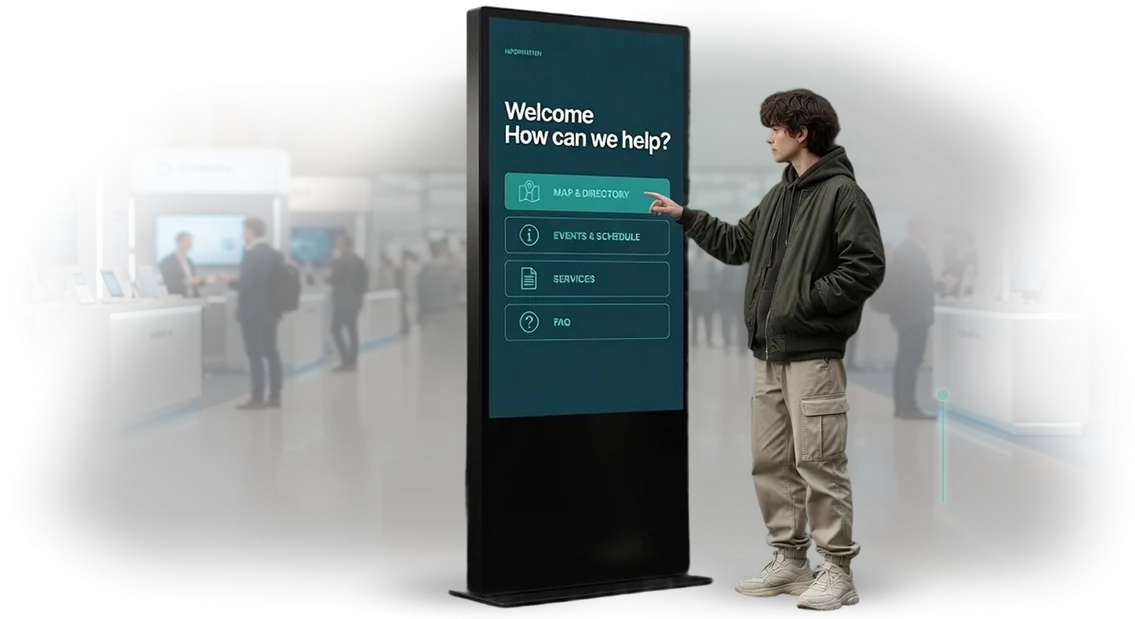
An interactive kiosk in a supermarket solves this problem. A bright touchscreen catches attention right at the entrance, and a clear interface lets shoppers find promoted products, see where they are, and even check ingredients or cooking instructions in just a couple of taps.
Shoppers are used to getting information instantly — from a smartphone, without queues or staff assistance. A kiosk for a store works the same way: it answers the request immediately and suggests the next step, holding attention all the way to the cart.
So implementing a kiosk isn't just installing a screen — it's a way to take back control of shoppers' attention. A properly configured scenario increases sales of promoted items, reduces unsold stock, and makes the shopping trip more enjoyable. That means stronger loyalty and repeat visits.
What an Interactive Kiosk Gives Shoppers and Store Owners
An interactive kiosk in a supermarket benefits both sides: shoppers find what they need faster, while the store increases the average ticket and builds loyalty. This isn't just an information screen — it's a working tool that pays for itself in everyday retail.
What the shopper gets
- Fast product search by name, category, or alphabet — instead of wandering the aisles.
- A store map with up-to-date layout and price tags.
- Information about promotions and personal discounts via the loyalty card.
- Price comparison for similar products — helps with decision-making.
- Recipes and product selections for a dish — inspiration for additional purchases.
What the store owner gets
- Higher average ticket thanks to recipes, complementary products, and visible promotions.
- Reduced staff workload — employees are less distracted by questions about where products are.
- Greater loyalty from regular customers through convenient service and exclusive on-screen offers.
- Analytics on shopper demand: which items are searched most, which promotions deliver results.
- An additional communication channel with your audience — instant updates to prices, news, and special offers.
We develop kiosks with the specific retailer's goals in mind: the interface, scenarios, and integrations are configured to match the store format. That's why the kiosk delivers measurable value from day one — rather than just decorating the lobby.
Which Kiosk Formats Work in a Supermarket and Why They Matter
In a supermarket, every shopper's minute counts: some are looking for a specific department, some are comparing promoted products, and some just want to check their bonus balance without standing in line.
Without clear navigation, visitors waste time and get frustrated, while the checkout becomes the only place where staff actually interact with them.
An interactive kiosk handles these tasks at once: it guides, informs, and draws shoppers into the loyalty program — all without adding extra staff.
We've put together three core formats that have proven effective in retail. They cover the main scenarios: from "how do I get there" to "why it's worth buying more."
| Kiosk Format | Who It's For | What It Gives the Customer |
|---|---|---|
| Navigation | New visitors, elderly shoppers, people "on the go" | Finds a department or product right away — less time searching, less stress |
| Product Catalog | Those who are unsure of their choice and looking for an alternative | Sees the range, availability, price, and ingredients — decides faster |
| Promotions & Loyalty Program | Regular customers, deal hunters | Checks personal discounts and bonuses, sees promotions, feels valued |
A navigation kiosk eliminates the endless stream of "where's the milk?" questions and frees staff from routine. A catalog helps shoppers explore products without rushing at the shelf and keeps them from leaving empty-handed if the exact item is out of stock.
A loyalty kiosk turns a routine grocery run into a game with bonuses — which directly increases the frequency of repeat visits.
It's important that all formats run on the same hardware and complement each other. We use proven software solutions for touch terminals — so navigation, catalog, and loyalty features can be combined into one interface without complex custom work and within reasonable timelines.
How a Kiosk Project Unfolds: From Brief to Launch
Before launching an interactive kiosk, it's important to understand how the work will be structured so you're not guessing about timelines or the final result. We run the project on a transparent model: at every stage, you see what's happening and make the key decisions. This lets us deliver a turnkey kiosk — from concept to a working device in your store.
-
Brief and task analysis. First, we figure out exactly what the kiosk needs to do: product selection, department navigation, a catalog with promotions, or appointment booking with a consultant. We clarify where it will be placed and who will use it, so we can propose the right solution.
-
Plan and estimate. Based on the brief, we prepare a concrete proposal: the screen structure, functionality, timelines, and budget. You immediately understand what you'll get in the end and what the kiosk development stages will be.
-
Structure and design approval. We finalize the screen logic, texts, and visual style aligned with your brand. You see how the kiosk will look and what shoppers will see before programming even begins.
-
Interface development and content. We build the kiosk itself and connect your product catalog, promotions, and other data. In parallel, we set up an admin panel so you can update content yourself without our involvement.
-
Testing and launching the interactive kiosk. We test everything on real hardware: speed, reliability, and usability. Then we install the kiosk in the store, connect it to the network, and make sure it runs stably during peak hours.
-
Support and growth. After launch, we stay in touch: we train your staff, update the assortment, and add new features as your business grows. You get more than just an information point — you get a tool that can evolve with your store's needs.
This approach guarantees that a turnkey kiosk project progresses without surprises, and you get value for your shoppers plus an additional communication channel from day one.
What's Included in the Delivery and Launch of an Interactive Kiosk
A supermarket shopper makes decisions in a matter of seconds — and an interactive kiosk must work flawlessly from day one. So you don't have to worry about technical details, we deliver a turnkey solution: from the enclosure to staff training. Below is the full package you receive with your order.
- Durable enclosure and anti-vandalism screen — the equipment is built for intensive use in the sales area, resistant to dust and accidental bumps from shopping carts.
- Pre-installed software — the interface is configured for your assortment and promotions, and price updates happen automatically.
- On-site installation and setup — an engineer arrives at a convenient time, installs the kiosk at the desired location, and connects power and network.
- Configuration for your scenarios — catalog, in-store navigation, loyalty program, or surveys: the kiosk works exactly the way your marketing needs it to.
- Staff instructions — short cheat sheets and a video guide so any administrator can restart the kiosk or replace consumables.
- Staff training — we run in-person or online training for cashiers and administrators: how to welcome guests at the kiosk, help with orders, and handle common questions.
- Warranty support — during the warranty period, we monitor performance remotely and dispatch a technician promptly when needed.
You get a single package for which one company is responsible: enclosure, screen, software, installation, and training. No need to hunt down separate contractors and coordinate them — we handle every stage ourselves.
All that's left is to launch the kiosk and watch it simplify choices for shoppers and increase the average ticket.
Case Study: How a Kiosk Boosted Sales for a Grocery Chain
Shoppers in a supermarket often get lost among the aisles: they search for a product, wander between shelves, end up buying less than they planned, and leave frustrated. Lines at the checkout only add to the negativity — and the chain loses customers. That's exactly the problem the Fresh Row supermarket chain brought to us.
We developed an interactive information kiosk that completely transformed the shopper journey. On the touchscreen, customers can find a product in a couple of taps, see the shelf and price, check promotions, and get a recipe based on the items in their cart.
The kiosk became more than just an inquiry point — it became an in-store navigation tool and a selection assistant: shoppers see the floor plan, mark the departments they need, and build a route, while the system suggests what else is worth picking up at a good price.
The results were visible within the first month. The average ticket grew by 17% — shoppers started adding more promoted items and recipe-based products to their carts.
Checkout wait times dropped by a quarter: guests found what they needed faster and spent less time in the aisles. Thanks to in-store navigation, the number of questions to staff decreased, and customers became more willing to return.
Notably, nearly a third of guests used the kiosk to search for products, and one in five used it to check promotions.
After a pilot launch at three locations, the chain decided to scale the solution to all its stores. Kiosks now operate in 24 supermarkets, and that's not the limit — expansion is on the roadmap.
If you'd like a similar kiosk case study for your chain, we'll discuss your scenario and show you the ROI calculation.
How to Choose the Right Kiosk Format for Your Store's Needs
Choosing a kiosk isn't about buying a "box with a screen" — it's about finding a tool that makes your store more convenient for shoppers.
There's no one-size-fits-all solution: a kiosk for a small store where service speed matters and a full-scale terminal for a hypermarket with department navigation are completely different configurations.
Selecting the right kiosk format starts with three questions: what's the floor area, what's the traffic, and what task should the kiosk solve?
Floor area and traffic determine the physical size of the device. In a small space with a flow of a few hundred people per day, a compact stand with a product catalog, promotions, and quick search is enough. It goes near the entrance or by the checkout and doesn't create queues.
In a large supermarket with heavy traffic, you need a more prominent unit with a large screen, department navigation, and product search — it helps shoppers find the right shelves faster and complete their purchases.
The use case defines the screen logic. If the goal is to relieve pressure on the checkout, the kiosk should guide shoppers to the result in a couple of taps.
If the goal is to increase the average ticket, seasonal offer showcases, recipes, and personal selections take center stage. The interface is designed around specific shopper behavior, not "just in case."
For a small store, a compact stand kiosk with a catalog and price-label printing is ideal: it takes up little space and fits easily into the layout. For larger spaces, floor-standing terminals with a floor map and department signs work better.
It's also important that the kiosk is easy for elderly visitors to use — large buttons, clear labels, and a minimum of steps.
The right kiosk format solves a specific problem: it cuts queues, improves navigation, and increases revenue. To choose it, all you need to do is describe your floor plan and shopper traffic — we'll recommend the optimal option and show you how it will fit into your store.
Frequently Asked Questions About Kiosks: Timelines, Warranty, and Maintenance
Customers rarely ask about the technical internals — what concerns them is timelines, warranty, and what happens after launch. We've gathered answers to common questions so you know in advance how we work and what you'll get.
What are the kiosk development timelines?
A standard kiosk — navigation, catalog, product ordering — takes 2–3 weeks from the moment the mockups are approved. If you need integration with your loyalty system or inventory management, the timeline may extend to two months, but exact dates are fixed in the contract.
What warranty comes with the kiosk?
We provide a warranty on both the software and the hardware. If anything fails during the warranty period, we'll fix or replace it free of charge. The terms are transparent, with no hidden clauses.
What should I do if the kiosk breaks down?
You call our support line, we run remote diagnostics, and resolve the issue. In most cases, it's handled within one business day. If parts need replacing, we arrange that according to procedure.
How is kiosk maintenance organized?
We offer scheduled maintenance: equipment checks, content and software updates, and preventive care. This reduces the risk of sudden breakdowns and extends the equipment's lifespan. Maintenance can be added as a standalone service or included in project support.
We structure our work so the kiosk is a reliable tool, not a source of problems. If you still have questions, ask them before we start, and we'll document all the agreements.Leave a Request — We'll Calculate Your Project Within Two Days
Leave a request on the page, and within two business days you'll receive a cost estimate for a kiosk tailored to your supermarket's needs.
We don't ask for prepayment for the consultation: first, we figure out where the kiosk will deliver the most value — at the entrance, near the checkout, or in the prepared foods section.
From there, it's a clear path from idea to working kiosk:
- Kiosk consultation: we clarify your goals, number of locations, use cases, and integration with your systems.
- Kiosk cost estimate: we lock in the estimate covering hardware, design, software, and commissioning. No hidden fees.
- Kiosk demo: we show how the screen will look and work on a real prototype. You see the future interface before signing the contract.
- Contract and project plan: we agree on timelines, stages, and responsible parties. You get a clear schedule: when the mockup will be ready, when the test version is due, and when launch happens.
- Launch and support: we install the kiosk, train your staff, and stay in touch after launch. If needed, we refine the functionality based on the first few weeks of results.
This way, you order a kiosk without risk: you understand the budget, timelines, and results before making a decision. Leave a request — and in two days you'll have the full picture of the project.