

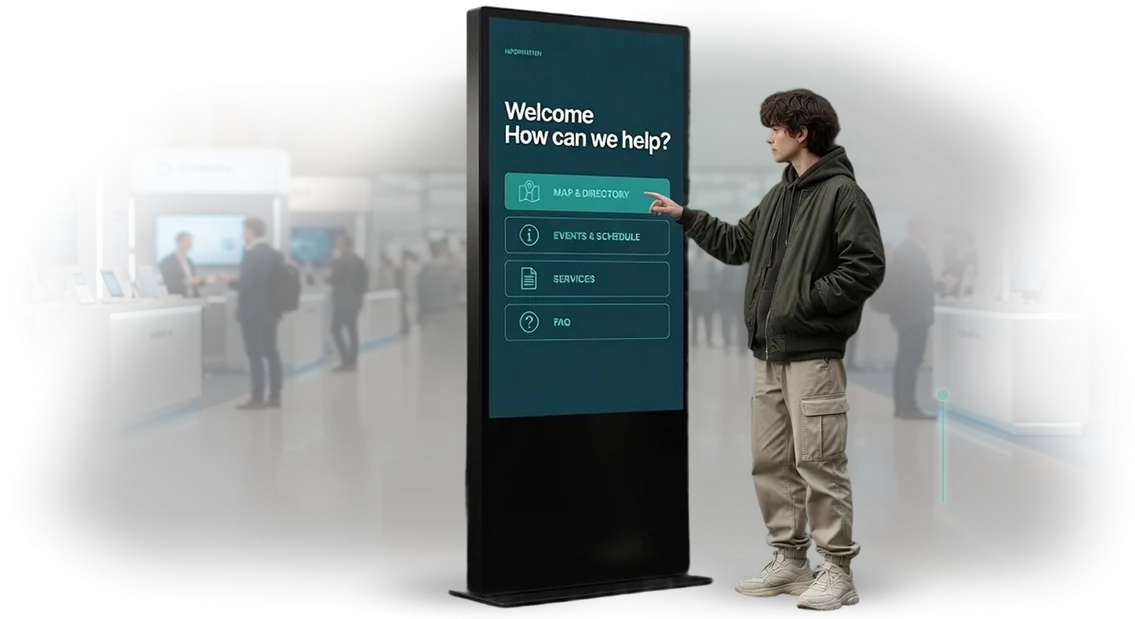
Theaters are losing audiences because of outdated navigation and queues
Theaters are losing audiences not because of the quality of their productions, but because of the small things that spoil the impression before the show even begins.
A guest who cannot find the right hall or has to stand in line at the box office for fifteen minutes is unlikely to come back — and just as unlikely to recommend the theater to friends.
At the same time, today's audiences are used to having any information available in a couple of screen taps, and they expect the same level of service from cultural institutions.
An interactive information kiosk for a theater solves this problem: it takes on navigation, reference information, and part of the box office workload.
Visitors find the right hall on their own, check the schedule, and get quick answers to their questions — without searching for an administrator or dealing with a crowd at the entrance.
This turns a visit to the theater into a simple, pleasant process that guests are happy to return to — and pay for.
Shorter queues are not just about comfort — they also mean additional revenue.
While a cashier is busy selling tickets for the next show, the kiosk simultaneously serves dozens of visitors: it displays the program, tells them about productions, and helps them find their way around the building.
As a result, the theater serves more guests with the same number of staff, and visitors are not irritated by waiting.
The higher the service level, the higher the loyalty. A theater that cares about comfort from the moment visitors walk in is perceived as a modern venue that respects its audience.
We help meet this need — we design and implement information kiosks that support the theater atmosphere and deliver tangible benefits to both audiences and management.
What an organization gains from an interactive kiosk
Visitors come to the theater for emotions, but the first impression is often formed in the lobby. An interactive kiosk solves several tasks at once: it increases ticket sales, relieves the box office, and shapes a modern image of the institution. For the audience, it is a convenient service; for the theater, it is a working tool for growth.
Increased ticket sales
When guests can choose their own seat on a hall map and pay for a ticket in a couple of minutes, the purchase threshold drops. The kiosk works as an additional point of sale — even during peak hours when the box office is overloaded, visitors do not leave without a ticket. This directly affects revenue and reduces losses from queues.
Relieving the box office and staff
The kiosk takes over part of the routine operations — selling standard tickets, giving hints about the program, and helping with seat selection. Cashiers get time for complex requests and live interaction with visitors. Queues become shorter, and staff get less tired from repetitive work and make fewer mistakes.
A modern image of the theater
The first impression of an institution is formed in the lobby. An interactive kiosk shows that the theater pays attention to details and keeps up with the times.
This strengthens its reputation, adds points with a young audience, and creates a comfortable digital touchpoint before the show even starts.
Each of these benefits reinforces the others: a convenient kiosk increases audience loyalty, and a well-designed interface helps the theater tell more about its program and history.
We design kiosks to fit the specific goals of an organization — from menu logic to integration with the ticketing system — so the result works for your business.
Formats of information kiosks for theaters and their capabilities
A theater lives by its audience, and the fewer barriers between a guest and a performance, the more loyal the audience. Regular posters and signs do not answer questions in the moment: where the hall is, whether tickets are available, what is on tomorrow.
An information kiosk takes these tasks on itself, and administrators and cashiers get more time for live interaction. Visitors value speed and independence — this is especially noticeable during intermissions and right before the show begins.
The kiosk format depends on the tasks and layout. We choose the design and content for a specific theater: where it will be installed, who the main users are, and which scenarios matter more — ticket sales, navigation, or the theater program.
| Format | For whom | What it gives the theater |
|---|---|---|
| Touchscreen stand | Visitors in the hall and lobby, near the box office | Self-service show selection, viewing descriptions and hall maps, buying tickets without queuing. Relieves the box office and increases revenue through additional sales. |
| Wall-mounted panel | Guests at the cloakroom, buffet, and staircases | Instant wayfinding by floor, the program for the day and upcoming premieres. Takes up no floor space, always in sight, suitable for small spaces. |
| Mobile stand | Events, tours, open-air venues | Can be moved around the building and used for off-site events. Sets up quickly, attracts attention, and helps run surveys or special offers. |
For a theater, it is important that the kiosk does not look like a foreign element. We adapt the design to the interior and style of the stage, and the content to your program and seasonal events.
This approach makes the kiosk a natural part of the space, supports the atmosphere, and strengthens the theater's image in the eyes of guests.
How kiosk development works: from brief to launch
Developing a kiosk for a theater is not just installing a terminal in the lobby. It is a project that must fit into the life of the theater: help visitors find their way faster, relieve administrators, and increase ticket sales.
That is why we have built the process so that you understand what is happening at every stage, control the timelines, and see the results.
-
Brief and immersion in the theater's tasks. We discuss where the kiosk will be located and who will use it — visitors, box office, administrators. We record the goals: navigation to halls, program, ticket purchases, information about productions. You get a clear project plan without unnecessary details.
-
Concept and project approval. We propose usage scenarios: how a guest will choose a show, how they will get to the right section, and what they will see on the main screen. We agree on the structure before development begins — this avoids expensive changes in the later stages.
-
Design in the theater's style. The kiosk's design matches the corporate identity, using photographs of productions and the atmosphere of the hall.
At the same time, the interface remains clear for visitors of different ages and levels of experience — even those who rarely use technology will understand it in seconds.
-
Development and content. We program the operating logic and connect the database with the program, prices, and hall maps. We fill the kiosk with content: descriptions, photos, videos.
All materials are easy to update — you will be able to change the program without involving developers.
-
Testing on real scenarios. We check how quickly a visitor finds the right show and whether people of different ages can handle the interface. We fix errors before the kiosk reaches the lobby — that is why launch goes without surprises or downtime.
-
Launch and support. We install the equipment, train administrators, and hand over instructions. After launch, we stay in touch: we update the program, monitor stable performance, and add new features as the theater grows.
This approach is what makes it possible to create a kiosk that visitors enjoy using, while the theater gets measurable benefits: fewer queues, more sales, and a modern service.
What is included in the delivery: the customer package
When you order an interactive kiosk for a theater, you get not just a program, but a complete ready-to-work package. We have thought through every stage — from launch to everyday use — so that your team can quickly master the system and get the maximum benefit from it.
-
Kiosk software. Runs on professional equipment and is tailored to the tasks of the theater: program, navigation to halls, ticket sales, information about productions. Guests find what they need on their own, and staff free up time for live questions.
-
Admin panel. A convenient personal account where you change the program, add banners, and edit the schedule without involving developers. Any update appears on the screen instantly — just a couple of clicks.
-
Staff training. We hold a session for administrators and ticket cashiers: we show how to use the panel, upload content, and solve typical tasks. Your employees work confidently in the system from day one.
-
Documentation. You get a clear guide to setting up and operating the kiosk, plus a short operator manual. All materials are collected in one place — nothing needs to be searched for or gathered piece by piece.
-
Warranty support. During the warranty period, we support the project: we quickly fix errors, answer questions, and help with setup. If something goes wrong, you will not be left alone with the problem.
-
Room for growth. As the theater grows, the system can be improved: add new screens, enable online payment, or integrate with ticketing services. You can always expand the functionality for new tasks.
This is not just "a program for a kiosk," but a complete solution that saves your staff time and improves the impression guests get from visiting the theater. You immediately get a working tool, not a "raw product" that needs to be finished on your own.
Case study: how an interactive kiosk increased ticket sales
One of the most telling projects is Scena Theater in a regional center. Before the interactive kiosk was installed, tickets were sold only at the box office: on peak days and before premieres, lines formed there, and some visitors left without buying a ticket. Ancillary sales also suffered — only a few people bought programs and souvenirs.
How it happened
We placed an interactive kiosk in the lobby so that visitors could choose the show and seat themselves and pay by card. The whole process takes less than a minute, and the kiosk immediately issues a ticket.
At the same time, the theater got a convenient tool for showing the program, news, and videos about premieres — so the kiosk also became an advertising medium.
Importantly, the equipment did not require extra staff from the theater. An administrator uploaded the schedule into the system once, and the kiosk works on its own from then on. We trained the staff and stayed available for any questions.
Project results
After six months of operation, the theater recorded a 30% increase in ticket sales. The queues at the box office shrank by half: people no longer miss the start of a show, and cashiers can spend time with those who prefer live communication. The share of sales through the kiosk is steadily growing, especially among younger visitors.
The theater director evaluated the project this way: "Previously, on peak days, the queue to the box office reached the doors, and some guests left.
Now the kiosk handles a third of sales, visitors are pleased, and we see the average spend on additional services growing."
After the successful launch, the theater ordered a second kiosk from us for its second building and asked to add season ticket sales. For us, this is the best indicator that the project benefits the client.
Answers to frequently asked questions about kiosks for cultural institutions
Doubts before purchasing a kiosk are normal. The most common questions are about timelines, warranty service, and content updates — let's look at each topic.
How long does kiosk development take?
On average, a project takes three to six weeks — depending on the number of screens and the complexity of the program. A clear brief and approvals at two stages allow the kiosk to be launched exactly in time for a premiere or the start of the season.
You receive a calendar plan with checkpoints so you can plan the purchase and installation without rushing.
How does warranty service work?
We support the kiosk after launch: engineers connect to the device remotely, and most issues are resolved within a few hours. If component replacement is needed, we take it on ourselves and agree on a convenient day — the theater is not left without a working kiosk.
This is real support with a single point of contact, not a "hotline" on paper.
How do I update content — the program, news, artists?
You work in a simple admin panel through a browser: upload photos and PDFs, change texts and schedules, and updates appear on the screen immediately. No need to contact programmers.
Access can be granted to an administrator, marketer, and cashier — each will see only their own area. Changing the program in the morning takes no more than five minutes.
Didn't find an answer to your question? Write to us — we will have a 15-minute call and discuss your theater, kiosks, and possible scenarios.Submit a request for kiosk development for your project
We understand: in a theater, every element helps the visitor immerse themselves in the atmosphere, and a poor digital interface ruins the impression.
That is why we develop information kiosks that fit organically into the space and solve the tasks of the box office, navigation, and program display at the same time.
Submit a request for a kiosk for your project — we will send a cost estimate and propose a time for a consultation. We will tell you how the solution will work specifically in your theater and suggest the optimal usage scenario.
After you contact us, you receive:
- a preliminary cost estimate within one business day;
- a consultation with an engineer and a manager on usage scenarios;
- turnkey development: from scenario to installation and launch;
- interface adaptation to your corporate style and the needs of your visitors;
- staff training and instructions for fast work;
- technical support after launch and a warranty on the project;
- a clear understanding of timelines and stages before the work begins.
It is important for us that you know in advance what you get for your money and do not face surprises in the middle of the project. That is why we fix the agreements in documents and stay in touch with you after delivery.
Fill out the form — and we will handle everything from idea to a working kiosk, while you focus on the main thing — your audience.
How to choose the right kiosk format for your venue?
Choosing a kiosk format starts not with a picture or design, but with an honest answer to three questions: what is the floor space of your venue, what tasks should the kiosk solve, and what budget is allocated for this project.
If you define these criteria before starting, you will save time and avoid overpaying for unnecessary functions. This is especially important for a theater: the kiosk must fit into the interior and not interfere with the flow of visitors.
The first criterion is physical space. In a spacious lobby with high ceilings, it makes sense to install a floor-standing kiosk with a large screen: it will become a noticeable point of attraction and will be visible from afar.
If the space is limited or the passages are narrow, the best choice is a compact wall-mounted panel. It does not take up useful space and still gives visitors the information they need.
The main thing is that the kiosk does not create a queue at the entrance and does not block the way to the cloakroom or the auditorium.
The second criterion is functional tasks. Think through what exactly the kiosk should do: show the program and the cast, help with navigation around halls and floors, or sell tickets.
If sales are the priority, you will need a solution with a reliable touchscreen and integration with the ticketing system — then the visitor can choose a seat and pay for the purchase themselves.
If the kiosk is needed primarily as a program and reference guide, a simplified model with a convenient menu and fast response is enough.
Theaters often combine both scenarios in one device — that is normal, but it is important to understand that each task requires its own configuration.
The third criterion is the budget and readiness for development. An entry-level option with basic functionality solves the main tasks and quickly pays for itself by reducing the load on staff.
A more complex solution costs more, but offers opportunities for growth: interactive scenarios, additional interface languages, and collecting analytics about popular events.
Do not chase the maximum configuration — choose the level that matches your current needs and allow for the possibility of upgrades later.
In any case, we always start with an audit of your venue: we look at foot traffic, placement points, visitor behavior patterns, and your current processes. Based on this, we propose specific formats and show how each of them will work in your theater.
This approach eliminates mistakes at the selection stage and guarantees that the kiosk becomes a helper, not an extra interior element.