

Why Your Tourist Center Is Losing Guests and Revenue
Visitors come to a tourist center for experiences, but often face chaos: confusing signs, lines at the information desk, scattered brochures. As a result, guests spend time not on leisure but on finding what they need — and leave disappointed.
It's an invisible but constant loss of visitors that directly reduces the center's revenue and reputation.
Without clear navigation, every third guest misses key locations, cafés, or souvenir shops. They don't see your strengths, don't linger, and don't come back. And bad impressions quickly turn into negative online reviews that scare off new guests before they even visit.
A classic information desk doesn't help: staff physically can't answer everyone, some questions are repeated dozens of times, and information about current events becomes outdated by evening.
Guests are left unattended at the most important moment — when they need to quickly get their bearings and plan a route.
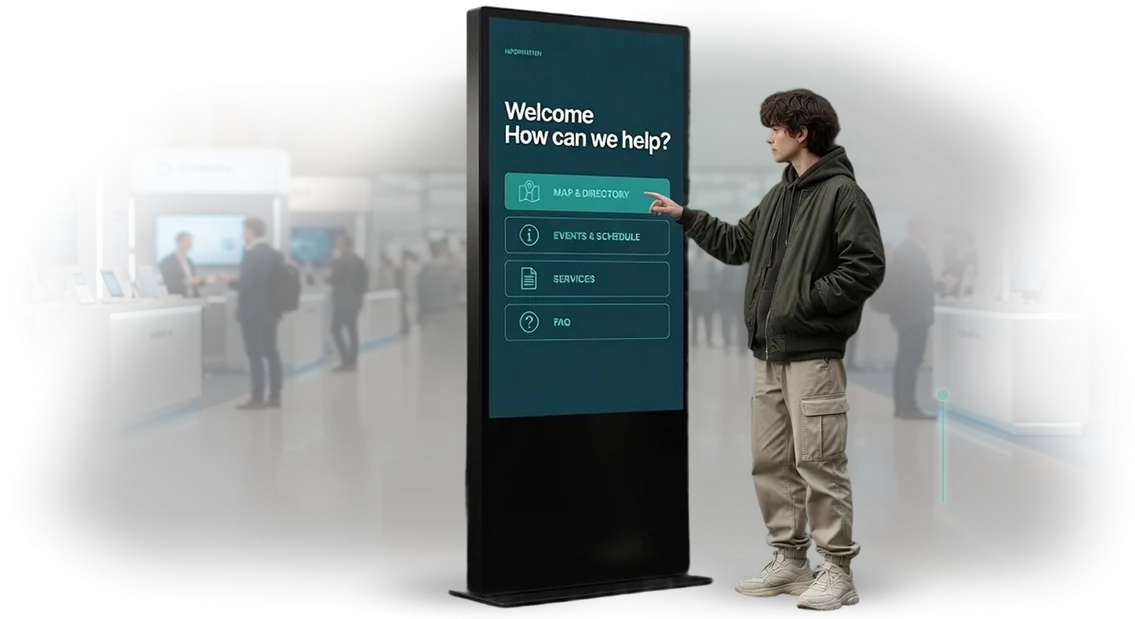
An interactive kiosk solves this: it instantly shows a map, points of interest, schedules, and routes without staff involvement. A visitor gets the needed information in 30 seconds, and you get more time for service and sales.
This is exactly the kind of solution we help implement — fast, clear, and with a tangible result for your center.
What Introducing Kiosks Will Bring to Your Tourist Center
You'll notice the first changes on launch day. The kiosk handles routine questions — routes, schedules, maps, information about facilities — and frees up staff for face-to-face interaction with guests.
Tourist navigation becomes clear and available at any time, even when the information desk is already closed.
Immediately After Implementation
Guests stop queueing for assistance: 80% of typical questions are resolved through the screen. This noticeably speeds up service and reduces staff workload.
Visitors find their way around faster, locate what they need, and get lost less often — which means they have a more positive experience overall.
The First Month of Operation
You see guest behavior change: they stay longer in the center because the kiosk suggests what else to see nearby, where to grab a bite, and which tours are available.
Visit duration grows by 20–30 minutes — a direct path to additional spending at cafés, souvenir shops, and paid events. At the same time, loyalty grows: guests appreciate the care for their comfort and are willing to return.
Next — The Systemic Effect
Based on data about popular queries and routes, you see what actually interests guests and can adjust promotional offers. The kiosk's smart suggestions turn casual visitors into participants of paid activities — sales conversion grows without additional marketing investment.
We have already helped tourist centers walk this path: from the first screen to full return on investment. We work remotely, on professional equipment, turnkey — from scripts to installation and support.
Interactive Kiosk Formats for Your Tasks
A tourist center is a place where visitors need to quickly get their bearings: where the entrance, café, restrooms, souvenir shop, and observation deck are.
If information is scattered across desks and signs — that means queues at the administrator, lost guests, and missed experiences. An interactive kiosk solves this problem the moment it arises — without involving staff.
Kiosk formats differ in their feature sets and usage scenarios. We select a solution for the specific area and visitor flow, so every guest gets an answer in 10–15 seconds and the tourist center reduces staff workload and increases guest satisfaction.
Popular Kiosk Formats
| Format | Target Audience | Value for the Client |
|---|---|---|
| Wayfinding kiosk | Visitors looking for a facility or route | Helps guests build a route on their own, reduces the flow of questions to staff |
| Guide kiosk | Tourists interested in history, architecture, and events | Increases visit duration, engages visitors in exploring facilities, creates a positive impression |
| Interactive map | Families with children, international guests | Quick search for points of interest, language switching, accessible to any audience |
| Multimedia kiosk | Event organizers and marketing teams | Informs about the schedule, promotions, and services, fills downtime, and promotes additional services |
This isn't an exhaustive list — kiosks are easy to adapt to non-standard tasks: for example, combining a wayfinder with a feedback form or creating a virtual tour of the premises.
All formats can be updated without redesigning, so you can change content for the season, new exhibitions, or special projects.
How Kiosk Development Works: 7 Steps
A transparent process is the key to the client's peace of mind. We've divided the work into seven steps so you always know what stage the project is at, what's happening, and when the result will be ready. Each stage is coordinated with you, and after launch we stay in touch and support the kiosk.
- Brief and Immersion. We identify the kiosk's goals: what information tourists need, how guests will use it, which scenarios matter, and what result you expect.
- Analytics and Prototype. We prepare the structure and logic of the future kiosk and show the navigation scheme — so you can see how visitors will find what they need in a couple of taps.
- Design Mockup. We create a visual style that fits your tourist center's interior and is clear to guests of any age.
- Project Approval. We finalize timelines, scope of work, and cost. You get a complete plan before development begins and understand what you're paying for.
- Development and Content. We write texts, process media, configure the system, and connect the necessary data and services — all in your brand's unified style.
- Testing and Debugging. We test the kiosk on real scenarios: from entering the menu to completing a session. We eliminate all inaccuracies so the launch goes smoothly.
- Launch and Technical Support. We install the equipment, train staff, provide clear documentation, and remain available for updates and refinements.
This sequence eliminates rushing and misunderstandings. You control every stage, while we handle the technical side and guarantee stable kiosk operation after opening.
What's Included in the Kiosk Package
When ordering a kiosk for a tourist center, it's important to understand what's included in the package. Launch timelines, budget, and the ability to easily update information all depend on this.
We put together the package on a "plug in and it works" principle: you get not just hardware, but a complete solution with licenses, content, and documentation.
Here's what's included:
- Equipment — a touchscreen kiosk with a vandal-resistant enclosure, a bright display, and a built-in computer. Suitable for 24/7 operation in the lobby, at the information desk, or at the building entrance.
- Software Licenses — a perpetual license for the developed software. No hidden fees, no cloud lock-in, no monthly subscriptions: the kiosk is entirely yours.
- Kiosk Content — design mockups, texts, a site map, photos, and videos. The content is created specifically for your tourist facility, so there's no need to look for separate contractors.
- Management System — an intuitive interface that lets staff update opening hours, promotions, news, and events themselves. No programmer required.
- Documentation — an operating manual, commissioning certificates, and a warranty card. A complete set for accounting and technical services.
- Updates and Support — during the warranty period, we make content edits and refine the software based on your requests. You're never left alone with the equipment.
In short, the package includes everything needed to launch and run the kiosk on a daily basis. All you have to do is choose a spot and put up an "Information" sign.
If you need a non-standard enclosure or additional options, we'll discuss them separately and prepare a custom proposal.
Case Study: How an Interactive Map Increased Guest Stay Duration
A tourist center is a place where guests decide where to go and how long to stay. But often visitors glance at a display stand, grab a couple of brochures, and leave — nearby exhibits, cafés, and shops go unnoticed, and the average stay lasts just a few minutes.
Solution
We solved this pain point with an interactive map on a touchscreen kiosk. Instead of a static stand, guests got a live wayfinder: points of interest, routes, events, and current offers — everything needed to plan a visit on the spot.
The map is built on the well-known mapping service 2GIS, so data about facilities is always up to date and requires no manual updates.
Results
The results speak for themselves. The average guest stay at the center doubled: from 20–25 minutes to 45–50. Visitors now visit 2–3 times more locations — instead of one or two facilities, they visit four or five.
And most importantly, the share of repeat visits has grown: guests come back to see what they missed the first time.
For the owner of a tourist center, this is a direct benefit: more time spent in the center means more spending at cafés and shops, greater reach for tenants, and a more attractive venue for new partners.
A single kiosk with an interactive map pays for itself through increased foot traffic to locations inside the center within the very first months of operation.
This case study confirms: an interactive map is not a "screen for show" but a working tool that increases visitor traffic and guest retention. We handle the development, content, and support — all you have to do is watch the numbers grow.
How to Choose a Kiosk Format for a Non-Standard Task?
If standard kiosk templates don't fit your task — that's no reason to give up on automation.
It's precisely in non-standard situations that an interactive kiosk delivers the most value: it solves a specific problem rather than just "looking nice in the lobby." We understand this, which is why we start not with ready-made solutions but with questions: who will use the kiosk, where will it be placed, and what should a visitor be able to do in 30 seconds?
For example, a tourist center with an unusual layout often needs not a standard sign but a route map that accounts for real obstacles and zones.
Sometimes a non-standard interface is needed: for the visually impaired, for families with children, or for foreigners speaking a rare language. In each such case, the screen format, placement, and menu logic are determined by the task, not by a manufacturer's catalog.
That's why we offer a short consultation: you tell us about your task, and we help you choose the format — a touchscreen counter, a floor-standing kiosk, a wall-mounted panel, or a custom structure.
We also explain how this will affect visitor convenience and your team's workload. This isn't a commitment to order — it's a way to remove uncertainty and figure out which option is actually worth considering.
A non-standard task isn't synonymous with a complex project. Often, simply adjusting the menu logic or choosing a different enclosure is enough to make the kiosk work effectively. The key is not to choose a format at random and not to force your task into an outdated template. Come to us with your question — together we'll find a format that solves precisely your task.
Frequently Asked Questions About Kiosk Development and Maintenance
Before ordering an interactive kiosk for a tourist center, clients most often ask the same things: what about the warranty, how is maintenance organized, and who is responsible for uninterrupted operation during the season.
Below are answers to the most frequent questions — without technical details, only what affects your facility.
What warranty applies to the kiosk and software?
All equipment and developed software are covered by an official warranty. If issues arise during the warranty period, we fix them free of charge and update the software to keep the kiosk running stably.
How does maintenance work after launch?
We work remotely: we monitor the kiosk's status, install updates, and help your staff get familiar with the system. There's a clear procedure for malfunctions — you contact us, we run remote diagnostics, and bring in a specialist if needed.
What if the kiosk stops working in the middle of the tourist season?
Priority support is provided for such situations. We respond within a business day, run diagnostics, and quickly restore operation — up to replacing the equipment. Issues that affect visitors are handled first.
Will we be able to change information on the kiosk ourselves?
Yes, you get a simple control panel: you can change texts, photos, opening hours, and the event schedule without a programmer. If you have questions, our specialists will help by phone or chat.
Didn't find an answer to your question? Write to us — a manager will contact you within a business day, clarify your task, and offer a solution tailored to your tourist center.What You Get After Installing the Kiosk
When you submit a request, we don't just start the project — you get a transparent action plan for the entire engagement. This eliminates the typical situation where a tourist center faces unclear stages, unexpected expenses, and delays. We define up front the result you'll see within a specific timeframe.
What's included in support from day one:
- Request and Consultation — you describe your task, and we ask the right questions about your guests, routes, and location. At this stage, it becomes clear which kiosk suits you best: for navigation, advertising, or collecting feedback.
- Cost and Timeline Estimate — before work begins, you receive a transparent quote and a schedule. No "we'll figure it out along the way": you know exactly the budget and the launch date.
- Solution Tailored to Your Task — we select the touchscreen stand, enclosure, and software based on the installation location, foot traffic, and style of the tourist center. You don't overpay for unnecessary options; you get exactly what will deliver results.
- Launch and Setup — we deliver, install, upload content, and connect the necessary services: an interactive map, an events program, and a feedback module. The kiosk is fully operational on opening day.
- Team Training — administrators and operators receive simple instructions for managing content and changing materials. No programmer is needed to update information — any employee can handle it.
- Post-Launch Support — if something changes or questions come up, you know who will respond and within what timeframe. We don't disappear after project delivery; we support you throughout the kiosk's operation.
Thus, right after the first meeting, you understand what happens next, how much it costs, and when your tourist center will start benefiting from the kiosk — a new information channel for guests, fewer questions to staff, and higher visitor engagement. Submit a request — and we'll prepare an estimate and launch plan for your facility.