

Why Universities Lose Visitors Due to Poor Navigation?
Every year, universities welcome thousands of first-time visitors: prospective students with parents, conference attendees, and event guests. For them, the campus is an unfamiliar space with buildings, lecture halls, and offices where it's easy to get lost.
When a person can't find the right door within a couple of minutes, they experience stress and frustration — and they project that impression onto the entire institution.
Poor navigation costs more than it seems. A prospective student who can't find the admissions office or gets lost on the way to an open house is unlikely to come back. Parents who witness chaos in the hallways begin to question the institution's organizational skills.
And conference guests remember not the interesting presentations, but how long they wandered looking for the conference hall.
Reviews of such cases spread quickly on social media and forums. One negative post saying "you can't find anything at this university" outweighs dozens of positive impressions.
As a result, the university loses not only potential students, but also partnerships, reputation, and its status as an open, modern institution. Visitors shouldn't have to think about navigation — they should be thinking about the content of your event or education.
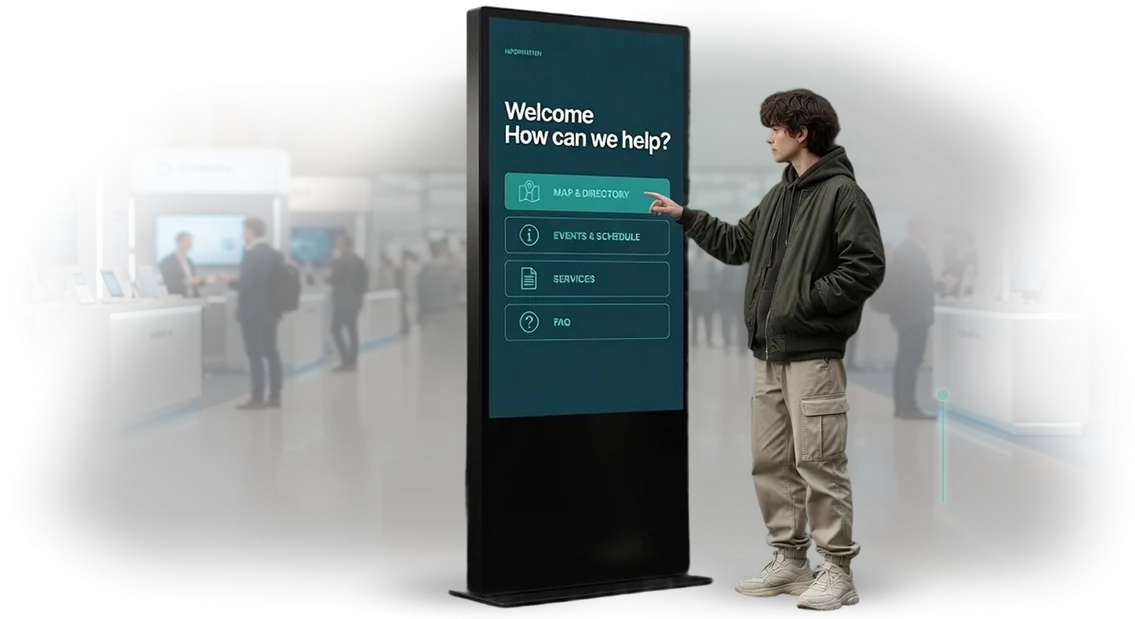
We help universities solve this problem with interactive information kiosks. Touchscreen stands with a campus map and room search work like live consultants: a person enters the building or department name — and gets a clear route within seconds.
This takes the load off staff, reduces the flow of "how do I get there" questions, and creates a sense of care for the visitor from the very doorstep.
Good navigation is part of a modern university's image. When visitors can easily find their way around, they feel confident and come back again.
Information kiosks address the main pain point — chaos and uncertainty — and turn the first impression of the university into a positive experience worth recommending to others.
What an Interactive Kiosk Gives Your University: 5 Key Benefits
Convenient Navigation Without Crowds at the Dean's Office
Applicants, first-year students, and university guests constantly ask the same questions: where is the lecture hall, how do I get to the admissions office, which office accepts documents. Staff get distracted from their work, and on high-traffic days, lines pile up at information desks.
An interactive kiosk handles this on its own. Visitors find the right building, office, or instructor on the campus map, build a route, and see the schedule — no staff involvement needed. Employees focus on their tasks instead of repeating themselves ten times over.
Relieving the Admissions Committee During Enrollment Season
During peak months, the flow of applicants multiplies, and every question requires a live answer. The kiosk takes on the routine: showing the list of programs, admission requirements, benefit lists, tuition fees, and application samples. Applicants get an answer in a minute without waiting in line for a specialist.
The data is always up to date — content updates take minutes and don't require a programmer. The admissions committee focuses on individual work instead of repetitive inquiries.
Increasing Engagement of Applicants and Students
Today's applicants choose a university based on their first visit impression. A kiosk with an interactive menu, virtual campus tour, and faculty videos creates the image of a modern university.
Visitors don't just get information — they get introduced to campus life, see its strengths, and remember the brand.
And after enrollment, the kiosk remains useful: class schedules, student council news, event listings, maps of coworking spaces and libraries. Students get used to using the kiosk, and the university gains another communication channel with its audience.
Fewer Errors and Disputes
When information is passed verbally, details get lost. The kiosk provides official data from a single database: document lists, deadlines, retake rules. Visitors see the complete and consistent picture, and the university has fewer reasons for conflicts and double-checking.
A Tool That Pays Off for Years
The kiosk works seven days a week and never calls in sick — it's a constant information point regardless of visitor flow. You pay once for development and get a tool that relieves staff every day, especially during peak seasons.
The university looks tech-savvy in the eyes of students and partners, which builds reputation and recognition.
Information Kiosk Formats for Different Tasks
Different audiences at a university look for different information: an applicant needs directions to the admissions office, a student needs a class schedule, a guest needs a campus map.
A universal point with a single scenario won't cover all requests, so the kiosk format should be chosen based on the specific location and task.
Below is a table of typical formats and their value for an educational institution. It will help you decide which kiosk to place in the lobby and which near the dean's office or in the hallway.
| Format | For Whom | What It Gives the User |
|---|---|---|
| Floor-standing kiosk | Applicants, guests, event attendees | Tall, sturdy enclosure with a large screen — visible from afar. Quickly orients visitors in a large lobby, relieves staff from routine questions |
| Wall-mounted kiosk | Students, faculty, staff | Compact placement in hallways and near classrooms. Doesn't take up usable floor space, allows checking schedules or finding an office without going to the dean's office |
| Touchscreen kiosk | All visitor categories | Touch control without keyboard or mouse — faster and more intuitive. Provides access to interactive navigation, reference information, and feedback, increasing user engagement |
The format choice depends on the scenario: floor-standing kiosks are best for high-traffic areas, wall-mounted ones for work zones, and a touchscreen display can be integrated into any building.
We help you select the optimal option for your layout and tasks, so the kiosk solves real university problems rather than just sitting in a corner.
Kiosk Development Stages: From Brief to Launch
A transparent work plan is important to ensure the kiosk at the university actually solves tasks — from applicant navigation to student information. We've structured the process so you see results at every step and can make changes without wasting time or budget.
- Kiosk brief and audience analysis. We discuss who will use the kiosk: applicants, students, faculty, or guests. We define scenarios — room search, class schedule, building map, admissions office contacts. We lock in expectations for design, timeline, and structure.
- Prototype and logic approval. We show how visitors will move through the screen: what sections they see, how many steps to the needed information. We approve the menu structure before development begins, so nothing needs to be redone later.
- Design and interface. We design screens in the university's brand style — with large buttons, contrasting colors, and comfortable typography for touch displays. We approve the layouts so the kiosk looks organic in the lobby or near the admissions office.
- Development and content. We build the functionality: schedule, map, news, virtual tour. We connect an admin panel so staff can update information themselves — without contacting developers.
- Testing and launch. We test the kiosk on real user scenarios: response speed, resistance to constant touch, data accuracy. We install the equipment at the right location, configure secure operation mode, and launch.
- Staff training and instructions. We conduct a short briefing for administrators: how to replace an announcement, add a file, restart the system if needed. We provide clear guides without technical jargon.
- Kiosk technical support. We support the project after launch: monitor stability, update content per your requests, and add sections for new university tasks.
This sequence eliminates surprises: you understand what's happening at each stage and control the outcome. The result is a working tool that genuinely helps students and applicants every day.
What's Included in the Interactive Kiosk Delivery
When ordering an interactive kiosk, the university gets not "hardware for hardware's sake," but a ready-made solution that works for the admissions campaign, navigation, and communication from day one.
We deliver a complete information kiosk package — from the enclosure to training materials for staff — and the university launches the kiosk immediately after installation.
The delivery includes:
- Kiosk hardware — enclosure, touchscreen, and control unit designed for intensive use in lobbies and hallways.
- Software — a system with an intuitive interface adapted to the university's tasks: schedule, news, campus map, admissions campaign.
- Content builder — update information without programmers: upload a file, make an edit — and the kiosk shows up-to-date data.
- Integration with university systems — schedule export and synchronization with the website, so data on the kiosk and portal match.
- Instructions and documentation — clear guides for administrators, operators, and content managers.
- Staff training — a short hands-on session on content setup and operation.
- Warranty support — maintenance and technical support for the entire warranty period, with issues resolved without downtime.
This package is a turnkey project: the university gets a working system, not individual components. The kiosk easily adapts to new tasks — whether it's the peak of the admissions campaign or updates to student life.
Case Study: How We Helped a University Increase Attendance
The admissions campaign at "Politech" was stalling: applicants and parents got lost on campus, couldn't find the right rooms, and left without waiting for a consultation.
Open house attendance had been declining for two consecutive seasons, and admissions staff spent up to 20% of their time on the same "how do I get there?" questions.
We proposed installing interactive kiosks with building navigation, meeting schedules, and a virtual tour. Instead of static brochures — a living assistant that works without breaks and answers common questions instantly.
What Changed After Implementation
- Open house attendance grew by 40% — applicants started completing the full route instead of turning around at the entrance.
- Consultation wait time dropped from 15 to 5 minutes: kiosks handled part of the questions immediately, reducing the load on administrators.
- 92% of visitors noted in a survey that navigation became clear, and the university's hashtag appeared three times more often in social media photos.
The kiosks paid for themselves in four months — thanks to the growth in applications from prospective students who stayed through the end of the tour.
After the first season, the university ordered an expansion: they added kiosks in dormitories and the building for first-year students. Now it's a standard element of the campus, not a one-off solution.
How to Choose an Information Kiosk for a University?
Choosing an information kiosk for a university starts not with the equipment model, but with the question: what exactly should it solve at your institution? For the admissions committee — it's relieving staff and providing quick answers to applicants.
For students — navigation across buildings, schedules, event information. For guests and applicants on open house day — a modern image and the ability to get the needed information without lines.
Once you define the primary use case, you automatically narrow down the suitable formats and avoid overpaying for unnecessary features.
The kiosk format directly depends on the installation location and the volume of information.
If the kiosk will stand in the main building's lobby and serve a flow of several thousand people, it's worth choosing a stationary touch terminal with a large screen — it withstands heavy use and is clearly visible from afar.
For the admissions committee, a kiosk with a built-in printer is convenient, so applicants can immediately get a handout or a copy of the schedule.
And for smaller academic buildings, a compact information stand works well: it takes up minimal space and handles basic tasks — showing maps, schedules, contacts.
The budget for a kiosk doesn't have to be allocated all at once — you can start with one terminal in the busiest location and gradually expand the network.
At the start, it's important to ensure content can be updated without reprogramming: then you can change information about open house dates, schedules, or admission rules yourself, without additional development costs.
This matters more than chasing the maximum set of options — most of which students and visitors simply won't use.
Consider the university's specifics: the number of buildings, applicant flow, and the digitalization level of internal services.
If the university already has an electronic schedule and a student portal, the kiosk should become a convenient access point to them, not a separate system.
A properly chosen kiosk pays for itself by reducing the load on administrators, increasing service speed, and creating the positive impression applicants get on their first contact with the university.
If you're torn between several formats — choose the one that solves the main task for the next two to three years, rather than trying to cover every possible scenario at once.
Frequently Asked Questions About Information Kiosk Development
Before launching an information kiosk, clients always ask the same questions: how long will it take, what will it cost, and who will maintain the system. We answer the key points based on projects for universities, admissions committees, and student campuses.
The process is fully transparent: you see intermediate results and get a finished system with staff training at the end. Below are answers to the most common questions.
How long does kiosk development take?
A basic kiosk is ready in 4-6 weeks: design, interface, campus and news navigation. Non-standard functionality adds a couple of weeks, but we always meet the required deadline.
Is it difficult to integrate the kiosk into the university's infrastructure?
No. The kiosk connects to the schedule, website, or internal services without restructuring the infrastructure. You just need to provide access — we handle the rest.
What guarantees and support are provided?
We provide a warranty on the software and offer support after launch. During the academic period, when the load is at its peak, we respond on a priority basis.
What does the kiosk cost consist of?
A transparent estimate: design mockup, development, equipment setup, staff training. No hidden fees — the final figure is fixed in the contract.
Who can update the information on the kiosk?
Any staff member can update news, events, and operating hours through a simple admin panel. No developer needed — the interface is similar to editing a webpage.
Discuss Your Kiosk Project for Your Institution
A university kiosk is not just a screen in the lobby — it's an around-the-clock assistant for applicants, students, and guests. It relieves the admissions committee, reduces lines at the dean's office, and creates a modern image for the university.
But to make the system work for your specific tasks, it's important to discuss the project in advance: where the kiosk will be placed, which scenarios are needed, and how it will fit into the institution's processes.
We work remotely and are used to non-standard university requests. We invite you to a kiosk consultation: we'll explain what building an information kiosk for your tasks looks like, what will be required from your side, and what timelines are realistic. You'll get a clear plan, not a technical description.
Ordering a kiosk from us means getting:
- A kiosk that students and applicants understand from the first screen, without instructions or training.
- Scenarios tailored to your university: schedule, campus map, admissions committee, room navigation, reference information.
- The ability to update content yourself — through a simple panel, without involving developers.
- Vandalism protection and uninterrupted operation in high-traffic areas.
- Integration with the website, schedule, or internal university systems — as needed.
- Post-launch support: updates, maintenance, scenario enhancements.
- Readiness for peak loads during document submission days.
You can discuss the project at any stage: even if you only have an idea to "put a screen in the lobby" — we'll help turn it into a working solution.
Contact us, and we'll prepare a proposal for creating an information kiosk for your university — taking into account the budget, facilities, and expected number of users.