

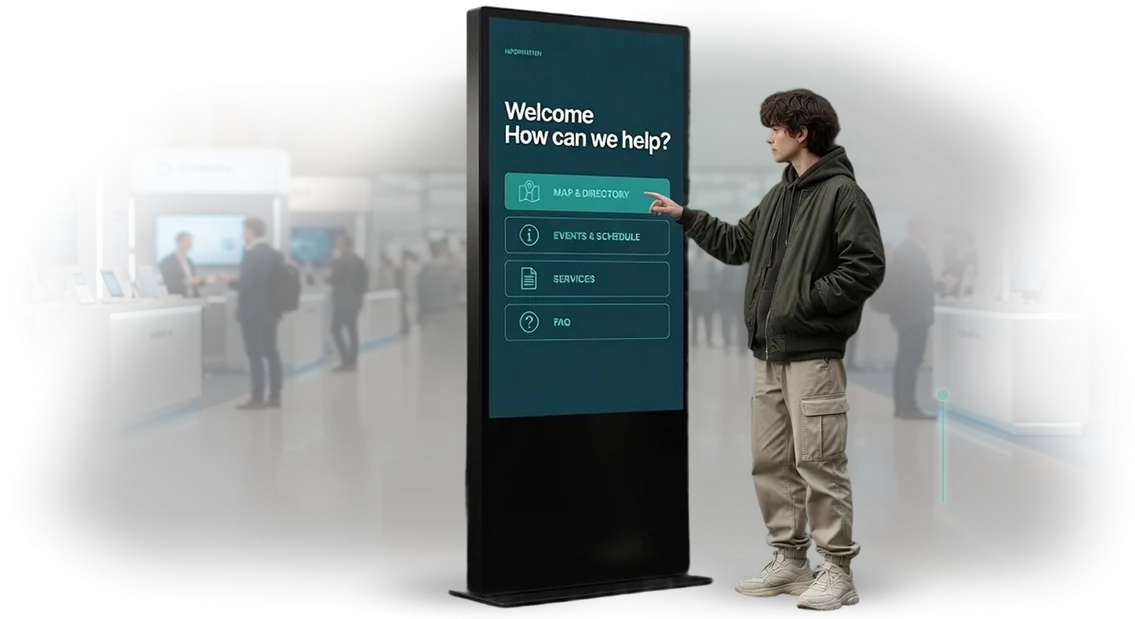
Reception Kiosk: How to Cut Queues and Increase Sales
Long queues at the reception are a familiar pain for hotels. Tired guests wait to check in, while the front desk clerk manually enters data, issues keys, and answers calls at the same time.
At peak hours this turns into chaos, and some visitors can’t take it: they leave for a neighboring hotel or get a ruined first impression.
Self-service at the hotel removes this burden. A reception kiosk lets guests complete express registration in a couple of minutes — confirm their details, get a key, and head to their room.
The clerk stops drowning in routine and focuses on personal interaction: greeting guests, helping with non-standard requests, and offering additional services.
It’s those additional services that are the hidden revenue reserve. When staff attention isn’t taken up by filling out paperwork, there is time to offer the guest a boutique dinner, spa, or excursion.
That kind of personalization increases the average check and makes the stay noticeably more comfortable.
A reception kiosk doesn’t replace people — it strengthens the team. It handles routine operations, leaving employees free to do what brings in profit. Queues shrink, guests get to their rooms faster, and the hotel gains more opportunities for additional sales.
We design and implement such solutions for the specific tasks of each hotel: we think through the scenario, create a clear interface, and integrate the kiosk into the existing reception processes. You get a tool that pays for itself through higher revenue and guest loyalty.
What Your Business Gets from a Kiosk: 5 Measurable Benefits
A reception kiosk is not a replacement for the desk clerk, but a way to increase profitability and service. Five measurable benefits show the effect it brings to your business in the first months.
Reduced check-in time. The guest registers independently in 2–3 minutes; even at peak times the queue moves twice as fast as with standard registration. Less time on formalities — more time for rest and higher satisfaction.
Higher conversion to additional sales. The kiosk offers the guest services that suit them specifically: spa, excursions, restaurant. The guest doesn’t need to search the website or call — the offer appears at the right moment. Based on our projects, up to 30% of guests order additional services right at check-in.
Increased guest loyalty. A modern interface, a welcome by name, and personalized recommendations create a feeling of care. The guest feels expected, and that is a direct path to positive reviews and repeat visits.
Reduced staff workload. Front desk employees get rid of paper routine and data-entry errors. They spend their time on personal communication, non-standard requests, and atmosphere — the things that can’t be automated.
Data collection for sustainable growth. The kiosk automatically records guest preferences, popular services, and typical requests. This data helps plan marketing campaigns more accurately and increase the average check without extra surveys.
Reception Kiosk Formats: Choose the One for Your Task
Before ordering a reception kiosk, it’s worth understanding which format suits your space and scenario. What matters is not design for design’s sake, but how visitors will interact: quickly sign up, get a pass, pay for a service, find their way on a map.
The right form — a floor-standing kiosk, wall-mounted kiosk, or touchscreen registration counter — determines whether the flow will be comfortable.
We compared the main reception kiosk formats based on our experience in hotels, clinics, and government institutions. The table is a quick guide for your type of business.
| Format | For whom | What the client gets |
|---|---|---|
| Floor-standing kiosk | Hotels, business centers, government institutions | Handles high traffic, doesn’t take up the desk clerk’s counter, works as a separate zone |
| Wall-mounted kiosk | Clinics, salons, small waiting areas | Saves space, visible at the entrance, doesn’t block the walkway |
| Touchscreen registration counter | Restaurants, exhibition spaces, event venues | Replaces the classic counter, looks modern, relieves staff |
Each format can be refined: add a payment module, pass printing, or integration with your booking system. We design the kiosk around your visitors’ behavior and the room layout, rather than offering a standard “box.”
Whichever format you choose, you get an interface that is clear to guests of any age and a build that withstands intensive use. Send us your floor plan and a description of your processes — we’ll select the optimal option and calculate the project to fit your budget.
How the Project Goes: From Brief to Launch in 4 Weeks
We structured the process so that in 4 weeks the kiosk is already welcoming its first guests — without missed deadlines or unnecessary approvals.
At each stage you see the intermediate result and can influence it, while we handle everything: from concept to staff training and technical support.
- Brief and task analysis. We discuss what exactly the kiosk should do: appointment booking, office navigation, document upload, or reference information. We clarify who will use it — visitors, guests, couriers — and how to fit the terminal into your reception area.
- Prototype and scenarios. We create an interactive prototype of the future interface that you can “touch” before development begins. You see the logic of the screens and make changes before resources are invested in the final version.
- Design concept. We develop the kiosk’s appearance to match your brand style, reception layout, and finishing materials. We approve mockups so the terminal looks like part of the interior, not a temporary stand.
- Development and integration. Our engineers build the interface and connect it to your systems: booking databases, calendars, CRM. In parallel, we prepare remote content management — you will be able to change information without a programmer.
- Testing on real scenarios. We check the kiosk under peak loads, the correctness of scenarios, and integration with other equipment — from queue systems to pass printers. You get a stable result, not a “raw” version.
- Launch and training. We install the terminal, configure it for your reception, and train administrators and staff. On the first day of operation, our specialist is on site next to the kiosk to make sure everything runs smoothly.
- Support and growth. After launch, we stay in touch: we monitor operations, update content, and refine features as your tasks change. You are never left alone with the technology.
This sequence eliminates the main risks — lengthy approvals, mismatched expectations, and missed deadlines. And you get the result in the agreed 4 weeks: the kiosk works, staff is trained, and visitors are satisfied.
What Is Included in the Delivery: A Complete Package for Your Kiosk
When you order a kiosk, you get not just a device but a turnkey solution. We take care of everything: from equipment selection to launch and staff training. All you have to do is use the result.
Here is what is included in the complete delivery package:
- Software and licenses — a pre-installed system with an interface for your tasks, with no hidden fees or need to buy additional components.
- Installation and setup — our engineers will come, install the kiosk in the right place, connect it to the network, and test all scenarios.
- Staff training — short practical sessions for front desk administrators and employees: how to manage content, update information, and handle common questions.
- Hardware warranty — an official warranty on the enclosure and components, covering any failures for the entire warranty period.
- Technical support — a dedicated line for your team: consultations and remote problem resolution come quickly, no need to wait for an email reply.
- Updates and refinements — we don’t abandon the project after launch: we regularly update the system and add new features as your tasks require.
This means you get a predictable budget and no routine: everything is included, deadlines are known, and the responsibility is on us. Usually the project takes from two to four weeks, depending on complexity.
But most importantly, after delivery the kiosk works immediately, and your employees already know how to use it.
Case Study: How a Hotel Cut Check-in Time by 70%
For the hotel Grand Central, we developed a reception kiosk to relieve the front desk during peak hours. Previously, check-in took 15–20 minutes: passport data, contract, explanation of rules and services — all on one employee.
When groups arrived, a queue formed in the lobby, some guests left, and the front desk staff had no time to offer additional services.
We installed a touchscreen kiosk that handles the routine: the guest scans documents themselves, selects the room and options, and pays by card. The administrator only checks the data and issues the key — even a guest without a reservation checks in within a couple of minutes.
Numbers after launch
In the first two months, check-in time dropped by 70%, and peak-hour queues practically disappeared. The kiosk automatically offers room upgrades, breakfast, and transfer — the share of additional sales grew by 15% without staff involvement.
Guests began mentioning speed more often in reviews, and the front desk now handles issues that require personal attention.
Today the hotel welcomes 20% more guests without expanding the team. Implementation took three weeks and paid for itself in four months thanks to savings on administrator hours and growth in additional sales.
We support the kiosk remotely: we update rates, add promotions, and help staff within an hour when needed.
Frequently Asked Questions About Kiosks: Reliability, Security, Payback
Before launching a kiosk, any manager has reasonable questions: what happens if the device breaks down, how protected is it, and how quickly will staff learn to work with it. Let’s look at the most common concerns and show how they are resolved in practice.
What to do if the reception kiosk breaks down?
We plan for this at the architecture level. Equipment is selected with a safety margin for round-the-clock operation, and critical components are duplicated so that a failure in one unit does not stop the entire kiosk. Our engineers receive a fault signal remotely before visitors even notice a problem.
In most cases, the issue is resolved remotely — by restarting the application, adjusting settings, or updating. If on-site repair is required, we arrive within the time agreed in the contract. Throughout this period, a support hotline is available to your staff.
How secure is visitor data?
The kiosk accepts only the information needed to complete the task: a booking, a questionnaire, feedback. Data is transmitted over secure channels and stored with restricted access. We don’t collect anything extra and don’t store information longer than the established period.
Access rights are configured so that employees see only their own sections. All actions with data are logged. As a result, the reception kiosk fully complies with your company’s internal security policy requirements.
Is it difficult to train staff to work with the kiosk?
The interface is built on simple and clear screens: the guest chooses the right section themselves, and the guidance prompts them at every step. Your administrator only needs to see the setup once to work independently from then on — training takes about an hour.
We also prepare a short manual and short videos for new employees. If questions arise, support responds by phone or messenger, and in critical situations connects remotely.
A kiosk is not a “black box” but a manageable tool backed by our team. You get service, control, and clear operating procedures. If you still have questions — ask us directly: we’ll advise how to implement a reception kiosk and which models pay off fastest.Order a Turnkey Kiosk: From Project to Launch in 4 Weeks
Ordering a reception kiosk means getting a ready-made solution, not a set of parts. We handle the entire cycle: from the first meeting to plugging it in. You don’t need to understand equipment, design, and installation — just describe the task, and we’ll take care of the rest.
What you get after ordering:
- An individual kiosk project tailored to your interior and usage scenarios.
- Cost calculation and a commercial proposal within two business days.
- Approval of mockups and design before production begins — you see the result in advance.
- Manufacturing, delivery, and turnkey installation with software configuration.
- Staff training and a clear guide for a quick start.
- Hardware warranty and technical support after launch — the kiosk works without your involvement.
Leave a request — we’ll prepare a proposal and calculate the cost to fit your budget. We’ll discuss the tasks, timelines, and implementation options. The 4-week launch is fixed in the contract, so you know exactly when the kiosk will start delivering value.
How to Choose the Right Kiosk Format for Your Business?
Choosing a kiosk format starts not with the model but with questions: who will use the stand, where it stands, and what task it solves. For a guest reception area, it is above all a first impression — the kiosk should greet, guide, and not create a queue.
So first we define the scenario: quick service sign-up, building navigation, viewing a presentation, or self-service registration. Each scenario has its own configuration, and that configuration determines convenience for your visitors.
Screen size, construction, and design are selected for the space. For a narrow counter, a compact wall-mounted kiosk works well; for a spacious lobby, a floor-standing panel that doesn’t get lost against the interior.
It’s important that the screen is at eye level and that control remains simple even for someone who sees a touch panel for the first time.
This directly affects service speed: people don’t spend time figuring things out, and you don’t get a stream of questions directed at the administrator.
The second criterion is the number of visitors and peak loads. If more than thirty guests arrive per hour, the kiosk must work without delays and not freeze at the worst possible moment.
We build our stands on reliable industrial components, so the result is stable even under intensive use. And the third point is appearance: the enclosure can be made in brand colors, with a logo, and in a consistent style with your interior. The kiosk becomes part of the space, not a “foreign box.”
If you’re not sure which format is right for you, our specialists will consult with you and help you choose. Send us your floor plan and describe your tasks — we’ll suggest a solution that handles them with minimal cost.
It takes one short conversation, and in return you get a solution that pays off from the first day of operation.