

Why a hotel loses guests without a booth reception counter
A hotel creates its first impression at the reception. A guest after a flight or a long journey wants a minimum of formalities and maximum care — but instead sees a queue, tired staff, and an outdated reception desk.
At that moment, a feeling of «second class» is born, and even an excellent room no longer saves the situation: the aftertaste remains.
The loss of guests begins imperceptibly: someone silently turns around and goes to a neighboring hotel, someone stays but lowers their rating of the service. Through reviews of the negative experience, thousands of potential clients learn about it, and bookings gradually fall.
Every minute of waiting at check-in directly hits loyalty and future revenue — the guest votes with their wallet where they were met quickly and warmly.
A modern booth reception counter is not just new furniture, but a tool that brings guests back. A well-organized reception desk reduces check-in time, relieves staff workload, and sets the tone for the entire stay.
The guest receives a greeting, quick processing, and care — exactly what they choose your hotel for again.
Our team designs and implements such solutions for the tasks of a specific property: from space planning to staff workflow logic. We make sure that service is felt from the first minute, and the reception desk works for you — attracting guests, not repelling them.
What benefits a check-in desk gives your business
The check-in desk is the guest's first point of contact with the hotel, and it is this desk that shapes the impression of the entire visit.
Guest check-in is often built on compromises: the desk works faster but falls short on personal approach, or it looks solid but creates queues.
An automated check-in desk removes this contradiction: it welcomes the guest stylishly, registers them in minutes, and opens the opportunity to offer additional services.
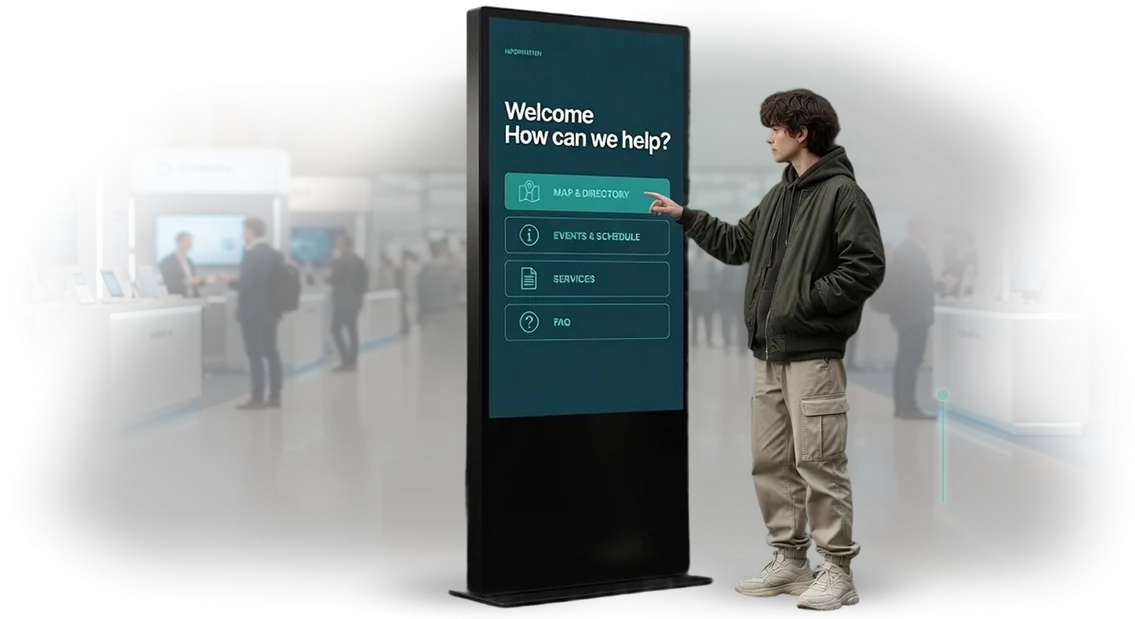
The first benefit is the hotel's image. A modern desk with a large screen, soft lighting, and an intuitive interface is immediately read as a sign of high service.
The guest remembers that the hotel is "top-level" — this works for recognition and forms a justification for a higher room price. For the owner, this is also the benefit of the desk as a showcase: the new guest sees exactly the image you built into the brand.
The second benefit is speed of guest service. Automation removes routine: the guest enters data independently, chooses checkout time, and receives a key without waiting for an administrator.
During peak hours, instead of a queue of ten people, there are two to three minutes of waiting. Less time on formalities — more attention to the guest: staff have time to greet them, give personal recommendations, and escort them to the room.
The third benefit is increased sales and average bill. At the moment of check-in, the guest is open to offers: a favorable room upgrade, breakfast at the restaurant, a spa treatment, or an excursion — the system suggests options on an individual basis.
Even ten additional services per day noticeably increase revenue, and repeat visits become more frequent: the guest sees that they are expected and remembered. All this adds up to direct monetary benefit, which quickly pays back the investment in the desk.
We develop automated check-in desks tailored to the hotel's tasks: we select the construction, interface, and logic so that your guests enjoy check-in, and the business gets a measurable result: growth in average bill and loyalty that guests tell friends about.
Each such desk is an investment that pays back through the quality of guest service and competent work with upselling.
Booth Stand Formats for Hotels and Business Centers
For a hotel or business center, the format of an information stand determines how guests and visitors get the information they need.
Desktop, floor-standing, and built-in solutions solve different tasks: some save space, others attract attention, and still others become part of the interior.
The chosen format affects how quickly a guest finds the conference room or restaurant and how much pressure is taken off front desk staff.
The table compares popular booth stand formats. Focus on foot traffic, room area, and the typical questions guests ask you.
| Format | For whom | What it gives guests and you |
|---|---|---|
| Desktop stand | Small hotels and compact reception areas | Quick access to information without taking up extra space |
| Floor-standing stand | Lobbies, entrance areas, waiting zones | Self-service navigation, fewer queues at the front desk, attracts attention |
| Built-in stand | Designer interiors, large lobbies | Becomes part of the furniture, preserves style, accommodates a large screen or several panels |
If guests often ask the same questions, a floor-standing stand will reduce the load on front desk staff. If space is limited, a desktop stand will fit right at reception. If status and design matter, a built-in model will emphasize the lobby's style.
We will help you choose the optimal format for your lobby, budget, and usage scenarios, and then develop an interface that is clear to every guest.
How registration desk development works: from brief to launch
Registration desk development is not buying a boxed software product, but a joint project. We go through the project stages together with you step by step: from brief to launch and support.
That way you know the timelines and scope of work in advance, and the result addresses the needs of your department.
- Brief and immersion in the task. We pin down the desk's goals: who the guests are, what scenarios apply, where it will stand, what design is expected. We define timelines and budget so there are no surprises.
- Scenario prototype. Based on the brief, we build the interaction logic: how many steps to the desired action, how a guest gets to information or registration. You see the structure before development and can adjust it.
- Design mockup. We visualize the desk in your brand style and adapt it to the interior. The design is approved before development begins — this eliminates costly revisions at later stages.
- Development and integration. We fill the desk with content and connect it to your systems — directories, customer database, external services. You get a working version within the agreed timelines.
- Testing and acceptance. We test the scenarios together with your staff: real guests, real requests. Errors are fixed before the official launch.
- Launch and training. We install the desk on site, configure the equipment and briefly train the staff. We provide remote support on the first day of operation if needed.
- Post-launch support. We keep a communication channel with an engineer: content updates, scenario refinements, equipment maintenance. The desk evolves along with your tasks.
What is included in the registration kiosk delivery package
The registration kiosk is not just a touchscreen in the lobby, but part of your service that greets guests and reduces the load on staff. To ensure it works without failures from day one, we include everything needed for launch and daily use in the cost.
- Complete equipment set — touchscreen kiosk, enclosure, cables, fasteners, and decorative elements matched to the style of your space.
- On-site installation — our engineers will arrive, install the kiosk in a convenient location, neatly conceal the wires, and check that all systems work.
- Setup for your tasks — menu, catalog, navigation, or visitor registration: we will fill and configure the scenarios in the way that is convenient for your clients.
- Staff training — a short practical session for administrators: how to manage the kiosk, update information, and handle typical situations.
- Instructions and documentation — clear memos for employees and an operating manual in Russian so that no one depends on the developer's prompts.
- Warranty for equipment and work — everything we supplied and configured is covered by warranty. If a malfunction occurs, we will fix it upon first request at no additional cost.
Please note: the warranty is already included in the base cost, and there is no need to purchase it separately. For most projects, we also offer extended support after it expires — under a separate agreement, so that you can develop functionality as your business grows.
Case: how the check-in kiosk paid for itself in 6 months
Client — a chain of business hotels with high occupancy on weekdays. Queues at reception took 10-15 minutes, guests were late for meetings, and administrators spent time on repetitive questions instead of live service.
The manager needed to speed up check-in and relieve staff without reducing the quality of experiences.
We installed an interactive check-in kiosk next to reception: a guest independently confirms the booking, makes a payment, and receives a key card in a couple of minutes.
There was no need to redesign the lobby — the structure fit into the existing space, and the interface was adapted for two scenarios: check-in and check-out.
Vysota business hotel chain was the first to implement such a solution at three properties. Two months later, the average check-in time had dropped from 12 to 4 minutes, the share of self-service registrations reached 40%, and queues during peak hours almost disappeared. Administrators switched to complex issues and upselling.
The department head received measurable results:
- kiosk throughput — 2 times more guests per hour;
- queue waiting time — from 12 to 4 minutes;
- the freed-up employee focuses on service and upselling, conversion to additional services increased by 18%;
- savings on staff and growth in additional revenue paid back the project in 6 months.
After the first months of operation, the client ordered kiosks for two more hotels in the chain — the best indicator that the solution works in daily operations, not just on paper.
How to choose the right check-in desk format?
The right check-in desk format is not a matter of design, but a decision that directly affects service speed and the impression visitors take away.
The choice depends on three key criteria: the size of the space, the usage scenario, and the budget you are prepared to allocate to the task.
The first criterion is space and traffic. In a small lobby with an intense flow of people, a compact tabletop desk will help avoid queues and will not block the passage.
For spacious waiting areas, a floor-standing kiosk with a large screen will attract attention and take over some of the administrator's functions, relieving the staff.
The second criterion is the operating scenario. If visitors simply need to get information, a kiosk with an intuitive touch screen is enough. If passes are to be issued or payments made, additional equipment will be required.
The main thing is for the interface to be simple, so that customers do not waste time figuring things out and your employees are not answering the same questions over and over, but focusing on genuinely important tasks.
The third criterion is budget and the long term. Tabletop formats are often more economical, but floor-standing ones provide a noticeable presence and usually serve longer.
Before deciding, evaluate not only the cost of the equipment, but also the costs of maintenance and content updates. A well-chosen desk pays for itself through reduced staff workload and improved customer convenience — a direct saving of time and money.
If you are unsure which format suits you best, that is fine. Our team analyses your location, visitor flow and tasks, and then recommends the optimal solution with a clear calculation of the benefit.
We have already helped dozens of customers choose a desk that works towards their results — and we are ready to help you too.
Frequently asked questions about kiosk development and support
Before ordering a kiosk, every manager has the same doubts: will the hardware withstand continuous load, is it hard to integrate it into current processes, will you meet the deadlines. We answer the main questions — so that you can make your decision calmly, not by gut feeling.
What happens if the kiosk breaks down at the height of business hours?
We use proven hardware designed for round-the-clock operation in high-traffic locations. Before shipping, every device undergoes many hours of testing.
If a failure does occur, our engineers will run remote diagnostics and, if necessary, promptly replace the module or come on site — so that downtime doesn't hurt your customers.
Can the kiosk work with our record-keeping systems and databases? Yes. We set up integration with your CRM, appointment booking or inventory management systems.
The kiosk transmits data on visits, orders or inquiries automatically — your staff won't have to re-enter information by hand, and you won't have to piece reports together bit by bit.
What is the development timeline, and will the project drag on? At the start we lock in a precise schedule and don't change it without your consent. A typical project takes 4–6 weeks: from brief to installation.
If you need urgent installation, we'll discuss separate terms — for example, accelerated enclosure production and parallel configuration of the software side.
What about warranty and support after launch? We provide a warranty on the hardware and the work — from 12 months, during which we fix any issues at our own expense. After launch we stay in touch: we update the software, add small improvements and advise your staff. The kiosk is never left unattended.
Order a turnkey registration desk today
Ordering a turnkey registration desk removes all organizational burden from you: we are responsible for the project from idea to installation. You don't need to find separate contractors, coordinate deadlines, and monitor quality — one contractor handles the entire task.
We fix the cost and deadlines in advance, and after handover we stay in touch. If you need to update content, replace materials, or modify the structure, you just write to us, without searching for new contractors.
What you get when you contact us:
- Consultation — we analyze your task and propose a solution that fits you specifically.
- Cost calculation within one business day — you immediately understand the budget and don't overpay for "details that came up later."
- Design and structural development tailored to your premises, brand, and visitor flow.
- Full turnkey cycle: production, delivery, installation, and on-site equipment setup.
- Pre-installed content and instructions for your staff — the desk is ready to operate from day one.
- Warranty and after-sales support — we are responsible for stable operation and quickly resolve any issues after launch.
Submit a request — we'll send examples of our projects and propose a solution for your task today. Tell us where the desk will be located and what matters to visitors — together we'll turn it into a working tool that improves service quality.