

Booth Reception Table for Hotels: How to Stop Losing Guests
Guests arrive after a long trip, and the first thing they see is a queue at the reception desk. Ten to fifteen minutes of waiting with suitcases in hand — and their mood is ruined, while their opinion of the hotel is already formed.
During peak hours, some guests are not willing to wait at all: they turn around and go to a neighboring hotel, taking with them not only the current booking but also future visits.
An interactive registration station — booth reception table — solves the queue problem at the most sensitive point of the customer journey.
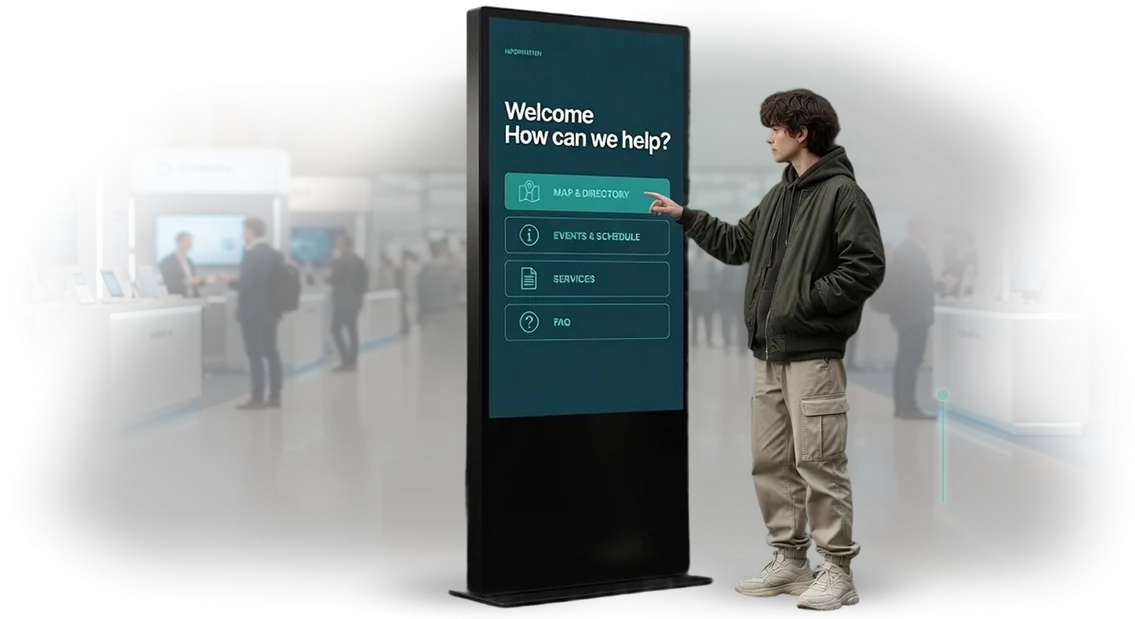
The guest approaches the screen, independently confirms the booking, and receives a key and a hotel map in a couple of minutes, without the involvement of a front desk administrator.
Implementing such a station does not replace live communication but relieves it: staff handle complex requests and special guests, while standard check-in runs automatically.
The result is less waiting, more calm, and more positive emotions. The guest gets to the room faster, and the hotel gains a measurable increase in loyalty and repeat bookings.
At the same time, the workload on staff during peak hours decreases, and peak-time overtime and related errors disappear.
We help hotels implement an interactive registration station turnkey: we select the scenario, configure it for your booking system, and train the staff.
Each such project starts with a guest flow audit and ends with clear metrics — average check-in time, share of guests using the station, satisfaction level. If you are losing guests because of queues, this is not a seasonal quirk but a process that can be changed.
What Changes After Implementing an Interactive Station
Guest arrival is the most stressful moment of the trip: fatigue, the road, the desire to get to the room faster. The longer registration takes, the higher the risk of ruining the first impression. The interactive station — booth reception table — removes this bottleneck.
According to the Cornell Hospitality Report, guests whose check-in took less than five minutes are significantly more likely to recommend the hotel to friends.
We bring this practice to any station: we use professional equipment and refined scenarios, so the system works flawlessly even at peak hours.
What Changes in Hotel Operations
| Benefit | How it looks | What the hotel gets |
|---|---|---|
| Registration speed | Guest enters data, pays, and receives the key on their own | Queue shrinks 2–3 times, more check-ins per hour |
| Guest loyalty | Minimum waiting, intuitive interface, care from the first seconds | Higher ratings and share of repeat bookings |
| Staff free time | Administrator does not scan documents but welcomes guests individually | Staff manage to sell additional services, average check grows |
These changes are visible already in the first month. Staff stop being "cashiers" and return to caring for guests, while the hotel gains a steady growth in key metrics without expanding the team.
Implementation takes no more than a week: we connect the kiosk to your booking system, configure scenarios, and train employees. After that, the station works autonomously, and you get a single check-in standard at every property.
Reception Kiosk Formats for Your Hotel's Needs
Hotels differ not only in star rating but also in guest flow, lobby layout, and service level. What works perfectly for a mini-hotel may not handle queues at a large hotel, and a bulky station can spoil the atmosphere of a boutique hotel.
That is why we offer not one universal device but three kiosk formats for guest registration — for different needs, room counts, and visitor expectations.
We adapt each format to your brand and integrate it with the hotel management system: check-in, check-out, payment, and ordering of additional services. There is no need to replace staff — the kiosk becomes a second administrator that works without breaks or mistakes. Below is a table so you can quickly determine which option suits your hotel.
| Format | Who it's for | What it gives the client |
|---|---|---|
| Compact station | Mini-hotels, hostels, boutique hotels with a small guest flow | Fast check-in without an administrator, lobby space savings, stylish accent at a moderate budget |
| Full-size kiosk | Standard hotels, city hotels with medium flow | Self check-in and payment, staff relief during peak hours, ability to order additional services (restaurant, spa services, transfer) |
| Modular zone | Large hotels, aparthotels, chains with high traffic | Multiple scenarios — check-in, check-out, information desk — in one place; scaling for season and flow growth, additional sales through the kiosk |
How We Run the Project: 6 Steps from Brief to Support
We structured the process so that you see results at every step and understand where the money goes. No "black boxes": after the brief, you receive a plan with timelines and cost, and every solution is approved before it goes into development.
- Brief and task immersion. You fill out a short questionnaire or call us. In 30–40 minutes we find out who will use the kiosk, which scenarios matter, and what information should be visible. At the end, we record the project goals — the entire further plan depends on them.
- Scenario design. Based on the brief, we design the screen structure and navigation logic: how a visitor reaches the right section, where attention stops, how their question gets resolved. At this stage, you see text descriptions and transition diagrams — they are easy to correct before the design is drawn.
- Design concept approval. We show 2–3 visual style options for your brand: color accents, fonts, element layout. You choose a direction, and we refine the rest in mockups — without rework on the finished product.
- Interface development and assembly. We assemble the interactive station using professional equipment and proven tools. We regularly show intermediate results so you can see how the kiosk looks and works before the physical installation.
- Testing and launch. We run scenarios on real data: fast navigation, correct information display, stable operation during prolonged use. We resolve any issues and install the kiosk at your location — with equipment setup and connection verification.
- Post-launch support. We stay in touch: we update content, monitor stability, and respond quickly to inquiries. We provide a warranty on work and equipment so you can focus on business rather than technical matters.
At the finish, you get a working station with easy management and minimal staff load. And transparent stages allow you to control the process — from the first brief to the day the first visitors start using the kiosk.
What's Included in Delivery: A Kit for Uninterrupted Operation
When you order an interactive kiosk for the registration desk (booth reception table), we hand you a complete kit, not just a set of parts.
The equipment is already assembled, the interface is filled with content, and the connection to your property management system (PMS) is verified — so the kiosk can be launched on installation day.
The kit includes:
- Equipment selected for your task and interior: the touchscreen, housing, and computer are mounted, connected, and tested. Nothing needs to be purchased or configured separately.
- An interface designed for your operating scenarios: an intuitive menu in Russian and English, large buttons, and search that helps guests quickly find the right information or leave a request.
- Integration with your PMS: booking, check-in, rate, and additional service data are pulled automatically, without manual entry or staff errors.
- A content management panel: you change prices, promotions, photos, and texts yourself through a convenient web interface — no programmer needed for updates.
- Instructions and staff training: short guides for employees and on-screen hints for guests, so the team can master the kiosk in one day.
- Warranty and technical support: we are responsible for the entire system, provide a warranty on equipment and interface, and our engineers quickly resolve any issues during business hours.
- Installation and launch at your property: specialists install the kiosk, check the PMS connection, and sign the commissioning certificate — you receive a working turnkey solution.
Case Study: A Hotel Cut Check-in Time by Three Times
Guests do not like queues at the reception: after a long trip, they have to fill out paperwork and wait for a key. The administrator spends up to fifteen minutes on each guest, and during peak season a queue builds up at the desk.
This creates tension, negative reviews, and extra working hours for staff. The problem is especially noticeable during evening check-in hours and business event periods.
Solution
For one of the Royal Stay chain hotels, we developed a self-service station fully integrated with the internal system. The guest presents a document, the kiosk finds the booking itself, shows the floor plan, and issues the key card. No paper hassle.
The Kiosk Effect
Average check-in time dropped from fifteen to five minutes — three times faster. Over 80% of guests chose self check-in during the season, and administrators could devote more time to non-standard questions.
The hotel's review rating improved, and the investment in the kiosk paid off within the first season. The kiosk confidently handled peak flow without losing speed.
Two months later, the hotel returned with a request for enhancements: we added automatic stay extension and access to the excursion program. Now the station also serves as an info center for guests. We are currently rolling out the solution to other properties in the chain.
For us, this is a story about how a single kiosk relieves staff, speeds up service, and increases loyalty — and most importantly, delivers a measurable result for the client.
Common Concerns Before Ordering an Interactive Kiosk
Before ordering an interactive kiosk, any manager has the same questions: will the equipment break, how quickly can we launch, and when will the investment pay off. Addressing these concerns is part of our work. Below we analyze the most frequent fears and show how we resolve them.
What if the kiosk breaks down?
We provide an official warranty on all equipment and commissioning work. During the warranty period, we repair or replace faulty components for free and visit your site if needed. After the warranty, we offer a maintenance contract — you are never left alone with the technology.
How long does kiosk development take?
A typical project takes two to four weeks — from brief to installation and setup. The timeline depends on interface complexity, the number of screens, and the need for integrations with your systems. We set exact dates in the contract so you can plan the launch without surprises.
How does the kiosk pay off and when can we expect returns?
The kiosk delivers value immediately: it increases the average check through add-on sales, reduces waiting time, and relieves staff.
In most cases, investments are recouped within several months — we calculate a precise payback model at the brief stage based on your metrics and traffic.
Can we change content without a programmer?
Yes. We provide a simple management panel: you update catalogs, promotions, news, and videos yourself. Training is free, and we demonstrate everything on a live example so your team feels confident from day one.
Let's Discuss Your Project? Leave a Request for Development
Leave a request for the development of an interactive kiosk — and we will send you a cost estimate, a solution option, and a launch plan. All of this gives you a concrete result for decision-making, not general promises.
We work with businesses from various industries: from retail and cafes to museums and government institutions. So in our response, we will take into account the specific tasks of your field: attracting customers, navigation, entertaining visitors, or data collection.
Within 1–2 days, you will receive specifics — from the housing format and usage scenarios to timelines and budget.
What you get after submitting the request:
- A cost estimate for your task — with a clear breakdown by stage, no hidden fees.
- A solution option: construction, content, and operating logic of the kiosk for your audience and space.
- A launch plan with checkpoints — from contract signing to installation and acceptance.
- Recommendations on content and scenarios so the kiosk delivers value from day one.
- Turnkey development: we handle design, production, software, and support.
- Answers to integration questions with your systems — from price lists to credentials.
To order a kiosk, leave a request in the form below or write to us. We will call back at a convenient time, clarify details, and prepare a proposal. It will take no more than 15 minutes, and the result stays with you.
How to Choose a Station Format That Pays Off?
Choosing a station starts not with a picture but with the question "what tasks should it solve in your hotel?".
A station pays off only when it accelerates real guest scenarios: reduces the check-in queue, frees staff for personal interaction, or gives guests access to services at any time of day. Without this, even the most beautiful structure will remain an expensive lobby decoration.
The first step is to separate the operations you want to automate. Self check-in requires one set of functions, payment and key printing another, and city and hotel services information a third.
The station format should match your set of tasks rather than include everything "just in case". Overpaying happens precisely when you build in functions guests do not use or install a touchscreen much larger than needed.
The second step is to analyze peak hours. If check-ins usually come in groups and the administrator cannot keep up, a self-check-in kiosk removes the main load and pays off already in the first season.
If guests more often ask for information or order additional services, a compact wall panel in the lobby is enough — it costs significantly less and returns investments faster.
The main rule is to choose the configuration for your hotel's actual scenario, not for an abstract "all capabilities at once".
We help create a technical specification based on your check-in statistics, select professional equipment, and set up the kiosk so that guests of any age can use it easily.
That way the station delivers value from day one instead of becoming a decorative interior piece, and its payback becomes a matter of math, not luck.