

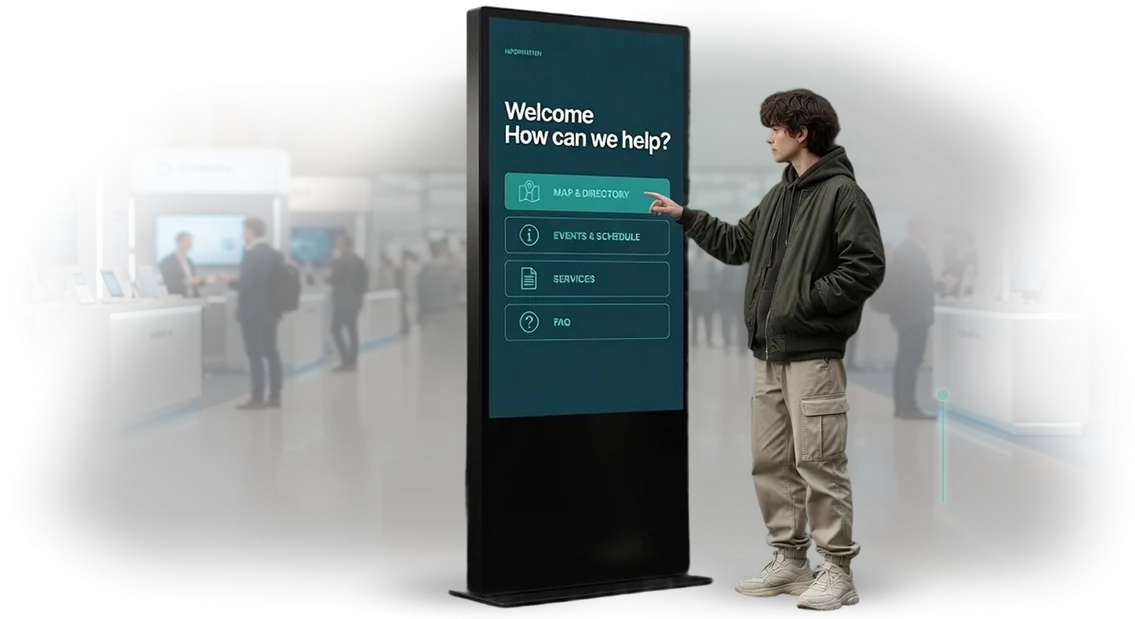
Clive booth reception phone number — guests cannot find it without a kiosk
In a hotel, a guest arrives with a specific task — for example, finding the clive booth reception phone number to check a reservation or call a transfer.
But if the reception contact is not immediately visible, the person starts searching, distracting the staff, and spending time that could have been spent on rest or work.
For the hotel, this results in an overloaded front desk, queues, and lost inquiries. A visitor who never gets an answer leaves disappointed, leaves a negative review, or chooses another hotel next time. As a result, reputation and repeat bookings suffer.
An interactive kiosk for the front desk solves this pain point. From the first touch, guests see the floor map, up-to-date service contacts, and an administrator call button — no searching or extra questions needed.
The interface is clear to visitors of any age, so there is no need to explain how to use it. Service speed increases, and the desk stops being a point of tension.
An information kiosk in a hotel takes over routine requests: it suggests the front desk phone number, the route to the room, restaurant opening hours, and even nearby attractions.
Staff are freed up for personal interaction, and visitors feel cared for from the first minutes of their stay.
We develop such interactive kiosks tailored to the hotel’s needs: we design screen logic, content, and design, and install equipment that matches the brand and interior.
As a result, guests always know where to find the front desk contact, and the hotel gets predictable service and fewer lost customers.
4 benefits of an interactive kiosk for the front desk
Every day at the front desk the same questions are repeated: where is the spa, how to call a taxi, until what time the restaurant is open, what is the front desk phone number. The guest waits for an answer, the administrator is distracted from check-in, and the queue grows.
An interactive kiosk takes over the routine: the guest finds the necessary information in half a minute, and staff handle only truly complex tasks.
Four key benefits
| Benefit | What the guest gets | What the hotel gets |
|---|---|---|
| Instant access to information | Gets their question answered without waiting in line | Reduced flow of repeated questions at the desk |
| Reduced staff workload | No need to find an administrator for small things | Staff focused on check-ins and bookings |
| Increased guest satisfaction | Fast service and a feeling of care | Higher ratings, loyalty, and repeat bookings |
| Always up-to-date data | Sees the latest schedule and contacts | No outdated paper signs or errors |
Guests quickly get used to the kiosk and perceive it as part of the service, not as a replacement for live staff. For the administrator, this is an opportunity to work more calmly: be less distracted, check in faster, and give more attention to important guests.
We implemented this scenario for the Holiday Inn hotel chain: after installing kiosks, repeated front desk inquiries fell by a third, and guests began booking additional services through the kiosk more often. The project paid back in less than six months.
Kiosk formats for displaying clive booth reception phone number
It is not always convenient for a guest to look for the front desk number — especially in the evening, in an unfamiliar city, or when no staff member is at the desk.
An interactive kiosk solves this instantly: the right phone number is always in front of their eyes, and if a handset is available, they can make a call with one touch.
The kiosk format is chosen according to the layout and scenario, so that the information is noticeable and not hidden in a menu.
For Clive Booth and similar facilities, we offer various configurations — from floor-standing units to wall panels.
Each option solves a specific problem: reduce the queue at the front desk, help guests outside working hours, or make the number accessible to people without a mobile phone.
| Format | For whom | What it gives the client |
|---|---|---|
| Floor-standing unit | Lobbies, entrance areas, busy places | Attracts attention, works as an information center, quickly calls the front desk |
| Wall panel | Narrow corridors, elevator lobbies, entrances | Saves space, the number is always visible, does not block passage |
| Tabletop kiosk | Front desk, concierge area | Additional communication channel, compact, does not take up floor space |
| Kiosk with phone | Guests without a mobile phone, urgent calls | Call with one touch, no dialing or searching for a code |
We do not just install a kiosk — we select the format for your layout, set up a large phone number and a quick call button. The guest solves the issue in 10 seconds, and your staff are less often distracted from their direct duties.
Specify the area and scenario — we will offer a suitable format and install it turnkey.
What is included in the kiosk delivery set: complete list
The delivery set is not just a housing on a stand and a screen, but a ready-to-work turnkey system. We have thought out the composition so that you receive a working tool, not a set of parts that you have to assemble and configure yourself.
The standard kiosk package includes everything needed for launch on the day of installation:
- Housing and mounting — a reinforced, vandal-resistant structure that withstands heavy visitor traffic and does not require frequent repairs.
- Touch screen and board — professional components selected for your task, whether it is a 2-hour event or round-the-clock operation in a shopping center.
- Software — an intuitive interface for visitors and a convenient control panel for your staff. You receive analytics on demand and popular content directly in your personal account.
- Installation and setup on site — our engineers come, install the kiosk, connect it to the network, and check that the entire system works.
- Staff training — a short session after which your employees independently change content, launch promotions, and manage schedules without calling developers.
- Documentation and warranty — operating instructions, work completion certificates, and warranty service. If something goes wrong, you know who to call.
Installation and initial setup are included in the price — this is stated in the contract, and there will be no surprises like “pay extra for installation.” Staff training is conducted at your site and takes no more than a couple of hours: that is enough for the responsible employee to work confidently with the system.
You receive a working kiosk that brings value from day one. All warranty and technical support are documented — you do not need to keep an engineer on staff or understand technical details, because that is our area of responsibility.
Case study: how a kiosk cut front desk waiting time in half
One clinic chain had a constant problem: during peak hours a live queue formed at the administrator’s desk. Patients waited 10–15 minutes just to find out where the right office was or how to make an appointment with a doctor.
Administrators physically could not answer all the questions, and this affected the impression of the clinic.
We proposed installing an interactive kiosk that took over the most popular questions: navigation by floor, doctor schedules, appointment booking, contacts. Patients found the answer on their own in a minute without distracting staff. The registration desk remained for live, non-standard situations.
Result after launch — waiting time in the queue was cut in half, from 14 to 7 minutes on average. More than 80% of visitors used the kiosk without staff help, and the workload on administrators dropped by almost a third. Staff began directing the time that previously went to repetitive answers toward patient care.
The head of the Альфа-Мед clinic noted that patients themselves say it has become easier, and the kiosk paid for itself in the first months of operation. The team is now planning to install the same terminals in other branches of the network.
We did not just install the equipment but regularly update the information, monitor operational stability, and refine scenarios according to changes in the clinic.
Therefore, the kiosk does not turn into a useless terminal — it remains a living tool that saves time for your guests and staff.
Frequently asked questions and concerns before ordering a kiosk
Before ordering an interactive kiosk, any manager has concerns: what if the equipment fails, how to update information, whether constant internet is needed, and what it will cost.
We have collected answers to the main questions — briefly, without technical details, and in business language. If you did not find your question, just write to us — we will advise you.
What happens if the kiosk breaks down?
We provide a warranty and service maintenance. In case of any malfunction, you contact us — an engineer will solve the problem remotely or come to the site. The average response time is fixed in the contract.
How is the information on the kiosk updated?
Updating is done remotely: you send new materials, we place them on the kiosk. If needed, we set up the control panel so that you can change texts and prices yourself — without a programmer’s involvement.
Is constant internet needed?
The kiosk operates autonomously. Internet is only needed for content updates and remote control. If there is no network access, information can be updated locally — via a USB drive or your office’s internal network.
How long will the kiosk last?
With active use — 5–7 years. We use industrial components designed for round-the-clock operation. Malfunctions are rare, and we replace individual elements within one day.
What are the development timelines and price?
A standard project takes 2–3 weeks. The cost depends on functionality and design — usually calculated after an audit. We will prepare an exact estimate after a short brief.
We hope we have removed the main doubts. Contact us — we will help you choose a configuration and calculate exact cost and timelines specifically for your task.Ready to launch a project? Order kiosk development
To order a kiosk, you do not need to understand technology or contractors. Just leave a request — next we will take the project turnkey: from consultation and cost calculation to installation and launch.
What you get after submitting a request
- Consultation: we will clarify the tasks, location, and kiosk format — you will understand which solution suits your business specifically.
- Kiosk development estimate: a transparent quote with cost and timelines — no hidden fees or “surprises” in the work.
- Preliminary plan: hardware diagram, design concept, and implementation stages — you see the result even before the start.
- Prototype and implementation: we build the kiosk, configure the interface and scenarios for your clients, and test on real tasks.
- Launch and support: we deliver, install, train staff, and stay in touch after project handover.
- Warranty and development: we update content and features if tasks change — the kiosk works and brings value for years.
If you need to buy a turnkey kiosk without lengthy approvals, mention this in your request. We will calculate the development cost, fix the price in the contract, and offer launch timelines.
Leave a kiosk request — we will respond within one business day, prepare an estimate and a preliminary plan.
How to choose a kiosk format for your front desk task?
You should choose a front desk kiosk not based on screen size or housing design, but on the task it must solve. Guests need fast appointment booking, clear office navigation, or quick meeting registration — each of these tasks requires its own format.
Therefore, first define which scenarios you want to cover: it could be a single function like an electronic queue or a full-fledged information desk with a schedule and map.
The second criterion is guest traffic and acceptable waiting time. If dozens of visitors come per hour, you need a kiosk with simple logic: minimum steps, large buttons, instant ticket printing, or sending a notification to an employee.
When there are more scenarios — choosing an office, booking a specific specialist, checking working hours — a well-thought-out menu structure is important so that the person does not get confused and does not turn to staff. In both cases, our task is to reduce friction between the visitor and the service they need.
Equally important is how the kiosk integrates into front desk operations.
A good format is not an autonomous “box” but part of a system: the kiosk transfers data to your appointment database, duplicates the visit in the employee’s calendar, and helps the administrator see the day’s picture without manual entry.
Think in advance about which operations should be automated, and then the kiosk will not replace a person but serve as their tool that removes routine.
The third criterion is the total cost of ownership, not just the equipment price. Consider the ease of content updating, reliability under daily load, and speed of service maintenance.
We select a configuration for your traffic and premises: a floor kiosk for the lobby, a stationary display for the desk, or a tabletop tablet for small waiting areas. This way you get a stable result without overpaying for unnecessary functions.
If in doubt, start with a narrow task and a pilot format. One kiosk with one scenario will already show how queues and administrator workload change, and then you can easily scale the solution to other front desk areas. The main thing is that the kiosk solves your task, not just be an impressive device.