

Reception booth ideas: losing clients at the information desk?
Have you noticed how often guests leave without an answer? Picture an ordinary day: a person walks into the lobby, looks around for help, but sees a queue at the desk or an administrator on the phone.
A couple of minutes later, they silently leave — so the information desk turns from a quick orientation point into a client loss spot.
Based on our observations, most reception inquiries are the same questions: where a specific office is, how to get to the meeting room, where to pay for a service, who to contact. These take up to half of an employee's working time.
The administrator physically cannot give every guest attention, especially during peak hours. Those who don't get an answer simply leave — and often they are potential clients who never come back.
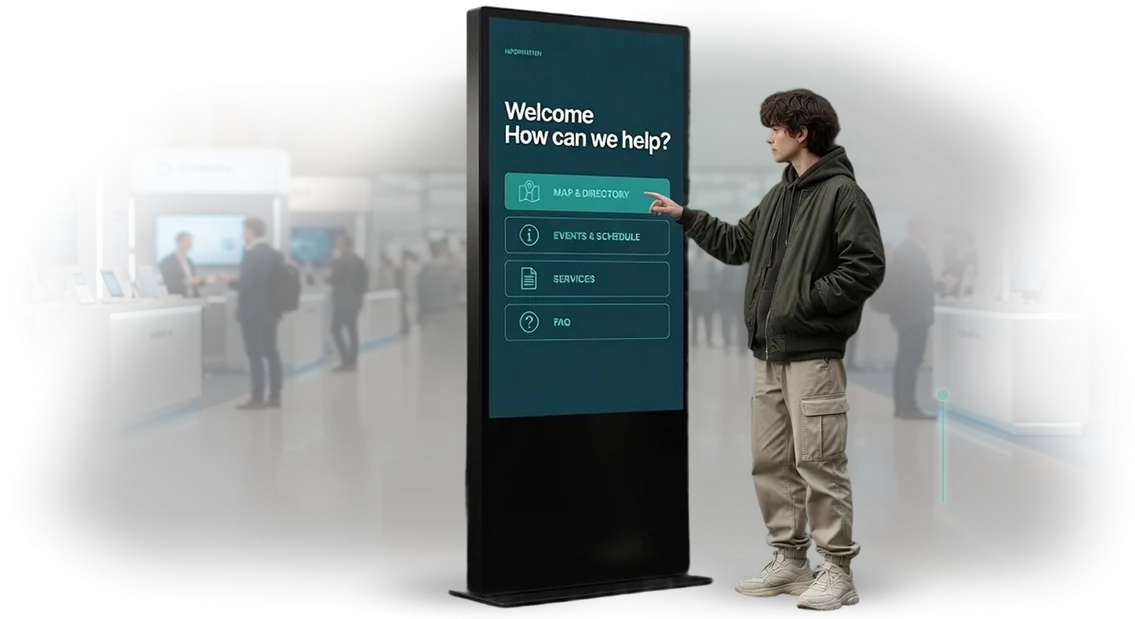
We address this need with an interactive kiosk that works like a smart consultant right at the information desk.
The kiosk doesn't get tired, doesn't get distracted, and answers the most frequent questions in seconds: it shows the route, provides opening hours, and helps guests navigate the building or the premises.
The guest gets the needed information independently, while staff are freed up for live interaction with those who really need assistance.
The result — the desk stops working at zero capacity. The kiosk handles routine inquiries, reduces queues, and lowers the workload on staff.
Visitors remember the care and convenience, return more often, and recommend you — while you stop losing clients before the conversation even begins.
What an interactive desk gives you: benefits for your hotel
Guests remember the first minute in a hotel. If there is a queue at the desk, even the best service becomes irritating. An interactive desk removes the waiting: check-in in a couple of minutes, and the administrator is free for non-standard requests. Plus, the kiosk works without lunch breaks or night shifts.
Speed and 24/7 operation
The kiosk doesn't get tired and doesn't take breaks, so a guest can check in at night and doesn't stand in line in the morning. This reduces the staff workload and boosts loyalty.
Upselling without a manager
Guests choose breakfast, spa, or a room upgrade on the screen themselves. The offer appears at the right moment — conversion is higher than with flyers. Hotels increase ancillary sales by 15–25% in the first months. Staff don't spend time persuading.
Recognition and image
A modern desk shapes the impression of a tech-forward hotel. A bright interface is memorable — guests photograph it and share it on social media, giving the hotel free mentions. According to J.D. Power, 60% of travelers expect digital check-in — the kiosk meets that expectation.
We take full responsibility for the result: we design the logic, set up the integration with the hotel management system, install professional equipment, and train your staff. All you have to do is accept your guests' gratitude.
Reception booth formats for your task
Choosing the right reception kiosk format determines how guests interact with it in your space. A proper design saves floor area, avoids queues, and looks natural in any interior — from a compact lobby zone to a spacious hall.
Format comparison
| Format | Who it is for | What it gives the client |
|---|---|---|
| Freestanding | Spaces with footfall of 100+ people per day | Can be placed anywhere, easy to move, attracts attention, and relieves the administrator's workload |
| Wall-mounted | Narrow corridors, meeting rooms, small registration desks | Takes up no floor space, doesn't block passage, quick to install and easier to maintain |
| Built-in | Front offices, waiting areas with integrated furniture | Looks like part of the interior, protected from damage, doesn't attract extra glances |
The table shows the business benefit of each option. A freestanding desk is most often suitable for self-service visit registration and office navigation. A wall-mounted kiosk works well for information and queue check-in in spaces with limited area. A built-in receiving module is a stylish tool for spaces where design supports brand recognition.
We will help you choose a configuration for your tasks: we'll consider the number of visitors, the usage scenario, and the specifics of your premises.
We'll tell you which format will deliver the most value in your case and design the kiosk so it pays for itself in the first months.
How we develop and implement a kiosk: stages
We start a project not with code but with the task and the installation location. We analyze guest flows, frequent questions, and the goal: queue management, check-in, information.
This way your reception booth ideas become a clear plan — you see the result before development begins.
- Brief and goals. We discuss the installation area, guest profile, and the main scenario: navigation, check-in, or booking. We define measurable indicators — waiting time, number of inquiries.
- Screen prototype. We show a mockup: main menu, sections, help. You edit the structure before any code — changes at this stage are fast and inexpensive.
- Interface design. We adapt the screens to your brand style: large buttons, contrast, clear labels. Guests understand it without guidance — staff workload is lower.
- Development and integration. We program the logic and connect the kiosk to your data: schedules, maps, notifications. Professional equipment ensures stable operation during peak hours.
- Testing and launch. We test scenarios with real visitors, train staff, install the kiosk, and support the first days. Any flaws are fixed immediately.
- Support and growth. We update content, add sections, and monitor analytics. The kiosk becomes a tool that grows alongside your tasks.
What is included in delivery: a turnkey package
When we say "turnkey," we mean a kiosk that is fully ready to work. You don't search for contractors or deal with technical details — you get a solution that already works. The standard package includes:
- Design mockup. We develop the kiosk's appearance in your brand style so it stands out in the lobby and attracts guests' attention.
- Software. We install an easy-to-understand system with your content — menu, catalog, navigation. Visitors will figure it out in seconds.
- Administration. We handle technical support: update the software, monitor stability, and add materials without your involvement.
- Staff training. We conduct a briefing for your team — any administrator can manage the kiosk without needing programmers.
- Installation and launch. We deliver, install it in the right spot, and check that everything works. You receive a fully functioning kiosk.
- Warranty and support. We provide an official warranty on equipment and work. During the warranty period, we eliminate any malfunctions free of charge.
This is a single package: all elements are matched to each other and work as a system. Warranty is included in the price, so you are protected from unexpected expenses. All that's left is to turn the kiosk on — and it starts delivering value from day one.
Case study: how a kiosk increased hotel sales by 30%
The hotel chain Nordic Stay Hotels faced a typical story: guests check in but barely use additional services. There was a queue at the reception desk, while the bar, spa, and tour desk were quiet.
We suggested not just an information desk, but a kiosk-assistant that solves the problem right at the moment of check-in.
The kiosk was placed in the lobby, next to reception. Guests don't see a boring menu but short prompts: what's happening in the hotel today, which master class is available, what can be booked in a minute.
Staff simply confirm requests — service speed increased, and guests started choosing additional services themselves while waiting for their room keys.
Results from the first two months: additional service sales grew by 30%, and the average check for spa and restaurant bookings increased by 15-20%. Every second guest who stopped at the kiosk left a request for a tour or service — previously that number was only 8-12%.
The kiosk became part of the experience: guests photograph it and tag the hotel on social media — that's free exposure for brand recognition.
After the pilot, the owner ordered additional equipment for three more locations — we adapted the scenarios for each hotel and updated the content for the season.
This example shows that a kiosk pays off not as a "schedule tablet" but as a full-fledged sales channel. An interactive desk operates without days off, never gets tired of proactively offering, and is still perceived by guests as a helpful assistant.
How to choose a kiosk format for your budget and tasks?
There is no universal kiosk that works equally well in a small coffee shop and in a business center lobby. So first, define the main task: what the device should do — register visitors, take orders, provide information, or simply introduce guests to the service catalog.
Based on that, the functionality is formed: whether you need a touchscreen, printer, document scanner, integration with your CRM, or just an information display. The more precisely the task is defined, the less you overpay for unnecessary modules.
The second step is budget. For a typical "desk with a tablet in a waiting area" scenario, a simple floor-standing or wall-mounted structure is enough: it's a quick solution at a moderate price that pays for itself in a few months.
If you need an impressive guest reception at the front desk — with a large screen, lighting, and video presentation capabilities — the investment is higher, but the return is more noticeable: the interface works like an extra employee that greets, guides, and answers frequent questions.
We always show two or three configuration options for different budgets so you can see the difference in cost and result rather than choosing blindly.
The third point is content complexity and updates. If information changes frequently (promotions, schedules, menus), choose a kiosk with remote management: content can be updated without a specialist visiting, right from the office.
If the kiosk performs one fixed function — for example, an electronic queue at a clinic — a simplified setup scheme is sufficient. In any case, we design the system so you can change texts, images, and videos yourself without spending money on repeated programmer visits.
When choosing a format, focus on the usage scenario: a floor-standing kiosk suits active zones with high traffic, a wall-mounted kiosk saves space and works well in narrow corridors, and a tabletop kiosk offers maximum mobility — it can be moved between desks or events.
We help calculate the number of devices based on your visitor flow and, if needed, add analytics features — how many people used the kiosk, which sections were viewed most, where guests lingered longest. This data helps improve service and even increase additional service sales.
If you are unsure which format to choose, send us a draft of your task, and we'll offer an option with justification for your budget. Within a day you'll receive a comparison: cost, implementation timeline, and what exactly the visitor will get in each option. That way you make an informed decision, without unnecessary expenses and with a clear result.
Frequently asked questions about kiosk development and implementation
Before launching a kiosk, clients usually have the same questions — about timelines, ease of operation, and integration with an existing accounting system. We answer them right away so you understand how the project goes and what you get in the end.
How long does kiosk development take?
A standard project takes from two weeks to a month and a half — the timeline depends on the number of screens, scenarios, and integration requirements. At the start, we set a plan with checkpoints, so you always see what stage the project is at and when the launch will happen.
Will it be difficult for staff to use the kiosk?
No. We design the interface for your visitors and staff: large buttons, clear prompts, logical scenarios. No training is needed — a short briefing is enough. Administration is also extremely simple: you update the content yourself, or we do it remotely.
How will the kiosk integrate with our accounting system?
We handle the integration. The kiosk exchanges data with your accounting system directly or through a secure intermediate layer — whichever is more convenient in your situation.
Appointments, order statuses, and directories sync automatically, without manual data transfer or downtime.
What about warranty and support after launch?
We provide a warranty on the work performed and the equipment. After launch, you stay in touch with our engineers: we respond during business hours and update content and features as your tasks grow. You're never left alone with the system — we support the project for as long as needed.
Ready to discuss your scenario? Tell us how you see the kiosk working — we'll recommend the optimal solution in terms of timeline, scope, and budget.Order your interactive kiosk development today
When you order interactive kiosk development, you get not just "hardware with a screen," but a tool that greets clients, sells, informs, and collects contacts without staff involvement.
The sooner we start the project, the sooner it begins working for you: paying off, relieving administrators, and improving the overall impression of your company.
We handle the entire process — from idea to launch. After you contact us, you'll have a clear picture of timelines, budget, and capabilities before signing any contract. Here's what's included in the work on your kiosk:
- Consultation — we analyze your task and recommend which interaction and placement scenarios will deliver the most value in your specific business.
- Cost and timeline estimate within 2-3 days — a transparent quote with no hidden fees; you know what you're paying for and when you'll get the result.
- Prototype and design concept — you'll see how the kiosk will look before you spend budget on production.
- Reliable equipment selection — we use professional components that provide stable operation in high-traffic locations.
- Adaptation to your corporate style — the kiosk becomes an extension of your brand, not just a gray box.
- Testing and turnkey launch — we verify scenarios, configuration, and security so you get a working system right away.
- Staff training and ongoing support — content updates, technical maintenance, and help whenever you need it.
In the end, you get a manageable and measurable point of contact with visitors: it reduces queues, increases additional service sales, and creates a modern image. Leave a request for a consultation — we'll calculate the cost and propose solutions for your task. We'll start with a simple brief, and we'll handle the rest ourselves.