

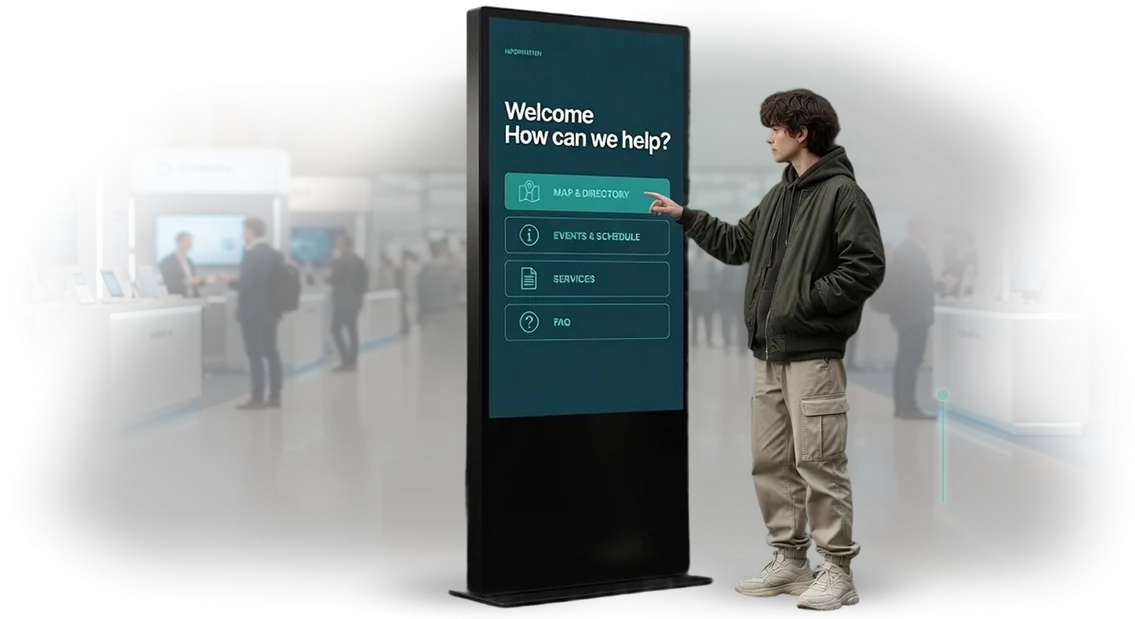
reception stall ideas for hotels: a kiosk instead of a queue at the reception
Guests don't like standing in line at the reception desk — especially after a long journey or during peak check-in hours.
While the front desk agent checks in one guest, the others wait, lose patience, and remember the hotel as "a place where everything is slow." And if guests with questions about excursions, the spa, or the restaurant show up at the same time, the queue grows even longer — and service suffers in two directions at once.
For a manager, this is not just guest dissatisfaction but direct losses: front desk agents spend time on repetitive questions instead of offering additional services and increasing the average check.
Guests who don't get a quick answer often simply head to their rooms — without booking the spa, without dinner at the restaurant, without excursions. The hotel thus loses revenue it could have earned with almost no acquisition cost.
An information stand — a kiosk in the hotel — solves this problem: guests independently learn about services, the property map, and the transfer schedule, and get through registration faster.
Front desk agents stop answering the same questions and focus on guests who really need help. We design such kiosks to fit the hotel's needs — from an information menu to a full self-check-in zone.
As a result, reducing queues becomes a measurable outcome rather than a hope: less waiting time, satisfied guests, and more upsell opportunities. For the stand to truly work rather than create new complications, a clear interface and reliable support are essential.
We handle development and maintenance — the hotel gets a ready-made tool that saves staff time and improves the guest experience.
What you get: faster service and higher sales
Guests value their time: the faster an issue is resolved at the front desk, the higher the loyalty and the likelihood of a repeat visit. Hotels like Hilton already use automation — and this is not just a trend but a way to boost satisfaction and revenue.
An interactive kiosk takes over the routine, frees front desk agents for face-to-face interaction, and suggests additional services to guests. Check the list below to see which tasks your kiosk will handle within the first month.
-
Quick answers for guests. Registration, check-out, property map, spa and restaurant schedules — all in a couple of touches, no queue, no waiting. The guest gets an answer in 30 seconds instead of a tedious wait at the desk.
-
Less load on front desk staff. Employees stop repeating the same information ten times over. The freed-up time goes to non-standard requests — a direct path to higher guest ratings and tips.
-
Higher revenue from additional services. The kiosk can offer room upgrades, spa treatments, excursions, dinner at the restaurant. Guests see current offers at the moment they have the desire and the time — so conversion beats paper brochures.
-
Service quality control. The system records every operation: how many guests used the kiosk, what services they ordered, how long registration took. This data helps you improve service and plan occupancy without guesswork.
-
Staff savings. The kiosk pays for itself by reducing the load at the front desk: you don't need to expand the team for high season, and current staff work more efficiently.
We configure the kiosk for your hotel, integrate it with your property management system, and train the staff in just a few days. You get a tool that starts delivering value immediately after launch.
Kiosk formats: from info stand to self-service checkout
In a hotel, a single kiosk rarely covers every scenario. An info stand in the lobby, a self-check-in station, and a self-service checkout are different touchpoints — each with its own task and its own audience.
When you choose the right format for a specific zone, guests get what they need faster and staff stop wasting time on routine.
Below are the typical formats we integrate into hotel operations, along with the value they deliver.
| Kiosk format | Where it is used | What it gives the hotel |
|---|---|---|
| Info stand | Lobby, elevator area, spa | Answers questions about breakfast, Wi-Fi, and services without staff involvement — reduces the load on the front desk |
| Check-in station | Entrance area, reception | Guests check in independently in 2–3 minutes — queues disappear even during simultaneous arrivals |
| Booking kiosk | Lobby, restaurant, poolside | Suggests activities and immediately books an excursion or a table — higher upsell revenue |
| Self-service checkout | Fitness center, parking, hotel shop | Accepts payment without a cashier and works around the clock — you control revenue and never miss an order |
We don't just supply equipment — we match the scenario to your guest flow and building specifics. Our engineers work out the screen logic, integration with your property management system, and a design that fits the interior.
As a result, every kiosk delivers value from day one: faster check-in, higher revenue per guest, and a modern service experience.
Project stages: from brief to launch
A clear six-stage process — you always know where the project stands and when you will get the result. We handle everything: from the first discussion to post-launch support.
- Brief and task analysis. We discuss the kiosk's goals, the visitor profile, and the installation location. We document the requirements and deadlines — you get a transparent estimate with no hidden surcharges.
- Interface and scenario design. We plan the screen structure and navigation logic so guests quickly find what they need. You approve the workflow before design begins.
- Design and prototype. We create a visual style matching your brand and build a clickable prototype. You see how the kiosk will look and work before development even starts.
- Development and integration. Our engineers implement the logic and connect catalogs, databases, or external services. We show intermediate results — you stay in control of progress.
- Testing and refinement. We test scenarios on real hardware and eliminate any flaws. You get a stable solution that won't let you down on day one.
- Launch and support. We deliver, install, and configure the kiosk at your site. We train employees, hand over documentation, and stay in touch: updates, refinements, and technical support are included.
In the end, you get a working interactive kiosk within the agreed timeline — with a clear interface, branded design, and post-launch support.
What's included: a complete package for your business
We deliver not just a kiosk but a ready-made solution that can go live on the day of installation. The entire package is assembled so your staff can start working without lengthy preparation and guests can use the kiosk without instructions.
Here is what the package includes:
- Turnkey equipment — a touchscreen kiosk configured for your tasks and fully tested. It is ready to operate in the hotel lobby or visitor reception area from the first day.
- Interface in your brand style — the design, section logic, and texts are adapted to your service. Guests quickly find information, and you don't need to print new signage when things change.
- Instruction manual for the hotel — a clear step-by-step guide for front desk staff: how to switch the kiosk on, update information promptly, and resolve common issues without calling a specialist.
- Staff training — our engineers run a short session after which your team confidently works with the system and helps guests instead of shying away from the technology.
- Kiosk warranty — we are responsible for the stable operation of both equipment and interface. Requests are handled quickly; maintenance and issue resolution are our job.
The result: you get a working turnkey tool and save time that would otherwise go to coordinating multiple contractors. Everything — from equipment to training and support — comes in one package.
Case study: hotel doubles its share of additional sales
Guests don't like waiting, and one front desk agent physically cannot both check people in and tell them about the spa, restaurant, and excursions.
At Severnaya Gavan hotel, this led to queues and lost revenue: guests simply didn't know about additional services, so they left after spending only on the room.
We installed an interactive kiosk next to the reception desk. Guests check in independently and at the same time see the hotel's current offers — dinner at the restaurant, spa treatments, early check-in. The front desk agent only needs to hand over the key and answer non-standard questions.
Implementation results
- The share of additional sales doubled: spa bookings rose by 70%, restaurant bookings by 40%.
- Guest check-in time dropped from four minutes to one and a half — the queue at the front desk disappeared.
- Guests are more willing to return: 8 out of 10 who used the kiosk rated it "convenient and fast".
Staff stopped repeating the same information over and over, and guests got seamless service. The kiosk paid for itself in four months from additional spa and restaurant bookings alone — not counting staff savings.
After that, the hotel ordered similar kiosks for two more branches, and we adapted the interface to their brand style. Now the network gets a steady stream of additional sales rather than relying on the mood of a front desk agent.
Frequently asked questions about kiosks and non-obvious points
Business owners often put off kiosk implementation because of three fears: the device will break at the worst possible moment, content management will be too complicated, and the new device won't "get along" with existing systems. These are legitimate concerns — but they are resolved at the design stage, not after launch.
We treat development as part of your service: we select professional equipment for the operating conditions, build in a safety margin, and provide tools any employee can handle without technical training.
The result is a customer touchpoint that works as part of your infrastructure — not as a separate "piece of tech."
| Customer concern | How we solve it |
|---|---|
| The kiosk will break and customers will face a blank screen | We build on a reliable component base, engineer cooling and protection from external impact, and offer a service contract with a one-day response time |
| We won't be able to change prices, promotions, or the menu ourselves | We provide a simple admin panel: content updates take just minutes, with no need to call a contractor |
| The kiosk won't fit into our CRM, catalog, or inventory system | We develop integrations with your current systems so all data stays in a single view |
What happens if the kiosk breaks down?
We build in remote status monitoring — the system sends a signal to an engineer before the problem becomes visible to a guest. Under the warranty and service contract, we ensure repair or replacement of components in the shortest possible time. Your business doesn't stop.
Will we be able to update information without programmers?
Yes. We create an intuitive admin panel for this: upload new images, change a price, add an event — save. The kiosk picks up the updates immediately. Staff training takes no more than an hour.
The kiosk is already working — what about warranty and support?
We provide an official warranty on the equipment and software, and then offer a flexible maintenance schedule: from basic support to full service with regular replacement of consumables. You always know who is responsible for the device's operation.
If you still have questions we haven't covered — ask us directly: we'll show you how it will work in your scenario.Order reception stall development for your hotel: steps and guarantees
After your request, you get not just a commercial proposal but a complete project plan: cost estimate, timeline, and a presentation of solutions tailored to your hotel.
We create reception stalls that become part of your brand image and support your service — just like at hotels of the level of Four Seasons.
We work on a transparent timeline so you control every stage:
- Brief and consultation — we identify the tasks, guest flow, lobby style, and budget.
- Cost estimate and personal proposal — we fix the estimate, timeline, and scope of work.
- Design concept — we present a 3D visualization and agree on the appearance.
- Production and setup — we manufacture the stand, install the software, and test everything.
- Launch and training — we mount the kiosk, train the staff, and hand over the instructions.
We take on the risks and provide guarantees that protect your budget:
- fixed cost — no hidden payments;
- warranty on the structure and electronics — up to 2 years;
- technical support and updates after launch;
- free staff training for the hotel;
- handover of source materials and access rights;
- kiosk refinement if key tasks change.
As a result, you get not just an information stand but a manageable tool that speeds up registration and increases guest loyalty. Leave a request and we will get back to you within one business day, calculate the cost, and prepare a personal proposal for your hotel.
How to choose the right kiosk format for your tasks?
The right kiosk format is not a matter of technical specifications but of your business tasks. A front desk employee spends up to 30% of their time on repetitive guest questions: how to get somewhere, where to eat, what services are available.
A free-standing touchscreen stand removes this load by answering typical requests instantly, while the front desk agent handles complex situations and personal interaction.
If your main goal is to speed up check-in, you need a full-fledged registration module with document printing and integration with your property management system.
If the task is to introduce guests to the infrastructure — for example, to show the pool, restaurant, and spa — a compact floor stand with convenient map navigation is sufficient.
For cafes and restaurants, a wall-mounted or compact kiosk in the waiting area works best: it shows the menu, waiting time, and promotions, shortening the line at the cash register.
In clinics and medical centers, the kiosk acts as an electronic registration desk: doctor appointments, room number confirmation, queue reminders.
Patients don't have to crowd around the desk, and the front desk staff receives a structured flow of data instead of chaotic questions.
There is no universal "best" format — there is the kiosk that fits your traffic, your space, and the guest's usage scenario.
That is why we start with a short audit: we count visitor flow, look at congestion points and staff tasks, and only then propose the specific type of equipment and screen logic.
You get not just a device, but a tool that solves a measurable problem: reduces queues, speeds up service, or increases the average check.