

Check-in queues kill service: you need an airport check-in kiosk
Check-in queues are the main enemy of service. Passengers get irritated, miss connections, and leave angry reviews on social media.
Airlines and airports suffer reputational and financial losses: customers switch to competitors, and increasing passenger traffic demands more counters and more staff. Peak hours become a source of stress for everyone—from passengers to counter employees.
The modern traveler is used to self-service—in banks, stores, and gas stations. They expect the same at the airport. If there is a fast airport check-in kiosk next to the queues, passengers will gladly choose it, saving time and nerves.
This is not a luxury but a service standard set by the market. Those who fail to keep up with customer expectations lose traffic.
Charter flights and holiday peak loads make the situation worse, when passenger traffic exceeds the capacity of regular counters several times over. At such moments, a check-in kiosk becomes the only way to maintain order and respect for the customer.
Introducing a check-in kiosk redistributes the workload: automation takes over routine operations, while staff focus on complex cases—non-standard baggage, special passengers, and selling additional services.
Queues shrink several times over, service levels rise, and repeat bookings increase. This has a direct impact on revenue: a satisfied passenger comes back and recommends the airline or terminal.
Still, many managers postpone the project for fear of investment: it seems that a kiosk is expensive, time-consuming, and complex.
We address that fear: we conduct a passenger flow audit, suggest the optimal number of check-in kiosks, design a user-friendly interface, and integrate the solution with your booking system.
The client gets a measurable result—lower waiting times, reduced staff workload, and fast payback. And we take responsibility for launch and support.
How we launch a check-in kiosk in 5 steps
We understand that deciding to launch a check-in kiosk raises questions—how long the implementation will take, who is responsible for the result, and what happens after delivery. That is why we built a five-step process where every stage removes uncertainty. You get a turnkey project with clear launch dates and no hidden costs.
- Brief and audit. You describe how check-in works today and what tasks you want to solve. We assess the scope, propose a solution, and lock down the cost estimate and timelines—with no “surprises” in the middle of the project.
- Scenario design. We develop the kiosk logic around your specific needs: speed for passengers, service and upsell for hotel guests. We approve layouts before development begins.
- Development and integration. We create the kiosk turnkey and connect it to your systems: booking, guest or passenger management. We use professional equipment so the kiosk works reliably during peak loads.
- Pilot launch and training. We place the kiosk at your site, run real scenarios together with your staff, and train them to respond to unusual situations. All feedback is fixed before the official launch.
- Support and evolution. We stay in touch after delivery: update content, add new features, and monitor stability. You always know who to contact—this removes the main risk of any project.
This sequence makes the project transparent: you see the result at each step and understand what you will get in the end. The kiosk launches on the agreed schedule, and the team remains on hand after implementation.
What you get in the kiosk package
When you order a kiosk, you get not just a device but a fully prepared solution that starts working from day one. We cover the entire cycle—from equipment selection to launch and staff training—so you don’t have to coordinate multiple contractors.
Here is what is included in the delivery package:
- Equipment and software. The kiosk itself with a touchscreen, enclosure, protection, and a pre-installed check-in system. You don’t need to buy anything “along the way.”
- On-site installation and configuration. Our engineers arrive, install the kiosk, connect it to your network, and test all operating scenarios—from check-in to printing.
- Staff training. We give administrators a short briefing: how to welcome guests, handle standard situations, and refill consumables. Training takes no more than a couple of hours.
- Clear instructions. Every employee gets a simple cheat sheet for daily operations. You don’t need to understand technical details.
- Warranty on the kiosk and its components. The equipment is officially under warranty; during the warranty period we fix faults free of charge—usually within 1–2 business days.
- Technical support. You get a dedicated communication channel: phone, chat, or email. We help if something goes wrong, remotely or with an on-site visit.
- Updates and enhancements. The system can evolve with your business: we add new scenarios, change the design, and connect additional services.
The main thing you get is a complete turnkey package and a clearly defined area of responsibility. You know who is responsible for the kiosk and don’t waste time looking for contractors. We handle the technical side, and you get guest check-in without queues and paperwork.
Frequently asked questions: we answer before the project starts
Before ordering a check-in kiosk, every manager asks the same questions: will the equipment withstand constant load, when will the investment pay off, and how will the kiosk fit into current processes.
We answer the main doubts briefly and to the point—so you can make a decision without extra calls and approvals.
How reliable is the kiosk during daily operation in the check-in area?
The kiosk is designed for round-the-clock operation in high-traffic areas: the enclosure, screen, and printing module are selected for intensive use. Across our projects, there has never been a case where the equipment needed replacement in the first year of operation. We guarantee stable performance and quick recovery in emergencies.
When will the kiosk pay off and what savings does it deliver?
We calculate payback based on your numbers before we start. In a typical hotel, the kiosk cuts guest check-in time by 3–4 times, relieves the reception desk, and reduces the need for extra staff during peak hours.
With a load of 100 or more guests per day, the investment usually pays off in 6–12 months, and after that the kiosk works in your favor.
Will the kiosk work with our current booking system?
We take care of connecting to your accounting software and configure the kiosk to match your existing check-in and check-out processes.
You don’t need to change software or retrain staff—guests get a familiar interface, and administrators see bookings in the same system as before. We test the integration through test scenarios before launch.
Who is responsible for kiosk maintenance and how quickly are issues resolved?
After launch, the kiosk remains under our support: we remotely monitor its status, update software, and visit for repairs when necessary. We respond to most requests within one business day, and critical issues are resolved remotely—so check-in never stops. We also give your staff a short training session so they can handle basic situations on their own.
If the above is not enough, we will send you a calculation based on your traffic and current check-in costs. Just tell us how many guests pass through your desk per day, and we will show what effect the kiosk can deliver specifically at your hotel.Order kiosk development and get an audit
Submit a request for kiosk development and get an audit and expert consultation. We will review how your check-in and visitor flows work and show where automation can speed up service and reduce staff workload.
You don’t need to understand the technology: we will prepare a cost estimate and payback assessment in business terms.
The audit creates no obligation. Through years of work with hotels, airports, and public spaces, we have accumulated enough data to see immediately where a kiosk will deliver results and where it won’t.
During the audit, we:
- analyze scenarios: who uses the kiosk and which tasks we automate;
- assess current service speed, queues, and staffing costs;
- prepare a transparent cost estimate for development and integration;
- calculate an approximate payback: time and money saved per month;
- suggest 2–3 kiosk formats—from basic to a terminal with additional features;
- answer support and update questions so you know the total cost of ownership.
You will receive a document with conclusions and recommendations. Then the decision is yours: order the kiosk from us or not. Leave your contacts—we will get in touch within one business day and schedule a convenient time for the audit.
How to choose the kiosk format for your task?
Choosing a format is not a matter of taste, nor is it “the more features, the better.” The decision is driven by three things: what the visitor does at the kiosk, how much time they have, and what impression the brand should create.
Agree, a hotel and an airport have different tasks: a traveler with a suitcase needs speed and minimal steps, while a guest at a premium hotel expects atmosphere and a sense of care.
That is why we don’t sell a “box with a touchscreen” but rather select a configuration to match your business objective. For a hotel check-in area, this could be a compact station that saves space at the reception desk and relieves the administrator.
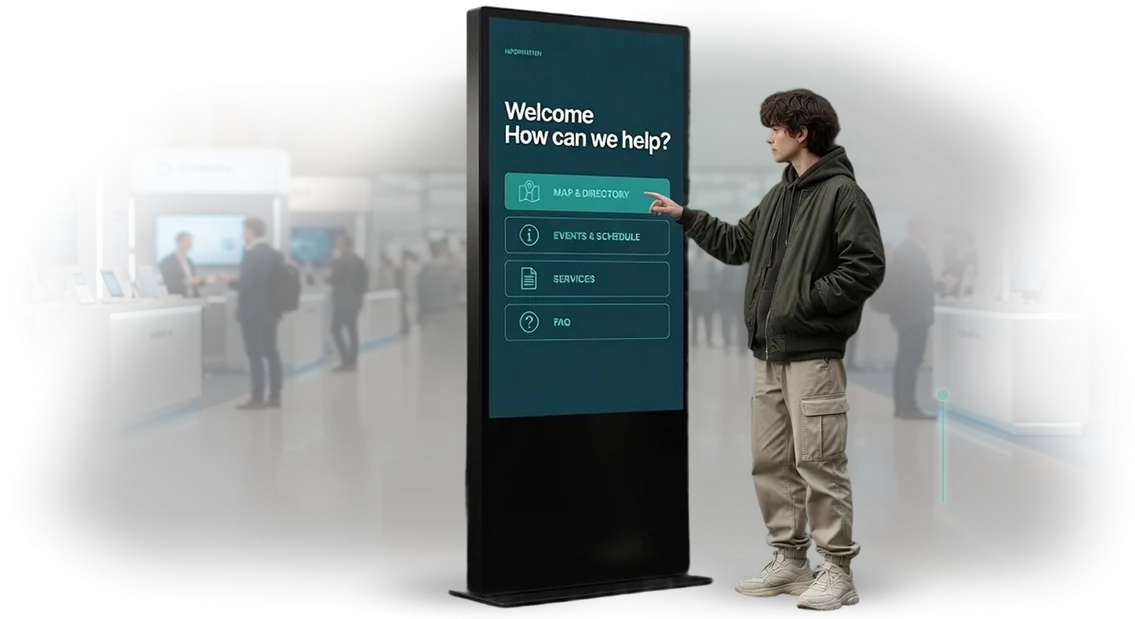
For an airport or train station, it’s a full-height kiosk with a reinforced enclosure that can withstand high loads and won’t sit idle. And for an exhibition or showroom, a model with a custom design that attracts attention by itself.
Our team analyzes your scenarios before purchase: number of visitors, peak hours, type of operations, and security and design requirements. After that, we offer 2–3 options with a clear calculation of cost and payback.
You see not an abstract “kiosk” but a solution: will service speed increase, will queues decrease, and what staff will be required.
Trust us with the selection and get a format that pays off from the first month. We take on design, production, and launch, so you can focus on your business instead of technical details.