

Tired of queues? A stall reception kiosk will cut waiting time
Every day starts the same way: a queue forms at the reception desk, guests get anxious, and front desk staff answer the same questions over and over.
The longer the wait, the higher the risk that a visitor will simply turn around and leave — or leave a negative review that a thousand potential customers will see. Meanwhile, staff burn out: instead of handling tasks that require attention, they spend hours on routine.
This situation costs more than it seems. A lost guest is not just a missed transaction — it's also a damaged reputation. People are used to service where everything happens quickly and without unnecessary words, and that's exactly the expectation they project onto your brand.
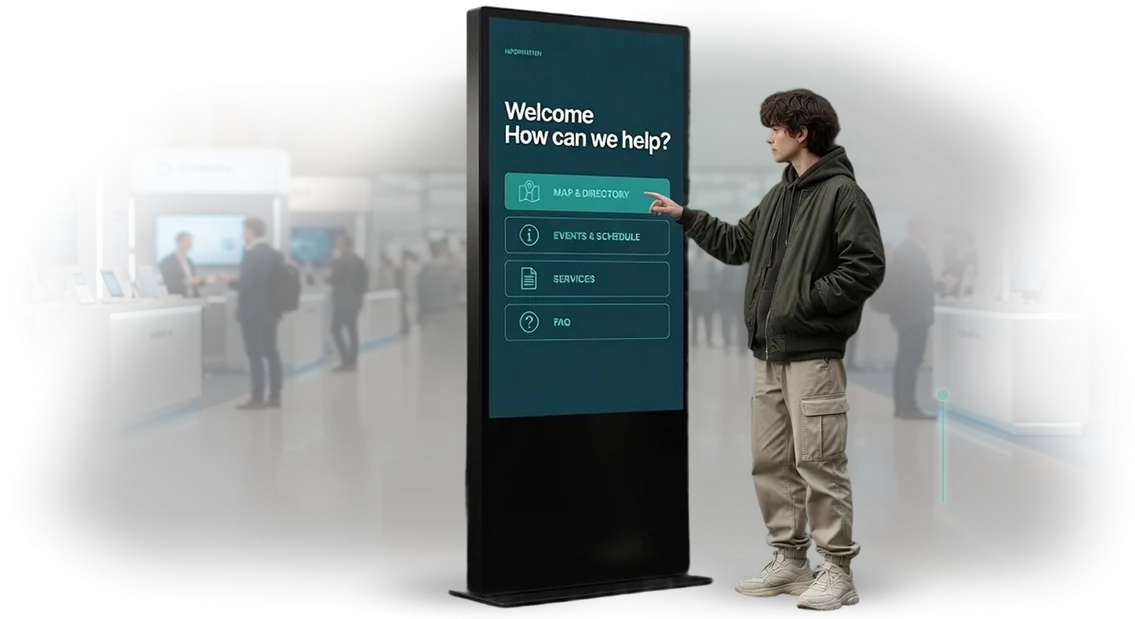
An interactive kiosk for stall reception solves the problem before it arises. Using self-service, the guest checks in at the reception desk, gets the information they need, selects a service, or calls a staff member — without a queue and without intermediaries.
The front desk staff step in only when truly needed and spend their time on guests rather than repeating the same reference information.
As a result, the reduction in queues becomes noticeable within the first days: average time at the desk drops, throughput grows, and guests leave feeling cared for. Staff stop working themselves to the bone, and you get a manageable touchpoint that works around the clock.
We design and implement such kiosks for the specific needs of your facility: from scenario selection to launch and staff training. Tell us about your situation — we'll suggest how to eliminate queues and restore guest comfort.
What you get from an interactive kiosk
An interactive kiosk is not just a screen with information, but a working tool that speeds up service and increases the average check. It takes over routine tasks and, in return, delivers measurable results within the first weeks after launch.
Service speed — no queues and no delays
Guests get answers in seconds without waiting for a free staff member. During peak hours, the queue moves two to three times faster, and visitors stop getting anxious about the wait.
Staff relief — employees focus on important tasks
Routine requests — how to get somewhere, what's included in the service, where the facilities are — are handled by the kiosk on its own. Front desk staff and consultants are freed up for live interaction with guests and for handling non-standard situations.
Increased guest loyalty — an impression that sticks
A modern interface and instant response create the image of an attentive brand. The visitor feels their time is valued and gladly returns — and also recommends you to friends.
Additional sales — the kiosk knows how to upsell
Built-in scenarios suggest ancillary services to guests: an excursion, a souvenir, extra time. This turns the kiosk from an information desk into a full-fledged revenue channel.
Kiosk installation formats for stall reception
The kiosk format is not a technical parameter but a solution to a business task. It determines how easily a visitor notices the device, how quickly registration goes, and how much space the structure takes up.
For a welcome zone or reception desk, it's important that the kiosk doesn't clash with the interior and doesn't require remodeling the space.
We select the enclosure for your scenario: a tabletop option for a compact reception area, a floor-standing column for the lobby, or a kiosk with a printer for issuing passes and tickets. Below is a table with the formats and the benefits the client receives.
| Format | Target audience | What it gives the client |
|---|---|---|
| Tabletop kiosk | Compact reception desks, areas with limited space | Saves space, speeds up registration, easily integrates into existing furniture |
| Floor-standing kiosk | Lobbies, entrance areas, exhibition stands | Attracts attention, helps visitors find their way independently, reduces staff workload |
| Wall-mounted kiosk | Corridors, elevator areas, narrow passageways | Uses vertical space, doesn't block walkways, available at any point |
| Kiosk with printer | Areas for issuing tickets, passes, and permits | Reduces queues, automates document issuance, eliminates manual entry errors |
| Reception desk | Entrance zone, executive reception | Builds company image, replaces part of the administrator's functions, collects visit data |
How kiosk development and implementation work
Kiosk development is not buying a ready-made device — it's a joint project in which your business gets a clear result within agreed timelines. We've structured the process so you can see at every stage what you're getting and what it costs.
The final launch requires no special knowledge from you: we bring the project to a working solution and hand it over to your team.
- Brief and analytics — we study your venue, guest flow, and typical scenarios. We capture objectives and desired metrics, then determine timelines and budget. You get a work plan before production begins.
- Concept and design — we propose the kiosk's look and interface logic, presenting sketches and mockups. We agree on everything before launch so you know in advance how the kiosk will fit into the space.
- Development and approval — we build an interactive mockup you can touch: we walk through key scenarios together with you. We make revisions before the final product, so surprises at launch are ruled out.
- Production and installation — we manufacture the enclosure, configure the software, mount it at your site, and connect it to the required services. We test it under real conditions and hand over a turnkey solution.
- Staff training — we give your employees a short briefing: how to change content, track guest activity, and respond to common issues. Your team works with the kiosk confidently from day one.
- Launch and support — we support the go-live, monitor the first days of operation, and respond quickly to any questions. After launch, we stay in touch: we fine-tune scenarios and help with content updates.
What's included in kiosk supply and setup
When you order a kiosk, the main risk is getting a box of equipment and a hundred-page manual. We do it differently: we deliver a fully ready solution that can be switched on and used the same day.
You don't need to hire a contractor for installation, design, or setup — we cover everything ourselves.
What's included in the package
- Equipment and installation — we select the enclosure and screen for your space, install the kiosk, connect power and network, and verify operation on site.
- Software — we configure the system for your tasks: catalog, navigation, feedback, integration with your services and databases.
- Design mockup — we develop the kiosk's interface and exterior design in your brand style so it fits harmoniously into the space.
- Staff training — we show your team how to change content themselves: news, promotions, prices, menus. No programmers needed for daily tasks.
- Warranty and support — we provide a warranty on hardware and software, respond promptly to requests, and update the system as your needs grow.
- Reliability — we use industrial components designed for 24/7 operation, so the kiosk runs stably during peak hours and doesn't require frequent repairs.
If desired, we add remote analytics: you see which sections visitors use most and improve content without extra costs. All of this is included in the base package, with no hidden surcharges.
Real result: how we accelerated guest check-in by 40%
A hotel with heavy guest flow at check-in hours always means queues at the registration desk. Guests are tired after the trip and wait 10–15 minutes, their mood sours, and front desk staff have no time to offer spa, excursions, or the restaurant. This scenario is familiar to anyone who has ever checked into a large hotel on a Friday evening.
We solved this problem by installing interactive kiosks on professional equipment — Elo Touch touchscreen panels, proven in dozens of projects.
The kiosk was integrated with the hotel management system: guests scan their documents themselves, receive a key, and choose additional services before even approaching the desk. Staff handle only complex situations and live interaction, not re-entering data.
The result exceeded the client's expectations. Check-in time dropped by 40% — from 12–15 minutes to 4–5. Queues at peak hours disappeared completely, and guests got to their rooms faster.
Upsells grew too: the kiosk shows hotel services with visual materials, and guests book spa treatments and the restaurant right during check-in. The share of guests who purchased something extra increased by a quarter.
For the hotel, this is direct savings: front desk staff don't need to work overtime, guests spend more money on site, and reviews have become noticeably more positive. The project paid for itself within a few months, and the client later expanded the system to a second building.
If your business has the same pain points — queues, unhappy visitors, missed sales at the entrance — we're ready to show a live demo and calculate the effect for your scenario.
The approach is proven and the risks are minimal: integration takes only a few weeks, and the result is visible immediately after launch.
Frequently asked questions and concerns before you start
You've already assessed the value for your clients, but it's important to address the risks before starting. We take on installation, setup, and support — below we answer the questions business owners ask most often.
What happens if the kiosk breaks or freezes?
We provide a warranty on the equipment and configuration, and we supply a replacement device while repairs are underway. Monitoring runs automatically: we learn about a problem before the visitor does and restore operation within a few hours.
Is it difficult to install the kiosk and train the staff?
The kiosk connects like a regular device, and setup is done remotely. Employees don't need technical knowledge — a short briefing and a clear guide are enough to work from day one. Updates are installed automatically, without your team's involvement.
How well is the kiosk protected from tampering and viruses?
We use professional equipment and a closed environment, so external actions don't affect operation. Protection against failures and automatic recovery to working mode are built in. For a company, this means a stable customer touchpoint without constant oversight.
When will the kiosk pay off, and what results will we see in the first month?
The effect is usually visible right away: service speeds up, the load on the reception desk drops, and visitors get the information they need without waiting.
The exact payback period depends on traffic and scenario — we'll calculate it during a consultation based on your figures.
Ready to ease any remaining doubts — request a cost calculation for your business, and we'll show you what the result will be.Leave a request for interactive kiosk development
An interactive kiosk works for you 24/7: it takes requests, registers visitors, answers frequently asked questions, and reduces queues.
But for it to genuinely deliver value, the task needs to be defined correctly — and that's where specialists who've already launched similar projects come in.
Leave a request — and we'll conduct an audit of your idea, propose a solution, and calculate a cost estimate. You'll get a clear action plan, not abstract promises.
What you get after contacting us:
- Audit — we'll analyze your task and recommend which kiosk format fits.
- Cost and timeline calculation — a transparent estimate with no hidden surcharges.
- Functionality consultation — we'll help you choose the right options without overpaying for extras.
- Placement and design recommendations — so the kiosk blends organically into the space.
- Support at every stage — from launch to ongoing content updates.
- Workmanship warranty — we stand behind the result.
This doesn't obligate you to anything: we share our expertise, and you make the decision. Fill out a short form — it will take a couple of minutes. After that, we'll take over and offer a solution that pays for itself.
How to choose a kiosk format for your task?
Choosing a kiosk format starts not with a picture, but with three questions: how much space you have, what guest flow you need to handle, and what functions the kiosk should cover.
The answers determine the enclosure type, screen size, and number of units — and therefore the budget and payback speed.
If space is limited, a narrow wall-mounted station or a wall kiosk with a small touchscreen is the right fit. For a spacious lobby, a full-height enclosure with a large display works better: it's more noticeable, can show more information, and doesn't get lost in the interior.
It's important to plan the approach zone in advance: even a compact kiosk must remain accessible to someone with bags, a stroller, or a wheelchair.
Guest flow determines how many kiosks to install and how fast the scenario should be. If several hundred people pass through per hour, several compact units with a simple menu are better — so the visitor completes their task in 20–30 seconds without creating a queue.
For a smaller flow, a richer interface works: catalog, articles, photos, and videos that the guest can explore calmly and without rushing.
Functions dictate the equipment. For navigation and presentations, a touchscreen is enough. For booking an appointment or ordering a service, a confirmation printer and a secure data-entry flow are added. For payments — a card reader and a reinforced enclosure.
The more functions, the more space the kiosk takes up, and the more carefully the screen logic must be designed so the guest doesn't get confused.
We select the format for your space, flow, and tasks — not the other way around. At the brief stage, we calculate the load, draw placement options, and recommend which kiosk will deliver results without overpayment.
So you get not just a "nice stand," but a working tool that pays off and solves your task.