

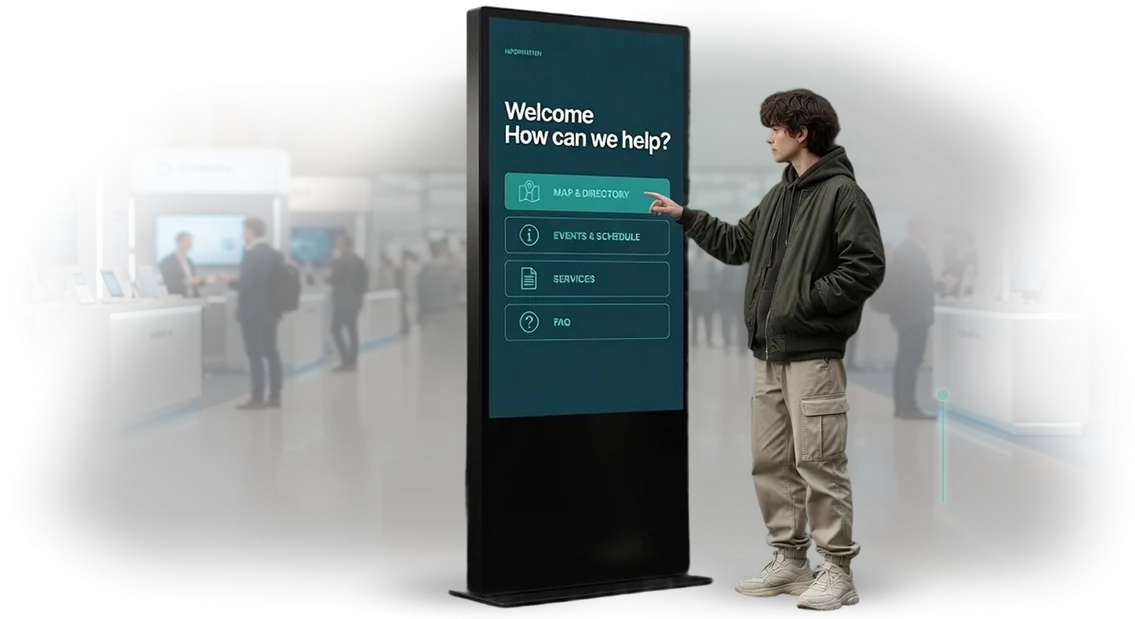
Why hotels lose guests without a digital reception kiosk
Hotel guests are not ready to wait: after a flight or a long journey, they need to check in quickly and rest. Even a 10–15 minute queue at the front desk becomes a reason for negative emotions.
During peak check-in hours, waiting stretches to half an hour — and the fault lies not with the staff, but with an outdated guest service format. Travelers choose a hotel where they are expected, not where they wait.
A customer lost to waiting is not just dissatisfaction, but real money: loyalty drops, negative reviews appear, and repeat visits become rare. The modern guest is used to digital services working instantly — from online booking to calling a taxi.
A hotel that doesn't offer this speed loses to its neighbors and loses direct bookings to online aggregators.
The solution lies in digitalizing service: a digital reception kiosk receives guests within minutes, without queues or paper forms. Guests choose their language, verify their card data, and get their key — while staff handle personal interaction and complex issues.
This is not just a replacement for the front desk, but a new standard of service that pays off through loyalty, reviews, and repeat visits.
We have been helping hotels implement such kiosks for over a decade: we design scenarios for your hotel, configure integrations with hotel systems, train staff, and support you after launch.
Your guests get fast check-in, and the hotel gets fewer lost bookings, higher ratings, and more direct sales. This is the step that sets modern service apart from yesterday's.
What benefits an interactive registration kiosk provides
Every day, visitor registration turns into a stream of repetitive actions: capturing data, finding records, answering the same questions. During peak hours, this results in queues, irritated guests, and overloaded administrators.
An interactive registration kiosk takes over the routine — service speed grows noticeably, and visitors stop waiting.
The kiosk works without breaks or days off — around the clock, even when the administrator's desk is already closed.
Guests can register themselves at a convenient time, which is especially valuable for clinics, business centers, hotels, and educational institutions with irregular schedules. This way, you raise your service level without expanding your staff.
Staff are freed from mechanical operations and gain more time for meaningful tasks: helping in complex situations, consulting, and caring for regular customers. This not only reduces workload but also increases staff engagement — the work stops being a "conveyor belt". And customers feel the attention and are more likely to come back.
The kiosk eliminates data-entry errors — records are created without typos and never get lost. Every interaction is automatically saved in your system, giving you a complete picture of visits and patterns in audience behavior.
Based on such information, it becomes easier to make decisions about guest service and service development.
The solution pays off quickly: costs for an additional front desk and for fixing errors go down, and your service becomes modern and attractive. Our team designs and launches kiosks for any industry — from simple registration to automatic visitor distribution across offices. You get a reliable system that works steadily day after day.
Digital kiosk formats for hotels, retail, and clinics
Different tasks require different formats: an interactive station at the entrance, a self-service kiosk in the hall, or a compact booking panel.
We select the configuration for your business scenario so that visitors solve their own tasks while staff handle more important matters.
| Format | For whom | What it gives the customer |
|---|---|---|
| Interactive registration kiosk | Hotels, apartment hotels | Guest checks in within 2 minutes without a queue, even late at night |
| Navigation and services kiosk | Hotels, shopping malls, business centers | Visitor finds the right department or office on their own, sees promotions and services |
| Catalog with ordering | Retail, building materials, furniture | Shopper checks stock, places an order, and pays without a consultant's help |
| Booking kiosk | Clinics, salons, government services | Patient chooses a doctor and time, receives a ticket without a long queue |
Behind any format is a single technical foundation: professional touch panels, a server side, and refined KioWare kiosk software. Our engineers configure scenarios for your business and update content remotely — changing promotions, doctor schedules, or menus.
For you, this means stable 24/7 operation and a launch without hiring a separate technical specialist.
Any format easily integrates into existing systems: for a hotel — into the property management system, for a store — into inventory accounting, for a clinic — into specialist schedules.
This way, the kiosk becomes not "just another screen" but a working tool that saves staff time and increases the average check.
Stages of launching an interactive kiosk: from brief to launch
We start with a brief — a short interview about the kiosk's tasks, your audience, and expected results. We record goals, budget, and timelines so you understand what you are paying for. Then we work transparently, with approval at every key stage.
- Brief and task analysis. You describe usage scenarios, and we propose the optimal format and functionality for your industry.
- Prototype and approval. We show the screen structure before development — you see the navigation logic and make changes without extra costs.
- Design and content. We style the kiosk in your corporate identity, adapt texts for the screen, and add clear prompts.
- Development and integration. We connect payments, booking, and synchronization with databases. We test speed and stability.
- Launch and training. We install the kiosk on site, set up remote monitoring, and train your staff.
- Support and development. We update content and functionality as tasks grow and make sure the device never sits idle.
The full cycle takes from a few weeks to a couple of months depending on complexity. You get a working service channel that pays off by relieving staff and improving service quality.
What is included in the interactive kiosk delivery
We take on the entire process — from concept to a working digital receptionist. You don't need to look for contractors separately: in one place you get a ready-made solution that you simply turn on and start using.
The final interactive kiosk delivery package includes:
- Equipment. A professional enclosure with a touchscreen, protected against dust and impacts. Suitable for a lobby, entrance, or waiting area — looks neat and lasts for years.
- Software. An application for your task: service booking, issuing certificates, office navigation, questionnaires. Everything is already configured for your scenario.
- Interface design. Screen design in your corporate style: large buttons, clear text, adapted to your audience.
- Installation and configuration. We deliver, install it in the right place, and connect it to the network and your systems — catalogs, customer database, booking services.
- Staff training. We conduct short briefings for employees: how to change on-screen information, track statistics, and resolve typical issues.
- Support and warranty. After launch, you stay in touch with our team: we answer questions, update content on request, and repair equipment when necessary.
Each item is not a "paid extra option" but a standard part of the delivery. You know in advance that you will receive a working turnkey kiosk, without hidden work or unexpected expenses. All that remains is to choose the installation location — we will handle the rest.
Case study: a hotel chain cut registration time by 40%
For the Horizon hotel chain — 14 properties in different cities — we deployed a digital reception kiosk that replaced the traditional front desk.
The main pain point the client came with: in the evenings, guests stood in queues for 20–30 minutes, and the peak check-in time coincided with staff fatigue. This led to negative reviews and the loss of some guests at the check-in stage itself.
How the solution works
We designed a scenario specifically for a hotel: guests scan their passport, choose a room, pay the deposit, and receive a key — with a couple of screen touches.
The system is integrated with the hotel's property management system, so rooms, bookings, and rates are pulled automatically, without administrator involvement.
Business results
Three months later, we measured the effect: registration time dropped by 40% — from 15 to 9 minutes on average. Peak check-in queues disappeared completely, and the front desk is now needed only for non-standard situations.
Freed-up staff were redirected to guest service — luggage assistance, concierge services, and care for regular customers. This raised the average service rating by 0.8 points and reduced the load on night administrators.
After a pilot project in two hotels, the chain scaled the solution to all its properties. Repeat launches took half the time — the system didn't need adaptation, and staff training was completed remotely in one day.
The client is already planning to add contactless payment and automatic checkout, and we support the kiosks and develop them for new tasks.
How to choose a kiosk format for your task?
Choosing a kiosk format starts not with the model but with the question: what task should it solve and who will use it? For one venue, a compact station with a menu is enough; for another, a large terminal with a map and navigation is needed.
Kiosk selection comes down to three factors: the visitor scenario, the installation location, and service requirements.
The scenario determines the interface and construction. If a visitor spends no more than 15 seconds at the screen, you need large buttons and instant response.
If it's a multimedia guide or a catalog with additional information, the screen diagonal and ease of content interaction matter more. Honestly assess how many people will use the kiosk simultaneously and how fast the queue should move.
The installation location dictates the kiosk requirements: outdoor placement requires protection from moisture and direct sunlight, a brightly lit lobby requires a high-brightness screen, and narrow corridors require a compact enclosure.
Accessibility for people of different heights and with disabilities also affects the choice. Our engineers take these parameters into account when designing and build in a safety margin in advance.
Finally, plan for growth: the ability to change content quickly, add new sections without rewriting the program, and get statistics for each scenario.
That's why we offer not a "ready-made box" but a solution that works toward your metrics: faster service, less staff load, higher visitor satisfaction.
Send us a description of your task — within one business day we will prepare format recommendations and a preliminary estimate.
Frequently asked questions about kiosk implementation: answers
Implementing a visitor reception kiosk is not a one-time purchase but a long-term solution. It's logical that managers care about reliability, repairs, and maintenance. We honestly answer the key questions.
What if the kiosk breaks down during peak hours?
We eliminate downtime: the kiosk recovers automatically after failures, and remote monitoring spots a problem before it affects visitors. If a repair is needed, we will replace the module under warranty within a few days and provide a replacement kiosk for that period.
Who will service the kiosk after launch?
We take on the maintenance. The plan includes regular checks, updates, and preventive maintenance — both remotely and with engineer visits. You don't need to look for contractors: you get a working device and a clear report on its condition.
What does the warranty cover and how long is it?
The kiosk and software come with a warranty of one year or more. We cover component replacement, repair work, and updates. If a dispute arises, we resolve it in the client's favor and build long-term relationships.
Still have questions? Ask us — we will consult you and calculate the cost for your project.What's next: how to start a project with us
Leave a request — and we will contact you within one business day. You don't need to understand technical details: just describe where the kiosk will be placed (at the entrance, in the lobby, in the waiting area) and what it should do. Everything else — the scenario, design, server side — we take on ourselves.
What you get right after reaching out:
- Consultation and cost calculation — a preliminary estimate will be prepared before work starts, without prepayment.
- Scenario recommendations — how to speed up guest registration, reduce queues, and lower the load on administrators.
- Kiosk examples for your industry — we will show real projects, including the digital reception kiosk for the Gallery chain, which paid for itself in two months.
- Main screen mockup — you approve the interface concept before development starts, not after.
- Interaction logic — how the client should solve their task in 30 seconds and what errors we will eliminate at the interface level.
- Launch plan with checkpoints — from prototype to kiosk installation at your site.
The next steps are simple: you send a request, we have a call, clarify details, and record requirements. Design and preparation of the commercial proposal take a few days.
After approval, we move on to interface development and kiosk assembly, finishing with installation and a short instruction for your employees.
This format lets you start a project without extra meetings and lengthy approvals. You get a transparent budget, clear timelines, and an understanding of what will happen at each stage.
Start with a short request: tell us how many guests pass through your area — and we will offer the optimal solution.
Translate the above into English. Preserve structure exactly.