

Interactive Floor: How to Avoid Losing Customers and Profit
Every day, dozens and hundreds of visitors pass through a shopping mall, showroom, or exhibition booth. They look around, but only a few stop at a display window or advertising structure.
The rest walk past — that is lost attention that could have turned into interest, a purchase, and a repeat visit. The question is how much that loss costs your business.
Visitor behavior has changed noticeably: static navigation and regular signage are no longer enough to attract and retain them. Interactive solutions, especially an interactive floor, let you draw a guest into a game or exploration right while they are moving.
A person stops, interacts with the image, gets an emotional response — and associates it with your brand. Our measurements show that such a zone gathers two to three times more brand contacts than a regular poster.
An interactive floor is not just space decoration but a working customer-attraction tool. It creates a reason to linger, take a photo, share it on social media, and come back again.
In children's centers, such zones extend the time a family stays; in showrooms, they hold attention on new arrivals; at exhibitions, they help visitors remember your booth specifically.
But how do you avoid overpaying and choose a solution that truly works? How much profit do you lose when a guest walks past indifferently?
You will find the answers to these questions in our article: we will break down how an interactive floor helps return your investment and what to look for when buying at a fair price.
Key Business Benefits: From Visitors to Leads
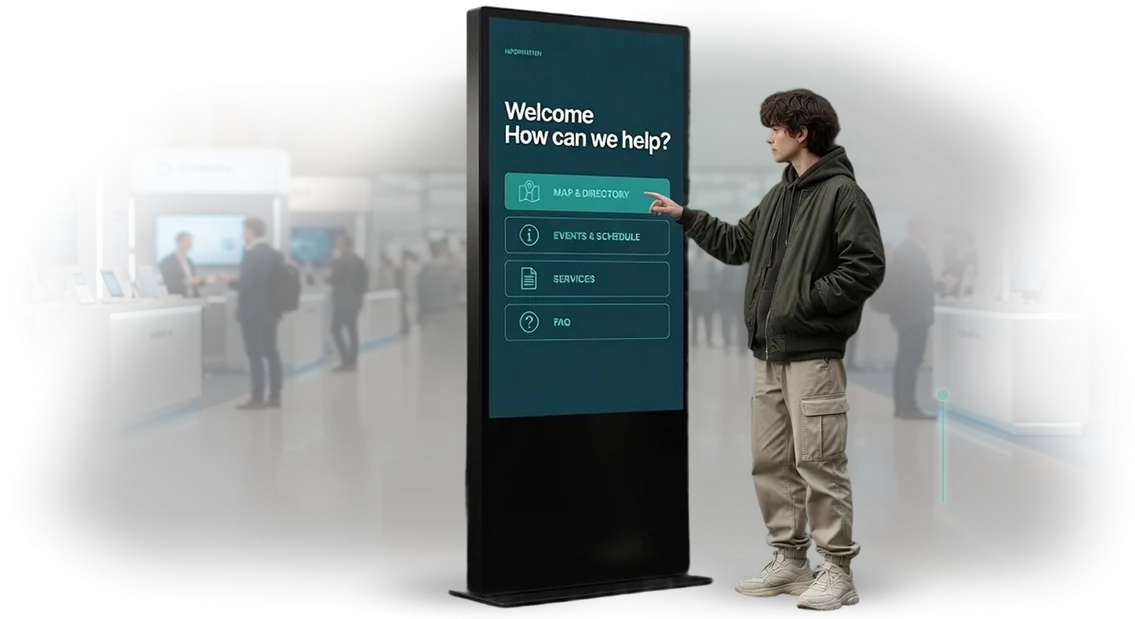
An interactive kiosk is not just a screen in the lobby. It draws guests' attention from the first seconds: a person walks up, joins the game, explores the display, takes a selfie.
This interaction is remembered for a long time — after the visit, guests talk about it, come back, and recommend it to friends.
The first benefit is growing brand awareness. When a guest plays, takes photos, and shares shots on social media, the brand gets free mentions and expands its reach without an advertising budget. Each such post is a live recommendation that works longer than any targeted campaign.
The second is growing the lead database. The kiosk can be configured so that after the game the guest leaves a contact in exchange for a promo code or a personal result.
This turns a visitor into a lead: you get a phone number or e-mail, then nurture them with email newsletters and bring them back for a purchase.
The third is a higher average check. While the guest is engaged, the kiosk shows products of the day, highlights promotions, and recommends add-ons to the purchase.
According to our measurements, after interacting with the kiosk, the average check increases by 15–25% — guests buy more under the influence of emotions and prompts.
And most importantly — guest reaction. People love stories in which they take part. An interactive kiosk delivers emotion, and emotion builds loyalty: the guest comes back on their own and brings friends. That is exactly why a business pays off a kiosk in just a few months.
Interactive Floor and Kiosk Formats: Which to Choose?
An interactive floor, a kiosk, and a touch table are not interior decoration but working tools for different tasks. The floor draws the eye and keeps guests engaged; the kiosk speeds up service and reduces staff workload; the table helps explore a product or service.
The choice of format directly affects ROI: if the solution does not match the visitor flow and the logic of the space, even a spectacular screen will not deliver results for the business.
| Format | Who it's for | What it gives the customer |
|---|---|---|
| Interactive floor (floor projection) | Shopping malls, museums, exhibitions, children's centers, food halls | Wow effect and a queue of guests, social media photos, longer dwell time |
| Interactive kiosk | Restaurants, clinics, salons, banks, government institutions | Shorter queues, self-service navigation, round-the-clock operation, reduced staff workload |
| Touch table | Showrooms, schools, sales offices, exhibitions | Deep dive into product details, contact capture, help with selection and order placement |
| Comprehensive hall design | Retail galleries, entertainment complexes, exhibition booths | A single attraction zone, higher average check and repeat visits |
Formats are easy to combine: floor projection sets the mood, the kiosk handles navigation, and the touch table helps choose a product.
This way, comprehensive hall design works as a cohesive system rather than a set of scattered screens — each element amplifies the overall effect and delivers measurable value to the business.
The price of an interactive floor and kiosk is based on the area, the number of scenarios, and integration with the POS system, accounting system, and product database.
Send us your space parameters and visitor flow — within one business day we will prepare an estimate tailored to your format and task.
Project Stages: From Brief to Launch and Support
When you order an interactive floor, you are not buying a "box" but a tool that attracts visitors and pays for itself.
That is why our engineers keep the process transparent: you always know what stage the project is at, when you will get an interim result, and what is included in the final cost. All key decisions are approved in writing — this rules out rework and unnecessary expenses.
- Brief and development stages. We record the goals, audience, area, and expectations for the interactive experience. Based on this, we prepare the solution architecture and a preliminary estimate.
- Design and approval. We create a design concept, describe scenarios and functionality, and select equipment. You approve the plan — and we move to implementation.
- Content creation and assembly. We develop games, animations, and scenarios for your brand. In parallel, professional equipment is assembled and configured — everything is tested before the trip to your site.
- Preview and revisions. A few days before launch, you see the working version. We make revisions and give final approval so there are no surprises at the venue.
- Launch and deployment. We deliver the system, install it, and adjust it to the lighting and the space. We train your staff and hand over a clear instruction manual.
- Tech support after launch. We stay in touch: we update content, help with events, and quickly resolve any issues. Warranty obligations and support — so your interactive solution keeps generating profit for a long time.
What's Included in the Delivery: A Complete Package for Your Site
When you order an interactive floor, you get not just equipment but a complete turnkey solution: from the first consultation to launch at your site.
All elements are selected for your space and goals, so there is no need to look for separate suppliers, content developers, and installers.
The standard package includes:
- Equipment and sensor system. Professional projector, motion sensors, protective housing, and cables — the package is designed for heavy-duty use in shopping malls, museums, and entertainment zones.
- Content for your goals. Ready-made game and quiz scenarios plus adaptation to your theme: logo, brand colors, promotional materials.
- Installation and configuration. Our engineers come to your site, install the system, and project the image with precise calibration for your projector and surface.
- Staff training. We show how to turn the system on, switch modes, and handle minor issues — your employees will be able to launch games without calling a specialist.
- Warranty and technical support. The equipment warranty is 12 months; for the entire term, we provide phone consultations and assistance. If needed, we come to your site and restore operation.
Additionally, we can include regular content updates so visitors come back for new games. All of this lets you launch an interactive zone within 5-7 business days after mockup approval.
Each item in the package solves a specific business task: stable operation during peak hours, unique content for your brand, and a quick start without involving third-party contractors. You pay once and get a working tool for attracting visitors and increasing revenue.
Case Study: How a Kiosk Increased Sales by 40% in One Quarter
A common retail problem: a customer walks in, looks at the display, and leaves without buying. Promotions have a short-lived effect, and expanding the sales staff is expensive.
We solved this with an interactive kiosk for the home goods chain Домовик: the device took on the role of a personal consultant that works without tiring and without breaks.
The kiosk was placed in the entrance zone.
Instead of a static catalog, the guest gets a scenario: "assemble a room," "pick a gift," "what you need for renovation." Products that complement each other appear on the screen, and the customer immediately sees a ready-made solution.
All that's left is to send the list to a sales associate or build a cart — the user's choice is picked up by the mobile app.
What the Chain Got
Over the quarter, sales in complementary product categories grew by 40%, and the average check increased by 18%. The kiosk paid for itself in two months — one of the fastest results for retail.
Additionally, the store saw more repeat visits: customers came back to "finish" the scenario and check new selections.
The secret is that the choice becomes visual and fast. The customer doesn't need to read price tags or look for a consultant — the kiosk suggests logical add-ons on its own. This increases sales without discounts and doesn't require changing the POS system or training staff.
The same scenario can be adapted to your format — clothing, electronics, groceries, or services. We tune the logic to your assortment and customer behavior, and launch takes just a few weeks.
How to Choose the Right Format for Your Task?
If you are considering an interactive floor, the right choice starts not with price but with your business goal.
When the aim is to attract visitors' attention and extend their stay, an interactive floor works best: it gathers people around it and creates a lively emotional atmosphere.
For clear information about products or services, a navigation kiosk is more effective — it gives guests independence and relieves staff.
The budget determines not the number of stations but how they are implemented. You can start with one compact zone that becomes a center of attraction and then scale the solution to other venues.
We select a configuration for your task, not for the maximum price — so you pay for results, not for extra options.
It's important to consider how visitors will interact with the equipment: session length, audience age, and level of technical proficiency. These details affect the choice of screen size, control sensitivity, and how content is presented.
In the end, interactive equipment should spark natural interest in guests and a desire to return — that is what delivers a fast return on investment.
If you are unsure which format is right for you, book a consultation. We will ask a few questions about your business, prepare options with an approximate budget, and show examples from your industry.
It will take a little time, but you'll get a clear action plan and the confidence that you chose the right solution.
Frequently Asked Questions About Purchase and Installation
Buying an interactive floor is an investment in customer acquisition. To help you decide with confidence, we have gathered answers to questions about warranty, lifespan, installation, and maintenance.
We are confident in the quality of our work, so we sign an official contract with all commitments. Installation is performed by our engineers, not third-party contractors.
What warranty is provided on the interactive floor?
We provide a warranty of up to 3 years on equipment and installation. For the entire warranty period — free maintenance and replacement of components in case of manufacturer defects.
How long does installation take?
Standard installation takes 1-2 days. We prepare the surface and install at a convenient time without stopping your venue's operations.
What is included in maintenance and repair?
Maintenance includes regular diagnostics, software updates, and preventive maintenance. In case of a breakdown, repair is completed within 48 hours, and spare parts are already in our warehouse.
What is the lifespan of an interactive floor?
The lifespan is 5-7 years with proper use. We use components from trusted manufacturers, so the floor retains its brightness and precision even under heavy load.
Ready to Discuss Your Project? Leave a Request
Are you looking for an interactive floor but don't want to overpay? We can help you calculate the exact cost for your task — without hidden expenses or unnecessary options.
To order a project, just leave a request; we will call you back within an hour and answer all your questions.
We are a team with 10 years of experience creating interactive solutions for business. We work with professional equipment from Panasonic, so the floor will run reliably even under high loads.
We will match a project to your budget, room size, and goals: attracting visitors, increasing dwell time, or creating a unique zone.
What you get when you contact us:
- Engineer visit to your site and space measurements.
- Accurate project cost estimate within one day.
- Selection of the optimal configuration for your budget without compromising quality.
- A personalized proposal tailored to your business specifics.
- A transparent work plan with launch dates and the price fixed in the contract.
- Warranty on equipment and software, plus post-launch support.
Leave a request — it only takes a couple of minutes. We will respond within an hour, calculate the project cost, and prepare a personalized proposal. We'll start with a consultation, where you'll learn how an interactive floor will pay for itself in your space.