

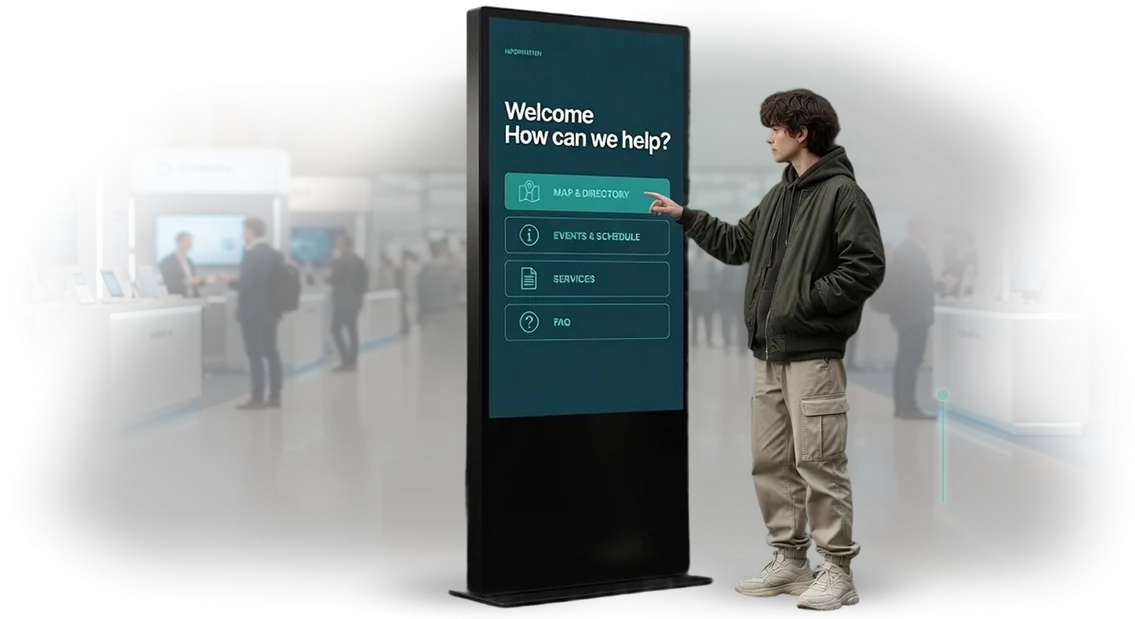
Buying an Interactive Touch Table: How to Make the Right Choice
Purchasing a touch table is a decision that needs to pay off every day: attract guests, hold their attention, and deliver new experiences.
But in practice, many customers choose based on pictures and the lowest cost, only to face freezes, inaccurate touch response, and a display that visitors simply walk past within a month. In the end, the budget is spent with no expected effect.
"We saved money on a 'simpler' model and got a table that couldn't even handle the evening rush.
Guests came up and touched it, but the screen couldn't keep up — within a couple of weeks the interactive feature was dead, and we had to change contractors," recalls the head of an exhibition space.
To avoid repeating this mistake, it's important to define your requirements for a touch table before purchasing: what space it will stand in, how many people will use it simultaneously, how many hours a day it will be on, and how long it should last.
It's reliability — not the thickness of the enclosure or a flashy presentation — that determines whether your interactive solution will work for years or fail in the middle of an event.
We are a team with ten years of experience creating interactive solutions. We help you choose the right interactive touch table for your specific task, stress-test the equipment, and guarantee stable operation.
You get not "hardware for the sake of hardware," but a tool that boosts guest engagement and brings them back again.
Why Digital Displays Boost Sales and Retain Customers
A digital display is a sales tool, not just a screen. It lets customers explore a product on their own: choose a color, review specifications, and submit a request.
This kind of interaction holds attention far longer than a static display and leads to purchases noticeably more often.
When people spend more time at a display, they remember the brand and products better. According to our estimates, interactive displays increase purchase conversion by 20–30% and raise the average ticket through additional items seen on the screen. This is a direct path to sales growth without extra advertising spend.
For Retail Stores
In a store, a digital display handles tasks a conventional one can't: shows a product that isn't on the shelf, suggests related items, and introduces promotions.
A customer leaves with a purchase even when the desired product is out of stock, and the desire to return for new arrivals grows — this is customer retention in action.
For Exhibitions and Museums
At exhibitions and museums, visitors want to explore exhibits on their own rather than hunt for a guide. A digital display gives them an interactive map, descriptions, videos, and other materials that immerse them in the brand's story. Staff are freed from routine tasks, and visitors remember the event and tell others about it.
Client Testimonial
"We installed interactive displays in our electronics showroom, and customers began spending three times as long at the stand. Nearly every third visitor asked about the new arrivals they saw on the screen.
A couple of months later, we ordered the same displays for our other locations," says the head of the ExpoTech chain.
Our team handles the entire cycle: scripting, design, sourcing reliable equipment, installation, and support. To buy an interactive touch table or order a digital display that boosts sales and retains customers, get in touch with us. We'll prepare a project estimate for your tasks and budget.
Digital Solution Formats for Your Task
When the question is "should I buy an interactive touch table or choose a kiosk?" the answer depends on the scenario. One format helps hold a visitor in the waiting area; another quickly provides information or takes an order.
We match the solution to your space, visitor flow, and task, so that every square meter of your space delivers value.
Touch Tables: For Collaborative Exploration and Presentations
A table is ideal where a visitor is willing to spend a few minutes: showrooms, museum exhibits, business center lobbies, clinic or car dealership waiting areas. Several people can gather around a table — this turns viewing into discussion and increases time spent with the brand. A great option for a product catalog, an interactive map, or a real estate presentation.
Interactive Kiosks: For Navigation and Self-Service
A kiosk solves a specific task: shows the way, finds a product, books a service, or processes a payment. It works well in high-traffic locations — stores, malls, airports, and government buildings.
People walk up, get an answer in 10–20 seconds, and move on, while your staff is freed from routine questions.
Format Comparison
| Format | Who It's For | What It Delivers to Customers |
|---|---|---|
| Touch table | Waiting areas, showrooms, exhibitions, training | Holds attention, engages groups, sets the brand apart |
| Interactive kiosk | Stores, malls, airports, government facilities | Speeds up service, relieves staff, works 24/7 |
Often the right solution is a combination: kiosks for quick tasks, a table for deeper exploration. We design and test the scenario at your site, then launch a turnkey solution.
Contact us — we'll help you choose a format that pays off and advise where and what kind of interactive solution to place.
How We Build a Digital Solution for Your Business
A clear process is the key to customer peace of mind. We've structured our work so you always know what stage the project is at and can see progress toward launching your digital display.
No "black boxes": every step is agreed upon, you receive clear materials, and you understand the timeline.
- Brief and objectives. We discuss goals, installation location, and the visitor profile. We determine how an interactive touch table should work for your business: attract attention, inform, help with choices, or increase the average ticket.
- Concept and scenario. We propose a content structure and interaction logic. You see how visitors will use the solution: what to tap, what to view, what actions to take.
- Design and layout approval. We create the visual style and adapt it to your brand. We show screen mockups and make revisions until full approval — no surprises at the finish.
- Production and assembly. We manufacture the enclosure, source reliable components, and assemble the device. We run testing to ensure the table operates stably under heavy visitor flow and intensive use.
- Launch and training. We install the unit at your site, configure the software, and load the content. We train your staff: how to update materials, add promotions, and change content without contacting developers.
- Support and development. We stay in touch after launch. We help with updates, refine features, and answer questions. You can count on a fast response whenever changes are needed.
This is what the turnkey ordering process looks like. You control every stage, understand what's happening, and receive a working solution exactly on the agreed schedule. Most importantly, you're never left alone with the technology: we support the project even after launch.
What's Included in Delivery and Why It's a Turnkey Solution
When you buy an interactive touch table, you get not just a device but a complete turnkey solution. We handle the entire journey — from manufacturing the enclosure to installation and staff training. There's no need to search for contractors or dig into technical details.
Standard Package
- A durable enclosure built for intensive use in public spaces — it withstands visitors and daily operation.
- A touch panel with preinstalled software and fine-tuned calibration — the table works right after power-on.
- Installation at your site: connection, configuration, and verification of all usage scenarios.
- Staff training: how to launch content, update materials, and resolve typical issues without calling an engineer.
- Warranty and technical support — for the entire service life, you're never left alone with potential issues.
Extended Package
For those who need more than the standard configuration: a custom enclosure design to match your interior, non-standard sizes, integration with your CRM or accounting system, and additional interaction scenarios — such as contact capture or file upload via USB.
This is why it's a turnkey solution, not a "box of hardware." You pay once and get a working customer attraction point: no hunting for installers, programmers, or designers. Launch time starts at two weeks, depending on the configuration. After that, the table runs on its own, and we remain available for updates and support.
Completed Project: Increased Attendance and Screen Time
Our client, the City History Museum, faced a typical problem: visitors walked through the permanent exhibit in 10 minutes, the exhibits didn't hold attention, and families with children ran through the hall diagonally.
The management wanted to reignite visitors' interest in history, but conventional stands and posters no longer worked.
We proposed an interactive display based on a touch table: guests could "bring to life" old maps, browse archival photos, and assemble a virtual collection of exhibits.
The project was delivered in six weeks — from brief to installation and content, including staff training. The results exceeded expectations.
Project Results
Exhibit attendance grew by 35% in the first quarter after launch. Average screen time doubled: instead of 1.5 minutes, guests now spend about three minutes at the display, and many return again — with friends or children.
The interactive table became the main attraction point of the hall: groups constantly gather around it, people discuss their discoveries and share impressions.
For the museum, this means deep immersion in the material and live feedback — visitors begin to take an interest in the exhibits on their own instead of simply walking past.
Client Testimonial
"We expected it to be interesting, but we didn't think visitors would start lining up. The display became the centerpiece of the exhibit for both children and adults. The team delivered everything on time and stayed in touch after launch, helping us update content. We're planning to order another zone," — museum director.
This case shows that interactive solutions pay off not only in shopping centers: a well-designed touch zone can turn a museum exhibit into a living space people want to return to.
How to Choose the Right Format for Your Task?
The choice between a touch table and a kiosk is not a question of technology but of interaction scenario. A kiosk is ideal for quick actions: the visitor walks up, finds what they need, places an order or books an appointment, and leaves.
A touch table works differently: it invites people to stay, explore the catalog, compare options, and examine details. So the first question to ask yourself is: how much time are you willing to give customers to get acquainted with your offering?
If your goal is to relieve the information desk and speed up service, choose a kiosk. It takes up little space, is easy to learn, and gives visitors instant results.
If you want to impress guests, engage them in exploring a product, or create a memorable experience — a touch table will be the stronger choice. It's convenient for showing maps, floor plans, 3D models, and comparing products in a few touches.
This is especially valuable where decisions aren't made in a minute but after inspection and discussion.
The deciding factors are the size of the space, visitor flow, and the business goal of the interactive element. In a narrow lobby with a constant queue, a kiosk is more practical.
In a spacious waiting area, showroom, or museum, a table gathers a group around it and turns waiting into productive time. Think about who your visitor is: if they're in a hurry — they need a kiosk; if they're ready to explore — a table.
Often a single interactive solution is enough, and choosing the right format determines whether a person will come back to your product.
The key is not to guess but to rely on the scenario. Our engineers will help determine the right format for your task, show the strengths of each option, and propose a solution that pays off. You'll get not just a device but a tool that works toward your business results.
Common Concerns: Answers to Questions Before Ordering
Before ordering an interactive touch table, every manager has practical questions: will the equipment break, how quickly can it be launched, who will maintain it. That's normal — you're investing a budget and want a predictable result. We answer the typical concerns so your decision is an easy one.
What warranty do you provide?
The equipment and installation come with an official warranty, documented in the contract. If a fault occurs, we'll replace the part or fix the issue free of charge. No unexpected costs.
What happens if the touch table breaks down?
You call us — an engineer performs diagnostics remotely or on-site. The issue is usually resolved within one business day. You don't need to look for third-party technicians.
How long does launch take?
For a standard project — two to four weeks from the start. We produce the equipment, prepare the design and content, then install and configure. The schedule is fixed in the contract.
Does the table need maintenance after launch?
If you wish, we sign a service agreement for regular support: preventive maintenance, content updates on the screens, and replacement of consumables. You run your business, not technical routine.
Still have questions? Write to us — we'll give you timeline and warranty guidance for your task.Ready to Launch a Digital Space? Submit a Request
Submit a request, and by the next day you'll know the cost of an interactive touch table for your task, what it will look like, and when it can be launched.
You don't need to prepare a technical specification or understand the details: our engineers will have a short consultation and prepare an estimate for your budget.
We work with companies across industries — from retail and restaurants to museums and exhibition stands. So our estimate will factor in not only the equipment cost but also its placement, interface design, and delivery timelines. All of this is included in the estimate, with no obligation.
After you reach out, you'll receive:
- A cost estimate for your budget — transparent, with no hidden payments;
- An interface mockup — a clear view of how your content will look on screen;
- A launch plan — stages, timeline, and your team's workload;
- An engineer consultation — help choosing the table model and materials for your space;
- A warranty and contract — officially confirmed pricing and commitments;
- A solution demonstration — shown on a real project or in our showroom.
All that's left is to send your request. After a brief conversation with an engineer, you'll have all the documents and understand how to launch a digital space within the coming weeks.
It will take no more than 10 minutes, and from there you'll move forward with a clear plan and an accurate estimate.