

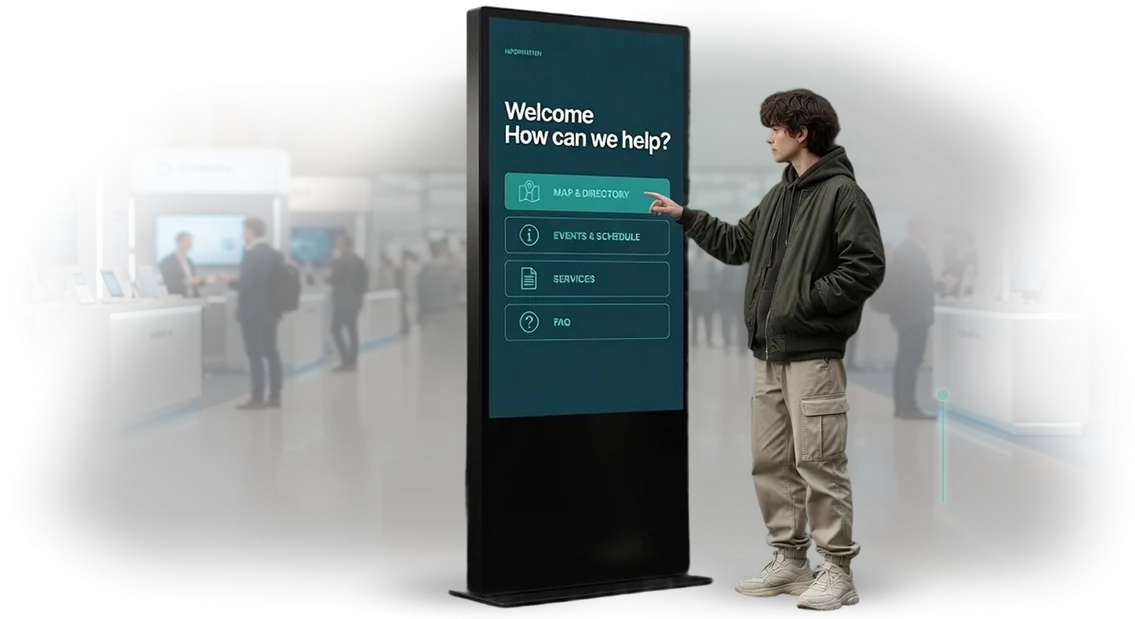
Interactive Table OKOF Code: How to Avoid Unnecessary Expenses When Ordering
When a customer searches for “interactive table OKOF code,” they need more than just a classification code for accounting. They need a clear answer: how much the equipment costs, how to register it, and how to avoid overpaying.
A mistake in the code or in the ordering approach leads to extra expenses — from uncomfortable questions during inspections to costs for reworking an already installed kiosk.
Most often, the project budget grows because of three things. The first is ordering “blind”: choosing a configuration without accounting for the actual load in the space, and then a few months later the screen can no longer handle the visitor flow.
The second is poorly planned content: the content is ordered separately from the equipment, and integrating it turns into additional development hours and unexpected payments.
The third is forgetting about installation, setup, and staff training — without them, the kiosk does not work at full capacity.
We eliminate these risks before the project even starts. Our engineers help select a configuration for your tasks and location specifics, and include installation, setup, and post-launch support in the estimate.
You get an interactive table turnkey with a transparent budget and a properly assigned OKOF code for accounting — without surprises or hidden surcharges.
A transparent estimate means saving 15–30% of the typical budget for such projects. Instead of paying extra for reworks, you immediately put only what you really need for your task into the budget.
As a result, the kiosk pays for itself faster: it attracts visitors, reduces the workload on staff, and runs stably throughout its entire service life.
Your Benefits When Ordering a Turnkey Solution
An interactive table turnkey is not just “one more screen” — it is a working tool that delivers measurable results: more time at the display, more consultations, more sales.
We handle the entire cycle — from idea and design to installation and staff training — so you get a solution, not a headache.
The main benefit is visitor engagement. Interactivity holds attention 3–5 times longer than a static display or a regular stand. Visitors explore products on their own, compare options, search for the information they need — and they do it with interest, not by force.
An engaged visitor is more likely to make a purchase decision right in the showroom, which means a higher average check and more repeat visits.
The second noticeable benefit is staff savings. The interactive table handles typical questions: where the product is, what the price is, what promotions are active, how to place an order.
Consultants stop repeating the same thing ten times and focus on real deals and complex requests. As a result, you reduce the workload on your employees or redirect their efforts to where they generate more revenue.
The third benefit is updatable content. Prices, promotions, new arrivals, and seasonal offers change within minutes, without printing houses or reordering structures.
You always show up-to-date information, and updates are launched remotely — flexibility that printed materials do not have. All this makes the interactive table not a one-time investment but a long-term sales channel that pays off and keeps working for you every day.
Interactive Device Formats for Your Task
The right format determines how the device fits into the space and which business tasks it covers. A kiosk, a table, and a touch panel solve different problems: from reducing staff workload to creating an impressive presentation area.
| Format | Who it is for | What it gives the customer |
|---|---|---|
| Interactive kiosk | Shopping malls, clinics, government institutions, fast food restaurants | Reduces the workload on staff, speeds up service, works in self-service mode |
| Interactive table | Showrooms, exhibition stands, museums, meeting areas | Attracts attention, holds visitors, creates a “wow” effect and increases brand awareness |
| Touch panel | Information desks, lobbies, product catalogs | Compact, always at hand, quickly provides the needed information — navigation, service descriptions, promotions |
We select the format for your task, space, and audience. If you are not sure which option is more effective, our engineers will help you decide at the brief stage and propose a solution that will pay off from the first weeks of use.
How We Develop a Turnkey Solution: Work Stages
We work transparently: at every stage you know what is happening and what comes next. No “magic” — all steps are agreed upon, timelines are fixed, and the result is visible before launch.
-
Brief and immersion. We find out how the kiosk will fit into your business: where it will stand, who will use it, and what task it will solve. This helps avoid spending the budget on unnecessary things.
-
Concept and prototype. We show the screen structure and user scenarios, and create a design mockup. You make edits before development starts — this is cheaper and faster.
-
Approval and plan. We fix the scope of work, timelines, and cost without hidden surcharges. You approve the plan and know exactly when the solution will be ready.
-
Development and assembly. We create the interface and software, while simultaneously preparing the enclosure and equipment. If necessary, we integrate the kiosk with your accounting system.
-
Testing and debugging. We check the operation on real scenarios: failures, non-standard actions, peak loads. By launch, the kiosk runs stably.
-
Launch and training. We install the kiosk at your site, configure it, and train your employees. We hand over instructions and all access.
-
Support and development. After launch, we stay in touch: update content, refine functions, and monitor stability. One contractor is responsible for the result — this is what turnkey work means.
This approach makes timelines predictable and avoids surprises on the last mile. You order development once and get a ready, working kiosk.
What You Get in a Ready Solution
A ready solution is not just equipment delivery, but a fully working information kiosk “turnkey.” You pay once and get a complete package: hardware, software, installation, setup, staff training, and warranty.
There are no hidden payments — the price is fixed in the contract and does not change during the project.
What is included in the price:
- Turnkey delivery. We bring, install, connect, and check the kiosk’s operation at your site. You do not deal with logistics or technical issues.
- Software with a license. Interface, content management system, integration with your data — everything is configured and ready to use.
- Installation and setup. Engineers will secure the enclosure, connect power and network, adjust the touch panel’s operation, and check stability.
- Staff training. We conduct training for employees: they will learn how to start the device, change content, and solve simple issues without calling a specialist.
- Warranty and support. We provide an official warranty for the equipment and the work. If any malfunction occurs, our engineers go to the site, repair or replace the hardware.
- Updates and development. We regularly update the software and add new functions so that the kiosk remains relevant in a year and in five years.
As a result, you get a working kiosk from day one — with a full package of documents and a clear instruction manual. All you have to do is upload content and benefit from the device.
Case Study: How We Doubled Visitor Engagement
A museum called “Kvantum” approached us — a venue with a large visitor flow but almost zero engagement. Guests would look at the exhibits for 30 seconds and leave, and tour guides did not have time to cover even half of the material.
The problem was not the value of the exhibits, but the static presentation: information needs to be absorbed at your own pace, not read from a sign on the wall.
We suggested replacing several stands with an interactive table. We placed part of the permanent exhibition on it in a game format: an exhibit can be “taken apart” into layers, its mechanics seen in action, and quiz questions answered.
The control is intuitive without instructions — suitable for children and adults, and the museum did not need to change its concept or hire new employees.
The result was measurable within the first month. The average time at the area increased from 1 minute to 4–5 minutes, and the share of visitors who used the table doubled.
Guests began filming the process and posting videos on social media — over the month, free mentions of the museum reached an audience of 50,000 people, even though no advertising budget was allocated.
For the museum, this means living exhibitions and more repeat visits: 40% of those surveyed said they would return to try “that table.” While visitors wait in line for the table, they also stop by the café and the souvenir kiosk — the average check per visitor increased 1.5 times.
Development took 4 weeks, we took over support, and the customer received a working interactive table — the OKOF code for putting it on the balance sheet was included in the document package.
The same format works for stores and exhibitions: tell us about your site, and we will prepare a solution for your budget.
How to Choose a Device Format for Your Task
The device format is chosen not from a catalog, but according to the business task. If a visitor needs to quickly get information, find an office, or order a service — a vertical kiosk with a touch screen is enough.
If the point is to keep the visitor longer, show a product in detail, and allow them to explore a map, catalog, or complex diagram — an interactive table will be more effective.
When selecting, it is important to consider how people will approach the device. In a high-traffic area, a kiosk allows you to serve the queue without creating bottlenecks.
A table requires free space around it: visitors gather around it, explore content together, and connect their own devices. So first define the scenario: a quick answer or an engaging introduction to the material. This affects the screen size, the interface, and the content.
Equally important are the specific requirements of the space and operating conditions. An outdoor installation requires a protected enclosure, a children’s space requires safe corners and impact-resistant coating, and a showroom requires a solution that fits the interior.
If this is not taken into account at the selection stage, the device may turn out to be fragile, unsuitable for the climate, or simply inconvenient for staff.
Once the format is defined, the question of equipment accounting remains. An interactive table, like a kiosk, needs a correct OKOF code so that the asset can be added to the balance sheet without unnecessary questions.
We support the client all the way to commissioning: we help with classification, documents, and staff training.
We select interactivity based on your metrics — reach, time spent with content, repeat visits. Visit our demonstration hall or order an online consultation: using a specific task, we will show which format will deliver results and which one is better to avoid.
Frequently Asked Questions About Development
Before a project starts, customers always have the same key questions: how long development will take, what warranties are available, and what will happen to the interactive table after launch.
We have collected answers to the most important ones so that you understand the terms before signing the contract and do not worry about the details.
How long does interactive table development take?
The usual time is two to four weeks, depending on the amount of content, the number of integrations, and the design. At the brief stage, we set a precise schedule and checkpoints so that you can see progress at every step.
What is the warranty on equipment and work?
We offer a warranty on the interactive panel and software — 12 months by default. During this period, we fix any issues free of charge. After the warranty expires, you can sign a regular maintenance contract and extend the device’s service life.
What happens after launch?
After launch, we train your employees, hand over instructions, and remain available for consultations. If you need to update content, add functions, or integrate the kiosk with other systems, we will arrange that under a separate support agreement.
Which OKOF code should I use for an interactive table?
An interactive table belongs to the group “Household electronic equipment” (for example, code 330.28.23.23).
After clarifying the specifications, our engineers will advise the exact OKOF code and prepare the document list for your accounting department — this will save you from unnecessary questions during asset registration.
If you still have doubts, just write to us. We will explain how the project will look at each stage, help you choose the optimal format for your tasks and budget, and stay in touch after launch to keep the device running stably and delivering value.Order Development and Get a Ready Tool for Your Business
Tell us about your task — and we will offer a solution that works for your revenue and customer convenience. We start with a consultation: we will analyze where an interactive table will deliver the most value and help you decide on the format and scenarios.
After ordering, you will receive:
- A ready business tool — an interactive table that solves a specific task: navigation, product presentation, service catalog, visitor entertainment.
- A clear cost and timeline estimate before work begins — we agree on the budget and stages so there are no hidden surcharges or surprises.
- An interface in your brand style — customers immediately recognize your company and easily understand how to use it.
- Turnkey launch — we will configure the equipment, upload content, test performance, and train your employees.
- Updates and support — content can be changed for promotions and seasons, and we remain available after launch.
- Clear statistics — you will see which scenarios are in demand and improve your service in time.
Leave a request on the website — in response, we will send you a cost estimate and propose a time for a consultation. This way, you get a ready solution without extra calls and waiting: we will discuss the details, set the timeline, and get to work.