

Interactive table in the library: how to bring back visitors' interest
Libraries today compete not only with digital services but also with a huge amount of entertainment available in a couple of clicks.
The traditional "book lending" format no longer holds visitors' attention, and every year it becomes harder to attract both children and adults to the library.
At the same time, the library has every chance of becoming a modern public space — you just need to offer guests a different experience that cannot be recreated at home with a tablet.
An interactive table for a library is exactly that kind of tool. It combines access to the electronic catalog, multimedia materials, quizzes, and building navigation, turning an ordinary visit into a live exploration.
Visitors can explore rare books digitally, view maps and illustrations, and take part in quests — without feeling like they are being "given a lesson." The result is obvious: people stay longer, come back again, and bring friends.
Introducing new technology in a library is not just modernization for show. It is a way to reset the institution's image in the eyes of the local community, increase reach among schoolchildren and students, and become a venue for family leisure.
A library with an interactive table is perceived as a progressive knowledge center rather than a storehouse of dusty tomes. For management, this also brings clear numbers: growth in visitor numbers, longer visit times, and new user groups that did not come before.
Modernizing a library with such a solution does not require major renovation or a huge budget.
The key is to choose the right usage scenarios for the age of visitors and the library's goals, integrate the table into the existing collection and navigation, and ensure reliable operation without constant staff involvement.
We help make this happen carefully and quickly: we design interfaces that are clear to visitors of all ages, fill the system with your content, and train your staff.
From declining attendance to a lively library hall, there is just one step — a properly organized interactive space.
We are ready to take it with you: from the idea and scenario selection to installation, launch, and support, so that library modernization delivers measurable results within the first few months.
What benefits the interactive table brings
An interactive table in a library is not a tribute to fashion but a working tool that changes the rules of the game. Visitors no longer get lost in the halls: they find the right department themselves, check the event calendar, and explore the electronic catalog.
For staff, this is a noticeable reduction in workload, and for the library, it is a chance to present itself as a modern knowledge center.
The main advantage is convenience for visitors. A touchscreen is clear to both a schoolchild and a retiree and requires no instructions. Guests receive information instantly rather than waiting for a librarian's help. This increases satisfaction and creates a positive visiting experience.
The second benefit is greater engagement. People are more willing to interact with interactive materials: they browse virtual exhibitions, take part in quizzes, and leave feedback.
The library gains an active audience, the time spent on site increases, and events are promoted more effectively.
We have already implemented such a project in one city library. Its head shared the results: "Over the first quarter, the number of visitors who independently used the navigation doubled, and a third more guests came to events announced through the table. Central City Library."
An interactive table pays off not only in direct terms but also through reputation growth. After implementation, the library is perceived as a modern space that attracts young people and families. We adapt the solution to your tasks and content so that you get exactly the effect you need.
Formats and implementation options
An interactive table is not a single universal device but a flexible solution that adapts to the space and the use case.
Interactive table formats differ by purpose: for museums — floor-standing models with a large touch area; for schools — mobile stands that move between classrooms; for lobbies or libraries — built-in tables that take up no extra space.
Here are the main form factors:
| Format | Who it is for | What it gives the client |
|---|---|---|
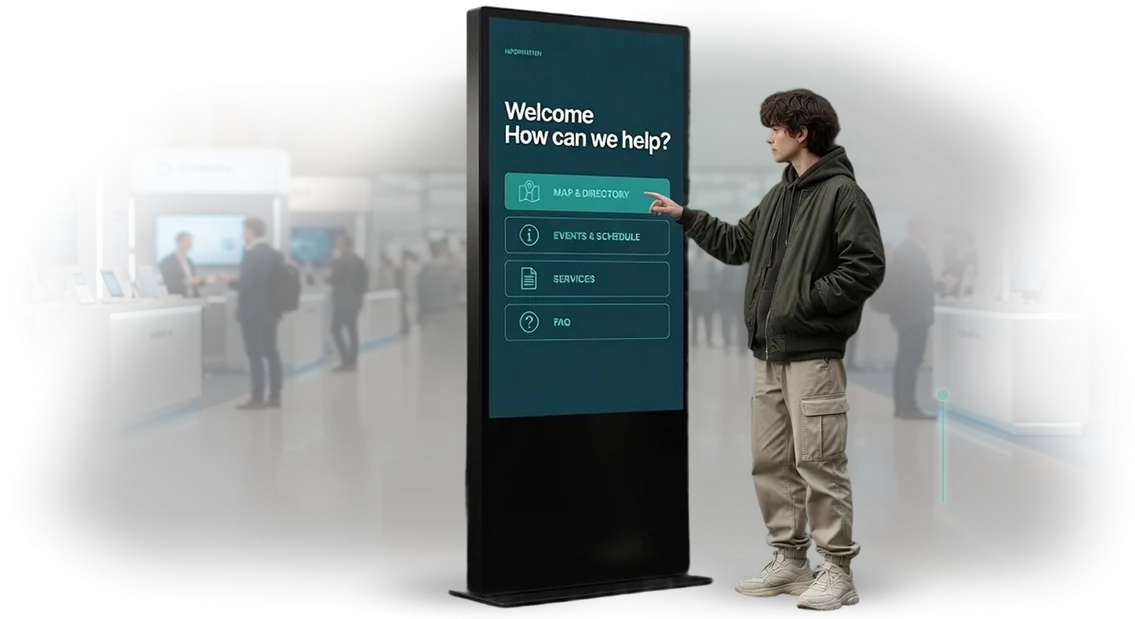
| Floor-standing | Museums, exhibition halls, public spaces | Gathers groups of visitors around it and becomes a point of attraction; convenient for tactile exhibits and quizzes |
| Built-in (tabletop) | Libraries, schools, meeting rooms | Fits compactly into furniture and creates no barrier — users approach easily and explore material on their own |
| Mobile | Schools, temporary exhibitions, events | One table replaces several stationary ones: it can be moved between classrooms and halls, and the scenario can be changed quickly |
| Wall-mounted | Narrow lobbies, corridors, information areas | Saves floor space and remains accessible to visitors of different heights — good for navigation, schedules, and event boards |
The format directly affects visitor reach, launch time, and budget. We will suggest an option for your floor area, number of guests, and goal — from a single quiz to a permanent exhibition.
Tell us about your task, and our engineers will prepare an implementation option with a cost estimate and work schedule.
How the project work proceeds
We have structured the process so that you understand what is happening at each stage and when you will get the result. Below are the stages of developing an interactive table for a library.
Based on our experience with implementations of different scales, from district to national libraries — for example, in the city library — this approach reduces approval time and resolves questions before the start.
- Brief and discovery. We discuss the library's goals: who will use the table and which scenarios are needed — from navigation to quizzes. Based on this, we propose a concept and a preliminary estimate.
- Prototype and approval. We present a mockup of the interface and the operating logic for approval. You see what the screen will look like and can make edits before development begins — this saves time and budget.
- Development and assembly. Our engineers create the design system, program the scenarios, and assemble the enclosure. We use professional components that withstand intensive use in a public space.
- Testing. We check operation under real conditions: touch resistance, font readability, and behavior with large numbers of visitors. You receive a tested solution, not a "raw" product.
- Launch, training, and support. We deliver, install, configure, and train the staff. We provide clear instructions — your team will be able to update content without programmers. If needed, we connect technical support and regular content updates.
Implementation time depends on the complexity of the scenarios: from two weeks to a month and a half. To order an interactive table, simply leave a request — we will conduct a brief and come back with a solution for your task. And after launch, we stay in touch: rest assured, the project will not be left without support.
What the project includes
The project is not just a touch table. We put together a turnkey solution so that you do not have to assemble it from parts supplied by different contractors. One contract — and you get working equipment ready to use from day one.
The project includes:
- Interactive table hardware — we select the model according to room size, visitor numbers, and tasks: from standard models to large panels with impact-resistant glass.
- Installation and connection — our engineers deliver, install, and connect the table and verify all operating scenarios.
- Software and interface — we configure the system, upload your content, and create a convenient and clear interface for visitors.
- Design and branding — we style the screens to match the library's design so the table fits organically into the space.
- Staff training — we conduct a practical session: how to use the table, update materials, and handle common situations.
- Instructions and reference guides — we prepare a set of documents for staff and visitors, including surface-care rules.
- Warranty and technical support — we provide a warranty on hardware and software and offer remote assistance throughout the warranty period.
The cost already includes all work and materials: equipment, delivery, installation, configuration, and training. No hidden payments. If you later need to add functions or replace content, you can contact us separately, but no additional payments will be required at the start.
Case study: how we increased attendance
For one city library, we created an interactive table that turned an ordinary lobby into a point of attraction. Previously, visitors walked past the shelves without stopping; now they are greeted at the entrance by a live map of the collection, quizzes, and hall navigation. Here is what changed in the first months of operation.
Implementation results
Just a month after launch, the library reported a one-third increase in attendance. The interactive table became the most photographed spot: guests take pictures and tag the library on social media — this generated free reach of several thousand people.
The average time at the table is 5–7 minutes; during that time, visitors manage to find the book they need, learn about events, and submit a request for a library card.
Library staff gained a convenient tool: they can update content themselves, add event listings and collections, without contacting developers.
The administrator notes that the number of "where can I find…" questions has decreased, while event registrations have grown by 40%. We still support the project — refreshing the content and monitoring stable operation.
Client testimonial
The director of the Central City Library shared her impression: "We expected a beautiful showcase, but we got a full-fledged assistant. Visitors approach the table on their own, children draw on it, parents search for books — it has brought the space to life. Special thanks for letting us easily change content without programmers."
After the successful launch, the library ordered a second interactive table from us for the children's department. The project became an example of how modern equipment pays off not in money but in visitor attention and reputation.
How to choose the right format for your task?
To avoid making the wrong choice, start not with price or appearance but with the question: what task should the interactive table in the library solve — navigation, educational content, children's leisure, or presenting the collection?
The answer immediately determines the format selection: a stationary model for the lobby, a compact cabinet near the shelves, or a mobile option that moves between halls.
This determines how many visitors can use the device simultaneously, how well it fits into the layout, and what budget is justified.
Simple selection advice comes down to three parameters: the number of simultaneous users, the floor area available, and the type of content. If several people will work at the table, choose a large surface with multiple touch points.
A compact enclosure suits a narrow lobby, while a stable and safe structure is better for a children's room. Do not chase screen size: look at real usage scenarios, otherwise you will overpay for features that visitors will not use.
A common mistake is buying a device without thinking through the content in advance. An interactive table in a library comes alive when it has quizzes, maps, an electronic catalog, or multimedia exhibits.
That is why we recommend ordering an interactive table turnkey: together with the hardware, you get an interface, preinstalled scenarios, and the ability to update content without involving a programmer. This removes the main risk — that an expensive table turns into an ordinary screen and sits unused.
How to choose an interactive table for good? Draw up a technical specification with our engineers: describe the visitor flow, the floor area, and the desired outcome — they will suggest the right format, calculate the load, and show the economics of the solution.
We handle delivery, installation, and configuration, train the library staff, and remain available for support after launch. As a result, you get not just a device but a working tool that increases readers' interest and helps them find the information they need faster.
Frequently asked questions about project implementation
Before introducing an interactive table in a library, clients most often ask the same questions: who will maintain the equipment, how breakdowns are handled, and what happens if the technology fails during an event.
These are normal concerns — how they are addressed determines whether you will work with the project comfortably every day.
Below are answers to typical questions. We deliberately avoid technical details — here is only what affects your confidence in the project.
What happens if the interactive table breaks down?
All equipment is covered by warranty: during the warranty period, we repair or replace faulty components free of charge. If the problem cannot be solved remotely, we deliver a backup table for the duration of the repair — library operations do not stop.
Will it be difficult for library staff to learn how to use the table?
No. We train your staff at launch: we show how to turn the table on, change content, and resolve common issues. The interface is designed so that any librarian can learn it within a day, even without technical experience.
Is special maintenance required after installation?
Basic care is enough: wipe the screen and restart the table periodically. We take care of the rest — our engineers remotely monitor system health and alert you to potential issues before they affect operation.
How quickly do you respond to a fault report?
Within a business day. First we try to resolve the issue remotely; if that does not work, we send a technician or begin the equipment replacement process.
The average recovery time is one to two days, and when a backup table is available, visitors will not notice the outage at all.
Will we be able to change the table's content ourselves?
Yes, a simple administrative panel is provided for this. You can update the event board, library news, quizzes, and navigation yourself, without involving programmers.
We train staff and provide instructions, so each new piece of content appears on the table in a couple of minutes.
If you have a question not listed here, ask us directly. We will look into your situation in detail and prepare an answer tailored to your library's specifics.Discuss the project and get a cost estimate
Every library has its own goals: one needs an interactive table for children and teenagers, another for collection navigation or displaying rare editions. We take this into account and prepare an estimate individually for your request, not according to a template.
Leave a request for a consultation — and within one business day you will receive:
- A cost estimate for an interactive table based on your task and budget, with no hidden surcharges;
- Configuration options: size, touch panel type, enclosure, and design to match the library's interior;
- Production and installation timeline estimates that account for your schedule;
- Examples of completed projects in libraries and cultural spaces;
- Content recommendations: which formats and applications work best for your audience;
- A clear step-by-step plan: from contract to launch and staff training.
An interactive table in a library is not just a "screen on a stand" but a tool that attracts new visitors, holds children's attention, and increases the library's recognition as a modern space. That is why we approach the estimate as a project, not as the sale of a ready-made device.
No technical brief is required for the estimate: a short description of the space, the number of visitors, and your goals is enough. Fill out the form or write to us via messenger — we will respond within one business day.
You can order an interactive table with a precise cost estimate and a clear implementation plan in one step: leave a request, and we will contact you.