

Interactive Touch Table for Children: The Cost of Losing Customers
Imagine a family with a child at your venue: while the parents study the menu or go shopping, the child quickly loses interest and starts acting up. Instead of a calm 30-40 minutes, you get guests walking out and a spoiled impression. This situation repeats every day, and each time it happens, it's lost money.
The cost of this scenario is higher than it seems. A dissatisfied guest won't come back and won't bring friends. Word of mouth and reviews work against you, and repeat visits generate up to 60-70% of revenue.
The bottom line: skipping interactive solutions for children's areas costs more than a touch table, whose price is known in advance.
An interactive table for children changes this picture. The child is absorbed in play, the parents calmly take care of their business, and you get grateful guests who want to return.
Children themselves ask their parents to come back — that's free advertising and growing family loyalty.
Developing an interactive table for your specific needs — with your brand identity, favorite games, and scenarios — sets your venue apart from competitors.
We help you choose the format and calculate the payback: the investment is recovered through repeat visits and a higher average check. Without live interactivity, you lose the attention and money of guests who are already in your hands.
What an Interactive Table Delivers: Children's Delight and Sales Growth
Children's Emotions and Delight
An interactive table turns waiting into a game. The child creates pictures, solves puzzles, and interacts with animation — this brings genuine delight. Parents see their child's smile and associate it with the place they came to.
This kind of experience is remembered on an emotional level. The next time, the child will ask to come to you, not to your competitors.
More Time at Your Venue
While the child is engaged, parents calmly choose from the menu, talk, or shop. The average guest stay time increases noticeably. And the longer a guest stays, the higher the chance they'll order dessert, a second cup of coffee, or an additional service.
This is especially important for cafés, clinics, salons, and stores with children's zones.
Recognition and a Reason to Return
An unusual table becomes a local landmark. Parents photograph their children playing and post the photos on social media — that's how new visitors learn about you. Word of mouth and guest posts work as free advertising.
The table can be customized to your brand: logo, characters, and corporate colors. Then every game reinforces recognition and increases foot traffic.
Upselling Without Being Pushy
Ads for new menu items or coupons for the next visit can easily be built into the game scenario. The child gets a task from a hero — find the hidden ingredient — and the parent receives an offer to try that dish. Sales grow without pressuring the guest.
This format increases the average check and customer loyalty.
Touch Table Formats: From Compact to Interactive
The choice of format directly affects the usage scenario: who will use the table, how much space it will take up, and what reaction it will evoke from guests. The wrong format can "kill" even excellent content — visitors will simply walk past.
We select the configuration for your specific task: for children's zones, museum exhibits, showrooms, or public spaces. Below is a comparison of popular formats so you can understand which option solves your task and what results it delivers in practice.
Which Format Solves Your Task?
| Format | For whom | What it gives the client |
|---|---|---|
| Tabletop | Exhibition halls, cafés, waiting areas | Compact placement, two or three people can work with content at once, natural user posture — suitable for browsing catalogs and educational programs |
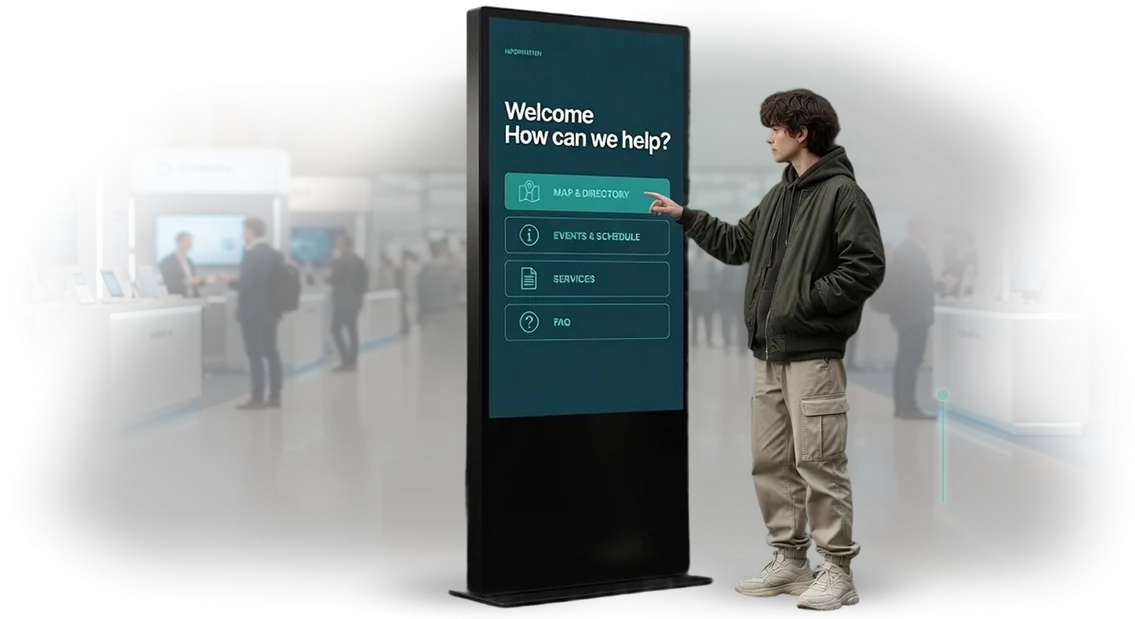
| Floor-standing | Children's spaces, shopping centers, educational centers | Play through movement and involvement of several participants, gathers children's attention, creates a "living" attraction zone |
| Corner | Museums, showrooms, non-standard interiors | Efficient use of space, the visitor route goes around the object, clear zoning and panoramic presentation of content |
A format is not just the "housing" — it's the scenario of interaction with your audience. Send us the floor area and the key task — we'll recommend an option that delivers the required foot traffic and engagement, without overpaying for unnecessary features.
How the Project Works: From Brief to Launch and Support
We start with a brief, not with "browse our catalog." It's important for us to understand where the table will be placed, who will work with it, and what task it solves: entertainment, education, navigation, or all at once.
Based on this, we design the scenario, interface, and construction so the equipment doesn't gather dust in a corner but genuinely engages children and brings value to you.
Development timelines are fixed in the contract before we even start. You don't have to guess when the project will be ready — you see the launch date and intermediate checkpoints at every stage.
Stages of Creating an Interactive Table
-
Brief and immersion. We discuss the tasks, target audience, installation location, and budget. We define expectations for functionality and design.
-
Scenario and design development. We develop the concept, draw a screen prototype, and create a visual style for your brand. You see what the table will look like before production begins.
-
Technical solution approval. We select the housing, size, materials, and mounting for your space. We take into account active use by children, safety, and resistance to heavy loads.
-
Content development. We create games, educational modules, and animations. We configure the operating logic, the ability to update content, and the option to add new scenarios after launch.
-
Assembly and debugging. We manufacture the table, install the software, and test all touch responses and long-running operation. We verify the device works stably in an office, shopping center, or museum environment.
-
Installation, training, and launch. We deliver, install on-site, and connect everything. We train your staff on the basics: powering on, changing content, calibration. We hand the project over for operation.
-
Service support. We stay in touch after launch: warranty service, content updates, consultations, and help if anything needs refinement.
To order a touch table with a clear result and no surprises, simply leave a request. We'll conduct a brief, propose a solution for your budget, and show what the project will look like at every stage.
What's Included in the Delivery: A Complete Package for Your Venue
When you buy a touch table for a children's area, you get not just equipment but a ready-made point of attraction for children and parents. That's why the complete package is included in the price from the start: from the stand to content and staff training.
You won't have to buy "little extras" or figure out complex settings — after installation, the table works, and your staff knows how to use it.
The interactive table package includes:
- Stand and touch panel — a sturdy housing designed for active use by children, protected against impacts, moisture, and scratches.
- Ready-made interface — an on-screen menu with games, quizzes, and educational programs configured for the age of your visitors.
- Educational content — a package of materials for children: tasks for logic, memory, and creativity. You can update and add new games at any time.
- Documents and instructions — acts, warranty card, and user manual: a complete package for your accounting team and staff.
- Staff training — a quick setup and demonstration: your administrators will learn how to turn the table on, change content, and resolve common issues without calling an engineer.
- Service support — warranty on equipment, remote support, and fast repair when needed.
This approach removes the client's main fear: "we bought an expensive toy and it's gathering dust." Everything needed for launch is included in the price — you pay once and get a working zone that attracts visitors and pays off through increased time spent at the venue.
Case Study: Interactive Table Doubled the Time Families Spent
In a regional history museum, children walked through the exhibition in 25 minutes, and parents complained they had "seen everything." Family visitors didn't linger: the souvenir shop and café stood idle, and the museum lost part of its revenue.
We proposed installing an interactive touch table for children — not as entertainment, but as a way to hold attention and connect exhibits with play.
Living History Museum — the interactive table was deployed in three weeks. Three game programs were installed on the table: artifact exploration, route building, and a quiz with augmented images. Adults got involved no less than children: the tasks required joint decisions.
Results for the Museum
The average time a family spent at the museum grew from 25 to 52 minutes — double. In two hours, the table hosted 60+ game sessions, and nearly 40% of families made a repeat visit within the next six months. The café and children's zones received additional traffic: weekday traffic rose by a third.
This interactive table case is a clear example: the price of the device is not an expense but an investment in foot traffic. Payback is achieved within a few months through a higher average check and recommendations.
The key is getting a ready-made scenario built into the exhibition rather than overpaying for equipment.
We support the project after launch: we update content and add seasonal tasks. A couple of months later, the museum ordered another program for the neighboring hall — which confirms the value of the result in practice.
How to Choose a Touch Table Format and Find Out the Cost?
We select a touch table format not from a catalog, but based on your goals: who will use it, which space the table will be in, and what result you need — holding attention, educating, entertaining, or collecting contacts.
Both the configuration and the price depend on the answers to these questions. That's why at the first stage we ask a few clarifying questions and then offer two or three options — from basic to expanded — so you can see the difference in features and budget.
The price of a touch table is made up of the screen size, housing, number of game scenes, and content complexity. Importantly, most of the cost is the software, and it can be scaled: you can launch the table with one or two key games first and add new ones later.
This approach lets you fit the interactive solution into your budget without losing quality and without paying for features that won't be used.
So you don't overpay, we offer only the functionality that genuinely works toward your goal. For example, a children's entertainment center needs a simple, bright interface with three games, while a museum needs deeper educational scenarios.
We show the cost of each block separately: housing, screen, content, and installation. This way you know what you're paying for and can drop anything unnecessary before work begins.
After a short brief, we prepare a calculation with a fixed price and a description of what's included within one or two days. If the budget is limited, we'll propose a phased rollout: one table first, then scaling.
In the end, you get a solution that solves your task and a transparent estimate — without hidden surcharges or imposed options.
Frequently Asked Questions Before Ordering an Interactive Table
Before ordering a touch table for children, every manager asks the same questions: how long will it take, what about the warranty and repairs, and will the staff be able to change content themselves. Let's go through the typical doubts — briefly and to the point.
How long does manufacturing and installation take?
The standard timeframe is 7 to 14 business days from mockup approval. This includes production, content loading, and delivery within the city. If you need a simple table without custom design, we can deliver faster.
For large projects with multiple zones, we develop an individual schedule, but it is always fixed in the contract. You know the exact dates from day one and don't have to guess when you'll open.
What is the warranty on the equipment and what does it cover?
We provide an official 12-month warranty on all hardware and the touch panel. If the table stops working due to our fault, we will repair or replace it for free within a few days.
The warranty is not just "on paper": we have our own service department and a stock of spare parts. For branch networks, we offer an extended 2-3 year contract — this removes the risk of sudden repair expenses.
Will the table break in a children's center? Is it hard to repair?
The design is built for daily intensive use: impact-resistant glass, a moisture-protected housing, and anti-vandal elements. We design tables specifically for children's spaces, so an accidentally dropped toy or active play is not a reason for a breakdown.
If a problem does come up, just call us. We'll help resolve 80% of content-related issues remotely, and for hardware faults, our engineer will come to you. Parents and staff don't need to handle the tech themselves.
Can we update content on our own?
Yes. We set up a simple control panel that lets you change games, images, announcements, and schedules in a couple of minutes. Your employee only needs to know how to use a tablet — no programmer required.
Changes are published immediately across all tables in your network. This is convenient for seasonal promotions, new menus, or educational programs. If you'd like, we can also handle updates ourselves — we'll fix the terms in the contract.
The question "how much does an interactive table for children cost" is answered after a short briefing: the final price depends on size, housing, number of game scenarios, and order volume. Send us a description of your venue — we'll calculate the cost and timeline within one business day.Order a Touch Table for Your Needs — Let's Discuss the Details
A touch table is a tool that works toward your goal: it holds children's attention, simplifies navigation, and makes the exhibition interactive. But for it to truly pay off, the format and content need to be selected correctly.
We help you do this before development begins — without "unnecessary options" and unclear expenses.
After submitting your request, you'll receive:
- A cost calculation for a touch table tailored to your needs: from the basic configuration to the expanded one — you see the price for a specific configuration.
- Consultation on the format: size, placement, and usage scenarios — matched to your visitors and space.
- Content selection: educational games, interactive tasks, a product catalog, or a presentation — matched to your project's goal.
- An implementation plan: timelines, stages, and areas of responsibility — you understand what happens at every step.
- A commercial proposal with clear terms — ready to be sent for approval.
- Support after launch: content updates, feature enhancements, and technical maintenance.
To order a touch table or simply discuss an idea, leave a request on the website — we'll get in touch within one business day, ask clarifying questions, and prepare an estimate.
This doesn't obligate you in any way: you'll receive a consultation and a commercial proposal, and the decision will be yours.