

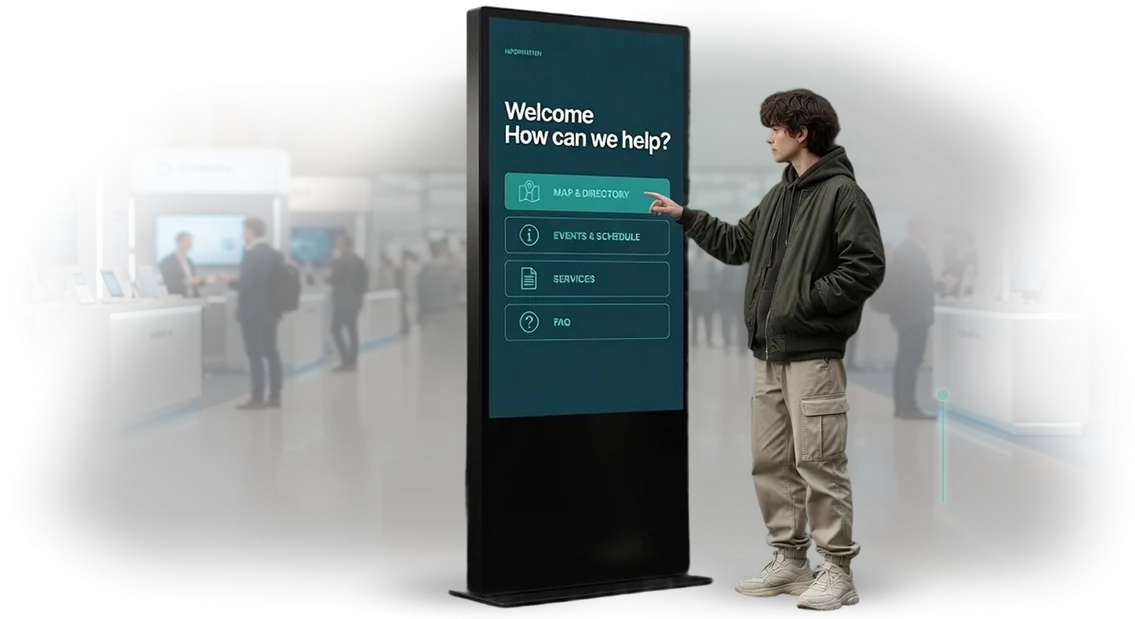
Visitors don't linger at screens — and you lose sales
When a visitor walks past an information kiosk without stopping for a second, that is not a coincidence. Ineffective information kiosks with outdated interfaces and slow response times give people no reason to pause.
Visitors don't get the information they need, don't engage with the offer, and move on — often straight to competitors. Today visitors expect instant response, convenience, and an experience, yet they face a dull screen.
Low visitor engagement directly hits revenue. A guest who didn't interact with your product won't make a repeat visit and won't tell anyone about you.
You lose customers because of outdated technology, even though you could turn every screen into a point of sale and a source of loyalty. Every lost contact is not just a missed sale — it's also a damaged impression of your brand.
But even when the need is clear, the main barrier remains: the question “how much does an interactive table cost?” Without a clear understanding of the return on investment for interactive tables, many decision-makers postpone the purchase and keep losing profit day after day.
We solve this problem. Our team develops interactive solutions that are worth the investment: we help you assess the impact before launch and make the kiosk a living sales tool, not just an eye-catching screen. You get a predictable result, clear value, and confidence that your money delivers profit.
What you get: growth in engagement and sales
An interactive table turns a visitor from a passive observer into an active participant. Instead of walking past a display or stand, people stop, start interacting, and remember your brand. This becomes the starting point for growth in engagement and, as a result, sales.
The first thing you get is attention. An interactive table stands out from a regular exhibit: motion, touch response, a live scenario. Visitors come up on their own, so you don't need to spend budget on extra advertising.
Time spent at such a table is many times longer than at a static stand, so the chance that someone will truly explore your offer is much higher.
The second result is greater conversion into inquiries and purchases. When visitors manage the information themselves, they understand the value of the product faster and hesitate less.
They can leave a contact, choose a plan, or view the catalog right at the table — all of this shortens the path from interest to sale. With the same foot traffic, you get more inquiries.
The third effect is brand recognition. An unusual format is memorable: people take photos, shoot videos, and share their experience on social media. Each of those posts acts as a free recommendation for your audience. This expands your reach without advertising spend and builds the image of a modern company.
The fourth benefit is stronger customer loyalty. When visitors feel comfortable and engaged, they sense your care and come back again.
Experience shows that after interacting with an interactive table, guests are more willing to join loyalty programs, leave reviews, and recommend you to others.
Finally, you get measurable results. We design scenarios around your business goals, set up interaction statistics, and show how long visitors spend at the table, which sections attract the most interest, and how all this converts into sales.
So you are not just buying equipment; you are introducing a tool that pays off through higher engagement and revenue.
Choosing a format: table, kiosk, or panel?
The same scenario can be implemented in different formats — and that choice determines how convenient it will be for the visitor and how much value the business gets.
There are three main solutions: an interactive table for the sales floor, a floor-standing kiosk, and a wall panel.
They solve different problems, so it is important to understand right away what you need: to engage people waiting in line, to present the assortment, or to replace a consultant.
| Format | For which tasks | What it gives the client |
|---|---|---|
| Interactive table | Catalog demonstration, product selection, “live” viewing in a showroom or sales floor | The visitor explores the product independently, sees price and availability — engagement and time spent increase |
| Floor-standing kiosk | Navigation, booking a specialist, self-service payment, issuing certificates | Eliminates queues and reduces staff workload; the client resolves their issue without waiting |
| Wall panel | Presentation of services, video, infographics, site map | Attracts attention and informs while the client waits or passes by — works like a display window |
A table is most often chosen when you need to let clients “play” with the product: rotate it, compare, select. It fits perfectly in a furniture showroom, car dealership, or electronics store. A kiosk is for quick operations: ordering, payment, navigation.
A panel is for unobtrusively telling visitors about the product in a waiting area or at the entrance.
If you are not sure which format suits your task, our engineers will help you choose the right solution based on room size, visitor flow, and usage scenario.
We focus not on the “hardware” itself, but on making sure the equipment delivers measurable results: more time at the display, shorter queues, and a higher average check.
How an interactive solution is developed
We have structured the process so that you see results at every step and always understand where the project stands. No “black box”: first a short brief, then a solution diagram, a prototype, approval, and only then development.
We set clear timelines for the whole journey — usually from 3 to 6 weeks depending on the format and the number of interaction points.
- Brief and objectives. We discuss where the kiosk or table will work, who your audience is, and what task the solution should solve: navigation, catalog, or guest entertainment.
- Analysis and proposal. Our engineers suggest the format, construction, and scenarios. You receive a cost estimate and timelines before work begins — no surprise surcharges.
- Interface prototype. We show how the screen will look and how users will move through the scenario. At this stage, changes are made quickly and inexpensively.
- Approval. We finalize the design, texts, logic, and equipment list. You approve the final look of the solution, and then assembly begins.
- Development and assembly. We build the housing, screen, control module, and content. In parallel, you receive a test version of the interface to review.
- On-site launch. We deliver, install, configure, and test the solution in real conditions. We train your staff on basic operations.
- Support and development. After launch we stay in touch: we update content, add scenarios, and help with equipment maintenance. You are never left alone with the technology.
This approach has already been proven in dozens of projects, from museums to shopping centers. You get a working turnkey solution with a clear estimate, fixed timelines, and post-launch support.
And we get the confidence that the product is actually being used and bringing value to your guests.
What is included in a turnkey package
Transparent pricing is the main concern for clients before ordering an interactive table. We work on a turnkey model: you pay a fixed price and don’t need to worry about who will supply the housing, who will write the program, or who will install it. Below is a typical scope of delivery included in the cost of a kiosk in most projects.
- Equipment — touch panel, anti-vandal housing, and mounting elements. The interactive table configuration is selected for your space: from compact models for a lobby to floor-standing structures for showrooms.
- Software — interface, logic, and management system. You get an easy-to-use tool for uploading content, changing promotions, and reviewing interaction statistics.
- Design layouts — design of all screens in your corporate style. We take into account your logo, brand colors, and style so that the kiosk becomes an extension of your brand.
- Installation and setup — our engineers deliver the device to your site, install it, connect it, and test all scenarios. You don’t need to find separate contractors for each stage.
- Staff training for the kiosk — we conduct a short training session for your team: how to turn the device on and off, replace content, and act in non-standard situations. This usually takes 1–2 hours, and then your employees work independently.
- Warranty on touch equipment and technical support — official warranty period and a direct line to our engineers. If something fails, we solve the problem remotely or visit the site.
Important: none of these items is paid for separately — everything is included in the final project cost. The exact scope depends on the use scenario: navigation requires one set of functions, a catalog requires another.
We are ready to adapt to your task and, if needed, offer a custom configuration without compromising quality or timelines.
Case study: how we doubled conversion
A striking example is our interactive table project for a retail chain. A federal retail chain “Uyut” approached us: the assortment had grown so much that consultants couldn’t keep up with product selection, and customers left without submitting an inquiry. We needed to unload the staff and turn the catalog into a sales tool.
We proposed an interactive table for retail: customers choose a category themselves, browse products, compare features, and send selected items to an inquiry.
This format solved two tasks at once — the customer stopped waiting for a consultant, and the consultant stopped being a reference book. Instead, the salesperson receives a ready list and focuses on talking with the customer rather than searching the catalog. Less than a month passed from layout approval to launch in the first store.
Implementation results
After two months, we collected the results. Screen time increased by 40% — customers began exploring the assortment themselves, and conversion into inquiries doubled.
The workload on consultants did not increase: the table took over routine selection, while managers now focus on confirming and processing orders.
The project revealed one more non-obvious benefit: the average check of visitors who used the table turned out to be higher than that of other customers.
When people see the full assortment on screen, they add more items to their inquiry — that means revenue growth without spending on advertising. The figures were taken from the store’s internal analytics, so this is actual dynamics, not estimated data. After the pilot, the chain scaled the solution to its other stores.
We can adapt the same interactive table development case to your catalog and sales process.
How much does an interactive table cost?
The cost of an interactive table depends on the tasks it needs to solve. For some, it is an impressive exhibition element; for others, a navigation or catalog tool. The industry price range is wide: from a basic solution to a full multimedia project. We always start with a brief and prepare a calculation for your specific situation.
Three components influence the price. The first is configuration: surface size, housing design, integration into furniture or a stand. The more complex the form and the deeper the interior integration, the higher the budget.
The second is the software part: whether you need static content, a catalog, a quiz, multi-touch interaction, or integration with your database. Each option means hours of development and testing.
The third is support: warranty, content updates, replacement of components, and installation. We include all of this in the estimate — there are no hidden costs.
As a budget reference: a basic table with standard software and a standard housing — cost calculated after audit. A solution with custom design, expanded logic, and integrations — cost calculated after audit.
Complex projects for large spaces with non-standard shapes and scenarios — cost calculated after audit. We will give the exact figure after the brief, but even at the first consultation it will be clear which range your task falls into.
The key thing is a transparent estimate with no hidden payments, and a device that genuinely works toward your goals: attracting attention, increasing engagement, and making information accessible. Every cost item is discussed at the start, and the final amount is the same as the one quoted.
Frequently asked questions about cost and timelines
The most common question is why the price of an interactive table is not fixed.
The answer is simple: the cost of a kiosk depends on the tasks — the size of the touch panel, the housing material, the complexity of the content, the volume, and how the device will be integrated into your interior or business process.
We don’t publish an “average price”; we prepare an estimate for a specific case and fix it in the contract before work starts. Basic configurations start at a level determined after a brief, and the final amount becomes clear after a short consultation.
The second pre-order concern is timelines and warranty. A typical project takes 4–8 weeks, and we confirm reliability with a contract and service support. Below are answers to frequently asked questions about cost, timelines, and repair of touch equipment.
Why is the price of an interactive table not fixed?
Because every project is unique: one table works in a museum with panoramic content, another in a shopping center with a 12-hour daily load, a third in a meeting room for presentations. Hence the differences in the touch panel, reinforced housing, software, and content volume.
We will send you a calculation within 2–3 days after the brief, and once the layouts are approved, the price doesn’t change.
What are the development and launch timelines?
The standard cycle is 4 to 8 weeks: concept approval, housing production, software setup, content filling, and on-site testing.
If you need it sooner, we can shorten the timeline to 2–3 weeks — this is shown as a separate line in the estimate, but you get a working kiosk in time for an exhibition or event opening.
What warranty comes with an interactive table?
For equipment and housing — from 1 to 3 years depending on configuration; for software and content — 12 months. The warranty includes free remote software updates and consultations.
After the warranty ends, we don’t abandon the project: extended support and additional functionality are available under a separate agreement.
What if the touch equipment breaks down?
We have a service department: we set up remote diagnostics to identify the cause without an on-site visit, and if necessary, we deliver spare parts and replace modules. The response time is 1–2 business days, and for critical cases we provide a backup kit for quick replacement. We minimize kiosk downtime so your business doesn’t lose revenue.
Order a cost estimate
The price of interactive kiosks varies significantly: a compact table for office presentations is one thing, a touch kiosk with custom design for a shopping center is another.
How much an interactive table costs in your case depends on dimensions, functionality, volume, and installation method, so we calculate an estimate for your task rather than using average market prices.
Leave a request — and our team will prepare a turnkey cost calculation within one business day.
We will provide a consultation on the optimal configuration, advise how to reduce the budget without losing quality or reliability, and also help calculate a kiosk project if it is needed together with an interactive table.
What you will get:
- Preliminary cost calculation for an interactive table within 1 business day
- Consultation on choosing the right configuration for your tasks
- Transparent estimate: manufacturing, software, installation, and delivery
- Configuration options: from a standard solution to custom design
- Assessment of launch timelines and examples of similar projects in your industry
- Help preparing a technical specification so you can calculate a kiosk project in advance
Fill in the form below or call us — we will discuss the details and answer your questions. You can order an interactive table without prepayment: the preliminary calculation and consultation are non-binding.
You will receive a clear estimate and timelines before work starts — after that, the decision is yours.