

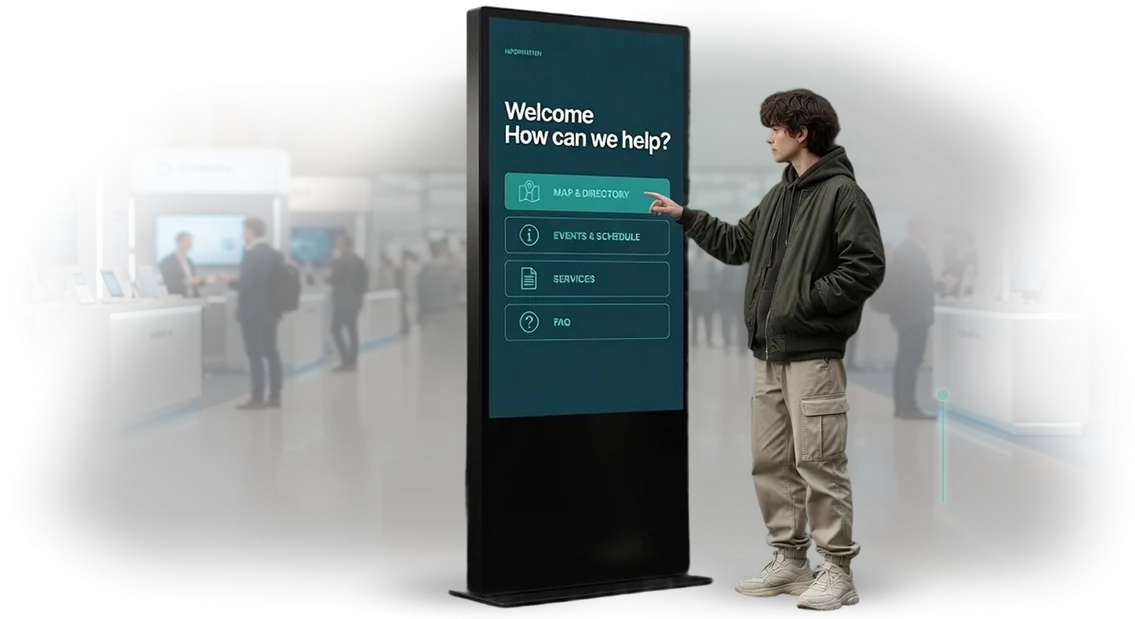
Windows 11 Kiosk Mode App: Solving Your Kiosk Problems
Interactive kiosks have become a familiar part of customer service: customers expect ordering, booking, or getting information to take just a few seconds. But when a kiosk freezes or throws an error, all attention shifts to the negative.
The visitor leaves — often to a competitor, and you lose not only that specific sale but future engagement as well.
On Windows 11, kiosks have more capabilities for stable operation, but this only works with proper application configuration. The weak points are not the "hardware" but a poorly thought-out interface and unstable program behavior.
As a result, even the most modern equipment disappoints customers, and staff spend time troubleshooting instead of helping visitors.
We create kiosk mode applications for Windows 11 that solve kiosk problems at the customer experience level. The program launches quickly, the interface stays clear, and failures are minimized at the development stage.
This helps retain customers: they get the service they need without frustration and gladly return again.
Our approach is not just "launch the app" but building a scenario that reduces staff workload and increases conversion of inquiries. Everything the visitor sees works predictably, so the kiosk becomes a revenue growth point rather than a source of problems.
Benefits of Kiosk Mode for Your Business
Implementing kiosk mode means moving routine tasks to self-service. The customer selects the service, places an order, books an appointment, or gets information — without waiting in line or dealing with intermediaries.
We create specialized applications for terminals based on Windows 11, and this is a reliable foundation that doesn't require constant administrator oversight.
Speed increases dramatically: instead of talking to an employee, the visitor spends one or two minutes at the screen. An intuitive interface guides them step by step, completes the operation immediately, and suggests additional services — increasing the average ticket.
For business, this means more satisfied customers in the same amount of time and higher revenue from each location.
Loyalty grows when visitors' time is respected. Fast and clear service builds a habit of returning to you.
Kiosks operate without breaks or days off, don't depend on staff mood, and always deliver the same correct response — this strengthens brand trust and increases the share of repeat visits.
Staff savings are another significant effect. Some functions move to the terminal, so employees can focus on complex issues and quality service.
One kiosk replaces several hours of routine work per day and pays for itself in just a few months — after which it starts generating net payroll savings.
In the end, you get an uninterrupted service point that accelerates processes, boosts customer loyalty, and reduces costs. Implementing kiosk mode is a step toward modern service that pays for itself within the first year.
Implementation Formats for Information Kiosk Applications
We know that the same kiosk can handle different tasks: show a catalog, accept requests, register visitors. That's why we offer different development formats — from standard solutions to fully custom projects.
This allows you to choose an option that fits the task scale and budget without overpaying for what you don't need.
| Format | For Whom | What It Gives the Customer |
|---|---|---|
| Standard solution | Small business, one or two locations | Fast launch in 1-2 weeks, predictable pricing, basic configuration for your materials |
| Standard solution with customization | Growing chain, non-standard scenarios | Recognizable interface, adding needed features without building from scratch |
| Custom development | Large projects, high integration requirements | Application tailored precisely to company processes, unlimited scaling and growth |
The choice of format depends on the project scale and how the kiosk fits into your company's operations. If you need to quickly test a hypothesis or handle a simple task — a standard solution will work.
If the kiosk will become an important sales or service channel, it's better to lay the foundation for growth from the start.
Custom development is not just a screen with a menu. We design scenarios for your visitors, integrate the kiosk with your accounting system, and create an interface that requires no training.
At the same time, you get the same kiosk mode on Windows 11 with protection against failures and unauthorized access.
Our engineers will help you choose the format and assess the scope of work before the start. Fill out the form or call us — we'll discuss your task and offer the best option.
How Kiosk Application Development Works: Stages and Timelines
The client needs to understand what's happening with the project and when the final result will be ready. That's why the process is transparent: at each stage, you see the intermediate result and can influence the workflow.
A typical kiosk project takes 3–5 weeks — timelines are fixed in the brief and don't change without your consent.
- Brief and tasks. We discuss who the kiosk is for, what actions visitors should perform, and what data they need. We document scenarios, timelines, budget, and each party's area of responsibility.
- Prototype and approval. We put together the screen structure and navigation logic. You see how visitors will move through the scenario and can make changes before development begins.
- Design and content. We style the interface to match your brand, prepare texts, hints, and visual materials. After the mockups are approved, technical implementation starts.
- Development and integration. We program the kiosk application logic and connect the necessary services: catalogs, maps, news, feedback forms. We work on the current version of Windows — this ensures stable kiosk mode and protection against accidental exits.
- Testing on a real device. We verify scenarios under conditions close to production: long idle periods, network failures, non-standard user actions. We fix any issues found before launch.
- Launch and handover. We install the application on your devices, configure auto-start and functional restrictions. We conduct a short training for your team and hand over instructions.
- Project support. After launch, we stay in touch: update content, monitor stability, and add new features as tasks grow.
At each stage, you receive a result and approve it — so the risk of mismatched expectations is reduced to zero. If adjustments are needed, you'll learn about them in advance, not at launch time.
What's Included in the Kiosk Application Delivery
When you order kiosk development, it's important to understand that you get not just a program but a complete solution for your business. We've prepared a transparent delivery scope so you can plan the launch without guessing what's left behind the scenes.
- Turnkey system. The application is installed and configured on your equipment and verified in real scenarios. All you have to do is turn on the kiosk and start using it.
- Full documentation. Clear instructions for startup, daily maintenance, and typical actions in non-standard situations. Any employee can quickly find the right section.
- Staff training. We conduct a short training session for your employees so they can confidently work with the kiosk and help visitors. Training can be done remotely or on-site.
- Warranty support. During the warranty period, we respond quickly to questions, fix errors, and visit the site when necessary. You're never left alone with a problem.
- Updates and improvements. We periodically update the system, improve the interface and functionality based on your customers' feedback. Your kiosk stays modern and user-friendly.
- Growth capability. The solution is designed so you can easily add new sections, change promotions, and connect analytics without a complete overhaul or significant costs.
This way, you get not just code but a working tool that improves service quality and pays back your investment.
Case Study: Interactive Kiosks in a Retail Chain
At the Свежий ветер retail chain with twenty stores, queues formed at the checkout counters during peak hours. Customers abandoned full carts and left — that's up to 15% of daily revenue lost.
At the same time, the assortment was growing rapidly, and customers demanded fast service without losing quality. Additional checkout counters didn't solve the problem — labor costs grew faster than traffic.
We proposed moving part of the purchases to interactive self-service kiosks. Our engineers deployed a proven kiosk platform on Windows that integrated seamlessly into the chain's accounting system.
Setup took less than a month, and there was no need to remodel the checkout areas in stores. Administrators didn't have to retrain staff — the kiosk interface is intuitively clear to customers of any age.
Business Impact
The pilot was launched at the four busiest locations. Within a month, service time was cut in half, and every third customer completed their purchase independently. The average ticket grew by 17% — the kiosks smartly suggested related products and loyalty program promotions.
The project paid for itself in five months, after which the chain expanded deployment to all stores.
Managers gained a tool that increases revenue on its own without requiring additional staff. The repeat order was placed quickly — the configuration was already refined, so implementation at the remaining locations took two weeks.
We now support the system: updating the interface, adding new scenarios, and monitoring stability. This allows the chain to respond quickly to demand changes and run marketing promotions without downtime.
How to Choose the Right Format for Your Task?
Start by describing the visitor scenario: what should they do at the screen — find a product, book an appointment with a specialist, pay for a service? The feature scope depends on this, not the other way around.
For simple information lookup, a stable application with crash protection is enough; for booking or payment, you need integration with your systems and higher reliability. By defining the main action, you immediately cut half of the unnecessary options and save budget.
Then estimate how many people will use the kiosk during peak hours and how often content changes.
A single screen in a small office and a network of ten terminals require different solutions: in the first case, a local application may suffice; in the second, you need centralized data loading and monitoring of each device. These parameters directly determine the development cost and support scope.
To avoid overpaying, start with a basic feature set and plan for expansion. Launch with the main scenario, collect real statistics, then add payments, reports, or notifications — without having to redo the project.
This phased approach lowers the initial budget and shortens the launch timeline, and the client gets a working kiosk in just a few weeks.
We select the format for your task and budget: bring a scenario description, and our engineers will honestly tell you where you can save and where to build in a safety margin.
The proposal typically takes one business day — no hidden work or "extras" along the way. You get a clear cost estimate and schedule, not general words.
Frequently Asked Questions About Kiosk Application Development
Clients typically have three groups of questions: what happens during a failure, how stability is guaranteed, and what risks exist. Here are brief answers — the rest is in the full FAQ.
What happens if the kiosk freezes or crashes?
We design the recovery scenario in advance: if the application freezes, it restarts automatically, the visitor doesn't see the error, and no data is lost. We set up remote monitoring — you see the kiosk status and can restart it remotely.
What stability guarantees do you provide?
Stability is built in from the start: we select equipment, configure auto-start and protection against accidental exit. In kiosk mode on Windows 11, the application is the only interface on the device. We provide a warranty on our work and keep the system up to date.
What are the project risks and how do you mitigate them?
The main risks are missed deadlines and mismatched expectations. We document the requirements in the brief, approve the prototype before development, and show intermediate versions. This way, you see the result at every stage and can adjust the task in time.
What does post-launch maintenance include?
We offer support after launch: remote content updates, backup, and monitoring. You can change promotions, menus, or texts without stopping the kiosk and without involving a developer.
Ready to Launch Your Project? Get a Consultation
We'll give you an idea of timelines and budget before the work begins: send us an inquiry — during a consultation, we'll review your task, suggest which solutions fit your business, and calculate a realistic cost estimate after audit.
No abstract "project days" — you'll get a clear plan for launching your kiosk mode application on Windows and see every stage.
Here's what our steps to launch look like:
- Leave an inquiry on the website — we'll respond within one business day.
- We'll have a consultation: discuss goals, audience, and kiosk usage scenarios.
- We'll prepare a cost estimate broken down by stages — no hidden extras.
- We'll agree on timelines: from design to final testing on your equipment.
- We'll implement and launch the project, and train your team to work with the system.
- After launch, we stay in touch: enhance functionality and help with maintenance.
As a result, you get a predictable process with clear dates and a final price, not a "rough estimate." Your interactive kiosk starts working and delivering value to customers exactly on the agreed date.
Fill out the inquiry right now — we'll discuss the next step during a consultation. It will save you time and eliminate risks at the start.