

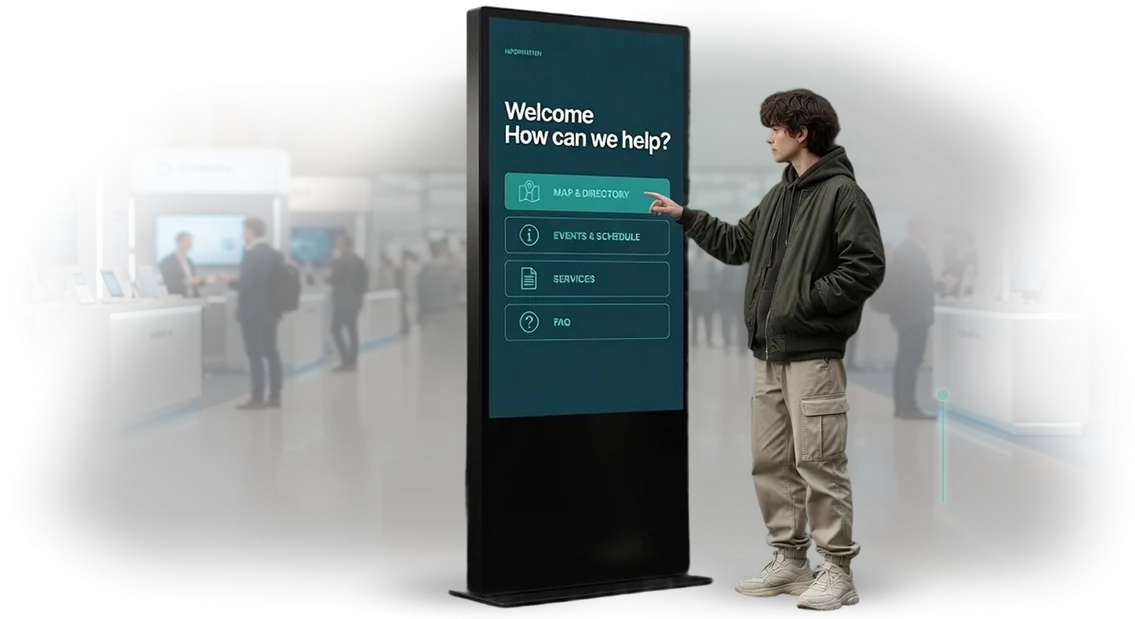
Why Your Kiosk Mode App Is Losing Visitors and Sales
A visitor approaches your interactive kiosk to quickly get information or place an order. If the kiosk mode app runs slowly, confuses the scenarios, or requires unnecessary steps — the person walks away to a competitor.
Every such departure is not just a lost customer, but missed revenue and a damaged impression of the brand.
An inconvenient interface in kiosk mode is especially noticeable during peak hours: a queue forms at the screen, staff get distracted helping instead of working with other guests. As a result, low sales become a systemic problem rather than a coincidence.
You invest money in equipment and traffic, but the return doesn't grow — because the kiosk itself repels people instead of guiding them toward a purchase.
A common cause is a kiosk built "like a smartphone app," without considering the specifics of a public screen. People don't want to figure out the menu, fear making mistakes, or simply don't have time.
The longer a visitor stands at the screen, the lower the conversion and the fewer repeat visits — and that means future profit is lost too.
We solve this problem systematically: we design scenarios for your customers, remove unnecessary steps, and make the kiosk help sell rather than hinder.
We identify exactly where visitors are lost and bring back speed and simplicity — along with growth in average ticket and loyalty.
What You Get from a Modern Interactive Kiosk
The benefits of a kiosk lie not in the technology, but in how customer behavior changes.
A properly configured "kiosk mode" (kiosk mode app) turns a passive visitor into an active buyer: they explore the catalog, compare options, and leave a request — without a queue or sales assistant help.
For a business owner, this means higher sales, staff savings, and a clear customer experience. Below is a checklist of what you get after launch:
- Interactive showcase. Even in a small space, you display hundreds of items: the customer browses the catalog, looks at photos, reads descriptions. This boosts brand recognition and leads to an on-the-spot order rather than "I'll think about it at home."
- Increased sales. The kiosk scenario automatically suggests related products and services. Like an attentive consultant who sells twice as much as usual, the kiosk unobtrusively raises the average ticket.
- Customer experience without queues. The visitor doesn't wait for staff: they find answers in a minute, place repeat orders, and come back again. According to customer experience research, an interactive screen holds attention three times longer than a static poster.
- Staff savings. Employees stop repeating the same information. Freed-up hours go toward live sales and complex questions — team efficiency grows without new hires.
- Additional requests after closing. The kiosk works without breaks or vacations. At night and on holidays, it takes orders that land in your request database in the morning.
In every project, we tailor the scenario to your niche: catalog, test drive, pre-order, loyalty program. The result — measurable business metrics: share of orders through the kiosk, number of requests per week, and reduced consultation time. You get a working tool, not just a screen in the hall.
Information Kiosk Formats for Your Tasks
Information kiosks solve different tasks: from navigation to sales. The format determines how visitors interact with your service and what business result you achieve. Below are popular options and their impact.
Popular Formats and Their Business Impact
| Format | For Whom | What It Gives the Customer |
|---|---|---|
| Touchscreen navigation kiosk | Shopping malls, business centers, museums | Visitors quickly find the right department, staff workload is reduced |
| Retail kiosk | Stores, pharmacies, home goods | Average ticket increases, queues shorten, service speed grows |
| Order kiosk | Restaurants, fast food, cinemas | Orders are taken without a cashier, higher accuracy and upsell volume |
| Interactive zone | Exhibitions, showrooms, events | Attracts guests' attention, engages with the brand, collects contacts |
| Outdoor information kiosk | City services, parks, transport | Provides information 24/7 in any weather, increases service accessibility |
Each format is not "hardware for the sake of hardware," but a ready-made scenario: from the first touch to the desired action. We select the enclosure, screen, and interface logic for your touchpoint and audience.
We develop the app in kiosk mode: it launches directly into the required scenario, is protected against accidental failures, and requires no constant supervision. You get a stable service that works for your visitors and your revenue.
How We Launch a Kiosk Project
Launching kiosks is not about installing devices, but about a new touchpoint with your customers. We have built a transparent process: you participate in key decisions, see the timeline, and understand the cost at every step.
As a result, you get a working kiosk that solves a specific business task — from increasing sales to relieving staff.
- Brief and goals — we discuss how the kiosk should help the business: sell, inform, or navigate. We record the expected outcome and success criteria.
- Plan and estimate — we prepare a detailed proposal: scope of work, timeline, and cost. You know the budget in advance and can adjust tasks without hidden surcharges.
- Prototype and approval — we show on screen how the kiosk will look and work before development. You make edits at an early stage — this saves time and money.
- Design for your brand — we configure visuals and texts in a consistent style so the kiosk strengthens brand recognition and fits harmoniously into the space.
- Assembly and testing — we connect the interface to the hardware and test real visitor scenarios: queues, touch, non-standard actions. We refine it to stable operation.
- Launch and implementation — we install the application, configure the kiosks, and train the staff. You get a ready customer touchpoint from day one.
- Support and development — after launch, we stay in touch: we update content, add features, and monitor stability. The kiosk works, and you don't get distracted by technical details.
We handle all coordination — from selecting hardware to training staff. All you have to do is monitor the results: conversion growth, number of inquiries, and customer satisfaction.
What Is Included in the Solution Delivery for the Customer
We prepare the kiosk turnkey — from hardware and interface to staff training and warranty service. You get a working solution, not separate pieces, ready to launch on the day of installation.
The standard package includes six blocks, each covering a specific management task:
- Hardware and installation — we select the enclosure, touchscreen, and system unit for your traffic and tasks, deliver, install, and connect them at the required location.
- Software — we pre-install the app with autorun, a secure kiosk mode, and remote content updates: you don't need to visit every screen.
- Interface design — we develop layouts in your brand style: large buttons, clear navigation, touchscreen adaptation.
- Instructions and regulations — short reference guides for staff: startup, content changes, common issues, and support contacts.
- Staff training — we conduct an online session for administrators and operators, demonstrate real scenarios, and share the lesson recording.
- Warranty and support — we set a warranty period for hardware and software and connect a technical support channel with a response within one business day.
Thanks to this package, you don't need to hire separate contractors for hardware, design, and programming — we handle all these tasks. At the start, we define responsibility points and deadlines so you can plan your budget and launch.
After handover, you receive a fully operational kiosk. Everything else is our responsibility: updates, consultations, troubleshooting.
Case Study: How a Kiosk Project Paid Off for a Dealership
For a premium segment dealership "Meridian", we developed an interactive kiosk in the waiting area. Visitors spent 15–20 minutes there without any benefit: scrolling feeds, stepping outside, or leaving without waiting for a consultation. Instead of wasted time, the kiosk provides managed interaction with the brand.
Through the screen, the customer selects a model, changes the configuration, sees the final price, and leaves a test drive request. The manager receives a signal about the request and approaches the visitor with a ready calculation.
This is not a replacement for live communication, but its acceleration: the customer comes to the consultant with a choice, so the conversation immediately moves to purchase terms.
In the first month of operation, the average ticket grew by 14%, the number of requests by 37%, and the time of "live" contact with the manager decreased by 20%.
The conversion of the waiting area into requests reached 22% — every fifth visitor started a dialogue with a manager instead of leaving silently. Before that, a static monitor with ads barely engaged people.
The project paid for itself in two months, after which the center ordered a second kiosk for the showroom.
The main takeaway — waiting stopped being passive. The customer takes the first step themselves, and the dealer records every such contact and measures the effect.
For us, this is an example of how a properly placed kiosk turns a service zone from a point of lost interest into a source of requests and repeat sales.
How to Choose a Kiosk Format for Your Business Specifics?
Choosing a kiosk format is not a matter of "like it or not," but of what task it must solve in your business. The same device suits a product catalog but is completely inconvenient for booking an appointment with a specialist or navigating a large building.
So first we look at the specifics: who will use the kiosk, where it stands, and what the customer should do — buy, get information, find an office, or leave a request.
For retail, order speed and payment convenience matter; for services — booking and scheduling; for museums and exhibitions — routes and additional information. Screen size, enclosure type, protection from the environment, and even the position of the touch area depend on this.
That's why a ready-made "box" often doesn't work: it solves average tasks, not your specific ones.
A custom kiosk is not just about exterior design and enclosure color. We configure the working scenario itself: menu logic, integration with your accounting systems or CRM, automatic notifications, and reports.
This approach turns the kiosk into a full-fledged sales or service tool, not just an expensive screen with information.
Ultimately, the right format always relies on the business process. We help you choose a configuration for your industry and tasks: we analyze customer flow, physical space, usage scenarios, and budget.
Then we propose the optimal solution and configure the kiosk so it delivers measurable results — more orders, shorter queues, or visitor convenience.
Answers to Common Concerns Before Launching a Project
Before launching any project, questions arise: what if the equipment fails, who will handle maintenance, and how is data protected. We've gathered answers to these concerns — briefly and to the point.
What if the kiosk breaks down?
Any technology can fail, but we build a safety margin into the project: we use reliable components and provide remote health monitoring.
In case of a malfunction, our engineer connects to the system and, in most cases, restores operation without an on-site visit — this saves your time and budget.
Who will service the kiosk?
We take on the full cycle: from installation to regular technical maintenance. Specialists handle updates, preventive maintenance, and cleanliness — you don't need to hire a separate employee. You get a working kiosk, not an extra burden on your team.
How is data protected?
Applications run in kiosk mode: the user sees only the necessary functionality and cannot access system settings. All data is transmitted over secure channels, and access to management is restricted — this protects both your information and customer data.
What about support after launch?
We stay in touch after the project is delivered. Support includes consultations, updates, and rapid incident response — both remotely and with on-site visits.
You won't have to search for a contractor for every little thing: we are responsible for the result throughout the entire kiosk lifecycle.
If you still have questions — we'll discuss them during a consultation and suggest a solution for your tasks.Get a Commercial Proposal in One Day
To order a kiosk, you don't need to gather multiple meetings or wait for weeks. Just leave a request — and by the next business day, we'll send you a commercial proposal with a cost calculation and estimated timelines. No abstract "stars": only specifics for your task.
If you need a consultation at the start, our specialists will help you decide on the format and functionality: information kiosk, catalog with payment, or touchscreen panel for navigation. We'll select an option for your industry, budget, and design expectations. As a result, you get a clear plan: what we do, how much it costs, and when we launch.
Here's why it's convenient to work with us:
- We calculate the cost in one day — without lengthy approvals or hidden surcharges.
- We select a solution for your industry: retail, food service, services, government institutions.
- We show production and launch timelines — you plan the operation of your location in advance.
- We flexibly configure features: directory, map, payment, surveys, feedback.
- We provide after-sales support: content updates, technical support.
- We provide an official contract and warranty on equipment and software.
Then we work on a transparent schedule: we approve the layout, produce the kiosk, launch it, and train the staff. Leave a request — we'll respond within one business day, calculate the cost, and offer the optimal configuration. It's non-binding.