

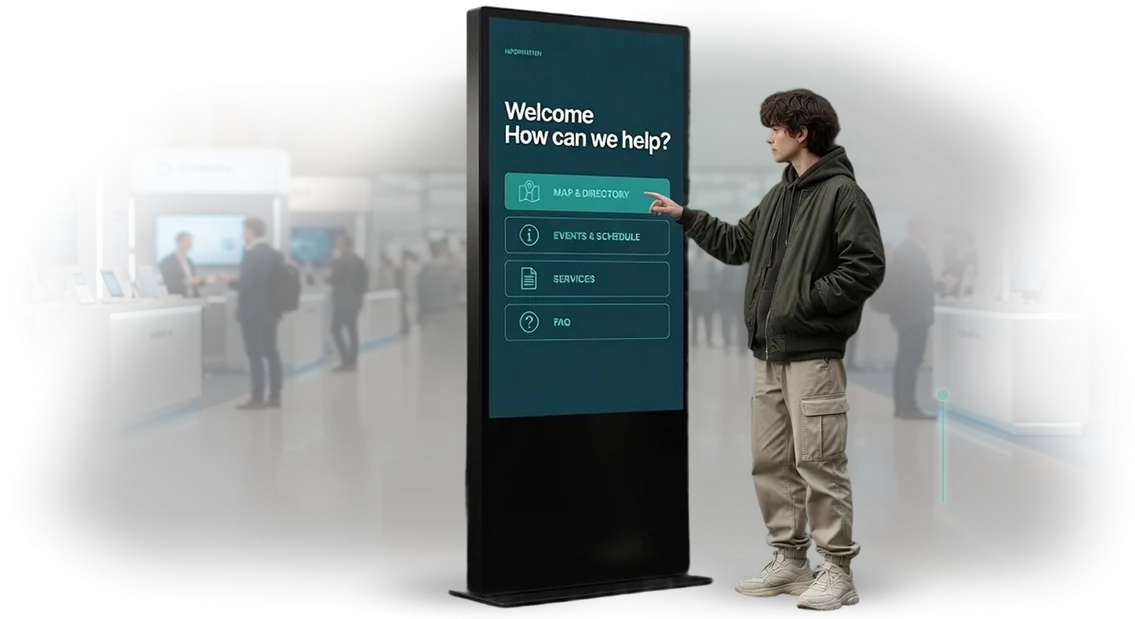
Interactive Kiosks for Libraries: Bringing Exhibits to Life and Attracting Visitors
Static stands and archival materials get lost against a backdrop of vivid digital experiences. Library visitors walk past display cases with rare documents without stopping — the exhibit does not work, and the effort invested in it goes unnoticed.
Modern visitors expect not just information, but participation: they want to touch, discover, browse, and hear the story. A library that offers this experience stops being a book repository and becomes a magnet for different generations — from schoolchildren to researchers.
An interactive kiosk solves this task: it brings the exhibit to life, turning archival documents into a living scenario with touches, search, and visual discoveries.
We have been developing such solutions for over a decade — we design the logic, fill it with content, and launch kiosks that become the main points of attraction in library halls.
Visitors linger at the kiosk for several minutes, study the materials, leave feedback, and return again.
Interactive presentation boosts interest in the collections, simplifies navigation through archives, and helps the library speak to guests in a modern language — without complex equipment or maintenance.
We take on the entire journey: from idea to a working station that draws attention and delivers measurable results.
What Benefits You'll Get from an Interactive Kiosk
An interactive kiosk in a library or archive stops being "just a screen" — it becomes a point of attraction that holds visitors for 10–15 minutes longer than usual.
In that time, a person gets to immerse themselves in history, find familiar surnames, browse digitized documents, and, most importantly, connect emotionally with the material.
These are exactly the pauses that turn a formal visit into a meaningful one, the kind people want to repeat.
Audience expansion is another tangible result. The interactive format engages both the older generation, which values access to archival originals, and young people accustomed to touchscreen interfaces.
The kiosk also works to attract families with children: while some explore documents, others discover history through a visual, interactive presentation. In the end, you reach an audience that previously didn't come to the library and increase overall visitor flow.
Any such kiosk is also a recognition tool. The unusual design and visually rich content themselves become a reason for photos, social media mentions, and recommendations.
A visitor who takes a picture in front of an interactive Book of Memory creates free advertising for you among their own audience. By regularly updating materials, you keep regular guests interested and give them a reason to follow your institution's news.
An additional bonus is collecting data on which sections draw the most attention. You see what truly interested visitors: which pages were browsed most often, which topics were discussed, which exhibits people lingered at longest.
This information helps you plan exhibitions, themed events, and collection growth. Instead of assumptions, you get an objective picture of your audience's real interests.
We have already implemented similar projects for libraries and archival spaces and know how to turn archival materials into a living, engaging experience.
You get not just a kiosk, but a working growth tool: longer visits, a wider audience, higher recognition, and clear statistics for development. We're ready to discuss how this could look in your specific space.
Kiosk Formats for Different Tasks: What We Deliver
Every library or museum solves different tasks: one is digitizing archival collections, another is looking for a way to hold young visitors' attention. A universal kiosk rarely fits all scenarios, so we deliver formats for a specific goal. Below are the typical options cultural institutions order most often.
| Format | Who it's for | What it gives the client |
|---|---|---|
| Interactive Book of Memory | Libraries, museums, memorial centers | Preserves stories and photos digitally, lets visitors leave their mark in the exhibit |
| Archive kiosk | Local history departments, state archives | Fast search through digitized documents without staff involvement, reduces workload for personnel |
| Touchscreen guide | Large libraries, exhibition halls | Self-guided tour: visitors choose their own route and pace for exploring exhibits |
| Multimedia stand | Children's and youth departments, lobbies | Game-like content interaction, increased interest in the collection and repeat visits |
Format selection starts not with technology but with the task: what should change after the kiosk is installed. We select the right configuration — from a single point to a network of devices across the building.
Content is updated remotely, without firmware reflashing or calling a specialist, so the kiosk doesn't become outdated after a season and keeps working for the institution continuously.
Stages of Kiosk Project Work
We structure our work so that every stage is transparent and predictable. The client always sees what's happening, what's already done, and when the result will arrive. This eliminates surprises and gives full control over timelines and investments.
-
Brief and task analysis. We start with questions: who will use the kiosk, what's the main function, where will it be placed, what content already exists. We lock in requirements, deadlines, and the expected result to move precisely toward the goal.
-
Design concept. We propose a visual style, menu structure, and navigation logic. You get a clear mockup you can show colleagues and discuss before development begins.
-
Mockup approval. We discuss details and make edits. Only after your approval do we move to implementation — this saves time and eliminates rework at later stages.
-
Implementation and content loading. We build the kiosk: develop the interactive part, upload archival materials, Books of Memory, and photos. At this stage you see intermediate versions and can track progress.
-
Installation and testing. We deliver the kiosk to the site, install it, connect it, and test it under real conditions. We make sure everything works stably, the screen is responsive, and visitors can easily understand the controls.
-
Launch and support. We train your staff and hand over operational documentation. After launch, we stay in touch: we update content promptly, answer questions, and support the project for as long as needed.
What's Included in the Kiosk Delivery: A Complete Package
We cover the entire cycle "turnkey" — from choosing the enclosure to launch and support.
That means you don't need to find contractors for installation, programmers for software, or designers to style archival materials: everything is already included in the cost and managed by us.
What you get in the delivery package:
- Kiosk hardware — a touchscreen and protected enclosure, assembled and tuned for your space. The device is built on a professional component base, so it works reliably even under continuous use in a reading room or lobby.
- Interface with a ready-made structure — the system is divided into sections: "Book of Memory", "Archive", "Search", "Reference". Visitors find information in a couple of touches, without help from a librarian.
- Content loading and styling — we transfer your lists, photos, biographies, and digitized documents into the system and configure how they're displayed. All you need to do is hand over the materials.
- On-site installation and connection — we deliver the kiosk, install it at the chosen spot, and check the network and power supply. It plugs into a standard outlet and is ready to work immediately.
- Staff training — in 1–1.5 hours, we thoroughly explain to administrators how to fill sections, update current announcements, and restart the system if necessary. No technical background is required from your employees.
- Warranty and technical support — the hardware comes with a warranty, and the software part includes unlimited support. In case of a failure, you'll have our contact channel, and a specialist will help remotely or with an on-site visit.
This delivery format is convenient because you get a single point of responsibility. Everything needed to run the kiosk — from "hardware" to staff training — is fixed in the contract and requires no separate coordination.
Case Study: How a Kiosk Expanded Audience and Increased Engagement
One library held a large archive of local history, but visitors walked past: the materials sat in the collection instead of being accessible. The task was simple — turn the archive into a living exhibit that would hold guests and bring in new ones.
Our team developed an interactive "Book of Memory" kiosk: a touchscreen panel with stories, photos, and documents about local residents.
In the very first months, the library saw the business impact. Attendance grew by 40%, and the average visit time doubled — previously a person stayed for 15 minutes, now they explore materials for about half an hour.
The kiosk became a reason to come again: guests return to review the stories and bring friends and relatives along.
Why did it work? Instead of static stands, an interactive scenario: flip pages, zoom into photos, read memories. Everyone finds something of their own: schoolchildren find material for reports, families find familiar surnames, city visitors find living history.
Library staff note that after using the kiosk, visitors ask more questions and check out local history books.
Project Results
- +40% attendance in the first months — the kiosk became its own reason to visit the library;
- visit time doubled — visitors are engaged, not "walking past";
- positive feedback: thank-yous from residents appeared in the library's guest book and social media;
- repeat visits: some guests return to show the kiosk to family or finish reviewing materials.
The library management is already planning to place the kiosk in the reading room and add new stories to it. The project showed the main thing: an archive can be not a "museum exhibit" but a working tool for attracting audiences and growing engagement.
How to Choose a Kiosk Format for Your Library's Tasks?
Choosing a kiosk format is not a technical task but a strategic decision about how the library will speak to its visitors. A screen that's too small will make people crowd around the stand, while a too-bulky design could block a passage or clash with the reading room's interior.
First, assess your audience and goals. If older people will approach the kiosk, large fonts and simple navigation matter. For young people and students — search speed and the ability to share what they find on social media.
Think about what a visitor should take away in two minutes: find a book, study a hero's biography, leave a memory about a relative, or simply become interested in the exhibit? The answer determines the menu structure and how materials are presented.
The volume of content determines the type of system. A virtual Book of Memory with thousands of entries needs a well-designed catalog and search, while a themed exhibition on the district's history only needs a linear scenario with striking transitions.
The placement location also affects the format: a spacious lobby calls for a floor-standing model, a cramped room — a wall-mounted touchscreen, and for queue-mode scenarios — a design with a comfortable tilt angle.
Another criterion is budget and development plans. A basic single-access-point model covers current tasks, but if you plan to expand — adding new halls, materials, or a connection to the institution's portal — it's better to build in scalability from the start. That's cheaper than swapping hardware and migrating the design later.
We help you avoid mistakes at the start: we analyze tasks, audience, and premises, suggest the optimal option, and show how it will work in your conditions.
The result is a kiosk that doesn't gather dust in a corner but becomes a working point of attraction, justifying the investment.
Frequently Asked Questions and Concerns About Kiosk Development
When ordering an interactive kiosk, many clients have the same concerns: what about the warranty, who will service the device, how quickly can information be updated, and whether the system will be too complex for staff.
These concerns are understandable: how well the kiosk is designed for day-to-day use determines whether it will deliver value for years.
We have been developing information kiosks for libraries, museums, and cultural spaces for over 10 years. In that time, we've refined a process that removes typical client worries. Below are answers to the questions most often asked before a project starts.
What warranty do you provide, and what happens if the kiosk breaks?
We provide a warranty on hardware and software for up to 24 months. The entire period includes service support: if something breaks, we organize fast repairs, and to prevent downtime, we'll offer a replacement kiosk. All terms are documented in the contract — you know in advance what to expect.
How will we update content?
No magic involved: you get a simple admin panel where you can change texts, images, and videos in a couple of minutes. Updates work over the internet or from a USB drive — no need to wait for a programmer. Library staff quickly learn the system, and we provide phone and remote support.
Are our staff capable of managing the kiosk?
We deliberately design the interface to be as simple and intuitive as possible. We train your staff and provide a day-to-day instruction manual. Administration takes no more time than uploading files to a computer. If questions arise — our support team is always available.
Can the design and functions be customized for our library?
Each kiosk is developed individually: we adapt the look to your brand style and add the sections you need — from a Book of Memory to convenient archive search. You get a device that solves your specific institution's tasks, not a generic template.
Order an Interactive Kiosk and Get a Turnkey Project
Leave a request for a consultation and cost calculation — we'll prepare a turnkey interactive kiosk for your library. You won't have to deal with technology or coordinate contractors: we're responsible for the project from the first brief to launch and ongoing support.
What you'll receive after ordering:
- Audit of library tasks and recommendations on kiosk format — for a Book of Memory, an archival exhibit, or collection navigation.
- Interface design in the style of your space, so the kiosk fits naturally into the hall and attracts visitors.
- Content loading: digitized photos, documents, biographical notes, memories — everything that matters for your Book of Memory.
- Professional equipment and installation in the library premises — without extra cables or complex setup.
- An intuitive interface for readers of all ages: from schoolchildren to the elderly.
- Staff training and a simple operating manual.
- Hardware warranty and technical support after launch.
Call us or leave your contact in the form — within one business day, we'll discuss your tasks and propose an individual solution for your library.
The consultation will show you how an interactive kiosk can bring your exhibit to life, attract new readers, and reduce the load on your staff.