

Why Guests Leave Palaces Without Vivid Impressions
Visitors come to a palace expecting a miracle — and get an enfilade of halls with signs reading "do not touch the exhibit." Attention fades by the third room, stories are forgotten by the exit, and instead of enthusiastic photos in social media, there are a couple of shots of the facade. Guests' impressions become flat, and this hurts reputation and attendance.
The problem is not the architecture, but the way the content is presented. A static exhibition speaks to the visitor in the formal language of museum labels: little context, no emotion, no opportunity to choose one's own route.
A tour guide physically cannot devote time to every guest, and independent viewing resembles reading a long instruction manual. As a result, a person mechanically walks through the halls and takes away only a vague "well, it's pretty."
For a palace, this means losing repeat visits and word-of-mouth. A guest who did not receive an emotion will not tell friends about you and will not come again.
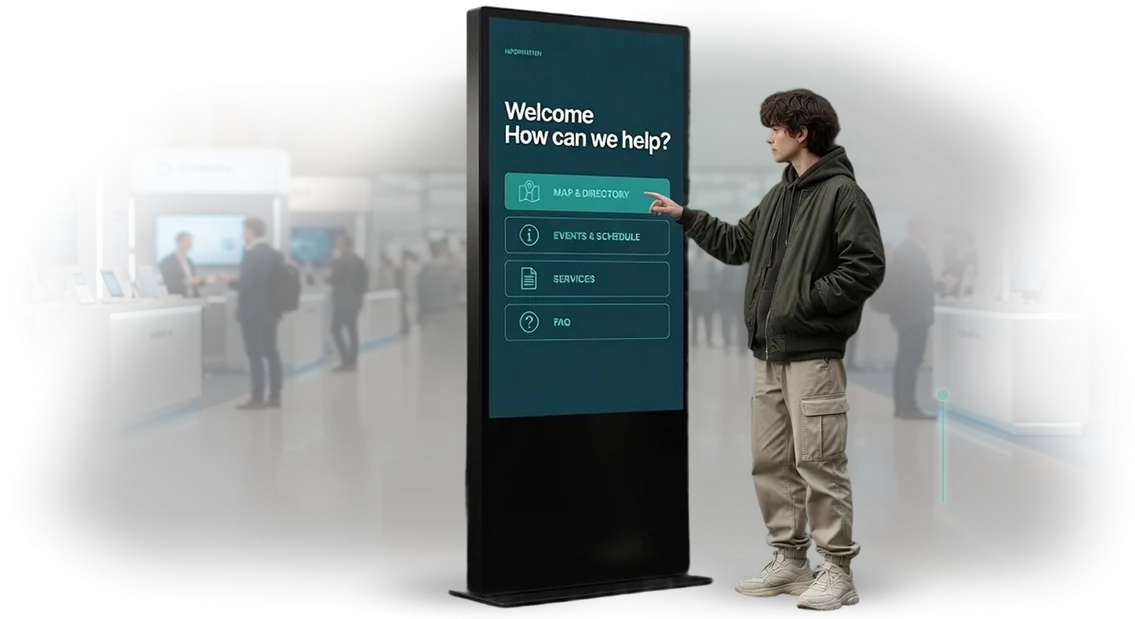
Modern audiences expect a dialogue: take a photo, explore a detailed story, compare how the interior looked before and now. This is where museum technologies come to the rescue — an interactive kiosk turns passive contemplation into a lively exploration.
Such a kiosk works like a personal guide: offers interesting facts, shows historical images, answers questions, and lets the guest choose the depth of immersion.
Through interactivity, a visitor lingers in the halls longer, shares impressions on social media, and takes away a personal story connected to the palace. This is the digitalization of palaces that brings emotion back into the museum space.
We specialize in such solutions: we design interactive kiosks that fit into historic interiors without disrupting their atmosphere and give guests that very "wow effect." We help palaces turn collection viewing into a memorable event — and thereby increase visitor loyalty.
What You Get from an Interactive Kiosk: 5 Key Results
An interactive kiosk turns passive acquaintance with history into a lively dialogue: increases visitor interest, engages them in the exhibition, and helps the palace grow based on data.
Visitor Engagement
Guests stop being observers: they choose stories themselves, browse archival documents, enter names into the book of memory. Such participation is memorable and creates emotions people want to share.
More Time at the Exhibition
When a guest controls the scenario, they linger at the displays longer. Impressions become deeper, and the desire to return stronger.
Interactive Exhibitions and Statistics Collection
The kiosk makes the exhibition interactive and collects data on which sections are chosen more often. You see visitors' real interests and adjust content without guesswork.
Image of a Modern Palace
The combination of traditions and technologies highlights the venue's status. Guests perceive the palace as a living space, and that works for reputation and attracts new visitors.
Staff Savings
The kiosk answers typical questions and provides "on-demand" tours. Employees focus on live interaction, and the staff doesn't need to be expanded.
Interactive Kiosk Formats: How to Choose for a Palace's Needs
A palace is a place where history meets the visitor. But the modern guest expects not static stands, but experiences: they want to browse archival materials, find a familiar surname in the book of memory, leave their own trace.
A properly chosen kiosk format turns an ordinary visit into a personal experience and increases the guest's time spent.
So you don't have to guess which option suits your venue, we've gathered typical scenarios. Each is based on a real demand from palaces, museums, and estates, not abstract "features."
| Format | Who it's for | What it gives the client |
|---|---|---|
| Touch kiosk | Guests who want to plan their route independently | Relieves staff: visitors find halls, events, and schedules themselves |
| Interactive book of memory | Relatives, veterans, honorary guests | Deep engagement: people search for their loved ones, browse pages of history, and share emotions |
| Archive kiosk | Researchers, local historians, school students | Access to digitized documents and photos without the risk of damaging valuable originals |
| Multimedia stand | Exhibitions, presentations, ceremonial receptions | Impressive presentation of the palace brand: video, music, and photos create atmosphere and are remembered |
It's easy to find your way: if you need to help guests with navigation, choose a touch kiosk. If the theme of memory and emotion matters, choose an interactive book of memory.
An archive kiosk digitizes your collections, and a multimedia stand becomes the center of attraction at an exhibition opening.
We help combine formats and build a unified scenario — from the first touch to the final screen, taking into account the specifics of your particular palace.
How the Development Works: Turnkey Project Stages
An information kiosk project is not buying a ready-made device, but a structured process in which you participate at all key points. That's why we divided the work into six transparent stages: you see the result and understand what decisions you're making.
-
We dive into the task: discuss who will use the kiosk, what content is more important, where it will be placed. We record all of this in the technical specification so nothing gets lost.
-
We create the concept: section structure, navigation, visual style. We show mockups and together select the optimal solution for the interior and tasks.
-
We approve the mockups: texts, colors, placement of elements. You know exactly what the kiosk will look like before production begins.
-
We produce the enclosure and simultaneously prepare the software. We use professional equipment and materials designed for continuous operation in public spaces.
-
We install the kiosk on site, connect it, and test it in real conditions. We check all usage scenarios so visitors are comfortable from the first minute.
-
We launch and support: train staff, provide instructions, remain available for content updates and technical maintenance.
What's Included in Delivery: Package for Your Facility
You receive a ready-to-use package — nothing needs to be figured out, purchased separately, or configured by yourself.
All equipment, software, and support are already included, so your facility opens to visitors on schedule, and staff immediately understands how to manage everything.
- Interactive kiosk or touch panel — professional equipment designed for round-the-clock operation in public spaces. The enclosure is protected from dust and accidental impacts, so the kiosk won't let you down on the day of an important event.
- Software with an interface in your design — styling in the spirit of the palace, museum, or archival hall: from color palette to fonts. The visitor immediately understands this is part of the exhibition, not an alien screen.
- Digital content library — a structure for books of memory, historical references, photos, and video materials. You can easily add new records without involving programmers.
- Administrative panel — an intuitive system for your staff: changing the exhibition, uploading new pages, statistics on queries and popular sections.
- Operating instructions — simple manuals for staff in Russian: how to turn on, reboot, replace content. Everything is written without technical jargon, with pictures.
- Staff training — a short practical workshop for your team: how to welcome guests, help with navigation, and resolve common issues. Staff will work confidently from the very first day.
- Extended warranty and technical support — we stay in touch after launch: help with failures, update software, and advise on extending equipment lifespan.
The entire package is assembled and configured individually to the specifics of your facility. You only need to appoint a person responsible for the kiosk — we take care of everything else.
Case Study: Interactive Book of Memory for a Palace — Results in Numbers
Palaces and estates live by history, but telling it the old ways is difficult: static stands lose guests' attention, and paper guest books often remain empty. Visitors come for emotions — if they don't get them, they don't return and don't recommend the palace to friends. We solved this problem for one regional memorial complex by creating an interactive book of memory.
What We Did
For Memorial Palace, we developed an interactive kiosk that combined archival photos, a chronicle of events, and the ability to leave a personal note. Guests browse pages on a touchscreen, find names and dates, and then write their own line into the shared history.
The equipment was chosen with high foot traffic in mind: it works reliably even during peak hours and doesn't require constant supervision.
Results in Numbers
The effect appeared within the first months. Palace attendance grew by 40%, and average time at the exhibition increased from five to fifteen minutes — guests don't just walk by; they study the material and share their impressions.
In reviews, visitors call the book of memory "the living heart of the museum" and ask to extend the format to other halls. For the administration, this is measurable benefit: more people, longer visits, higher likelihood of ticket sales for adjacent exhibitions.
After the successful launch, the palace ordered two more kiosks for other rooms and began using the records statistics to plan future exhibitions.
The case showed: properly designed interactivity turns memory into a point of attraction that directly works for reputation and attendance growth.
How to Choose a Kiosk Format if You Have Specific Requirements?
For palaces and historic buildings, standard touch stands really aren't always suitable.
Niches, columns, display cases, restrictions on wall mounting, interior style — all of this turns a standard kiosk into a compromise that's inconvenient to use and spoils the look of the space. The question arises: how do you get modern interactivity without disrupting the architecture?
The answer is an individual project created for a specific venue, taking into account the specifics of the space. We don't deliver a ready-made "box"; we develop the structure and design for your conditions: dimensions, shape, materials, placement method.
Wall-mounted, floor-standing, built into a niche, corner, with a tilted screen — non-standard solutions are our usual practice, not an exception.
For the client, this means there's no need to redo the space, search for an "ideal place," or abandon the idea. The kiosk appears where it's convenient for visitors and looks as if it was designed together with the palace.
And you get reliable internals, a protected enclosure, and a well-tuned content management system — all the advantages of a standard solution, but in a unique shell.
We start with a site visit and measurements, then offer two or three options that solve the task both logistically and aesthetically. Approval happens quickly because we've already worked with a wide variety of venues — from museum halls to functioning residences.
So specific requirements are not a reason for lengthy negotiations and extra costs, but a normal working situation.
Formulate your task, even if it seems complex: non-standard geometry, limited space, special operating conditions. We'll propose a solution that fits the space and works for years.
Frequently Asked Questions About Kiosk Development and Operation
Palace managers often postpone installing a kiosk: what if it breaks at the crucial moment, who will deal with it, how to change the content. In practice, modern stands operate autonomously and require no technical knowledge from staff. We answer the questions we hear most often.
What warranty comes with the kiosk and what does it cover?
We provide an official warranty on the equipment and software. If something breaks, we repair or replace parts free of charge. We provide remote or on-site assistance.
What is the service life of the kiosk?
The stand is designed for 7–10 years of operation. The durable enclosure and screen withstand constant use. Content can be updated at any time.
Who will maintain the kiosk?
We handle maintenance: we monitor operation remotely, update the software, and prevent failures. From you — just one phone call in an emergency.
Can we change the content ourselves?
Yes, you get a simple control panel. New photos, texts, and videos appear on the screen within a couple of minutes — no programmers or approvals needed.
What if the kiosk breaks during an event?
This is almost impossible: industrial components and auto-restart. We learn about the problem before you do — more than a hundred successful projects.
Leave a Request — We'll Calculate Your Project in 1 Day
Leave a request for development, and by the next day you'll know the cost and timeline of your project. We understand how important certainty is for palaces, museums, and cultural spaces, so we'll prepare an estimate without lengthy approvals or hidden conditions.
With your request, you'll also get a consultation from an engineer who will advise how best to organize an interactive book of memory and an archive kiosk for your specific location.
We'll show solution options using examples from our work, so you can see what it will look like at your venue — and what benefit it will bring to visitors.
What you get after contacting us:
- Calculation of project cost and timeline within 1 business day.
- Engineer consultation — without technical jargon, in plain language.
- Solutions selected for your interior and tasks: from a compact kiosk to a multimedia zone.
- A presentation with work examples and explanations of how each option increases guest engagement.
- A clear stage plan: from concept approval to installation and staff training.
- Post-launch support — we don't disappear after project delivery.
Leave a request right now — it's not binding, but it gives you a full picture of budget and timeline. The sooner you know the details, the calmer it is to plan the season, events, and renovation work in the halls. We'll call back at a convenient time, answer your questions, and prepare an individual proposal.
Fill out the form — and in a day you'll know how, step by step, to turn your palace's archival materials into a living history that people will want to study and reread.