

How to Hold Visitors' Attention at Monastery Complexes
Monastery guests arrive seeking silence, history, and a special frame of mind — but often walk past text panels without pausing for even a minute.
Overloaded information on plaques loses its living appeal: the visitor never gets a chance to read closely, feel the era, or sense themselves as part of the story.
As a result, the impression blurs, and the complex is perceived as "just another landmark" rather than a place worth returning to.
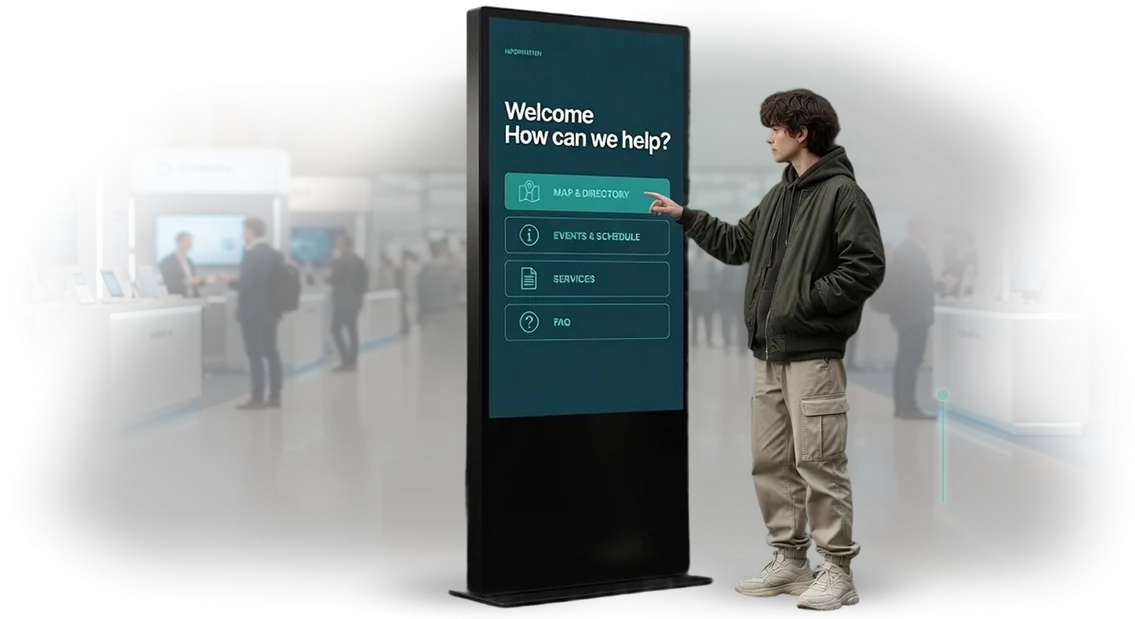
An interactive exhibition solves this problem: it draws the guest into a dialogue with history instead of passive viewing. A touchscreen kiosk at a key point along the route lets visitors choose a topic, open rare photographs, and listen to stories about events and people.
The visitor controls their own immersion — and that holds attention many times longer than any static stand.
For a monastery complex, this means not only a deeper impression for guests but also greater recognition. Captured attention turns into positive words on social media, recommendations, and repeat visits.
The kiosk presents history with care — without fuss or haste, at the pace that feels natural for a guest in such a place.
We design these exhibitions around the specific needs of each complex: we determine installation points, presentation formats, and the level of detail.
The guest gets a clear and beautiful interface, while you get a tool that transforms a silent territory into a living narrative that holds visitors' attention.
What an Interactive Kiosk Will Bring to Your Site
For a monastery complex, it's important not only to welcome guests but also to leave them with a profound impression. An interactive kiosk makes history tangible, connecting the past with the present in a way no ordinary information stand or paper brochure can.
Live Guest Engagement
Visitors come seeking silence and authentic history, but often don't know where to begin their tour. The kiosk turns a stroll into a dialogue: guests choose episodes for themselves, zoom in on old photographs, and listen to stories about significant events. This holds attention, builds trust, and creates a sense of personal discovery.
The format deepens immersion and increases the time spent at the site. Guests don't just walk the route — they return to interesting topics, review materials, and share their impressions with loved ones, creating natural promotion for the complex.
Preserving Memory in a Digital Archive
The archive kiosk solves the core task — preserving the history of the monastery complex in a convenient and secure form. Old photographs, manuscripts, and eyewitness accounts are digitized and organized so they can be accessed at any moment.
Staff gain a tool for working with the heritage, while guests gain access to materials that were previously hidden. Memory ceases to depend on paper media and human factors: it remains on the territory and works to attract new visitors.
Growth in Repeat Visits and New Tour Formats
An interactive kiosk is a reason to come back. Updated materials for commemorative dates, special collections for holidays, and different scenarios for individual and group visits give guests a reason to return and see a familiar place in a new light.
Tour guides gain an assistant: the kiosk takes on part of the material presentation, freeing up time for live conversation and answering questions. These formats suit both younger and older generations — everyone finds their own level of immersion and takes away a personal story.
Interactive Kiosk Formats for Monastery Complexes
An interactive kiosk in a monastery is not just an information stand but a tool that addresses a specific task: preserving memory, providing access to archives, or guiding guests through the territory.
Whether visitors want to return and recommend the cloister to their loved ones depends on how well the format matches your goals.
We distinguish three core formats — each for its own scenario and audience. Below is a brief comparison to help you find your bearings.
| Format | Who It's For | What It Delivers to the Client |
|---|---|---|
| Book of Memory | Parishioners, descendants of families, new visitors | The ability to find the names of loved ones, browse the cloister's history, and leave a record about one's own family — a living link between generations and a reason to return |
| Archive Kiosk | Researchers, historians, clergy | Quick access to digitized documents and photographs without the risk of damaging the originals. Saves hours of manual searching and provides answers within minutes |
| Interactive Guide | Pilgrims, tourist groups | A well-planned route around the territory, stories about shrines and history — at a comfortable pace and without dependence on a tour guide |
We don't force one enclosure to fit every scenario. At the briefing stage, we find out who will use the kiosk, which materials have already been digitized, and what matters more — showcasing an exhibition or providing in-depth reference information.
Only then do we choose the content, structure, and design for your task, so that the kiosk works for you rather than just standing in a corner.
How an Interactive Kiosk Is Created
As with any serious project, predictability is key. We structure the work so that you see results at every step and understand what's happening — from the first briefing to the day the kiosk greets its first visitors.
Approval at each stage is not a formality but a way to protect you from unnecessary costs and revisions. You always know what you're paying for and what you'll get in the end.
- Briefing and immersion in the task. We study your materials, archives, and goals. We define what story the kiosk should tell and what response it should evoke in visitors.
- Concept and content structure. We propose a scenario: sections, navigation, and presentation logic. We agree on the structure before the first resources are invested in design.
- Design mockup. We show how the kiosk will look on screen and fit into the space. We take the monastery complex's style into account — from the color palette to the fonts. We make revisions before approval.
- Assembly and technical implementation. We fill the kiosk with content, configure the operating logic, and adapt the screen to real conditions: lighting, visitor height, and potential obstructions. We use professional equipment to ensure a stable result.
- On-site testing. We test the kiosk under operating conditions: in bright light, in silence, and under heavy visitor flow. We make sure the controls are understandable to people of different ages.
- Launch and training for your team. We hand over the kiosk and show how to add content and handle routine tasks. We explain what to do in non-standard situations.
- Post-launch support. We stay in touch: we help with updates, answer questions, and, if necessary, quickly travel to the site. The kiosk is never left unattended.
This process saves your time and nerves. You get not a "kiosk for the shelf" but a working tool that fulfills its task from day one — attracting attention, telling a story, and leaving an impression.
What's Included in the Interactive Kiosk Delivery
We've put together a package so that the kiosk works immediately after installation and requires no technical knowledge from your team. Everything needed arrives ready-made: from equipment to content, from instructions to ongoing support.
You receive not just a device but a working tool for introducing visitors to the monastery's history.
- Touchscreen stand with a protected display — reliable equipment that withstands heavy use and isn't afraid of high visitor traffic. Installed indoors or outdoors without unnecessary work.
- Kiosk interface with large buttons and clear navigation — visitors of any age will easily figure it out without assistance. The menu is adapted for touch control, not a computer mouse.
- Content built around your exhibition — we structure chronicles, archive documents, photographs, and videos into a convenient narrative scenario. You upload materials to us — we turn them into an interactive book of memory.
- Admin panel for updating information — your staff can change texts, posters, or service schedules themselves without a programmer. All that's needed is a regular browser and access rights.
- Instructions and guidelines for staff — short reference cards on powering on, daily care, and basic actions. Your employees can launch the kiosk within five minutes of the initial installation.
- Technical support and maintenance for the entire service life — we answer questions by phone and remotely, update content when necessary, and monitor system stability.
Each item in the package addresses a specific need: so you don't have to separately source equipment, order design, hire developers, or figure out a complicated interface. In the end, the kiosk works as part of the exhibition, not as a source of extra headache.
Case Study: How an Interactive Kiosk Increased Guest Engagement
At a monastery complex visited by tens of thousands of pilgrims and tourists every year, the site's history remained behind glass: plaques, booklets, and occasional guided tours.
Guests walked past the stands in a matter of seconds, and archival materials were available only to a narrow circle of researchers. The management faced a task — to make the heritage alive and accessible to everyone.
Wedeveloped an interactive kiosk with a book of memory and archive. Instead of static text — a touchscreen where every guest can choose a story, view photographs, listen to audio narratives, and leave their own mark in a digital guest book. The interface was specifically designed for different ages — from schoolchildren to the elderly.
The result was felt immediately. Average time at the screen grew from 20 seconds to 4 minutes — guests stopped walking past and began immersing themselves in the content.
In the first month, the kiosk recorded over 12,000 sessions, and more than 800 visitors left entries in the digital book. Verbal feedback from tour guides confirmed it: people began staying longer in the exhibition and returning more often to the stands with additional questions.
What the Client Gained
- Growth in guest engagement: time at the screen increased 12 times.
- Living content: archival materials proved to be in demand — a third of guests viewed at least three exhibits.
- Feedback collection: guest reviews are now systematized and help develop the exhibition.
A few months later, the complex's management ordered a second kiosk for an adjacent territory and asked to add a tour route module. That's the best evaluation of the work — they came back not for a "pretty picture" but for a solved problem.
How to Choose the Optimal Format for Your Site?
Choosing a kiosk format is not a matter of technology but a matter of which task you're solving.
For monastery complexes, there are usually three scenarios: preserving the memory of people and events, providing access to archival materials, or helping guests find their way around the territory. The right answer always lies in what matters most to your audience.
The Book of Memory works best when the focus is on people and destinies. Such a kiosk lets a visitor find a name, read a biography, view photographs, and leave their own entry in electronic form.
This creates a living dialogue between past and present: the pilgrim doesn't just look at a screen but feels a personal connection with history. If emotional immersion and preserving names matter to you — this is your choice.
The Archive Kiosk solves a different task — in-depth work with materials. Chronicles, documents, old maps, rare photographs, scholarly articles: all of this can be easily searched by year, event, or person. Here the value lies not in emotion but in completeness of information.
This format suits sites where research activity is carried out, pilgrimage groups interested in history are received, or there is a need to systematize a large body of data.
If the main goal is to introduce guests to the territory and key shrines, an interactive guide with routes and descriptions of sites is sufficient.
But often one doesn't exclude the other: a single kiosk can combine the Book of Memory and an archive section, with the guide as an additional screen in the lobby or at the entrance. The key is not to overload a single interface, or the visitor gets lost.
We help you decide on the format before development begins.
Send us a description of the site and its audience — we'll calculate the volume of materials, propose a section structure, and select a configuration that works toward your goal rather than formal "pretty touches." You'll receive a clear plan, not an abstract technical specification.
Frequently Asked Questions About Implementing Interactive Kiosks
Implementing an interactive kiosk at a monastery complex raises questions: how will the equipment fit into a historic space, who will maintain it, and how difficult is it to update information? We answer the main concerns so you can make a decision without uncertainty.
We take on not only development but also installation, connection, and ongoing support. Below are answers to what our clients most often ask before a project begins.
Will installing the kiosk require redevelopment or complex work?
No. The kiosk is a compact structure that fits into the existing space without altering the architecture. All that's needed is a standard power outlet and internet access — wired or via Wi-Fi. Installation takes one day, and we do all the work carefully without harming the interior.
Will the kiosk disturb the monastery's atmosphere?
We adapt the enclosure design to the site's style: we use calm dark tones, wood or stone textures, and create an exhibition-grade appearance. The device looks like part of the museum space, not a technical element. If desired, the kiosk can be installed in a niche or disguised as an analog stand.
How is content updated and who handles it?
Content is changed remotely through a simple control panel — no specialist visit required on site. You can add a new entry to the book of memory, upload photographs, or change texts yourself in a few minutes. If needed, we can set up periodic updates according to your schedule and take that upon ourselves.
What happens to the kiosk in the event of a breakdown or failure?
The kiosk runs on professional equipment designed for long-term operation. We provide warranty and post-warranty service, remote status monitoring, and rapid replacement of components when necessary. You're never left alone with the technology — support is available under the contract.
Will the kiosk withstand visitor flow and accidental impacts?
The enclosure is protected against dust, moisture, and mechanical damage, and the screen against scratches. The system is designed to operate throughout visiting hours without overheating or failures.
Even with a large number of guests, the kiosk maintains stable performance and doesn't require constant supervision.
Order an Interactive Kiosk Developed for Your Task
Every monastery complex holds a history that deserves to be passed on — to visitors, pilgrims, and researchers.
An interactive kiosk turns archive documents, photographs, and testimonies into a living experience, but only if the project is thought through around your tasks, audience, and location.
We take on everything: from idea to launch, so you get a working solution, not a "kiosk for kiosk's sake."
Tell us about your task — we'll prepare a cost estimate and propose a format that suits your site specifically. Submitting a request takes a few minutes, and the consultation comes with no obligation.
- Request a consultation — we'll assess which kiosk option and content your monastery complex needs.
- Fast project estimate — you'll receive a clear work plan, a breakdown of stages, and a commercial proposal with no hidden conditions. The cost is calculated after an audit of your task.
- Adaptation to your audience — the interface and materials are built around your visitors: from pilgrims to tourist groups and schoolchildren.
- Consideration of venue specifics — we'll plan placement in a museum, church area, refectory, or outdoors, including enclosure protection.
- Work with archival materials — we'll help digitize and structure data so the complex's history comes alive in the kiosk.
- Post-launch support — we'll update information, add new materials, and provide technical assistance.
Leave a request on the website — we'll get in touch, clarify the details, and prepare a personalized proposal. That way you'll save time and get a kiosk that truly works to preserve memory and impress guests.