

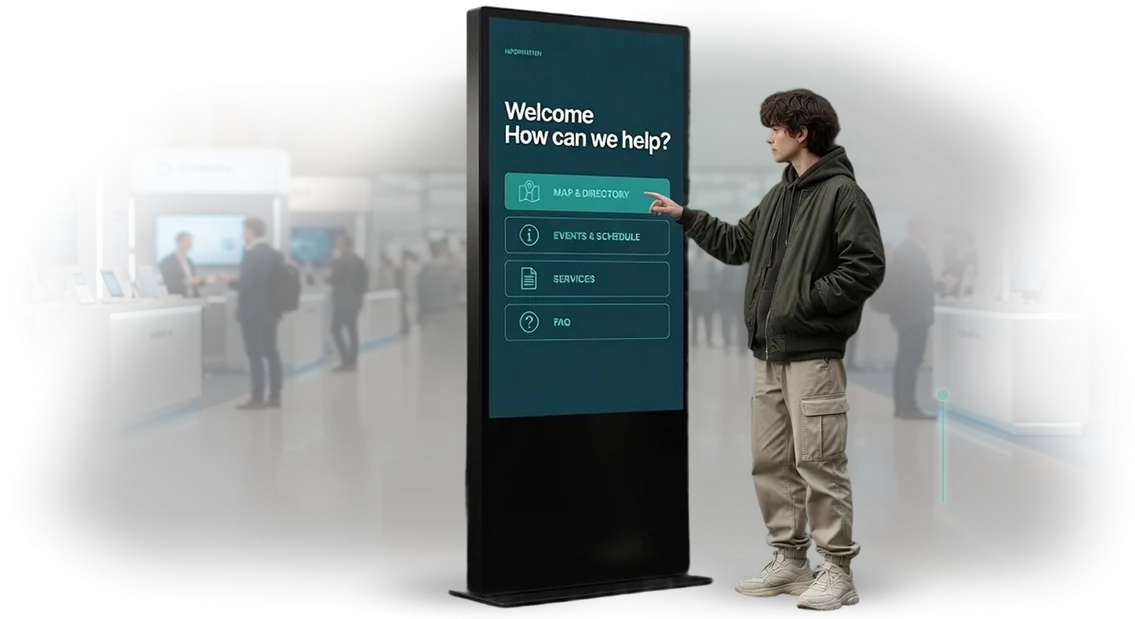
Interactive Kiosks for Technical Museums: How to Bring Back Visitor Interest
Visitors to technical museums increasingly walk past exhibits without stopping at displays for more than a couple of seconds.
The reason is not a weak exhibition — but the presentation format: static showcases and placards lose the battle for the attention of a guest accustomed to a lively digital environment.
Interactive kiosks change the dynamic of the visit: instead of passively looking, a person begins to interact with the story of technology. They choose for themselves what to view, compare, and set in motion — and this holds attention far longer than a regular tour.
For a museum, this is not just an exhibition upgrade but a tool for engaging visitors and increasing their loyalty.
A guest who controlled the process remembers the visit and returns — and also recommends the museum to acquaintances, which directly affects visitor flow and venue recognition.
Digitalizing museums through kiosks delivers results without a major overhaul of halls: the equipment is compact, easily fits into any interior, and can be updated for a new exhibition. At the same time, the interaction mechanics are tailored to specific exhibits and audiences.
We help transform an exhibition from "look and pass" into "try and stay." We develop scenarios that bring technology to life, engage both adults and children, and give visitors a reason to linger — and the museum a steady interest in its collections. If you want guests to study every display in depth — let's start by discussing your exhibition.
What You Get from Interactive Kiosks: 5 Key Benefits
Visitors to a technical museum come for experiences, not just dry facts. Ordinary displays with text and static photos are passed in a minute, and much of the exhibition goes unnoticed.
An interactive kiosk changes this: it turns exploring an archive, a book of memory, or the history of exhibits into a living process. The guest chooses for themselves what to view and read next, while the museum gains the ability to tell each person exactly what interests them.
Through this kind of interaction, interest in the display grows, and the time a visitor spends at the kiosk increases many times over.
A person flips through memories, examines photographs, returns to sections that caught their attention — and throughout all this time, the museum continues talking to them.
The kiosk works without tiring and requires no tour guide presence: this is especially important for small halls and archival exhibitions where staff is lacking.
An interactive kiosk helps turn visitors into contacts. A guest can leave an email address or feedback right at the display, subscribe to announcements and special events.
This way you build a database of interested people who can later be invited to a new exhibition, lecture, or open house. For the museum, these are ready-made leads — an audience that already knows and loves your project, with regular repeat visits at no extra advertising cost.
Finally, a modern kiosk strengthens the museum's image as a technologically advanced and open space. Younger audiences are more eager to share their impressions on social media, and partners and sponsors see your project as innovative.
At the same time, content updates take minutes: museum staff can edit texts, change photos, and add new materials themselves without involving developers. You get a tool that easily adapts to a new exhibition and stays relevant for years.
Interactive Kiosk Formats for Technical Museums: Which One to Choose
A visitor to a technical museum is not limited to examining exhibits — it is important for them to learn the history behind the machines, the fates of the designers, and the context of the era.
Tour guides cannot always answer everyone, and placards at showcases do not convey the volume of information. An interactive museum kiosk fills this need: the guest chooses the depth of immersion, and the museum gains a tool for presenting materials without expanding staff.
There is no one universal format for all cases — technical museums have different tasks: some preserve enterprise archives, some collect personal stories of industry veterans, others need a hall navigator. To make it easier to decide, let's compare three main formats.
| Kiosk Format | Who It's For | What It Gives the Client |
|---|---|---|
| Book of Memory | Factory museums, departmental museums, exhibitions about working people | Preserves stories of veterans and employees; visitors flip through pages like in a real album, leave notes and photos |
| Archive Kiosk | Technical museums with large collections of documents, drawings, photographs | Quick access to digitized materials on demand — search by name, date, workshop, or equipment model |
| Universal Information Kiosk | Museums with visitors of all ages, large exhibitions | Combines hall navigation, exhibit descriptions, multimedia, and feedback; replaces several separate displays |
It is important to understand the difference in scenarios. The Book of Memory works on emotional engagement: it is placed at the start of the route or in a memorial zone so the guest can connect with people's stories.
The Archive Kiosk is a tool for research work: it is indispensable when a visitor arrives with a specific request — to find a photo of a workshop, trace the history of a model, or locate a relative's name.
The universal format suits situations where the budget is limited but everything needs to be covered: from hall plans to detailed articles about the technology. In this case, the kiosk becomes the entry point to the exhibition and takes the load off staff.
The choice comes down to one key question — what matters most to the museum: preserving memory, archive depth, or visitor convenience. We will help determine the priority at the briefing stage and propose a format that will pay for itself in the first month of operation.
Kiosk Development Stages: From Brief to Launch
We have structured the development process so that the museum is involved at every stage and you always understand what is happening with the project.
No "black box": from the initial brief to the kiosk launch, you receive clear solutions that lead to a specific goal — bringing the exhibition to life and creating a new experience for visitors.
- Brief and exhibition audit. We study the museum, its audience, and current exhibits. We determine how the kiosk will fit into the route and what tasks it will solve: navigation, exhibit storytelling, archive work.
- Concept and scenario. We design the interaction logic: what the visitor sees on screen, in what order they move between sections, how quickly they find the information they need. We approve the scenario before development begins — this saves time and budget.
- Design mockup approval. We develop a visual style that matches the museum's atmosphere and remains comfortable for all ages — from schoolchildren to elderly guests. The mockup shows the final look of the interface before programming.
- Interface development. We program the screens, navigation, and touch controls. Special attention goes to response speed and simplicity: the visitor should not have to figure out a "menu" — it should be intuitive from the first touch.
- Content filling and digitization. Together with your team, we gather materials: photographs, documents, videos. We help adapt archives for an interactive format so information reads easily and holds attention.
- Testing with visitors. We test the kiosk in real conditions: load, usage scenarios, resistance to active touching. We make corrections until the kiosk works flawlessly.
- Launch, training, and support. We install the equipment, configure it, and train museum staff. After launch, we stay in touch: we update content, add sections, and help with maintenance.
This approach turns kiosk creation into a manageable project with clear timelines and results. You get not just a device but a working tool for museum modernization that engages visitors and reduces staff load from day one.
What's Included in the Interactive Kiosk Delivery: The Complete Package
When a museum chooses an interactive kiosk, it is important to understand: the delivery includes not just a "screen on a stand" but a complete solution that can be put into operation right away.
We structure the kiosk composition so that from delivery to first use, you have no extra questions — everything needed is already accounted for.
The basic package of a touchscreen kiosk for a technical museum includes:
- Touchscreen kiosk — professional museum-grade equipment in a protective enclosure, resistant to intense visitor traffic and designed to operate throughout the day.
- Software — an interface for visitors and a convenient panel for staff: uploading materials, editing sections, tracking usage statistics.
- Content model — a ready-made structure for placing exhibits, photos, videos, documents, and historical references. You get clear logic by which materials are easy to find and update.
- Instructions and regulations — short guides for startup, daily maintenance, and content replacement. Staff can figure it out without special training.
- Museum staff training — a hands-on session where your team learns to manage the kiosk, make changes, and handle typical situations.
- Warranty and support — diagnostics, software updates, and consultations throughout the warranty period. The support team is available to keep the kiosk running.
This composition allows the kiosk to be put into operation within the first days after installation, and to expand its functionality and add new materials as needed.
The detailed list is fixed in the contract — you know in advance what the museum receives and what we are responsible for.
Case Study: How an Interactive Archive Kiosk Increased Section Visits
A technical museum with a rich archive faced a familiar problem: visitors walked past unique exhibits without realizing what stories lay behind them.
Text placards and paper catalogs did not hold attention — people took a couple of steps and moved on, while staff had to repeat the same thing ten times over.
We proposed an interactive archive kiosk — a touchscreen stand where digitized documents can be flipped through in a couple of touches, the facility's chronicle can be studied, and the right exhibit can be found.
our team developed the system so that both schoolchildren and elderly people could use it: large fonts, clear navigation, no complicated instructions.
The implementation results speak for themselves. Average time at the exhibition grew by 40% — guests stopped rushing past, began studying stories, and sharing discoveries with each other.
The number of archive requests doubled: visitors return to the kiosk to clarify details, and staff receive fewer repetitive questions.
For the museum, the kiosk became not just technology but a tool for preserving memory. The archive is now accessible to anyone who wants to touch history, regardless of time of day or staff availability.
And a few months later, the museum ordered a second kiosk for a new hall — the best indicator that the project works.
Addressing Common Concerns Before Ordering a Kiosk
Before ordering an interactive kiosk for a technical museum, practical questions arise: will the equipment break, is it easy to update materials, and how long will launch take.
We have gathered the most common concerns and answered them briefly — this will help you make a decision faster and with more confidence.
How reliable is the kiosk during constant operation in the hall?
Kiosks are designed for intensive use in public spaces. We use industrial components and durable enclosures, so the equipment works stably even with high visitor traffic. If needed, we provide service support and fast component replacement.
Is it difficult to update content?
Content management is built on a clear administrative panel. A museum staff member without specialized knowledge can independently upload new materials, change texts, or replace images in a few minutes — without stopping the kiosk's operation or involving developers.
How long does kiosk launch take?
From concept approval to installation and configuration, it usually takes a few weeks. The exact timeline depends on the amount of content and the degree of custom design. We set the schedule in advance and stick to it so the kiosk meets its first visitors right on time.
Does the kiosk need the internet?
No, the kiosk operates fully autonomously. All data is stored locally, so the exhibition does not depend on connection quality in the building. The internet is used only for additional functions — such as remote statistics or content updates — but this is optional.
What warranty do you provide on the kiosk?
We provide an official warranty on the equipment and software. Throughout the warranty period, we maintain system functionality, resolve any issues remotely, and — if necessary — send a specialist to the site.
If your question is not listed here — contact us. We will advise on the right solution for your museum and prepare a clear proposal.Order Development of an Interactive Kiosk for Your Museum
Visitors to technical museums come for an experience: it matters to them not just to see exhibits but to understand how they worked and what role they played in history.
Ordinary placards and static showcases lose attention within minutes, while interactive kiosks keep guests engaged, allow deeper exploration of materials, and encourage sharing impressions.
Ordering such a kiosk means giving the museum a modern format that increases visitor loyalty and extends time spent in the exhibition.
We have already developed projects for museum spaces and know how to turn archival materials into living history. We work remotely and take on the entire cycle: from idea and design to equipment delivery and staff training. All you have to do is choose the right option.
What you get by submitting a request:
- Consultation on kiosk format — we will advise which enclosure and control method suit your exhibition and audience.
- Cost calculation — we will prepare an estimate to match your budget, with no hidden fees or unnecessary options. Final cost for your project is calculated after a brief audit.
- Prototype to choose from — we will offer several interface and scenario options, and you pick the one most convenient for visitors.
- Content adaptation — we will help structure your archives, photographs, and documents into a clear and engaging story.
- Staff training — we will show how to manage the kiosk, update materials, and handle typical visitor questions.
- Post-launch support — we stay in touch to keep the kiosk running stably and delighting guests every day.
Submit a request for the development of an interactive kiosk for your museum — and we will prepare a solution that strengthens your exhibition and sparks interest in every visitor. We will contact you within one business day, clarify the details, and offer the optimal option.
How to Choose the Right Interactive Kiosk Format?
Choosing the right interactive kiosk format starts not with the equipment model but with the exhibition's goal.
In a technical museum, a kiosk can be a chronicle of discoveries, an interactive lab map, a quiz, or a zone with historical documents — and each scenario has its own optimal solution.
The more precisely you define what the visitor should do at the screen, the easier it is to choose the format.
The second criterion is the area and location of the installation site. For a narrow corridor or small hall, a wall-mounted touch panel that does not take up useful floor space makes more sense.
In a spacious exhibition, a floor-standing kiosk or touch table allows several visitors to approach at once, increasing reach and reducing queues. A mistake at this stage results in the kiosk obstructing visitor flow or going unnoticed.
The third factor is the level of technical support. Honestly assess who at the museum will update content, power on equipment, and handle small issues. If there is no permanent team, choose autonomous solutions with simple material upload and remote management.
Complex formats with dozens of settings are only good where trained staff exist. Otherwise, the kiosk turns into an expensive artifact that sits idle.
Budget also influences the format, but not just the price. Sometimes a small wall panel solves the task better than a large terminal, and the saved funds go toward quality content — animation, sound, archival materials. It is content that holds attention, not the enclosure.
That is why we select a format based on the task, area, and maintenance capabilities, rather than offering the "biggest" option.
In our practice, a middle-ground scenario most often proves effective for technical museums: one or two usage scenarios, two or three languages, screen diagonal headroom, and minimal controls.
Try this approach — and the kiosk will become a natural part of the exhibition, not a separate stand.