

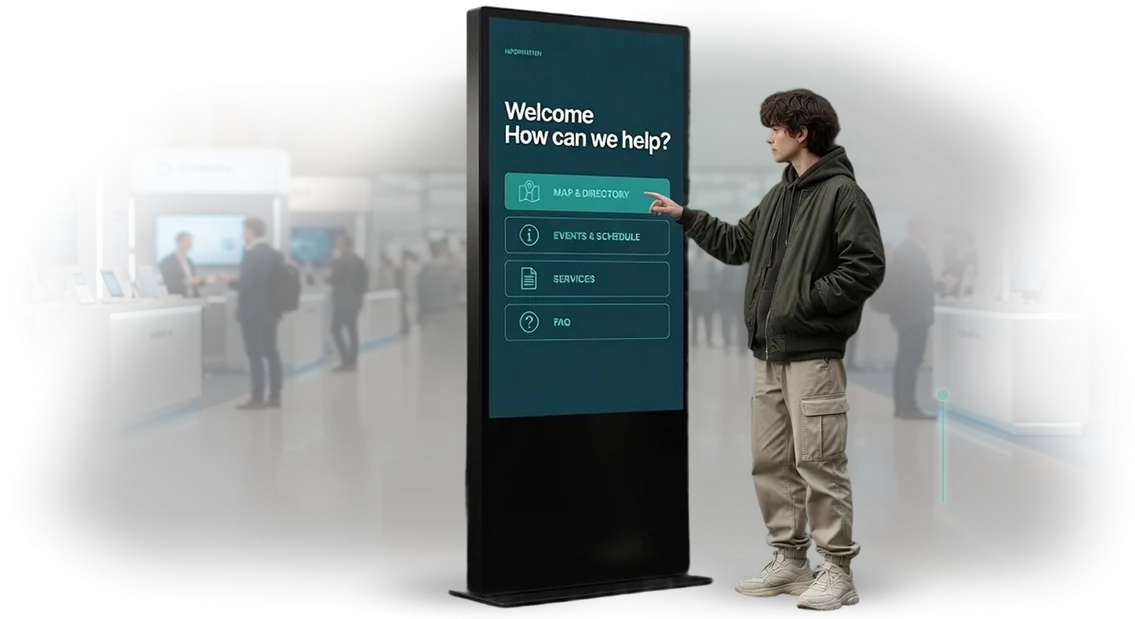
Why Do Administrative Buildings Need Interactive Kiosks?
Visitors to administrative buildings — business centers, government offices, corporate offices — waste time finding the right office, while reception staff get distracted by the same questions over and over.
This information vacuum turns into queues, late arrivals to meetings, and a negative first impression of the company.
An interactive kiosk solves this problem: it works like a digital concierge that never gets tired and never gets distracted. On the terminal screen, visitors see building navigation, a list of departments, operating hours, and answers to frequently asked questions.
Such an information terminal takes the load off administrators and speeds up every guest — from the first touch to the right door.
For the building owner, the efficiency is obvious: staff focus on their own tasks instead of repeating directions ten times, visitors reach specialists faster, and the management company gets a predictable flow of people without chaos in the lobby.
Our team develops interactive kiosks tailored to a specific administrative building — from a simple directory to full-fledged navigation with floor plans in just a few touches.
Beyond direct time savings, the kiosk shapes the image of a modern and caring organization. Visitors see that someone has thought about their convenience — this builds trust and loyalty toward any institution, from a business center to a government agency.
The investment in an information terminal pays off through the reduced load on reception and the elimination of repetitive requests, while the building becomes noticeably more comfortable for people.
What Benefits Does Implementing an Information Kiosk Deliver?
A visitor to an administrative building arrives with a specific goal: to obtain a certificate, submit documents, or get to an appointment. If navigation is confusing and the information desk is overloaded, even a small task turns into stress.
An information kiosk changes this scenario — people quickly find the office they need on their own, and the organization has more time for meaningful work.
Visitor Convenience — No Queues, No Stress
The kiosk works instantly: visitors choose the department or office they need, see the route map, and get contact details. There's no need to wait for an administrator to become free, and if someone is embarrassed to ask — they still get the answer.
This is especially important in high-traffic buildings where navigation becomes part of service quality.
Better Service — Reception Is Unburdened
A share of routine questions is taken off staff: how to get somewhere, where a particular specialist is located, what documents will be needed. Administrators focus on genuinely complex tasks and don't get distracted by repetitive queries.
During peak hours, the kiosk absorbs the main flow, so waiting times drop and the level of service rises.
Building Prestige — A Modern Image
An information kiosk is a visible element of a modern space. It shows that the organization cares about visitors and is not afraid of technology. Guests, partners, and tenants perceive such a building as more reliable and client-oriented.
Client Benefits — Measurable Changes
As a result, the load on reception decreases, visitor satisfaction increases, and staff have more time for their core tasks.
The kiosk becomes an entry point into the building's digital infrastructure and can easily be extended with new features over time: appointment booking, reference information, feedback.
Kiosk Formats for Different Tasks
In an administrative building, the flows of staff and visitors intersect every day: someone needs to find an office, someone needs to book an appointment, and someone just wants to check operating hours.
Without automation, these questions fall on the secretary or security — hence queues and lost time. A kiosk solves the problem, but only if the format matches the task.
Our team develops interactive kiosks for specific administrative building scenarios: from a compact touch terminal to a full-fledged virtual concierge.
We use professional equipment and adapt the interface to your visitors so that the system is understandable from the first screen. Compare the main formats below.
Format Comparison
| Format | Who It's For | What It Gives the Client |
|---|---|---|
| Reference kiosk (touch terminal) | Buildings with high visitor traffic: business centers, government institutions | Fast navigation to offices, floor map, operating hours — without reception staff. Queues shrink, repetitive questions disappear. |
| Virtual concierge | Reception desks and entry areas where personal attention matters | Greets visitors, calls the right employee, books appointments. Creates the image of a tech-forward building and increases tenant loyalty. |
| Information stand | Waiting areas, elevator lobbies, conference halls | Constant updates on events, policies, and company news. Reduces the flow of verbal questions and keeps everyone on the same page. |
Pick the row that matches your situation — we'll take care of the rest: design, manufacture, and implement a kiosk that works for your benefit. If you are unsure about the format, we'll come and assess the load at your facility.
How Development and Launch Work
Launching an interactive kiosk in an administrative building is not just installing a screen. For the system to genuinely relieve administrators and help visitors, every stage of development matters — from understanding scenarios to staff training. We follow a transparent process and show results at every checkpoint.
- Brief and objectives. We define the scenarios the kiosk needs to support: navigation, employee lookup, appointment booking, building news. We determine the main screen and the priorities of your visitors.
- Design and layout approval. We prepare the menu structure and a screen prototype. You see the future kiosk before development starts and can make edits to the text and logic.
- Prototype development with your data. We fill the kiosk with real information: departments, employees, floor plans. We test how quickly a visitor finds the right office.
- Installation preparation. We configure remote management and updates. You will be able to change content without calling in a contractor, and the system will be ready for long-term operation.
- Kiosk installation in the building. We deliver the equipment and mount it at the agreed location. We connect it to the network, test the touch screen, and confirm accessibility for visitors.
- Staff training. We show administrators how to update information and use the system. We provide a quick-reference guide and support contacts in case of questions.
- Launch and support. We hand over the finished kiosk and stay in touch. We help with refinements and make sure the system runs reliably.
Thanks to this process, you know in advance what you're getting and stay in control of the timeline. No improvisation — only agreed solutions that support the building's image and save staff time.
What's Included in the Delivery Package
When you order a kiosk, you get a ready-to-use solution for navigation and visitor information — not just a device. The delivery package includes everything needed to operate from day one: equipment, software, content, and support.
You won't have to coordinate multiple contractors or wait for everything to "come together" on site.
- Kiosk equipment. Touch panel, vandal-resistant enclosure, and system unit designed for 24/7 operation in the lobby. We'll align the design and dimensions with your interior.
- Software. Virtual concierge interface, reference system, building navigation, and news feed. The software adapts to your room layout and information search logic.
- Content management panel. An intuitive interface that lets staff without special technical skills edit texts, upload files, and update schedules. This removes dependency on the developer for routine updates.
- Design and menu structure. We plan scenarios for different visitors: guests, employees, clients. We simplify finding information and reduce the load on reception.
- Installation, setup, and training. Delivery, mounting, connection to power and network, and verification of all functions. We give a short orientation to administrators and provide operating documentation.
- Support and content updates. Warranty service, remote health monitoring, and regular software updates. As requirements grow, we expand the kiosk's functionality.
Case Study: How We Solved a Problem for Administrative Buildings
The lobby of an administrative building is where a visitor forms a first impression of the institution. But often this is exactly where queues form, the secretariat gets overloaded, and people lose hours when they came for a certificate, a pass, or an appointment.
One of our clients, the Interdepartmental Administrative Services Center, faced this problem head-on: staff were drowning in repetitive questions, and visitors left dissatisfied.
We proposed deploying a kiosk — an interactive consultant that took over the routine. Guests choose the service they need, get a route through the building, book an appointment with a specialist, and can call an administrator if necessary.
This is not just a screen with a schedule, but a full-fledged navigation and appointment-booking system.
Project Results
After launch, the average waiting time in the lobby was cut in half, and the load on the information desk dropped by a third. In the first month, more than 4,000 visitors used the kiosk, and 70% of them completed their task without any staff involvement.
Most importantly, the administration noticed that people were leaving positive reviews about the navigation — and ordered similar kiosks for a neighboring branch.
Client Feedback
"We expected the kiosk to simply show a map. Instead, we got a tool that unburdens the team and makes the building genuinely welcoming to visitors," says the head of the administrative complex.
For us, this confirms our approach: we don't just 'install hardware' — we solve the client's problem.
If you recognize your own situation — let's discuss how a kiosk will affect your visitor processes, using the specific numbers from your building.
How to Choose a Kiosk Format for Your Facility?
Choosing a kiosk for an administrative building starts not with the screen or the enclosure design, but with the tasks it needs to perform. A reference kiosk, specialist appointment booking, floor-by-floor navigation, or a promo zone — each scenario requires its own format.
If you identify this before development starts, you won't overpay for unnecessary features and will get a solution that actually works.
The second important step is to analyze visitor flows and the facility's layout. A high-traffic lobby suits a floor-standing kiosk with a large screen; an elevator hall suits a compact wall-mounted panel; a waiting area suits a stand that allows seated viewing.
It's also important to consider how often information is updated and whether you need ticket printing or integration with the access-pass system — this determines the feature set and software.
A common mistake is choosing a kiosk based on a photo in a catalog. What looks impressive in one building can get in the way in another.
That's why we start with a consultation: we gather requirements, identify who will use the kiosk — staff, guests, or organization clients — and propose the optimal format for your facility.
In the end, you get not just a 'kiosk with a screen,' but a tool that increases service speed and reduces the load on administrators. We lock in the requirements, agree on the solution, and only then begin development. Come for a consultation — we'll select the format that fits your building and your goals.
Frequently Asked Questions About Kiosk Development and Implementation
When you implement an interactive kiosk in an administrative building, the first questions are usually not about technology. Clients ask about timelines, warranties, and who will maintain the system.
That's fair: the kiosk should work reliably from day one and not become an extra burden for your staff.
We have been working on such projects for over 10 years, so we know in advance what to prepare for. Below are the questions we hear most often — along with honest answers.
What warranty do you provide, and what happens if the equipment breaks down?
We provide a full warranty on the system and components from the official manufacturer. In the event of a failure, our engineers carry out remote diagnostics and, if necessary, replace the faulty component. Response times are discussed individually and recorded in the contract.
How long does development and launch take?
The timeline depends on the feature set and the building's readiness for installation. At the briefing stage, we record all milestones and deadlines.
A typical project from design to launch takes anywhere from a few weeks to a couple of months — you receive a clear schedule before work begins.
Will our staff be able to manage the kiosk on their own?
The system has a simple administrator interface in Russian. We train your staff remotely or on site — training takes a few hours, after which your team can independently change content and add information.
Who is responsible for technical support after launch?
We stay in touch even after the project is delivered. All requests go to our service team, which works remotely and visits the site when needed. There is no need to search for a separate contractor.
Let's Discuss Your Project and Prepare a Proposal
For an administrative building, it's essential that visitors can quickly get answers: where to go, which office, how the pass system works. An off-the-shelf template doesn't account for your facility's specifics, so we start with a conversation about your tasks.
We consult, clarify scenarios, and prepare a project estimate — without obligations and hidden conditions.
After you submit a request, you get:
- A consultation: we analyze which features the virtual concierge needs specifically in your building.
- A tailored solution: we propose a menu structure, communication scenarios, and navigation logic for your visitors.
- A project estimate: we show timelines and the scope of work so you can plan your budget.
- A clear launch plan: we describe who prepares the content, how setup works, and how administrators are trained.
- Support after delivery: we help update information, add sections, and develop the kiosk further.
We work with administrative buildings of all scales — from business centers to government institutions. That's why our proposal takes into account operating hours, visitor flows, and security requirements.
Leave a request on the website or by phone — we'll call you back within one business day, clarify the details, and prepare a proposal. After that, we'll just agree on a convenient time to start.