

Visitors leave without finding the information they need
A visitor enters a terminal or business center and first looks around for where to go and who to ask. If there is no answer within a few seconds, they head to the reception desk — and a queue of equally lost people forms there.
The information service at that moment is drowning in the same repetitive questions: where is the exit, how to get to the right hall, where is the nearest coffee shop or pharmacy.
For the client, this means direct losses. Employees spend time on repetitive directions instead of working on tasks that require a human, and the guest leaves with the feeling that no one cared about them.
In an airport or a large center, where the flow is measured in thousands of people per day, every such small thing adds up to reputation and to the burden on staff.
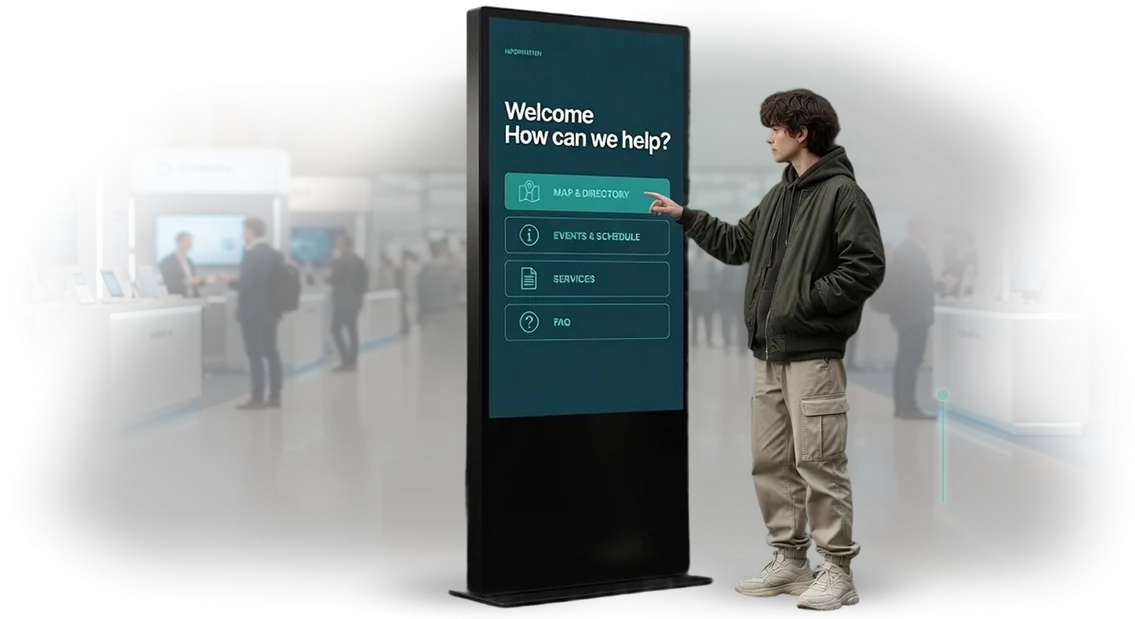
Developing interactive kiosks solves this pain at the entrance. We design navigation for visitors so that a person finds the right point on their own in a couple of taps — without asking an employee and without waiting.
The information service stops being a bottleneck: the kiosk handles the typical questions, and people focus on what truly requires their involvement.
Information support for guests works around the clock and just as smoothly during peak hours and quiet periods. The load on reception drops, the queue clears, and the visitor gets an answer when they need it — and leaves with a good impression rather than irritation.
What the customer gets from an interactive kiosk
An interactive kiosk is not "a screen with information" but an employee who never gets tired, never takes a break, and serves dozens of visitors at the same time.
While an administrator answers one question, the kiosk has already guided a hundred guests along their route: told them where to go, showed them a service, booked them an appointment.
Offloading the front desk stops being a theory — the flow of routine inquiries goes to self-service, and people handle complex requests where they are truly needed.
For a department head, it is also visitor reach that used to be lost. A guest who walked past the counter now gets an answer at the moment they need it — and at the same time sees your services, promotions, and partners.
Every touch works toward brand recognition: the kiosk speaks in your voice, in your style, at a convenient point.
New points of contact with the audience appear where there used to be a "dead" corner — in the lobby, at the entrance, in the waiting area. Guest self-service relieves the load during peak hours and does not require expanding staff for a seasonal influx.
We develop such kiosks for the customer's task: scenarios, interface, and logic tailored to your processes, not according to a template. You get a tool that pays off through reach and offloaded staff, not just another screen in the corner.
Kiosk formats for your venue's task
Venues differ — and so do the tasks kiosks need to solve.
At an airport, it's important to quickly route the flow to the right exits and counters; at a shopping mall, to show what's sold where; at a business center, to greet guests without keeping a live receptionist at the entrance.
That's why we don't sell "one box for everyone": first we figure out who your visitors are and what they should get within the first half-minute, and then we propose a format.
Below are four basic scenarios that most solutions are built from. They can be combined: a single venue often gets navigation, an information section, and a catalog all at once.
| Format | For whom | What it gives the client |
|---|---|---|
| Information kiosk | Airports, train stations, government institutions | Offloads information desks, answers typical questions without staff |
| Virtual concierge | Business centers, hotels, residential complexes | Greets guests, suggests routes and rules, reduces reception workload |
| Navigation terminal | Shopping malls, stadiums, exhibition venues | Guides visitors around the venue, helps find the right zone or booth |
| Catalog kiosk | Showrooms, museums, banks | Displays assortment, exhibits, or services, collects requests and contacts |
What matters when choosing a format
The format determines not only the appearance but also what data you will receive. An information kiosk shows what people ask about most often — that's ready-made analytics for the support service. A navigation terminal reveals where people actually go and where they get lost. A catalog gathers interest in specific items.
We help choose a format for your flow and goals, not for a pretty picture. Describe your venue and task — we'll come back with an estimate and a plan.
How the project runs: from brief to launch
The process is structured so that at any moment you understand what stage the project is at and what you will get as a result. No "black boxes": every step ends with a clear deliverable that you can review and approve.
- Brief and goals. We discuss the task: who your visitors are, what scenarios they go through at the kiosk, what needs to change — service speed, offloading the information desk, navigation coverage. We set measurable benchmarks against which we will later evaluate the result.
- Plan and estimate. We come back with a work plan, timelines, and team composition. You see what will be ready and when, and you make a decision before the start.
- Layout approval. We show how the screen will look and how a visitor will go from the first touch to the information they need. We make revisions at this stage — redoing a finished kiosk is more expensive and takes longer.
- Implementation. We build the interface and logic for your scenarios, and connect the necessary reference data and services. We work in iterations so that you see progress rather than waiting blindly for the finish.
- Kiosk testing. We test on real hardware: response to touches, behavior during failures, and clarity for a person who is seeing the kiosk for the first time. We also separately look at how the system behaves during prolonged unattended operation.
- Launch. We deploy at your site, train the employees who will be responsible for the kiosk, and stay in touch during the first days of operation.
- Post-launch support. We monitor stability, update reference information, and refine scenarios when your processes or visitor flow change.
This order removes the main risk — getting a finished solution that does not solve the task. You approve the meaning and appearance before you invest in implementation, and after launch you still have a team that knows your project and is responsible for its operation.
What is included in the delivery
The client receives not a "program file", but a kiosk ready for operation: the interface, the content, the integration with your systems, and people who know how to use it.
Below is exactly what is included in the delivery, so you understand what we are responsible for and what remains on your side.
- Kiosk interface — screens tailored to your scenarios: navigation by zones and services, search, map, schedule, calling an employee. We design for real visitors: large elements, clear prompts, multiple languages, operation that accounts for foot traffic and queues.
- Content and structure of the directory — we help gather and organize information so that a visitor finds an answer in 2–3 taps instead of wandering through menus. Texts, icons, order of sections, logic of prompts.
- Integrations with your systems — schedules, directories, service catalog, internal databases. Data is pulled automatically, so the kiosk does not become outdated a week after launch.
- Staff training — we show your team how to update information, add sections, and view request statistics. Usually one meeting is enough; after that, employees work on their own.
- Documentation — a clear guide for administrators and instructions for the support service: what to do in case of a failure, how to restart, whom to contact.
- Warranty support — we provide support after launch: we monitor stability, make content edits, and help with updates. You are not left alone with a working kiosk.
We separately define what counts as readiness: the kiosk is launched at your site, staff are trained, documentation is handed over, and support is in touch.
Such a delivery package covers the entire path — from idea to a working tool that greets visitors and reduces the load on employees.
How a kiosk helped an airport reduce queues
When a large international airport approached us, the problem was familiar to anyone who has ever flown: queues formed at information desks, passengers were nervous, and help desk staff physically could not keep up with answering routine questions — about the departure gate, check-in, baggage, and transfers.
Peak load fell on morning flights and the holiday season, when passenger traffic increased severalfold.
We proposed a solution that takes the load off people and hands the routine to technology: a network of information kiosks with a virtual concierge.
A passenger walks up to the screen and with a couple of taps gets an answer in their own language — without waiting and without searching for an available staff member.
What changed after launch
A few months after implementation, the share of routine requests that passengers resolve on their own through the kiosks grew to the majority — help desk staff switched to complex situations where a human is truly needed. Queues at information desks shrank, and the response waiting time dropped from minutes to seconds.
The client separately noted a rise in passenger satisfaction: in surveys, people began giving high ratings for terminal navigation more often.
For an airport, this is not an abstract metric but reputation and repeat choice — a passenger who quickly found their gate returns and recommends the airport to others.
We continue to develop the Airport Concierge project: we add new scenarios and languages as traffic grows. The client extended the cooperation — for us this is the main result of the implementation, because the information kiosks keep serving passenger traffic every day.
How to choose the right format for the task?
Choosing a format starts not with the hardware, but with answering three questions: where the kiosk is located, how many people pass through it, and what task it needs to solve.
Everything else depends on these inputs — screen size, feature set, printing method, the need for speech or document recognition. If you skip this step and immediately discuss the "bells and whistles," the project risks turning into an expensive toy that nobody uses.
The type of venue sets the scenario. At an airport or train station, the kiosk operates on a high-traffic flow: a person walks up for a minute, needs to quickly find an exit, a desk, or a flight — the interface must guide them by the hand and not require input.
In a business center or hotel, the logic is different: the visitor is willing to linger, and what matters to them is floor navigation, calling the right employee, booking a meeting. In a shopping mall or clinic, the information desk function and queue booking come to the fore. The same kiosk in terms of purpose requires different information delivery in different locations.
Visitor flow determines the requirements for reliability and speed. Where hundreds of people pass by per hour, queues at the screen and freezes are unacceptable: responsiveness, clear prompts, and operation without staff involvement are important.
In places with infrequent but thoughtful visitors, more elaborate scenarios can be allowed — for example, printing a pass or a detailed reference.
Implementation goals are the third filter. If the task is to relieve the front desk, the kiosk takes on typical questions and bookings. If you need to collect visitor data or show advertising, the emphasis shifts to analytics and media blocks.
If it's about security, it shifts to identification and access control. A format built for a specific goal pays off through visitor attention and relieved staff, rather than gathering dust in a corner.
We help you navigate this choice without unnecessary costs: we analyze your venue, flow, and tasks, propose a format that solves exactly your task, and take on turnkey implementation.
Frequently asked questions before ordering
Before starting, customers most often ask the same questions — about the warranty, content updates, and what happens if a kiosk breaks down. Below are short answers that clear up most doubts before work even begins.
What happens if a kiosk breaks down?
We build a margin of reliability into the project: the enclosure and touchscreen are designed for a heavy flow of visitors, and the software itself reports a failure.
If something does break down, you have a clear procedure — who to call and within what timeframe an engineer will arrive. During repairs, hints and navigation can be moved to a backup device so that the flow of guests is not left without information.
How do you update content — do you need your own specialist?
No, a programmer is not needed for this. We build a control panel where a member of your team changes texts, schedules, the map, and hints themselves — through an ordinary browser. Edits take effect immediately, without an engineer visit. If the structure of sections changes or a new language is added, we help with the setup.
What warranty is there and what does maintenance include?
The hardware and software are covered by a warranty, and after launch we stay in touch: we monitor operation, update the system, and help with changes. Maintenance can be taken on entirely by us — then your team does not get distracted by the technical side at all.
How long does launch take, and can you start small?
The first working kiosk usually goes live within a few weeks. You can start with one location, assess how guests use the hints, and only then scale to other areas — an airport, a lobby, a check-in desk.
If you still have questions about the warranty, maintenance, or content updates — let's discuss the task and come back with an estimate and a plan for your site.
Let's discuss your task and come back with a plan
When we launched information kiosks for an airport network, the client came with one pain point: passengers were getting lost in the terminal, while the information desks sat empty.
We built interactive points where a guest can find the exit, a cafe, and the check-in desk in a couple of taps.
Already in the first month, the load on live consultants dropped, and the number of inquiries at the kiosks tripled — people would rather ask a screen than stand in line.
After launch, the client received not just a device, but a working service. We trained their team, handed over instructions, and stayed on for support: content edits, hint updates, response to failures.
Six months later, the direction was expanded to new terminal zones — the repeat order came without a tender, because the first kiosk paid for itself through passenger attention.
Sheremetyevo Airport — one of the projects where we went the path from idea to ongoing support. The same result awaits you: we discuss the task, come back with a plan and a timeline estimate, and then launch a turnkey kiosk.
What you get after ordering
- A working interactive kiosk, ready for load from day one
- Trained staff who manage the content themselves
- A project plan with clear timelines and stages
- Post-launch support — no "built it and disappeared"
- Improved metrics: fewer queues, more satisfied visitors
- The ability to scale the solution to new locations
To order a kiosk, describe your task — we will come back with a timeline estimate and a launch plan.