

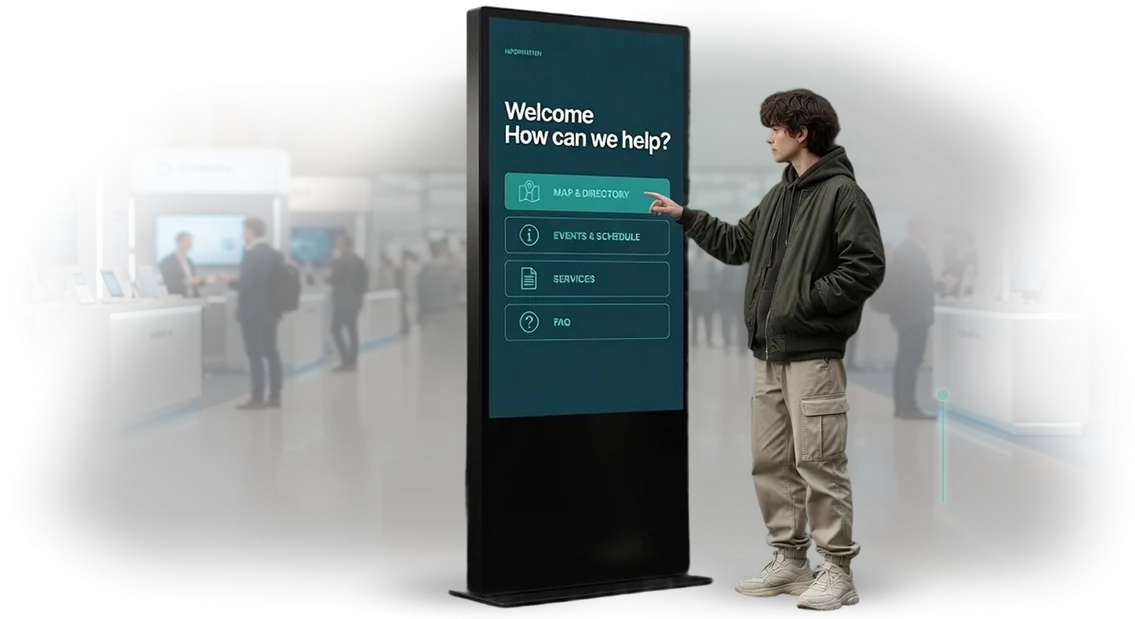
Kiosks for auto services and car repair shops: how not to lose customers
Customers don't like to wait, especially when it comes to their car.
In an auto service center or car repair shop, a queue for a consultation is not just a pause in work but a direct loss of customers: while a visitor stands at the counter, they can change their mind and drive off to a neighboring service.
Incomplete consultation is the second hidden threat: the mechanic is busy, answers briefly, and the customer leaves with the feeling that their problem wasn't understood.
Every such departure is not only a lost order but also a spoiled impression of the service. The person tells friends about the failed visit, leaves a negative review, and as a result, the service loses not one customer but a whole circle of potential customers.
Queues overload administrators, interfere with mechanics' work, and eat up time that could be spent on quality service.
The solution is an interactive kiosk for auto services that handles the initial consultation and relieves the pressure on staff.
An informational kiosk for a car repair shop allows the customer to independently choose a service, find out the cost and timing, and leave a repair request — without waiting at the counter.
Instead of standing in line, a person immediately gets answers to the main questions, and the administrator gets involved only at the booking or order stage.
Automating the consultation gives the service a double effect: on one hand, customers stop leaving because of waiting and misunderstanding; on the other, staff is freed up for real work on cars.
The kiosk works around the clock, doesn't get tired, and responds equally politely at any time. It's a simple way to make the service modern and customer-focused without expanding the team.
We have already implemented such solutions for dozens of service locations and know how to turn a waiting area into a place where an order is born.
We'll help you set up the kiosk for your services and integrate it with your current processes — so that the customer comes to you, not to competitors.
What will change in the service after installing a kiosk
After installing the kiosk, the service stops losing time on routine. The customer chooses services on their own, sees prices, and books a convenient time — the administrator doesn't need to be distracted from work and repeat the same thing ten times. Request intake runs around the clock, even when employees have already gone home.
Faster service is noticeable from the first days. Queues at the counter get shorter, and booking diagnostics or repairs happens without calls and clarifications — the mechanic receives a request already with a description of the problem and the car owner's contact details. Each customer spends 10–15 minutes less at the service.
The kiosk helps increase the average ticket. When a service is selected, it suggests related work: filter replacement, brake system inspection, computer diagnostics.
The customer sees the full picture of maintenance and more often agrees to additional items that the car needs anyway — the service earns more without aggressive sales.
The workload on staff decreases. The administrator stops answering typical questions like "how much," "when is it available," "how do I book" — the kiosk answers on its own.
Employees focus on customers who are already in the service and on complex tasks that require live participation.
The service itself looks more modern and technological, which increases car owners' trust. The customer remembers the convenience of the visit, returns again, and recommends the service to friends — the benefit keeps working after every visit.
Kiosk formats for auto services and car repair shops
For an auto service and car repair shop, the kiosk format solves practical tasks: booking a service, customer waiting, information about services.
It's important that the stand doesn't obstruct movement and fits into the premises — so we choose the construction based on the layout and visitor flow.
| Format | For whom | What it gives the customer |
|---|---|---|
| Countertop kiosk | Auto services with a waiting area and an administrator | Helps book the customer for a convenient time, show the price list and work status, and reduces the load on staff |
| Wall-mounted kiosk | Small car repair shops and service stations with limited space | Takes up minimal space, allows the customer to independently choose a service and leave a request |
| Virtual concierge | Services with high traffic and multiple services | Greets the customer, answers frequent questions, and directs them to the right specialist without waiting |
For auto services where customers spend time waiting, the countertop kiosk works as an additional manager: it shows the progress of work, offers additional services, and allows paying for the order.
In car repair shops with a small area, a wall-mounted kiosk provides the same capabilities without taking up useful space.
The virtual concierge is suitable for chains and large services: it handles initial communication, selects a booking time, and passes the request to the mechanic.
We choose the format based on your tasks — from a single point to a comprehensive system that combines booking, navigation, and service information. The result is fewer queues, simpler booking, and more orders for repeat maintenance.
How the kiosk is implemented: 6 steps
The implementation of the kiosk goes through six stages — from brief to launch and further support. We work with auto services and car repair shops, so we understand how important customer convenience and staff time savings are. You get a clear plan with dates and a dedicated manager who leads the project to the end.
- Brief and task analysis. A short interview with the person responsible for the service's operation: we record which services to show, how to book customers, and what questions visitors ask most often. At this stage you receive an accurate estimate and timeline — nothing "comes up" along the way.
- Visitor scenarios. We design the kiosk logic: how a person quickly finds the needed service, books, calls a mechanic, or leaves contacts. We make sure the interface can be used by people of any age and without special training.
- Layout approval. We show the visual design: button placement, menu, brand style. You make edits before development starts — this eliminates rework and unnecessary costs.
- Development and content. We assemble the kiosk itself and fill it with your services, prices, promotions, and contacts. You receive a working prototype that can be tested right at the auto service before the official launch.
- Kiosk launch and employee training. We install the equipment, set up integration with your booking system, and train administrators and mechanics. The staff understands how to help a visitor and what to do in a non-standard situation.
- Support and development. After launch, we stay in touch: we update prices, menus, and promotions on your request. Adjustments are made quickly — without a separate project or long approvals.
The entire process takes from two to four weeks depending on the volume of information and the readiness of layouts. You control each stage, while we handle the technical side and staff training.
What is included in the supply and setup of the kiosk
You receive a turnkey solution: equipment, software, configuration, and warranty — without needing to understand technical details. We take on the entire cycle so that the kiosk starts working from day one and doesn't distract you from your main task — serving customers.
Here is what is included in the supply and setup:
- Equipment set — a touchscreen kiosk with a housing, mounting, and cabling. Everything arrives ready to connect: just plug it in and follow a short instruction.
- Pre-installed software — navigation around the auto service, a directory of services and prices, and a repair booking form. No licenses or complex installations — everything is already configured.
- Adaptation to your auto service — section structure, logo, contacts, working hours, promotions. You provide the data, and we place it in a clear, visitor-friendly format.
- Content updates — change prices, service descriptions, and news through a simple browser interface, or let us know — we will update remotely. No need to wait for a programmer or spend time calling a specialist.
- Warranty on the kiosk and software — if equipment fails, we replace it under warranty, and if software issues occur, we usually inform you and restore the system remotely.
- Technical support — we provide consultations on kiosk operation, run diagnostics, and help solve the issue on the same day you contact us. If an engineer visit is required, we'll agree on a convenient time.
All of this is packaged into a single contract: you know what you are getting and understand who is responsible for each element. As a result, visitors find the information they need faster, distract administrators less, and are more willing to book services. The kiosk becomes part of the service, not a source of additional hassle.
Case study: how we reduced the waiting queue and increased the average ticket
In an auto service chain, a virtual concierge often runs into one thing — while the mechanic is busy, customers stand in line, lose time, and leave to competitors.
At the same time, the reception staff is overloaded: they answer the same questions, make manual bookings, and don't have time to offer additional services.
Implementing an informational kiosk changes the service's economics: the queue disappears, and the average ticket grows thanks to careful prompts at the right moment.
How it happened
The owner of an auto service chain contacted us: during peak hours, 5–7 people gathered at the reception, mechanics were idle because of poorly coordinated booking, and customers in the waiting area didn't know about additional services.
Instead of hiring another administrator, we installed an interactive concierge kiosk. The customer independently chooses a service, sees the car's readiness status, books the next visit, and receives personal recommendations for scheduled maintenance.
We configured the kiosk to fit the specific chain's processes: integration with the accounting system, dialog scenarios for typical situations, and an intuitive interface for customers of any age. The launch took less than a month — without stopping the workshop or retraining the entire staff.
Automation results
After three months of operation, queues in the waiting area decreased by 30% — booking and inquiries no longer required the administrator to be personally present.
The average ticket increased by 18%: the kiosk unobtrusively suggests related work — oil change, suspension diagnostics, seasonal tire fitting — and the customer books it right away instead of putting it off.
Repeat visits deserve special attention: the virtual concierge reminds customers about scheduled maintenance and offers to book a convenient time. The share of customers who returned within six months increased by a quarter.
The service gained stable workload without expanding the team, and the owner received transparent statistics on demand for each service.
What if you have specific requirements for the kiosk?
Non-standard requirements are not a problem, but a reason to make a kiosk that fits your auto service perfectly. Standard solutions are often designed for average scenarios: choose a service, book, pay.
But every workshop has its own procedures: a special list of work, approval with a mechanic, special conditions for corporate clients, or specific intake forms. We take this into account and configure the kiosk to your real tasks, not the other way around.
An individual kiosk starts with a discussion: you tell us how your auto service is organized, which operations need to be automated, and which data matters. We design the logic and interface so that they follow the customer's familiar path.
If needed, we integrate with your accounting system and add non-standard scenarios, such as preliminary diagnostics or choosing a specific mechanic.
Special conditions are also taken into account: operation in a noisy workshop, use with gloves, limited space, or a custom design to match your brand style. The kiosk can be stationary or portable, with a protected housing and a screen adapted to bright lighting.
All of this is discussed at the project stage — you don't adjust to a template, you get a solution for your conditions.
The main point is that we take on all setup and support. You get a working tool that saves administrators' time, speeds up booking, and improves service quality.
Even if your requirements seem non-standard, chances are we have already dealt with a similar task — and we know how to solve it.
Answers to frequent questions about kiosks
We understand: before ordering an interactive kiosk, you want to make sure it won't cause any trouble. Below are answers to the most common concerns of auto service and repair shop owners: breakdowns, updates, training, and payback.
What happens if the kiosk breaks down? Is there a warranty?
All equipment comes with an official warranty — it covers both hardware and software. In case of a malfunction, we run remote diagnostics and, in most cases, resolve the issue remotely without downtime.
If repair is required, we quickly replace the device with a backup unit. You don't lose work: customers continue using the kiosk while yours is being repaired.
How often do I need to update information? Is it difficult?
Updates are made by you — through a clear admin panel from any computer or tablet. An employee without technical training can change prices, promotions, and service descriptions in a few minutes.
No programmers or long approvals needed. If necessary, we help with the initial setup and advise on how to structure the content best.
Will our staff need training to work with the kiosk?
No, special training is not required. The kiosk is designed so that any employee can figure it out: the interface is intuitively clear for both the customer and the administrator.
We give a short demonstration for your team — 20–30 minutes, usually enough. After that, the staff works independently, and you save time and nerves.
When will the kiosk pay for itself and what benefit will it bring?
The kiosk pays for itself through two factors: it relieves the administrator and increases the average ticket. Customers book services themselves, learn about extras and promotions, and you get more time for actual work.
According to our statistics, car repair shops recover their investment within a few months just from additional services. The exact period depends on customer flow, but you will feel the benefit from the first week.
If you still have doubts — ask us a direct question, and we will provide details for your auto service.Order a kiosk demonstration for your business
Imagine: a customer walks into an auto service, sees a convenient kiosk, and independently chooses a service, books a repair, and finds out the readiness status. No queue, no distracted administrators.
The demonstration is an opportunity to see how such a scenario works in your specific premises and with your list of services.
Leave a request — and we will show you the kiosk on real auto service tasks: booking maintenance, online order placement, car readiness notification. It's non-binding: you evaluate the interface, speed, and convenience for the customer before making a decision.
What is included in the demonstration and the calculation for your task:
- an engineer visit to your auto service with a demonstration kiosk
- selection of scenarios for your services and typical customer questions
- a clear cost estimate for the kiosk and integration with your systems
- clear timelines: when we will install and how many days it will take to launch
- examples of solutions for auto services and car repair shops with different visitor flows
- consultation on placement: waiting area, reception, security post
After the demonstration, you will receive a commercial proposal that you can discuss with your team or the owner right away. If the solution fits — we will start designing for your premises.
If not — you will be left with a clear understanding of what kiosk you need and what budget to plan for.
Leave a request on the website or call us — we will find a time for the demonstration on a day convenient for you. This way, you will close the question "how will this work for us" and get an accurate estimate for your auto service.